OEM/ODM Sportswear Manufacturer | 3-Day Sampling | Low MOQ | 50K Monthly Capacity | ISO9001 & BSCI Certified

Top 10 Best Equestrian Clothing Brands: Product Lessons for Riding Apparel Buyers
Compare the best equestrian clothing brands by riding apparel range, technical performance, fit, price positioning and collection strategy. Learn what buyers can benchmark before developing custom equestrian apparel with experienced manufacturers.
Top 10 Best Equestrian Clothing Brands: What Buyers Can Learn From Leading Riding Apparel Collections
The best equestrian clothing brands do more than create attractive riding clothes or place a recognizable logo on performance apparel. Their strongest collections are usually built around a clear rider, riding discipline, use case and price position. A competition breech has a different job from an everyday riding tight, while a winter training jacket must solve different problems from a lightweight show shirt.
For apparel buyers, this makes established riding brands useful product benchmarks. Studying the best equestrian clothing brands can reveal how successful companies organize breeches, riding tights, competition jackets, technical tops and seasonal outerwear around real riding needs rather than treating every product as an isolated SKU.
But copying a popular style is not a complete product strategy.
A more useful approach is to understand why the product works. Buyers can compare fabric direction, fit, grip placement, pocket construction, layering, size range, seasonal colors and price positioning. They can also study how leading brands separate competition wear from training products and premium technical pieces from more accessible everyday riding apparel.
The best equestrian clothing brands give apparel buyers useful benchmarks for product specialization, riding function, fit, sizing, price positioning and collection planning. Instead of asking only which brand is popular, buyers should study which rider each brand serves, which products create its strongest identity, how those products differ by riding use and what manufacturing capabilities would be required to develop a competitive private label collection.
This distinction becomes especially important when a buyer moves from market research into product sourcing. A successful riding tight may look simple in an online product photo, but its commercial value can depend on fabric stretch and recovery, waistband stability, pocket position, grip design, size grading and how the garment performs when the rider is actually in the saddle.
The same principle applies to jackets and competition apparel. Two products may look similar from the outside while using different fabrics, construction methods, trims and quality standards. This is why buyers studying the best equestrian clothing brands should look beyond appearance and ask what product decisions support the final retail position.
Price also needs context. A premium competition brand and an accessible recreational riding brand may both sell breeches, but they are not necessarily solving the same customer problem. Product specification, technical function, brand positioning, distribution model and target rider can all influence the final retail price.
For private label buyers, the practical question is therefore not, “Which brand should we copy?” It is, “Which product principles are relevant to our customer, and which ones can we realistically manufacture at our target quality, MOQ and price?”
This guide examines the best equestrian clothing brands from that perspective. It compares how leading names approach riding apparel, product specialization, technical performance, sizing, seasonal collections and market positioning. It then connects those lessons with the practical decisions buyers face when evaluating custom products, samples, manufacturers, factories, MOQ, price structures and production reliability.
For brands planning their own collection, studying the best equestrian clothing brands is most valuable when market research leads to a clearer product brief. That brief can then be used to decide which products should launch first, which functions are commercially important, which details need to be tested in samples and what type of manufacturing partner is suitable for the program.
The objective is not to reproduce an established brand. It is to understand the product logic behind strong riding collections and use those lessons to build a clearer, more differentiated and more commercially realistic equestrian apparel range.
Which Best Equestrian Clothing Brands Should Apparel Buyers Study?
The best equestrian clothing brands worth studying are not identical in product direction. Ariat builds across English, Western and lifestyle categories; Cavalleria Toscana and Equiline provide useful references for premium competition apparel; LeMieux demonstrates coordinated collection building; Kerrits is strong in rider-focused technical bottoms; and brands such as Horse Pilot show how technical function can become part of a clear product identity.
For apparel buyers, the useful question is not which company is universally “best.” A brand that provides an excellent benchmark for competition jackets may be less relevant to a startup developing affordable riding tights. The value comes from understanding what each brand does particularly well and whether that lesson matches your own target rider, product type and price position.
The following ten best equestrian clothing brands provide different reference points for product planning, from broad riding ecosystems and premium competition wear to technical training apparel, inclusive sizing and weather-focused collections.
1. Ariat — What Can Buyers Learn From Building a Broad Riding Product System?
Ariat is a useful benchmark for buyers who want to understand how an equestrian business can expand from specialist performance products into a much broader riding and lifestyle system without losing a recognizable market position.
Founded in 1993, Ariat operates across English and Western riding as well as work and outdoor categories. For apparel buyers, its value as a benchmark comes from the breadth of the product architecture rather than one individual garment.
Product areas worth studying include:
- Riding breeches and tights
- Competition and show apparel
- Technical riding tops
- Jackets and outerwear
- Western riding apparel
- Riding and lifestyle footwear
- Casual products that extend beyond the saddle
The important lesson is category expansion with a clear customer connection. A rider who first enters the brand through boots or breeches can find additional products for training, competition, outdoor work and everyday wear.
For a private label business, this does not mean launching every category at once. It means thinking about where a successful first product could logically lead. A brand starting with riding tights, for example, might later add technical tops and lightweight jackets rather than immediately developing unrelated products.
Buyer lesson: Build a product roadmap around the rider, not around random available styles.
2. Cavalleria Toscana — What Defines a Premium Technical Equestrian Collection?
Cavalleria Toscana is particularly useful for studying the relationship between premium visual identity and technical riding apparel. Its collections show that performance garments do not have to look excessively sporty to communicate function.
Competition jackets, breeches, polos and technical tops are generally presented with controlled silhouettes, refined branding and a premium equestrian aesthetic. That consistency matters because premium positioning is created by the complete product rather than by a logo alone.
Buyers benchmarking this type of collection should look at:
- Fabric appearance and hand feel
- Clean garment construction
- Silhouette and proportion
- Branding scale and placement
- Color coordination
- Technical details that remain visually restrained
- Consistency between competition and training products
A common sourcing mistake is trying to create a premium-looking garment by adding expensive trims to an ordinary base product. Premium positioning normally requires the fabric, pattern, construction, finishing and branding to support one another.
Among the best equestrian clothing brands, Cavalleria Toscana therefore provides a useful reference for buyers planning a higher-value collection where visual restraint and technical performance need to work together.
Buyer lesson: Premium positioning should be designed into the complete specification, not added at the end through branding.
3. LeMieux — How Does a Coordinated Product Ecosystem Increase Brand Value?
LeMieux demonstrates how coordinated products can turn individual riding items into a recognizable collection. The brand extends beyond rider apparel into a broader horse-and-rider ecosystem, making color, seasonal coordination and cross-category merchandising particularly useful areas for buyers to study.
A buyer developing private label products can learn an important commercial lesson here: customers do not always shop one garment at a time.
A technical riding top can coordinate with breeches. A jacket can follow the same seasonal color direction. Rider apparel can visually connect with selected equestrian accessories. This creates opportunities for larger baskets and makes a collection easier to present through campaign photography, retail displays and social media.
However, coordination should not become unnecessary SKU expansion. Five products that work together commercially may be more useful than fifteen products that share a color but solve no clear customer need.
Buyer lesson: Think in product families. Use shared colors, materials and design language where appropriate, but give every SKU a clear commercial role.
4. Pikeur — What Can Buyers Learn From Competition-Focused Product Consistency?
Pikeur provides a useful benchmark for brands interested in competition-oriented equestrian clothing with a long-established product identity. Riding breeches, show jackets, technical tops and seasonal outerwear allow buyers to study how traditional equestrian expectations can be updated without making the collection feel disconnected from the sport.
The lesson is consistency.
When developing a new collection, it is easy to chase every visible trend: a new pocket shape, another waistband, a fashionable color, a different logo treatment and several unrelated fabric directions. The result may contain individually attractive products but still fail to look like one brand.
Studying established brands such as Pikeur helps buyers ask better questions:
- Which silhouette should remain recognizable?
- Which details can change seasonally?
- Which products should be more fashion-driven?
- Which competition products require greater continuity?
- Where does technical innovation improve the product rather than simply add cost?
Buyer lesson: A collection needs enough newness to remain interesting, but enough continuity to remain recognizable.
5. Kerrits — Why Can Product Specialization Become a Competitive Advantage?
Kerrits is particularly relevant when studying rider-focused bottoms, technical comfort and practical riding use. Its riding tights and breeches provide a useful benchmark for buyers who want to understand why a seemingly simple product category can contain meaningful technical differentiation.
For riding bottoms, buyers should look beyond fabric color and surface appearance. Commercially important decisions can include:
- Waistband construction
- Stretch and recovery
- Knee or full-seat grip
- Pocket position and depth
- Seam placement
- Coverage
- Lower-leg construction
- Compatibility with riding boots
- Size range
- Comfort during extended saddle time
This is where the best equestrian clothing brands can be more useful as technical references than as style references.
A brand does not necessarily need twenty different breeches. It may gain more from developing two or three products with clearly different jobs: perhaps an accessible everyday tight, a more structured breech and a higher-specification competition option.
Buyer lesson: Deep specialization in an important rider problem can create more product value than a very broad but poorly differentiated catalog.
6. Equiline — How Can Performance and Traditional Equestrian Style Work Together?
Equiline gives buyers another perspective on premium European equestrian positioning, particularly around competition and technical riding apparel.
The useful benchmark is the balance between sport-specific function and established equestrian visual codes. Competition clothing cannot be developed exactly like general gym apparel. Riders may expect mobility and technical fabrics, but the garment must also fit the visual standards of its intended discipline and competition environment.
For buyers, that creates a product-development question:
Which activewear technologies can improve a riding garment without making it stop looking like equestrian apparel?
Stretch fabrics, moisture management, lightweight construction and ergonomic pattern work can all be relevant. But applying every available performance feature to one garment may increase cost without improving its market position.
Buyer lesson: Start with the riding use case and target customer, then select technical features that support that position.
7. Horse Pilot — What Can Buyers Learn From Technical Innovation?
Horse Pilot is a useful reference for buyers interested in a more visibly technical interpretation of equestrian apparel.
Where some riding brands emphasize tradition, a technical brand can make weather management, movement, layering and performance materials a more obvious part of the product story. This approach is especially relevant to outerwear, training garments and products used across changing weather conditions.
For manufacturers and buyers, technical claims also create a higher evidence requirement.
If a jacket is positioned around rain protection, breathability or wind resistance, the fabric and construction need to support those claims. If a training top is sold around moisture management, buyers should understand what material specification supports that function.
This separates meaningful technical development from marketing language.
Buyer lesson: A technical feature becomes commercially stronger when the buyer can connect the claim to a material, construction method or relevant performance requirement.
8. PS of Sweden — How Can Modern Design Differentiate a Riding Collection?
PS of Sweden is useful for studying how contemporary design language can make equestrian products feel distinctive without removing their connection to riding.
For buyers, the important lesson is that differentiation does not always require a completely new garment category. It can come from the relationship between:
- Silhouette
- Seam direction
- Waistband shape
- Pocket design
- Color
- Branding
- Surface details
- Coordinated collection styling
This is particularly relevant in crowded categories such as riding tights and breeches, where many products can look similar in a basic front-and-back product photograph.
However, design differentiation still needs manufacturing discipline. Complex seams, unusual pockets or decorative details can change sewing time, fabric consumption, fit behavior and unit price.
Buyer lesson: Good design differentiation should be visually recognizable, technically achievable and commercially appropriate for the target price.
9. Romfh — Why Does Inclusive Sizing Matter in Equestrian Apparel?
Romfh provides a useful reference point for buyers studying extended sizing and rider inclusivity, an area that deserves more attention than simply adding larger numbers to a size chart.
A wider size range creates questions about proportion.
If a base pattern is only enlarged mathematically, the resulting garment may not provide the same waistband behavior, hip room, thigh fit, knee position or lower-leg fit across the full range. This matters particularly in breeches because riders interact with the saddle and riding boots while wearing the garment.
Buyers planning inclusive collections should ask:
- Which size is used as the base pattern?
- How is the pattern graded?
- Are larger sizes physically sampled?
- Does pocket position remain practical?
- Does grip remain correctly positioned?
- Is waistband height appropriate across sizes?
- Does the lower leg remain compatible with tall boots?
The lesson from inclusive products is therefore not simply “offer more sizes.”
It is “make the intended sizes work.”
Buyer lesson: Size range is a commercial promise; pattern development and sample verification determine whether the product can actually deliver it.
10. Mountain Horse — How Can Climate and Riding Conditions Shape a Collection?
Mountain Horse offers buyers a useful reference for thinking about equestrian apparel through climate, season and outdoor riding conditions.
This becomes particularly relevant when developing jackets, mid-layers, winter breeches and weather-oriented riding products. A collection designed primarily for Northern European winters should not use exactly the same product assumptions as one developed for warmer Australian, Middle Eastern or Southern U.S. riding conditions.
Before choosing a fabric or jacket construction, buyers should define:
- Target season
- Expected temperature range
- Wind exposure
- Rain exposure
- Indoor vs outdoor riding
- Training vs competition use
- Required layering
- Desired garment weight
- Target retail price
This helps prevent a common sourcing problem: choosing a fabric because it has an attractive functional name rather than because it suits the actual product environment.
Buyer lesson: Climate should be part of the product brief before fabric selection begins.
Best Equestrian Clothing Brands Comparison for Apparel Buyers
| Brand | Main Benchmark | Core Product Direction | Market Position | What Buyers Can Learn |
|---|---|---|---|---|
| Ariat | Product ecosystem | English, Western, footwear, apparel | Broad performance | How to expand around one rider customer |
| Cavalleria Toscana | Premium identity | Competition and technical apparel | Premium | How fabric, fit and branding support premium positioning |
| LeMieux | Coordinated collections | Rider and horse product ecosystem | Mid-premium to premium | How to build product families and seasonal color stories |
| Pikeur | Product consistency | Competition and training apparel | Premium | How to balance continuity with seasonal updates |
| Kerrits | Riding-bottom specialization | Breeches and riding tights | Performance | How to solve specific rider needs through product detail |
| Equiline | Competition performance | Breeches, jackets and technical tops | Premium | How to combine technical function with equestrian tradition |
| Horse Pilot | Technical innovation | Training and weather-oriented apparel | Technical premium | How to connect performance claims with product specification |
| PS of Sweden | Modern design | Contemporary riding collections | Premium lifestyle | How design language can differentiate familiar categories |
| Romfh | Inclusive sizing | Breeches and riding apparel | Performance | Why size development requires more than extending a chart |
| Mountain Horse | Climate-focused products | Outerwear and seasonal riding apparel | Functional performance | How climate and season should influence product planning |
What Should Buyers Take From These Brand Comparisons?
The best equestrian clothing brands become successful in different ways. Some focus more on product specialization, while others are stronger in product structure, riding function, fit, technical materials, design style or market positioning. Because of these differences, buyers should not make brand research only as a list of popular b
A startup may learn more from Kerrits’ focused approach to riding bottoms than from copying the breadth of Ariat. A premium competition brand may find Cavalleria Toscana, Pikeur or Equiline more relevant. A company building a seasonal technical collection may gain more from studying Horse Pilot or Mountain Horse.
The next decision is therefore not which of the best equestrian clothing brands should be copied. It is which benchmark is relevant to the product you want to manufacture, the customer you want to serve and the price level your market can support.
Once those requirements are clear, buyers can move to the next question: which Chinese equestrian clothing manufacturers have the product specialization, sample capability, MOQ structure and production reliability required to turn that benchmark into a commercially realistic private label collection?
Which Chinese Equestrian Clothing Manufacturers Should Buyers Compare?
Buyers studying the best equestrian clothing brands should compare Chinese manufacturers by relevant riding-apparel experience, product range, sample capability, MOQ, quality-control evidence and ability to reproduce approved specifications in bulk. A factory that is suitable for technical breeches may not be the best choice for show jackets, while a flexible multi-category manufacturer may be more useful for brands planning coordinated riding collections.
China has manufacturers serving different parts of the equestrian market, from specialist breeches and jodhpurs to competition apparel, riding tops, outerwear and broader private label collections. The important point is not to build the longest possible supplier list. It is to identify manufacturers whose actual production model matches the product being developed.
When buyers use the best equestrian clothing brands as product benchmarks, manufacturer selection should begin with the same level of discipline. A premium-looking reference image does not prove that a supplier understands riding fit, silicone grip, technical stretch fabrics, competition-jacket movement or bulk repeatability.
The following manufacturers provide useful starting points for comparison.
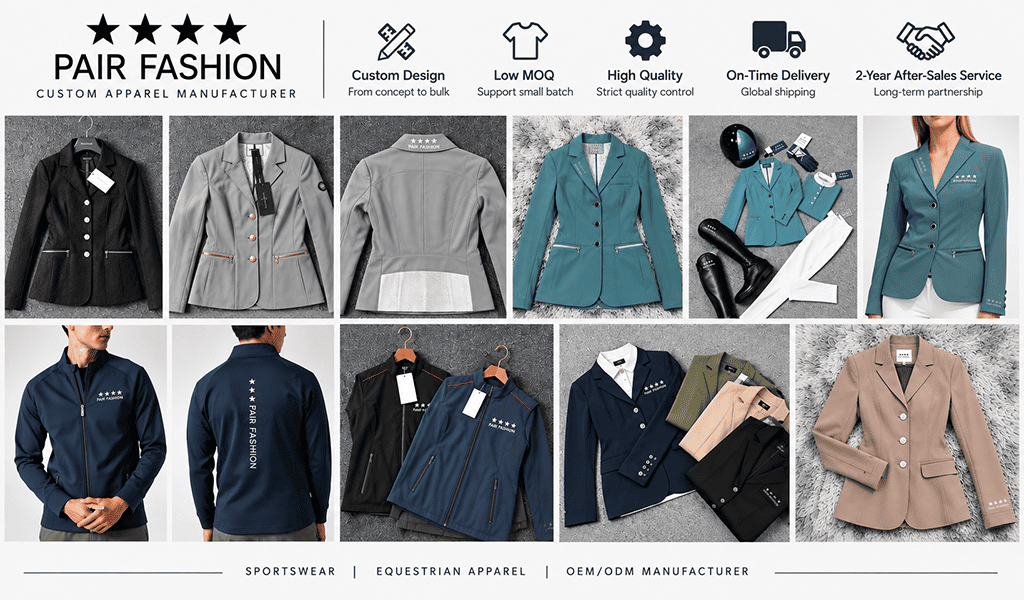
1. Pair Fashion — Flexible OEM/ODM Development for Complete Equestrian Apparel Collections
Location: Dongguan, Guangdong, China
Established: 2016
Core Products: Riding breeches, riding tights, equestrian tops, competition apparel, riding jackets, windproof outerwear and technical base layers
MOQ: Generally 100 pieces for regular custom styles; project requirements can vary
Sample Lead Time: Approximately 3–7 working days, with selected projects possible from around 3 days
Bulk Lead Time: Approximately 15–25 working days after sample approval, depending on complexity and quantity
Services: OEM, ODM and Private Label
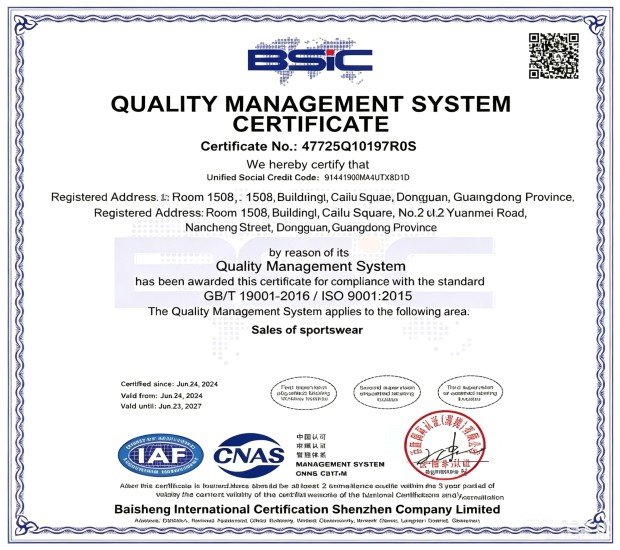
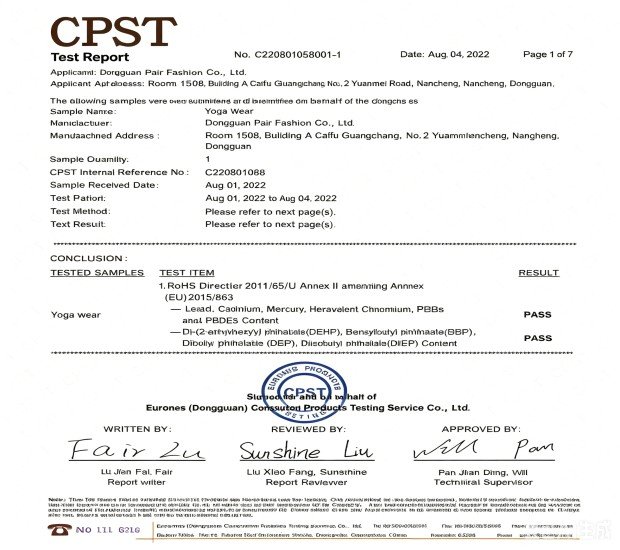
Quality / Compliance: ISO 9001, BSCI and GRS-related manufacturing/material support, with additional compliance documentation depending on the project
Production Capacity: Approximately 50,000 pieces per month under regular capacity planning
Pair Fashion is relevant to buyers who want to develop more than a single standard riding product. Its manufacturing scope includes equestrian bottoms, tops, jackets and competition apparel, while its product-development process can begin from a concept, reference garment, image or Tech Pack.
That makes the company particularly relevant when a buyer has studied the best equestrian clothing brands and wants to translate several benchmark ideas into one coordinated private label collection rather than simply purchase a ready-made wholesale style.
Development support includes pattern making, size grading, fabric sourcing, sampling, trims, labels, packaging and bulk production. For technical riding products, this matters because the finished result depends on more than visual design. Waistband behavior, stretch and recovery, grip placement, pocket construction, knee movement and lower-leg fit can all affect the product once it is used in the saddle.
Pair Fashion also operates dedicated equestrian production capacity within a broader functional sportswear manufacturing system. This can be useful for brands that want riding products to borrow relevant performance concepts from activewear while maintaining equestrian-specific fit and construction.
Best suited to:
- Startup and growing private label equestrian brands
- Buyers developing several riding apparel categories
- Brands needing OEM or ODM development rather than stock wholesale
- Projects requiring relatively fast sample development
- Brands that want to start with controlled quantities and scale into repeat orders
- Buyers developing coordinated breeches, tops and outerwear
May be less suitable for:
- Buyers looking only for finished branded stock
- Projects driven exclusively by the lowest possible unit price
- Very small one-off orders below the practical custom-production threshold
- Buyers unwilling to confirm specifications before production
Core strength: Flexible product development across multiple equestrian apparel categories combined with sampling, private label customization and scalable bulk production.
Potential limitation: Buyers should confirm the exact MOQ by style, fabric, color and customization level because a headline low MOQ does not automatically apply to every product configuration.
2. Run Equestrian — Specialist Manufacturer for Breeches, Jodhpurs and Competition Wear
Location: Guangzhou, Guangdong, China
Established: Public company information states manufacturing experience since 2009
Core Products: Riding breeches, jodhpurs, riding shirts, show jackets and competition wear
MOQ: From approximately 100 pieces per style for selected programs
Sample Lead Time: Around 7–15 days depending on the product and development route
Bulk Lead Time: Publicly stated production ranges include approximately 15–25 days for selected programs; buyers should confirm the schedule for the actual order
Services: OEM, ODM and Private Label
Quality / Compliance: Public company information references ISO 9001 and certified material options
Production: Public company information describes a 10,000 m² facility and multi-line production
Run Equestrian is more narrowly positioned around equestrian manufacturing. Its public product range emphasizes breeches, jodhpurs and competition clothing, making it a useful supplier to compare when riding bottoms form the center of the collection.
For a buyer studying the best equestrian clothing brands, this type of specialist supplier can be attractive when the product brief already has a clear technical direction. Full-seat grip, knee-patch constructions, high-rise breeches, competition silhouettes and different riding-bottom formats appear prominently in its product offering.
The trade-off is worth understanding. Specialization can provide stronger category familiarity, but buyers should still verify whether the manufacturer’s specific strengths match the planned product. Experience producing standard silicone-grip breeches, for example, does not automatically prove expertise in every premium fabric, inclusive size system or highly structured show jacket.
Best suited to:
- Brands centered on breeches and jodhpurs
- Buyers developing competition apparel
- Riding clubs and equestrian retailers
- Buyers who already have a relatively clear product brief
- Brands seeking a specialist equestrian supplier
May be less suitable for:
- Buyers whose collection extends far beyond the manufacturer’s strongest equestrian categories
- Projects requiring extremely small quantities
- Buyers who need unusual development work outside the supplier’s demonstrated product range
Core strength: Clear equestrian specialization, particularly in riding bottoms and competition-related apparel.
Potential limitation: Buyers should verify capability style by style rather than assuming that specialist positioning means equal strength across every riding-apparel category.
3. EquestCo — Small-Batch Equestrian Apparel With a Strong UK Market Focus
Location: Humen, Dongguan, Guangdong, China
Established: 2015
Core Products: Riding breeches, show jackets, riding shirts, base layers and custom team wear
MOQ: Public information lists 150 pieces per style/color for standard breeches, 100 pieces for show jackets and riding shirts, and lower quantities for selected team-wear programs
Sample Lead Time: Approximately 5–7 working days for selected sampling, with custom samples commonly stated at 10–15 days
Bulk Lead Time: Approximately 25–30 days, with longer lead times possible during peak periods
Services: Private label and custom equestrian apparel
Quality / Compliance: Public information references OEKO-TEX Standard 100, BSCI and ISO 9001:2015
Factory: Approximately 2,000 m², according to company information
EquestCo is worth comparing because its positioning is relatively specific: equestrian apparel with a strong emphasis on the UK market, clubs and riding organizations.
That focus can be useful when products must work within recognizable British competition and club-wear expectations. Its product mix covers breeches, show jackets, shirts, base layers and team wear rather than attempting to position itself as a general fashion manufacturer.
One useful lesson for buyers is that MOQ should always be read together with the product category. A supplier may advertise a very low starting quantity, while its standard custom breeches require a higher minimum per style and color. This is why buyers should never compare factories using only the largest MOQ number displayed on a homepage.
The same logic applies when comparing manufacturers inspired by the best equestrian clothing brands. The relevant question is not “What is your lowest MOQ?” but “What is the MOQ for this exact fabric, style, color, grip, branding and size breakdown?”
Best suited to:
- UK-oriented equestrian programs
- Riding clubs and team-wear projects
- Breeches, show jackets and riding shirts
- Buyers who value clearly stated product-category MOQ structures
- Small and medium private label programs
May be less suitable for:
- Brands requiring very high-volume global production
- Buyers seeking a very broad non-equestrian product ecosystem
- Projects whose target market has requirements very different from the supplier’s strongest UK focus
Core strength: Focused equestrian product range with relatively transparent public information about factory size, sampling, MOQ and production.
Potential limitation: Some of the lowest advertised MOQ options apply to specific team-wear programs rather than every custom product.
4. Velospan — Product-Focused Equestrian Clothing Manufacturing
Location: China
Established: Not clearly stated in currently available public information
Core Products: Riding breeches, equestrian tops, competition jackets, outerwear and selected sportswear
MOQ: Confirm directly for the required style
Sample Lead Time: Confirm directly
Bulk Lead Time: Confirm directly
Services: OEM and ODM services are publicly promoted
Certifications: Confirm current factory and product-specific documentation before ordering
Velospan is another manufacturer that buyers may encounter when searching for Chinese equestrian apparel production. Its publicly visible product assortment includes full-seat and knee-patch silicone-grip breeches, equestrian tops and tailored competition jackets.
The useful point here is not that every manufacturer must publish the same amount of information. It is that missing public information creates a verification task for the buyer.
If MOQ, lead time, factory history or certifications cannot be independently established from current public material, those fields should move onto the buyer’s supplier questionnaire rather than being filled with assumptions.
This is particularly important for brands benchmarking the best equestrian clothing brands, because a visually similar catalog product can create a false sense of technical equivalence.
Best suited to:
- Buyers initially comparing breeches, tops and competition apparel suppliers
- Brands willing to complete further factory verification
- Projects where a sample can be used to evaluate technical execution before commitment
May be less suitable for:
- Buyers requiring complete supplier documentation before initial contact
- Procurement teams that need fully published MOQ and lead-time data for early-stage screening
Core strength: Visible specialization in common equestrian apparel categories.
Potential limitation: Several important commercial and verification details need to be confirmed directly rather than assumed from the product catalog.
Chinese Equestrian Clothing Manufacturer Comparison
| Manufacturer | Location | Established | Core Products | MOQ | Sample Time | Bulk Lead Time | Best For |
|---|---|---|---|---|---|---|---|
| Pair Fashion | Dongguan | 2016 | Breeches, tights, tops, jackets, competition apparel | Generally from 100 pcs for regular custom styles | Approx. 3–7 working days | Approx. 15–25 working days | Multi-category private label collections and flexible development |
| Run Equestrian | Guangzhou | Since 2009* | Breeches, jodhpurs, shirts, competition wear | From about 100 pcs* | Approx. 7–15 days* | Selected programs around 15–25 days* | Specialist riding bottoms and competition apparel |
| EquestCo | Dongguan | 2015* | Breeches, show jackets, shirts, team wear | Product-specific; standard breeches listed at 150 pcs/style/color* | Approx. 5–15 days depending on sample type* | Approx. 25–30 days* | UK-oriented private label and club programs |
| Velospan | China | Confirm | Breeches, tops, jackets, outerwear | Confirm | Confirm | Confirm |
*Publicly stated supplier information should be reconfirmed when requesting a quotation because MOQ, capacity, lead time and commercial terms can change.
Why Is This List Shorter Than a Typical “Top 10 Factory” List?
A useful manufacturer shortlist should not be expanded simply to reach an arbitrary number.
Finding ten websites that contain the words “equestrian clothing manufacturer” is easy. Confirming that ten companies have relevant production capability, clear factory evidence, current commercial information and sufficient technical experience is much harder.
For buyers who have spent time studying the best equestrian clothing brands, lowering the evidence standard when choosing the factory would make little sense.
A manufacturer should move onto the serious shortlist only when the buyer can verify enough of the following:
- Relevant products: Does the supplier actually manufacture the type of breeches, tights, jackets or tops being developed?
- Factory identity: Is it clear who will manufacture the order?
- Pattern capability: Can the supplier develop or accurately work from the required fit?
- Material knowledge: Can it explain fabric stretch, recovery, weight and appropriate end use?
- Grip capability: Can it control knee-patch or full-seat placement, pattern and application?
- Sample process: Is there a defined route from first sample to approved sample?
- MOQ structure: Is the minimum stated per order, per style, per color or per fabric?
- Bulk evidence: Can the supplier reproduce approved specifications at production scale?
- QC: Are incoming, in-line and final inspection responsibilities clear?
- Repeatability: Can the same approved specifications be controlled for future reorders?
The strongest sourcing decision is therefore not the supplier with the longest list of claims.
It is the manufacturer whose verified capabilities match the product requirements that matter most to the order.
Brand Benchmark vs Manufacturing Capability
The best equestrian clothing brands are valuable because they show buyers what the market has already learned about riders. Manufacturers serve a different purpose: they must turn a defined product requirement into a repeatable physical garment.
That difference should remain clear.
A buyer may benchmark the clean premium appearance of a competition collection, the practical pocket construction of a riding tight and the weather strategy of a technical outerwear brand. Those references can come from three different companies.
The manufacturer does not need to “copy” those brands.
It needs to demonstrate that it can interpret the buyer’s own specification, develop an appropriate sample and reproduce the approved result in bulk.
For buyers developing a complete private label range, working with an experienced equestrian clothing manufacturer can also reduce the number of separate suppliers required for breeches, riding tops, jackets and competition pieces. The commercial advantage is not simply convenience; fewer disconnected development routes can make fit standards, materials, colors, branding and repeat orders easier to coordinate.
Ultimately, the lessons from the best equestrian clothing brands should become a product brief, not a shopping list of designs to reproduce. Once the rider, use case, price position and product specification are defined, manufacturer comparison becomes much more objective.

What Do Leading Brands Teach Buyers About Fit, Size Inclusivity and Rider Use?
The best equestrian clothing brands show that good riding fit must work during actual riding, not only when the customer stands in front of a mirror. Buyers should evaluate waistband stability, hip and thigh room, knee movement, grip position, lower-leg fit and boot compatibility across the intended size range. Inclusive sizing also requires real pattern development and sample verification, not simply extending a size chart.
Fit is one of the easiest areas to underestimate when developing equestrian clothing.
A pair of breeches can look excellent during a standing fitting and still become uncomfortable when the rider sits in the saddle. The waistband may roll or move, the knee area may pull, the pocket may become difficult to use, or the lower leg may create excessive bulk inside a tall boot.
This is why buyers studying the best equestrian clothing brands should look beyond the front and back of a product photograph. The real question is how the garment behaves when the rider moves.
Why Is Riding Fit Different From Ordinary Activewear Fit?
Riding apparel shares some characteristics with general activewear: stretch, recovery, moisture management and freedom of movement can all matter.
But the body interacts with the garment differently during riding.
The rider spends significant time with the hips flexed, knees bent and lower legs positioned against the horse, while the seat and inner leg interact with the saddle. Breeches and riding tights must also work with footwear that can extend high up the lower leg.
These conditions change the importance of certain measurements and construction details.
For riding bottoms, buyers should pay particular attention to:
- Waistband stability
- Front and back rise
- Hip and seat room
- Thigh compression
- Knee articulation
- Inner-leg seam position
- Grip placement
- Calf and ankle fit
- Garment length
- Tall-boot compatibility
A general fitness-legging block can sometimes provide useful development information, but it should not automatically be treated as a finished riding-tight pattern.
The product needs to be evaluated for the movement and contact conditions it will actually experience.
Standing Fit vs In-Saddle Fit: Which Should Buyers Evaluate?
Both matter, but in-saddle evaluation reveals problems that a static fitting can miss. A useful riding-apparel sample should be checked while standing, walking, bending the knee and sitting in a riding position so buyers can see whether the waistband, knee, seat, grip, pockets and lower leg remain correctly positioned.
Consider a high-rise riding tight.
While standing, the waistband may appear smooth and supportive. When the rider sits, however, the back waist could move downward while the front waist folds. A side phone pocket that looked perfectly positioned in the fitting room might become awkward when the hip is flexed.
The same problem appears in jackets.
A jacket can have an excellent standing silhouette but become restrictive when the rider reaches forward. Sleeve length, shoulder mobility, back length and hem position can all change visually and functionally in riding posture.
For this reason, sample approval should not depend on one photograph or one standing fitting.
A more useful evaluation can include:
- Natural standing position
- Walking and basic movement
- Deep knee bend
- Simulated or actual riding posture
- Sitting in the saddle where practical
- Testing with intended riding boots
- Repeated movement to identify migration or pressure points
Buyers do not need a laboratory to discover every fit problem. Sometimes a few minutes of relevant movement exposes issues that are invisible on a measurement chart.
What Should Buyers Learn From Plus-Size Equestrian Clothing Brands?
Inclusive sizing can expand the commercial reach of a collection, but only if the additional sizes deliver a usable fit.
This is where some of the best equestrian clothing brands provide an important benchmark: size availability is visible to the customer, but the real technical challenge sits behind the size chart.
A buyer considering extended sizing should not ask only:
“Can you make 2XL, 3XL or 4XL?”
A better question is:
“How will the pattern change so these sizes maintain the intended fit and function?”
Bodies do not become larger at exactly the same rate in every area.
As size increases, the relationship between waist, hip, thigh, knee, calf and garment length may need more thoughtful control than a simple percentage increase. Waistband height and elasticity may also need attention because the same construction can behave differently across a wider range of body dimensions.
For private label buyers, inclusive sizing should therefore be treated as a product-development decision, not a dropdown-menu decision.
Size Extension vs True Size Grading: What Is the Difference?
Size extension means making the product available in more labeled sizes.
Size grading is the technical process used to create those sizes from an approved base pattern according to defined measurement increments and proportions.
They are related, but they are not the same thing.
Imagine a riding tight approved in size M. The brand wants to sell XS through 4XL.
Simply enlarging or reducing every area at the same rate can create problems:
- The pocket may become too large or too small.
- The knee grip may shift away from the intended contact area.
- The waistband may become disproportionately high.
- The rise may not suit the intended body proportions.
- The leg opening may no longer work comfortably inside a boot.
- Seam positions may move visually.
- A logo may become incorrectly positioned relative to the garment.
Buyers studying the best equestrian clothing brands should therefore pay attention not only to how many sizes are offered but also to whether the product appears proportionally consistent across the range.
For custom development, the size chart and grading rules should be confirmed before bulk production rather than left for the sewing line to interpret.
How Should Waistband, Hip, Knee and Calf Fit Change Across Sizes?
There is no single grading formula that works for every riding product or target market.
The correct approach depends on the base pattern, fabric stretch, target body profile, desired compression and intended riding use.
However, several areas deserve particular attention.
Waistband:
The waistband must balance security and comfort. Too loose and it may move during riding; too tight and it can create uncomfortable pressure when the rider sits.
Hip and seat:
This area needs enough room for movement while maintaining the intended silhouette. Full-seat grip also makes placement consistency particularly important.
Knee:
The knee bends repeatedly while riding. Excess tension can restrict movement, while poorly positioned grip can move away from the intended contact area.
Calf and lower leg:
The garment should sit cleanly inside the intended footwear. Excess fabric can create bulk, while excessive compression may be uncomfortable.
These are not independent areas. Changing the rise can affect waistband position; changing fabric recovery can affect compression; changing inseam length can affect knee placement.
Fit development is a system.
How Do Tall Riding Boots Affect Breeches and Riding Tights?
Tall boots create one of the clearest differences between riding bottoms and many ordinary leggings.
The lower leg has limited space inside the boot, so unnecessary bulk can quickly become noticeable.
Buyers should consider:
- Seam thickness
- Cuff construction
- Ankle opening
- Fabric thickness
- Inseam length
- Grip termination
- Logo placement
- Sock interaction
A thick ankle seam that feels insignificant when the rider wears trainers can become irritating inside a close-fitting tall boot.
Likewise, excessive fabric length may fold around the ankle.
This is why buyers comparing the best equestrian clothing brands should not evaluate riding bottoms only with casual footwear in product photographs. Boot compatibility is part of product function.
Do Women, Men and Junior Riders Require Different Product Architecture?
Often, yes.
Changing only the size label is unlikely to create an optimized product across substantially different target groups.
Women’s, men’s and junior riding apparel can require different assumptions around body proportions, rise, hip shaping, garment length, pocket position and styling. The exact differences depend on the target customer rather than a universal rule.
Junior products introduce another commercial issue: growth.
Parents may value durability and practical fit differently from adult competition riders. A brand also needs to decide whether its junior line is simply a smaller version of the adult collection or a product range developed around younger riders’ actual needs and price expectations.
For a startup, developing every demographic simultaneously can create unnecessary pattern, sample and inventory complexity.
It may be more commercially sensible to establish one customer group first.
What Sample Sizes Should Buyers Test Before Approving Production?
Testing only the base size creates unnecessary grading risk. For a wide size range, buyers should approve the base size first and then verify selected sizes from different parts of the range before bulk production, especially when fit, grip placement, pocket position or inclusive sizing is commercially important.
Suppose a collection will run from XS to 4XL.
It may not be commercially necessary to make every size as a full development sample, but relying only on size M can leave too much untested.
A more controlled process could include:
- Base-size fit sample to establish the main pattern
- Revised fit sample if significant corrections are required
- Selected size-set samples to verify grading
- PP sample approval using locked specifications before bulk production
Which sizes should be physically checked depends on the range and product risk.
For a broad inclusive range, testing a smaller size, the approved base size and one or more larger sizes can reveal whether proportions, grip and functional details remain consistent.
This is particularly important when the product includes:
- Full-seat silicone
- Knee grip
- Large phone pockets
- Complex waistbands
- Multiple panel seams
- Compression fabrics
- Tall-boot-specific lower legs
A sample can prove that one garment was made successfully.
It does not automatically prove that every graded size or every bulk-production unit will perform the same way.
Why Does Fabric Change the Fit Even When the Pattern Is the Same?
One of the most important lessons for buyers is that pattern measurements alone do not determine garment fit.
Fabric behavior matters.
Two fabrics with similar fiber composition can have different:
- Stretch percentages
- Stretch directions
- Recovery
- Weight
- Surface friction
- Compression
- Hand feel
- Dimensional stability
For products where post-wash fit consistency is commercially important, buyers can also define dimensional-stability testing requirements. AATCC TM135 provides a standardized method for determining changes in fabric length and width after home laundering, helping buyers evaluate material behavior beyond the original sample appearance.
A riding tight developed and approved in one fabric may fit differently if bulk production uses another material with weaker recovery.
This is why changing fabric after fit approval should not be treated as a minor purchasing substitution.
For products inspired by the best equestrian clothing brands, buyers may be tempted to focus heavily on fiber content—for example, nylon/elastane versus polyester/elastane. But composition alone does not tell the full performance story.
The actual material needs to be evaluated against the product requirement.
How Can Buyers Turn Fit Requirements Into Manufacturer Instructions?
“Make the fit comfortable” is not a production specification.
Neither is “make it fit like a premium brand.”
A stronger product brief translates the desired customer experience into measurable and testable requirements.
For example:
| Buyer Goal | More Useful Development Instruction |
|---|---|
| Comfortable high waist | Define waistband height, finished waist measurement, fabric recovery and desired compression |
| Secure phone pocket | Define pocket dimensions, opening direction, location and phone size to be tested |
| Good knee movement | Check knee position and tension in bent-leg riding posture |
| Stable full-seat grip | Define grip coverage, placement, pattern and stretch compatibility |
| Comfortable under tall boots | Control lower-leg circumference, seam bulk, length and cuff construction |
| Inclusive fit | Define size chart, grading rules and sizes requiring physical verification |
This is where an experienced equestrian clothing manufacturer becomes useful. The manufacturer should be able to convert approved measurements, patterns, fabric, grip, size grading and construction requirements into a repeatable production reference rather than relying on subjective descriptions or visual references alone.
Fit Is a Commercial Issue, Not Only a Technical Issue
Fit affects more than the sample room.
Poor fit can contribute to returns, negative reviews, slow-moving sizes and customer hesitation about repeat purchases. Inconsistent fit between two styles can also weaken trust in the brand’s size chart.
For this reason, the best equestrian clothing brands are useful benchmarks not because every customer fits them perfectly—no apparel brand achieves that—but because mature collections demonstrate how important consistent product expectations become as a brand grows.
Private label buyers should establish their own fit standard rather than constantly changing direction according to whichever reference sample is currently being developed.
Once the target customer, base measurements, fit direction, grading rules and key movement requirements are defined, each new style can build from a more stable foundation.
That creates a stronger development loop:
Target Rider → Size Standard → Pattern → Fit Sample → Movement Test → Size Verification → PP Sample Approval → Bulk Production → Fit Feedback → Repeat Order
For buyers studying the best equestrian clothing brands, this is one of the most valuable lessons to carry into custom manufacturing: a good-looking sample attracts attention, but a repeatable fit system helps build a product customers are willing to buy again.
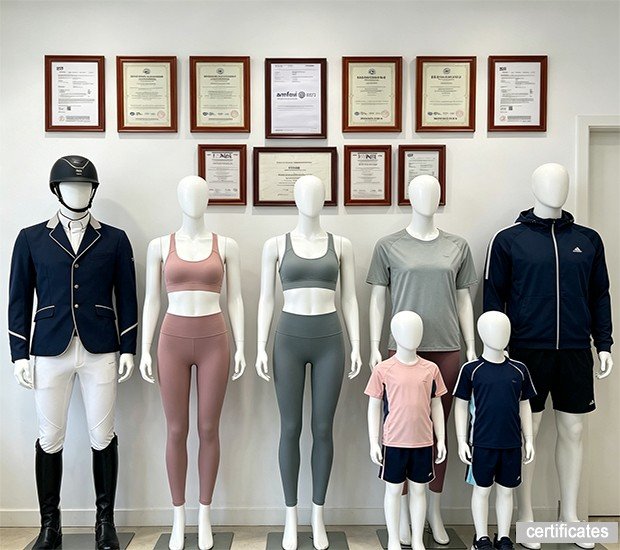
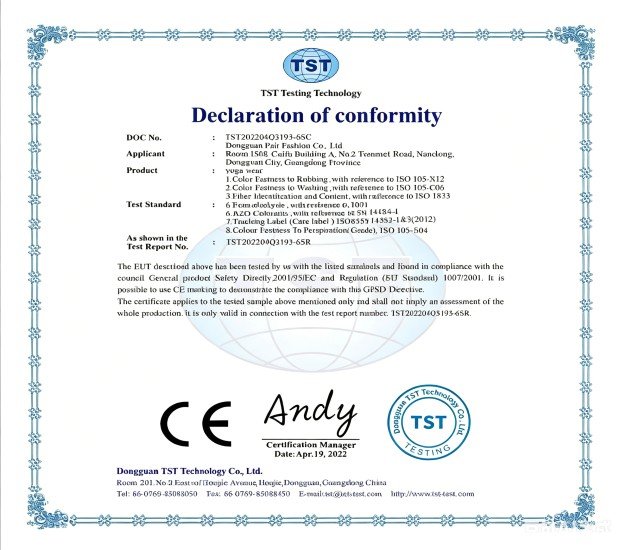
Trusted Manufacturing Standards For Global Sportswear Brands
We operate under internationally recognized quality, sustainability, and ethical manufacturing standards. Our certifications help ensure consistent product quality, responsible sourcing, and reliable production for global sportswear brands.
- 20+ Countries Served
- 6000+ Styles Developed
- 50,000 PCS Monthly Capacity
- 3-Day Sample Development
What Product Strategies Can Buyers Learn From the Best Equestrian Clothing Brands?
The best equestrian clothing brands show that successful riding collections are usually built around clear product roles rather than a large number of similar styles. Buyers should define the rider, discipline, use case, season and price position first, then decide how breeches, riding tights, competition wear, technical tops and jackets work together. The strongest lesson is simple: every SKU should have a reason to exist.
A common mistake when developing a new equestrian collection is to start only from the appearance. Buyers choose several good-looking reference pictures, change some colors, add their own logo, and then send everything to the manufacturer for quotation.
This way may help to make some products, but it does not mean these products can become a real and complete collection.
When buyers study the best equestrian clothing brands, the more useful questions are: Why does this brand offer both breeches and riding tights? Which products are intended for competition? Which ones are designed for everyday training? Why is one jacket lightweight while another is insulated? Which product brings a new customer into the brand, and which products encourage that customer to buy again?
These questions turn brand research into product strategy.
Breeches vs Riding Tights: Which Product Should Lead a New Collection?
Breeches and riding tights can serve different customers even when both are worn for riding. Breeches generally provide a more structured equestrian appearance, while riding tights can emphasize stretch, comfort and everyday training. A new brand should choose its first product according to the target rider and use case rather than assuming one category is automatically better.
The distinction becomes clearer when the specification is examined.
A structured breech may use a firmer performance fabric, shaped waistband, traditional pocket treatment, belt loops and carefully positioned knee or full-seat grip. Depending on the target market, it may need to work naturally with competition shirts, belts, show jackets and tall riding boots.
A riding tight can move closer to the comfort expectations of technical activewear. Buyers may prioritize high stretch, recovery, phone pockets, reduced bulk, flexible waist construction and all-day comfort.
When buyers move from product comparison into development, working with a specialized Horse Riding Breeches Tights Manufacturer can help define the differences between breeches and riding tights through fabric structure, waistband construction, pocket design, knee or full-seat grip and riding-specific fit before sampling begins.
Neither approach is inherently superior.
The commercial problem appears when the two products have almost identical specifications and differ only in name.
For example, launching four bottoms as:
- Everyday Riding Tight
- Training Riding Tight
- Performance Riding Tight
- Essential Riding Tight
does not create meaningful choice if all four use similar fabric, grip, waistband, pocket construction and price.
Buyers studying the best equestrian clothing brands should instead identify the job of each bottom.
A clearer first collection might contain:
- Everyday Riding Tight: comfort, phone storage and accessible price
- Technical Training Tight: stronger recovery and higher-performance fabric
- Structured Breech: cleaner equestrian silhouette and more tailored construction
- Competition Breech: discipline-appropriate appearance and controlled technical details
This creates a product ladder rather than a catalog of near-duplicates.
Competition Wear vs Training Wear: Why Should Buyers Separate the Use Cases?
Competition clothing and training clothing share some performance requirements, but they do not always have the same priorities.
A rider training several days each week may care strongly about comfort, easy washing, durability, practical pockets and repeat wear. Competition products may place greater emphasis on a clean silhouette, discipline-appropriate styling, refined details and compatibility with the rest of the show outfit.
That difference affects product development.
A training tight may benefit from a deep phone pocket that would be visually unnecessary on a formal competition breech. A lightweight training top can use more obvious ventilation details, while a show shirt may need to control those features more discreetly.
The same logic applies to jackets.
A training jacket may prioritize wind protection, stretch and practical storage. A competition jacket needs to consider riding posture, shoulder mobility, sleeve position and how the garment sits when the rider is in the saddle.
This is why simply applying “technical fabric” to every product does not create a technical collection.
Function should follow the actual riding situation.
Knee Grip vs Full Seat: How Does Function Change Product Positioning?
Knee grip and full-seat grip should be treated as functional systems, not decorative silicone prints. The right choice depends on riding discipline, rider preference, fabric behavior, desired saddle contact and market positioning. Buyers should evaluate grip coverage, pattern, density, elasticity and placement together with the base garment.
A buyer may initially think this decision is easy:
Knee grip uses silicone around the knee. Full seat uses more silicone across the seat and inner-leg contact area.
For manufacturing, however, the decision goes deeper.
The silicone pattern must work with the stretch of the fabric. Excessive coverage or unsuitable density can change how the garment feels. Poor placement can also reduce the value of an otherwise good product.
Buyers should therefore define:
- Grip type: knee or full seat
- Coverage: how much contact area is required
- Pattern: geometric, minimal, brand-inspired or another original direction
- Density: how closely the silicone elements are arranged
- Elasticity: whether the grip moves appropriately with the base fabric
- Placement: whether the grip remains correctly positioned across intended sizes
- Durability expectation: how the application performs through wear and laundering
There is also a branding opportunity.
A custom grip pattern can become a subtle brand signature, but it should not be treated as free decoration.
For brands developing technical riding tights, an experienced Horse Leggings Manufacturer should coordinate the grip system with fabric stretch, recovery, waistband construction, pocket placement and size grading so the functional details continue to work when the garment is stretched and used in riding movement.
Custom tooling, application requirements and order quantity can affect cost.
Among the best equestrian clothing brands, functional details tend to work because they support the product rather than competing with it visually.
Technical Tops vs Lifestyle Tops: Do They Serve the Same Customer Need?
Not necessarily.
A technical riding top is usually expected to perform during movement. Depending on season and market, buyers may prioritize moisture management, stretch, breathability, lightweight construction, UV-related fabric options or layering compatibility.
A lifestyle top has more freedom.
It may use a softer hand feel, relaxed silhouette or less technical construction because the product is designed for travel, stable life or casual wear rather than demanding riding sessions.
The distinction matters commercially because lifestyle products can expand the relationship between the rider and the brand beyond actual riding hours.
But lifestyle expansion should normally come after the brand has a clear reason for customers to trust its core riding products.
For a new private label business, five technically credible riding products can create a stronger market position than twenty generic lifestyle garments with equestrian graphics.
Why Are Riding Jackets Important for Seasonal Revenue?
Jackets give equestrian brands a way to respond to changing weather while also creating higher-value products within a collection.
But “riding jacket” is too broad to be a useful product specification.
A buyer may need to distinguish between:
| Jacket Type | Main Use | Product Priorities |
|---|---|---|
| Lightweight Training Jacket | Mild weather / warm-up | Stretch, low weight, breathability |
| Softshell Riding Jacket | Windy or transitional weather | Wind resistance, mobility, moderate protection |
| Rain-Oriented Shell | Wet outdoor conditions | Weather protection, construction compatibility, practical layering |
| Insulated Riding Jacket | Cold-weather training | Warmth, mobility, controlled bulk |
| Competition Jacket | Show environment | Riding posture, clean silhouette, shoulder movement, refined appearance |
The manufacturer should not select one generic fabric and use it for all five.
Before sourcing fabric, buyers should establish the target climate, season, riding environment, garment weight, expected function and retail position.
When these requirements move into custom development, a specialized Jackets for Riding Horses Manufacturer should coordinate fabric performance, layering, shoulder mobility, sleeve length, back-hem position and weather protection around the intended riding season instead of applying one standard outerwear construction to every jacket.
This is one area where studying the best equestrian clothing brands can be particularly useful. Buyers can see how established collections change material, construction and layering strategy across seasons instead of only changing color.
How Do Leading Brands Build Coordinated Colors and Product Families?
Color coordination can make a relatively small collection look much larger and more intentional.
Suppose a brand develops:
- One riding tight
- One breech
- Two technical tops
- One lightweight jacket
If selected colors repeat intelligently across those products, customers can build several coordinated outfits from only five core styles.
This has practical manufacturing implications.
Using common fabric colors, trims or branding treatments across several products can sometimes simplify development and improve visual consistency. However, buyers should check material minimums and color minimums before building a complicated color plan.
A mill may require a minimum quantity for a custom-dyed fabric that is much higher than the garment manufacturer’s advertised MOQ.
For example, a factory may accept 100 pieces per style, but the selected custom-dyed fabric may require enough material for several hundred garments. The real commercial minimum is therefore not determined by the sewing MOQ alone.
This is why color strategy should be discussed before sampling, not after the collection is already designed.
Why Can One Hero Product Be More Valuable Than Too Many SKUs?
For a new equestrian brand, a focused first collection usually creates cleaner learning.
Imagine two launches.
Brand A develops 15 styles, three colors per style and several untested fabric directions.
Brand B develops four products around one clear rider: a riding tight, structured breech, technical top and lightweight jacket.
Brand A has more products.
Brand B may have better information.
With fewer SKUs, it can place more attention on fit, sample revisions, product photography, customer feedback, inventory depth and repeat-order decisions. If one product performs particularly well, that product can become the foundation for future colors, fabric updates or related styles.
The best equestrian clothing brands may eventually operate broad collections, but buyers should remember that an established company and a startup do not have the same inventory tolerance, customer data or purchasing power.
A broad assortment is not automatically evidence of a strong launch strategy.
How Should Brands Use Best Sellers as Benchmarks Without Copying Them?
A benchmark should help buyers understand a product problem, not provide instructions for reproducing another brand’s design. Buyers can study category structure, fit direction, functional features, material expectations, price positioning and customer feedback, then convert those observations into an original product brief for their own market.
This distinction is commercially important.
If customers already have access to the original product, a weak copy gives them little reason to choose a new brand.
A stronger development process asks:
What problem is the benchmark solving?
Perhaps riders repeatedly value a stable high-rise waistband.
Then ask:
Does our target customer have the same problem?
If yes, the development brief might specify waistband stability during sitting and forward riding positions.
Then ask:
How can we solve it in our own product?
The answer could involve a different waistband height, internal construction, fabric recovery, seam structure or pattern shape.
The same method can be applied to pockets, grip, jacket mobility and technical tops.
A reference image says, “Make something that looks like this.”
A useful product brief says, “Our rider needs this outcome.”
That difference gives the pattern maker, material supplier and manufacturer much better information to work with.
From Brand Research to a Clear Product Brief
The most practical lesson from the best equestrian clothing brands is not a particular fabric, color or silicone pattern. It is the discipline of making product decisions around a defined customer.
Before approaching an equestrian clothing manufacturer, buyers should be able to answer at least these questions:
- Who is the rider? Recreational, training, competition or professional?
- Which discipline is the product designed for?
- When will the garment be worn? Training, competition, stable work or everyday lifestyle?
- Which climate and season does it target?
- What is the intended retail price?
- What are the two or three most important functional requirements?
- Which details are essential and which are optional?
- What size range is required?
- What is the realistic first-order quantity?
- Which product should become the hero SKU?
Once these answers are clear, the best equestrian clothing brands become much more useful benchmarks. Buyers can study relevant solutions without allowing another brand’s collection to define their own.
That also makes manufacturer selection more objective. Instead of asking a factory, “Can you make equestrian clothing?” the buyer can ask whether it can execute a specific fabric, fit, grip system, size range, construction and quality requirement at a commercially realistic MOQ and price.
A strong collection starts with a clear rider problem. Manufacturing should turn that problem into a repeatable product solution.

Why Do Brands Choose Chinese Manufacturers for Custom Equestrian Clothing?
Brands choose Chinese equestrian clothing manufacturers because China can combine apparel production with established fabric, trim, printing, silicone-grip, branding and packaging supply chains. For buyers studying the best equestrian clothing brands, the advantage is not simply lower labor cost. A suitable Chinese manufacturer can support product development, sampling, private label customization, controlled first orders and scalable repeat production within one sourcing system.
China is not automatically the right manufacturing location for every equestrian brand.
Nor is every Chinese garment factory suitable for riding apparel.
The useful sourcing question is more specific: Does the manufacturing ecosystem match the product, quantity, quality level, customization requirements and growth stage of the brand?
A startup developing its first four riding products has different needs from an established retailer ordering thousands of units across several seasonal programs. Buyers should therefore evaluate China as a manufacturing model rather than treating “Made in China” as either an advantage or disadvantage by itself.
Why Is China Important for Private Label Riding Apparel?
One practical advantage is the concentration of different manufacturing activities within established apparel regions.
A custom pair of riding breeches may require more than a sewing line. The complete product can involve:
- Performance fabric sourcing
- Elastic and waistband components
- Silicone grip application
- Zippers and snaps
- Pocket construction
- Custom labels
- Heat-transfer or embroidery branding
- Packaging
- Pattern development
- Size grading
- Sample production
- Bulk sewing
- In-line inspection
- Final inspection
When these capabilities are available within a relatively connected supply chain, buyers can reduce the number of independent vendors they need to coordinate.
This becomes more important as the product becomes more customized.
A stock garment with a logo may require little development. A private label breech with a custom waistband, specific pocket construction, original silicone grip, custom-dyed fabric, branded trims and a broad size range creates a much more complicated sourcing project.
Buyers researching the best equestrian clothing brands should recognize this difference. The finished products they see at retail are the visible result of many decisions made earlier in development and production.
What Type of Equestrian Clothing Can Chinese Manufacturers Produce?
China’s manufacturing base can support a broad range of riding apparel, although individual factories vary significantly in specialization.
Common categories include:
| Product Type | Typical Development Priorities |
|---|---|
| Riding Breeches | Structured fit, waistband, pockets, knee/full-seat grip, boot compatibility |
| Riding Tights | Stretch, recovery, comfort, phone pockets, grip, compression |
| Competition Jackets | Riding posture, shoulder movement, sleeve length, refined construction |
| Technical Riding Tops | Stretch, moisture management, breathability, layering |
| Base Layers | Next-to-skin comfort, stretch, lightweight construction |
| Softshell Jackets | Wind resistance, mobility, storage, seasonal use |
| Insulated Jackets | Warmth, controlled bulk, riding movement |
| Show Shirts | Clean appearance, stretch, collar construction, competition use |
| Team / Club Wear | Branding, color consistency, repeat orders |
| Junior Riding Apparel | Fit, durability, practical pricing and size planning |
The key is not whether these products can be manufactured somewhere in China.
The key is whether the specific supplier being evaluated has relevant experience with the exact product type.
A factory producing millions of basic T-shirts may have excellent general production management but limited experience with silicone-grip breeches. A smaller specialist manufacturer may understand riding bottoms much better but lack the capacity or technical construction required for a large structured-jacket program.
Factory selection should follow the product.
China vs Europe: Which Sourcing Model Fits Different Brand Stages?
China and Europe should not be compared only by unit price. European production can be attractive for proximity to certain markets, regional sourcing strategies and specialized manufacturing traditions, while China can offer broad supply-chain integration, customization and scalable production. The better choice depends on the product, order volume, development needs, target market and sourcing priorities.
A useful comparison looks like this:
| Sourcing Factor | Chinese Manufacturing | European Manufacturing |
|---|---|---|
| Supply-Chain Breadth | Strong access to fabrics, trims, branding and packaging | Varies significantly by country and manufacturing cluster |
| Custom Development | Broad OEM/ODM availability | Strong among appropriate specialist suppliers |
| Small Test Orders | Possible with selected flexible manufacturers | Possible with selected suppliers, often dependent on product |
| Large-Scale Production | Strong manufacturing infrastructure | Available, but capacity and cost structure vary |
| Communication Distance | Requires disciplined remote communication | Can be easier for European buyers depending on location |
| Freight Distance to Europe | Longer | Potentially shorter |
| Price Structure | Often competitive, but highly specification-dependent | Often higher for certain products, but not universally |
| Specialist Craft / Heritage | Depends on factory | Strong in selected traditional manufacturing regions |
| Fabric & Trim Ecosystem | Broad and highly integrated in major clusters | Strong in selected textile regions |
| Best Choice | Depends on product and business model | Depends on product and business model |
The purpose of this comparison is not to declare one region universally better.
For a brand developing a technically customized collection with several product categories, China’s integrated manufacturing network may be commercially attractive.
For another buyer, regional production closer to the target market may be more important than unit cost.
A sourcing strategy should reflect the business rather than a slogan.
Why Do Functional Fabric and Trim Supply Chains Matter?
Fabric selection is one of the areas where buyers can either gain or lose significant development time.
A buyer may ask for “premium four-way stretch fabric,” but that phrase is too broad to guide serious development.
For riding apparel, material decisions can involve:
- Fiber composition
- Fabric weight
- Four-way or two-way stretch
- Recovery
- Compression
- Breathability
- Moisture management
- Abrasion resistance
- Surface texture
- Brushing
- Water-repellent finishing
- UV-related performance options
- Recycled content
- Colorfastness
- Pilling performance
When moisture management is part of the product specification, buyers can also discuss whether the selected fabric should be evaluated through a recognized textile test method such as AATCC TM195, rather than treating terms such as “moisture management” or “quick dry” as sufficient technical evidence by themselves.
For riding garments exposed to repeated movement and contact, buyers can also define relevant fabric-testing requirements instead of relying only on supplier descriptions. For example, ISO 12947-2 provides a standardized Martindale method for determining the abrasion resistance of textile fabrics.
The same principle applies to trims.
A zipper, elastic, silicone application or heat-transfer logo may appear to be a small part of the garment, but failure in one component can create customer complaints even when the main fabric and sewing are good.
When buyers benchmark the best equestrian clothing brands, they should therefore avoid reducing a product to “80% nylon / 20% elastane” or another composition printed on a care label.
Two fabrics with the same composition can behave very differently.
A manufacturer should help narrow material options according to the product’s actual use rather than simply offering the fabric with the most impressive marketing description.
How Can Chinese Manufacturers Support Custom Grip, Fabric, Color and Branding?
Private label development can range from relatively simple customization to a substantially original product.
A useful way to think about it is in levels.
Level 1 — Branding Existing Products
- Logo
- Main label
- Care label
- Packaging
Level 2 — Controlled Product Modification
- Color
- Pocket adjustment
- Waistband adjustment
- Selected fabric alternatives
- Grip pattern
- Branding placement
Level 3 — Full Custom Development
- Original pattern
- Custom size chart
- Specific fabric direction
- Custom color
- Original grip design
- Custom construction
- Branded trims
- Complete packaging system
Buyers should decide which level they actually need.
If the objective is only to test whether an audience will buy equestrian apparel, a highly complex full-custom project may create unnecessary development cost.
If the brand is trying to compete with the best equestrian clothing brands through distinctive fit and product function, simply placing a logo on an existing style may not create enough differentiation.
The development model should match the business objective.
Is China Suitable for Startup Equestrian Brands With Smaller Orders?
It can be, provided the buyer selects a manufacturer whose commercial model supports smaller custom programs.
MOQ is often misunderstood.
A manufacturer may say its MOQ is 100 pieces, but buyers still need to ask:
- Is that 100 pieces per order?
- Per style?
- Per color?
- Per fabric?
- Can sizes be mixed?
- Does custom-dyed fabric have a separate minimum?
- Does custom silicone tooling have a minimum?
- Are branded trims subject to supplier minimums?
These questions can completely change the economics of a first collection.
Suppose a brand wants four styles in three colors.
At 100 pieces per style/color, that can become 1,200 garments, not 400.
If the target retail price and expected sales do not support that inventory exposure, the apparent “low MOQ” is not actually low for the project.
A smarter startup launch may use fewer colors, shared fabrics and a smaller number of hero styles.
The objective of a first order should be to learn without creating unnecessary inventory risk.
When Does a Larger Production Program Make More Commercial Sense?
Small orders reduce inventory exposure, but they do not always produce the lowest unit cost.
Some expenses are difficult to spread efficiently across a very small quantity:
- Pattern development
- Sample development
- Custom fabric
- Custom-dye setup
- Silicone tooling
- Embroidery or print setup
- Custom trims
- Packaging setup
- Testing
- Quality-control preparation
As order quantity increases, some fixed development or setup costs can be distributed across more units.
That does not mean buyers should order more simply to achieve a lower unit price.
The question should be:
Does the expected sales volume justify the additional inventory commitment?
For a proven product with reliable replenishment data, increasing quantity may make commercial sense.
For a new style with no sales history, a higher unit price on a controlled test order may represent lower total business risk than a cheaper unit price on excessive inventory.
Buyers studying the best equestrian clothing brands should remember that established brands often have sales history, wholesale commitments and repeat customers that a startup does not yet possess.
Their order structure should not be copied blindly either.
How Should Brands Plan for Repeat Orders?
A first successful order creates a new sourcing challenge: Can the manufacturer make the same product again?
Repeatability depends on controlling information.
Useful production records can include:
- Approved pattern
- Approved size chart
- Grading rules
- Approved fabric reference
- Approved color
- Grip artwork and placement
- Trim references
- Logo specifications
- Packaging requirements
- PP sample approval
- Locked construction details
- Quality records
Without these controls, a second order can slowly drift away from the first.
Fabric hand feel changes. A pocket moves slightly. The waistband becomes tighter. A color is “close enough.” The grip pattern is repositioned.
Individually, these changes may seem small.
Together, they can make customers feel that the product is inconsistent.
This is one reason the best equestrian clothing brands are useful manufacturing benchmarks: customers expect the same named product to deliver a reasonably consistent experience when they buy it again.
Private label brands need to build the same discipline as they grow.
When May China Not Be the Right Manufacturing Location?
China should not be selected simply because a buyer assumes it will always be cheaper.
Another sourcing model may be more appropriate when:
- The brand’s core positioning requires local production in a specific country.
- The project quantity is below the practical minimum for meaningful customization.
- Delivery requirements are incompatible with international production and freight time.
- The buyer needs extremely frequent micro-runs that a local supplier can handle more efficiently.
- A specialist process is better supported by another manufacturing region.
- The buyer cannot provide timely approvals or manage international development communication.
- The total landed cost removes the expected commercial advantage.
There is also a behavioral issue.
Custom manufacturing requires decisions.
If the buyer changes fabric, color, measurements, branding and construction repeatedly after sampling begins, the project can become slow and expensive regardless of where the factory is located.
Good manufacturing performance depends partly on good buyer inputs.
What Should Buyers Ask Before Choosing a Chinese Manufacturer?
For brands using the best equestrian clothing brands as benchmarks, the first supplier conversation should go beyond “How much?” and “What is your MOQ?”
A more useful initial checklist is:
- Which equestrian products do you manufacture regularly?
- Can you show relevant product examples without exposing another client’s confidential information?
- Can you develop from a Tech Pack, reference sample or concept?
- Do you make patterns and size grading internally?
- Which grip applications can you support?
- How do you select functional fabrics?
- What is the MOQ for my exact style, color and fabric?
- How long does sampling take?
- What happens after sample approval?
- How do you control bulk production against the approved sample?
- What inspections take place during production?
- How are repeat-order specifications recorded?
- What is the realistic bulk lead time for my quantity?
A capable equestrian clothing manufacturer should be able to discuss these questions in product-specific terms rather than answering every buyer with the same sales script.
Why China Is a Manufacturing Option, Not a Product Strategy
The best equestrian clothing brands did not become recognizable simply because of where their products were manufactured.
Their commercial value comes from understanding the customer, developing products for specific riding needs and maintaining a coherent market position.
Manufacturing should support that strategy.
For a private label buyer, China can provide access to custom development, functional materials, specialized processes, flexible production structures and scalable supply chains. But those capabilities create value only when the buyer has a sufficiently clear product brief and selects a manufacturer that can execute it.
The strongest sourcing sequence is therefore:
Target Rider → Product Position → Specification → Manufacturer Match → Sample Approval → Controlled Bulk Production → Market Feedback → Repeat Order
China can be an effective part of that system.
It should never be used as a substitute for the system itself.
How Should Buyers Compare the Price of Custom Equestrian Clothing?
Buyers should compare custom equestrian clothing prices only after suppliers are quoting the same product specification, fabric, quantity, color breakdown, grip, branding, packaging and delivery terms. The best equestrian clothing brands may sell visually similar products at very different retail prices, but factory quotations work the same way: a lower number means little when the underlying product and commercial conditions are different.
Price matters. But asking for the lowest price too early can make supplier comparison less accurate rather than more accurate.
A photo of black riding breeches does not show fabric recovery, fabric weight, silicone quality, waistband construction, pocket complexity, seam structure, branded trims or inspection requirements. Two factories can quote what appears to be the same product while actually calculating two different specifications.
Buyers studying the best equestrian clothing brands should therefore separate three questions:
What product are we trying to make?
What should that product realistically cost to manufacture?
Can the target market support the resulting retail price?
Only when these questions connect does a quotation become commercially useful.
Why Can Two Similar-Looking Breeches Have Very Different Factory Prices?
Because appearance represents only part of the product.
Imagine two pairs of navy full-seat breeches photographed from the front. Both have side pockets, a high waistband and silicone grip.
One uses a performance fabric that is easy to source and a standard silicone pattern. The other uses a more expensive fabric with better recovery, custom grip design, more complicated waistband construction, branded hardware and custom-dyed fabric.
From a small product picture, these two breeches may look almost the same.
But actually, they are two different manufacturing proje
Cost can change according to:
- Fabric price and consumption
- Fabric weight and width
- Stock color vs custom dye
- Stretch and recovery requirements
- Pattern complexity
- Number of panels
- Pocket construction
- Waistband construction
- Knee grip vs full-seat grip
- Standard vs custom silicone artwork
- Zippers, snaps and other trims
- Logo technique
- Custom labels
- Packaging
- Testing requirements
- Order quantity
- Color quantity
- Size breakdown
- Quality-control requirements
This is why a quotation should be attached to a defined specification rather than only a reference image.
What Determines the Manufacturing Price of Riding Breeches and Tights?
For many technical riding bottoms, fabric, construction, grip and order structure are among the largest variables.
Fabric
A fabric should not be evaluated only by fiber composition.
Two nylon/elastane fabrics can have different weight, stretch, recovery, surface feel and price. One may be a standard stocked fabric; another may require custom development or dyeing.
A more expensive material is not automatically better.
The right question is whether the fabric specification supports the intended product.
An everyday riding tight may not need the same material structure as a premium competition breech. Paying for functions the target customer does not value can make the product harder to sell.
Construction
More panels and seams do not automatically mean better performance.
They do, however, usually affect cutting and sewing.
A simple riding tight with two side pockets is different from a multi-panel breech with a shaped waistband, belt loops, zip pockets, ankle construction and detailed seam work.
The buyer should know which construction details solve a rider problem and which exist mainly for appearance.
Grip
Silicone is another area where “included” is not enough information.
Cost may vary according to:
- Knee vs full seat
- Coverage area
- Pattern density
- Custom artwork
- Tooling or setup
- Application process
- Number of colors
- Required durability
A custom logo-inspired full-seat pattern can create stronger product identity, but it may not make commercial sense for every entry-level product.
Branding and Packaging
A private label program may include:
- Main labels
- Size labels
- Care labels
- Heat-transfer logos
- Embroidery
- Silicone logos
- Custom zipper pulls
- Hangtags
- Branded polybags
- Retail boxes
Each individual component may seem inexpensive, but the combined effect can become meaningful—especially on a small first order.
Low MOQ vs Low Unit Price: Which Matters More?
Neither should be evaluated alone. A low MOQ reduces inventory commitment, while a lower unit price can improve gross margin. The better commercial decision depends on expected sales, cash flow, product confidence and reorder speed. For an untested style, paying slightly more per unit can sometimes create less total risk than ordering excessive inventory only to reach a lower price.
Consider a simplified example:
| Option | Quantity | Unit Cost | Inventory Cost |
|---|---|---|---|
| Supplier A | 100 pcs | $24 | $2,400 |
| Supplier B | 300 pcs | $19 | $5,700 |
| Supplier C | 500 pcs | $17 | $8,500 |
Supplier C has the lowest unit price.
That does not automatically make Supplier C the lowest-risk option.
If the product sells successfully, the lower unit cost may be valuable. If only 120 pieces sell, the brand has tied up substantially more cash in unsold inventory.
Now add three colors.
If the minimum applies per color, the commercial commitment changes again.
Buyers should therefore ask for the complete MOQ structure before comparing unit prices.
For brands learning from the best equestrian clothing brands, this distinction is particularly important. Mature brands may have sales history that justifies deeper inventory. A new private label company normally has less evidence.
The first production quantity should fit the product’s actual stage in the market.
Sample Price vs Bulk Price: Why Are They Different?
A custom sample is produced under very different conditions from bulk manufacturing.
One sample may require:
- Pattern creation
- Fabric sourcing
- Individual cutting
- One-off sewing
- Custom logo setup
- Grip setup
- Several communication rounds
- Measurement checking
- Courier shipping
Those activities cannot benefit from bulk-production efficiency.
For that reason, a sample costing substantially more than the later bulk unit price is not automatically unreasonable.
The more useful questions are:
- What is included in the sample fee?
- Is pattern development included?
- Are custom materials included?
- Is logo setup included?
- How many revisions are included?
- Is shipping separate?
- Will any development fee be credited against a future bulk order?
- What changes will require a new sample?
Buyers should also distinguish between sample cost and development cost.
A technically complicated product may require several rounds before approval. That does not necessarily indicate poor manufacturing performance; sometimes development is doing exactly what it is supposed to do—identifying and correcting problems before thousands of garments are produced.
Premium vs Mid-Market vs Entry-Level: How Should Specifications Change?
The best equestrian clothing brands occupy different market positions, and buyers should not expect one product specification to work at every price level.
A useful framework is:
| Product Position | Typical Priority | Possible Specification Direction |
|---|---|---|
| Entry-Level | Accessible price and essential function | Reliable stock fabric, controlled construction, standard grip, limited colors |
| Mid-Market | Strong function-to-price balance | Better material options, refined fit, useful pockets, selected custom details |
| Premium | Differentiation, technical detail and finish | Higher-spec materials, advanced fit development, custom trims/grip, refined construction |
These are not rigid rules.
A premium brand may deliberately use simple construction if simplicity supports its design language. An entry-level product can still require excellent sewing and dependable quality.
“Entry-level” should not mean “poor quality.”
It means the product specification is disciplined around the features the target customer values most.
This is where product development and commercial planning need to meet.
If the target retail price is $79, the buyer cannot continue adding every attractive technical feature without checking what happens to the landed cost and margin.
Retail Price vs Factory Price: Why Should Buyers Not Compare Them Directly?
Retail price contains much more than garment manufacturing cost.
Depending on the business model, a brand may need to cover:
- Product development
- Sampling
- Freight
- Import duties
- Warehousing
- Fulfillment
- E-commerce platform costs
- Photography
- Marketing
- Returns
- Discounts
- Wholesale margin
- Staff
- Taxes
- Unsold inventory
This means seeing a pair of breeches retailing for $200 does not tell a buyer what its factory cost is.
Likewise, seeing one of the best equestrian clothing brands sell a premium jacket at a high retail price does not mean a new brand should simply set the same price.
Brand recognition, distribution, customer loyalty and market positioning all affect what customers are willing to pay.
The useful benchmark is not the competitor’s price alone.
It is the relationship between product specification, perceived value, target customer and price position.
How Should Buyers Define a Target Price Before Requesting a Quotation?
Start from the business model, not from the factory.
Suppose a brand expects to retail a riding tight at $110.
The buyer should estimate the costs that sit between manufacturing and the final sale, then determine what landed product cost the business can support.
That creates a target.
The manufacturer can then help determine which fabric, construction and customization choices are realistic within that target.
This is much more productive than developing an expensive sample first and asking for a cheaper version afterward.
A useful RFQ can state:
- Target product
- Target market
- Target retail position
- Estimated quantity
- Number of colors
- Required size range
- Preferred fabric direction
- Essential functions
- Optional functions
- Branding
- Packaging
- Delivery market
The manufacturer does not necessarily need the buyer’s full financial model.
But knowing whether the project is intended to be an accessible training tight or a premium technical breech can prevent both sides from developing the wrong product.
How Should Buyers Compare Factory Quotations Correctly?
Normalize the inputs before comparing the outputs.
If Supplier A quotes 100 pieces in a stock color and Supplier B quotes 300 pieces in a custom-dyed fabric, their prices are not directly comparable.
Before choosing the lowest quotation, confirm that suppliers are pricing the same:
- Product specification
- Fabric
- Fabric weight or relevant material reference
- Color method
- Grip type and coverage
- Construction
- Branding
- Packaging
- Quantity
- Size breakdown
- Quality requirements
- Delivery terms
Then ask what the quotation excludes.
Possible exclusions can include:
- Sample fees
- Custom tooling
- Fabric testing
- Third-party inspection
- Special packaging
- Freight
- Duties
- Development charges
The lowest number on the quotation sheet can become the highest total cost if important requirements were not included.
Is the Lowest Factory Price Actually the Lowest Commercial Risk?
Often, no.
A supplier that saves $2 per garment but creates inconsistent sizing can generate returns and customer complaints worth far more than the original saving.
A factory that offers an attractive quotation but repeatedly misses delivery dates can create lost selling periods.
A low-cost fabric that loses recovery after repeated wear can damage repeat purchase.
At the same time, paying the highest quotation does not guarantee better quality.
Price is evidence of cost, not proof of capability.
Buyers studying the best equestrian clothing brands should therefore avoid both extremes:
“Cheapest is best.”
and
“Most expensive must be best.”
Neither is a reliable sourcing rule.
The better question is:
What am I receiving for this price, and can the supplier prove that it can deliver it consistently?
What Is the Real Cost of Choosing the Wrong Supplier?
The unit-price difference is often the smallest part of a failed sourcing decision.
Potential costs can include:
- Additional sample rounds
- Replacement fabric
- Rework
- Delayed launch
- Missed competition season
- Air freight caused by production delays
- Returns
- Refunds
- Inventory that cannot be sold
- Customer-service workload
- Re-shooting product photography after changes
- Lost wholesale relationships
- Damage to repeat-purchase confidence
Imagine saving $1.50 per unit on a 500-piece order.
The initial saving is $750.
If inconsistent measurements make 80 garments difficult to sell at a $90 retail price, the commercial impact can quickly exceed the original sourcing saving.
The exact loss will differ by business, but the principle is straightforward:
Unit price is only one part of sourcing cost.
Use Price to Make a Decision, Not to Avoid One
The best equestrian clothing brands demonstrate that customers can accept very different price levels when the product, brand and customer expectation are aligned.
Private label buyers need the same alignment on the manufacturing side.
A useful sourcing sequence is:
Define Product → Set Target Position → Align Specification → Confirm MOQ → Develop Sample → Compare Like-for-Like Quotations → Calculate Landed Cost → Evaluate Risk → Place Controlled Order
This sequence keeps price important without allowing price to control every other decision.
For buyers developing products inspired by the best equestrian clothing brands, the objective should not be to manufacture the cheapest possible version of an existing idea.
It should be to create a specification that delivers the required rider value at a cost the business can support.
That is the point where product strategy and sourcing strategy finally meet.

How Does a Brand Benchmark Become a Production-Ready Custom Equestrian Product?
A brand benchmark can become ready for production only after the buyer changes the visual ideas into clear product requirements, including fit, fabric, construction, grip, pockets, branding, sizing and quality. Buyers studying the best equestrian clothing brands can use reference products to understand the market requirements, but the manufacturer still needs clear measurements, approved samples and locked specifications before starting reliable bulk production.
This is the point where inspiration becomes manufacturing.
A buyer may begin with screenshots from several collections, a pair of breeches purchased from the market, sketches from a designer or an existing Tech Pack. All of these can be useful development inputs.
None of them should automatically become the final production standard.
The purpose of development is to identify what the buyer actually wants to keep, change, improve or remove, then turn those decisions into information that can be reproduced.
For buyers researching the best equestrian clothing brands, this distinction is important. Benchmarking should help define the target product. It should not become a shortcut for copying another company’s design.
Reference Photo vs Physical Sample vs Tech Pack: Which Is Better?
A Tech Pack usually gives the manufacturer the clearest technical starting point, while a physical sample provides useful construction and fit references and a photo is mainly a visual reference. However, development can begin from any of these inputs if the buyer and manufacturer clearly identify what is confirmed and what still needs to be developed.
Each starting point provides different information.
| Development Input | What It Can Show | What May Still Be Missing |
|---|---|---|
| Reference Photo | Silhouette, color direction, visible details | Measurements, internal construction, fabric specification, grading |
| Physical Sample | Fit reference, construction, measurements, material feel | Original specifications, grading rules, approved modifications |
| Sketch / Concept | Original design direction | Technical construction, measurements, material details |
| Tech Pack | Measurements, construction, materials, branding and details | Physical confirmation of fit and material behavior |
| Existing Brand Product | Market benchmark and user experience | Permission to copy protected design elements and buyer-specific requirements |
A buyer does not always need a perfect Tech Pack before contacting a manufacturer.
If some technical information is incomplete, the manufacturer can help clarify measurements, fabric direction, construction and sampling requirements during development.
But the less information available at the beginning, the more decisions need to be made before the product becomes ready for bulk production.
What Information Should Buyers Confirm Before the First Sample?
Before cutting the first custom sample, buyers should provide enough information to establish the intended product direction.
A useful development brief can include:
- Product type: breeches, riding tights, show shirt, base layer or jacket
- Target rider: women, men, junior or another defined customer group
- Intended use: training, competition, everyday riding or seasonal protection
- Target market: country or region where the product will be sold
- Fit direction: compression, close fit, structured fit or another defined silhouette
- Size range
- Base sample size
- Fabric direction
- Target fabric weight or performance
- Waistband construction
- Pocket type and position
- Knee or full-seat grip
- Logo method and position
- Color requirements
- Packaging
- Target order quantity
- Target price position
Not every field needs to be finalized on day one.
However, buyers should separate confirmed requirements from open development questions.
For example:
“Four-way stretch fabric” is a direction.
“Approved Fabric A, code 1234, black, 250 gsm” is much closer to a production specification.
The sample process exists partly to move the project from the first type of information toward the second.
How Does a Custom Equestrian Sample Process Work?
A controlled sample process can follow this sequence:
Concept / Reference → Requirement Review → Pattern Development → Material Selection → First Sample → Fit & Movement Evaluation → Corrections → Revised Sample → Size Verification → PP Sample Approval → Locked Specifications → Bulk Production
The exact number of samples depends on product complexity and the quality of the initial information.
A relatively simple riding top developed from a complete Tech Pack may require fewer corrections.
A new full-seat breech with an original pattern, unfamiliar fabric, custom waistband, phone pockets and new silicone artwork may require more development.
More sample rounds are not automatically a problem.
Repeated rounds caused by uncontrolled communication are a problem.
There is an important difference.
If each revision solves defined issues and moves the product closer to approval, sampling is reducing production risk.
What Should Buyers Check on a Breeches or Riding Tights Sample?
A sample should be evaluated as a product, not only as a piece of sewing.
For riding bottoms, buyers can divide the review into several areas.
1. Waistband
Check:
- Height
- Finished circumference
- Stretch
- Recovery
- Stability during sitting
- Front folding
- Back-waist movement
- Belt-loop position where applicable
A waistband can feel secure while standing but become uncomfortable once the rider bends at the hip.
2. Hip, Seat and Thigh
Check whether there is enough movement without creating unnecessary loose fabric.
For full-seat products, confirm that the grip remains positioned correctly across the seat and inner-leg area.
3. Knee Movement
The rider should bend the knee during fitting.
Check whether:
- Fabric pulls excessively
- Seams create pressure
- Knee grip stays in the intended area
- Panel lines remain appropriate
4. Pockets
A pocket is not automatically functional because a phone fits inside it.
Test:
- Pocket depth
- Opening direction
- Position
- Security
- Accessibility
- Interaction with saddle-contact areas
If the target customer regularly carries a larger smartphone, test with an appropriately sized device rather than guessing from pocket measurements alone.
5. Lower Leg and Boot Compatibility
The ankle and calf should be checked with the intended type of footwear.
Look for:
- Excess bulk
- Thick seams
- Uncomfortable cuff construction
- Incorrect length
- Grip extending too far
- Logo placement inside pressure areas
This is one reason buyers studying the best equestrian clothing brands should evaluate the product in its actual riding environment rather than approving it only from studio photographs.
How Should Buyers Evaluate Knee Grip and Full-Seat Grip Before Approval?
Grip should be evaluated together with the garment.
Buyers should confirm:
Pattern → Coverage → Position → Density → Stretch → Appearance → Durability expectation
A silicone pattern can look attractive when the garment lies flat but behave differently when stretched across the body.
For a full-seat product, the buyer should check whether the pattern transitions correctly across different panels and whether the coverage corresponds to the intended saddle-contact area.
For knee grip, the buyer should check its position while the knee is bent.
Size grading creates another question.
If the same grip artwork is used across multiple sizes, how will its placement and scale be controlled?
The answer should be defined before bulk production.
A buyer who has benchmarked the best equestrian clothing brands may have a strong visual preference, but the manufacturing decision should still consider the selected fabric and intended riding function.
When Should Fabric Be Approved?
Fabric should ideally be approved before final fit and PP sample approval.
Changing material after fit approval can change:
- Compression
- Recovery
- Drape
- Garment measurements under tension
- Pocket behavior
- Waistband stability
- Grip performance
- Hand feel
This is especially important for close-fitting riding tights and breeches.
If the approved sample uses Fabric A and bulk production changes to Fabric B because it is “almost the same,” the product is no longer being reproduced from exactly the same material reference.
Sometimes substitutions are unavoidable.
If a material becomes unavailable, the manufacturer should present an alternative for buyer approval rather than silently replacing it.
Depending on how different the replacement is, another sample or material test may be appropriate.
Does an Approved Sample Mean the Bulk Order Is Ready?
An approved sample is an essential production reference, but it does not by itself guarantee reliable bulk production. The approved sample must be supported by locked measurements, fabric references, construction details, grip placement, trims, branding, color requirements and quality standards so the production team knows exactly what must be repeated.
This is one of the most important differences between sampling and manufacturing.
A sample proves:
This garment can be made.
A production system needs to prove:
This garment can be made repeatedly.
Before bulk production, the buyer and manufacturer should therefore confirm the relevant production information.
This may include:
- Approved sample
- Final pattern
- Measurement specification
- Grading rules
- Approved fabric
- Approved color
- Grip artwork
- Grip placement
- Stitching requirements
- Pocket dimensions
- Trim references
- Logo artwork and placement
- Label information
- Packaging
- Inspection requirements
These become the locked specs used to control production.
What Is PP Sample Approval and Why Does It Matter?
A PP sample, or pre-production sample, is used to confirm the product before bulk manufacturing proceeds under the final approved conditions.
Depending on the project, the PP sample can help verify:
- Final fabric
- Final color
- Final measurements
- Final construction
- Final grip
- Final trims
- Final logo
- Final labels
The purpose is not to create another sample simply because the process needs more paperwork.
The purpose is to create a clear reference between development and bulk production.
For buyers using the best equestrian clothing brands as market benchmarks, this step is particularly valuable because it prevents visual inspiration from remaining vague all the way into manufacturing.
By PP approval, the important product decisions should no longer be described as:
“Similar to the reference.”
They should be described by approved specifications.
What Happens If the Buyer Changes the Product After Approval?
Changes are possible, but buyers should understand their effect.
Suppose a breech is approved and the buyer then asks to:
- Replace the fabric
- Raise the waistband
- Enlarge the pocket
- Change knee grip to full seat
- Move the logo
- Add another zipper
These are not simply comments on the approved product.
They create a new version of the specification.
Depending on the change, the manufacturer may need to update:
- Pattern
- Material consumption
- Cost
- Sample
- Lead time
- Grip artwork
- Production instructions
The later a major change is made, the more likely it is to affect schedule and cost.
A disciplined development process therefore creates a clear change-control point.
Before approval, changes are part of development.
After specifications are locked, changes should be documented and their impact confirmed before implementation.
Why Is Sample Approval Not the Same as Bulk Repeatability?
A skilled sample maker can spend considerable time producing one garment.
Bulk production works differently.
Patterns are graded, fabric is spread and cut in quantity, multiple sewing operators complete different processes, grip is applied across many pieces and quality must remain controlled through the production run.
This creates new risks:
- Measurement variation
- Cutting variation
- Seam inconsistency
- Grip-position variation
- Shade differences
- Trim substitution
- Incorrect labels
- Packing mistakes
That is why buyers should not evaluate a manufacturer only by asking:
“Can you make a good sample?”
They should also ask:
“How do you make sure bulk follows the approved sample?”
The answer may involve PP sample approval, locked specifications, production instructions, in-line inspection and final quality records.
These controls become more important as order quantities increase.
How Long Does Custom Equestrian Product Development Take?
There is no universal development time because the starting information and product complexity vary.
A complete Tech Pack, available fabric and relatively straightforward construction can move faster than a new product requiring pattern creation, custom material sourcing, multiple fit revisions and original grip development.
Buyers should separate three timelines:
| Stage | Main Work |
|---|---|
| Development | Requirements, pattern, material sourcing and revisions |
| Sampling | Making and evaluating physical samples |
| Bulk Production | Manufacturing after final approval |
For Pair Fashion projects, regular sample development is generally around 3–7 working days once the required development inputs and materials are sufficiently clear, while bulk production is commonly around 15–25 working days after the relevant approvals, depending on order complexity and quantity.
These numbers should not be treated as a promise that every custom project follows exactly the same schedule.
A complicated product requiring several revisions naturally takes longer than a straightforward repeat order.
The fastest development process is not the one that skips necessary approval.
It is the one that reduces avoidable uncertainty early.
From Best Equestrian Clothing Brands to an Original Production Standard
The best equestrian clothing brands can help buyers understand what riders already expect from fit, pockets, grip, fabrics, seasonal protection and product positioning.
But the manufacturing process needs to move beyond those references.
A strong development route looks like this:
Benchmark → Customer Need → Original Product Direction → Technical Specification → Sample → Riding Evaluation → Revision → PP Sample Approval → Locked Specs → Bulk Production
At the beginning, the buyer may say:
“We like the stable waistband concept we see in premium riding tights.”
By the end, the production team should know:
- The approved waistband height
- Finished measurement
- Pattern shape
- Fabric reference
- Elastic construction
- Stitching
- Size grading
- Approved sample
That transformation is what makes the product manufacturable.
For buyers studying the best equestrian clothing brands, this is ultimately more valuable than reproducing a successful style. The goal is to understand why a product works, define what their own rider needs and build an original specification that a qualified manufacturer can reproduce consistently.
A benchmark provides direction.
An approved and locked specification provides production control.
1. Product Development
Regular monthly product development ensures consistent updates to your brand line.
2. Fabric Sourcing
Regular monthly product development ensures consistent updates to your brand line.
3. Sample Making
Regular monthly product development ensures consistent updates to your brand line.
4. Bulk Production
Regular monthly product development ensures consistent updates to your brand line.
5. Packaging & Delivery
Regular monthly product development ensures consistent updates to your brand line.
How Can Buyers Verify Whether an Equestrian Clothing Manufacturer Is Actually Specialized?
Buyers should verify an equestrian clothing manufacturer through relevant product evidence, pattern and fit capability, grip experience, functional fabric knowledge, sampling, production control and repeat-order consistency. A large factory, attractive website or long certification list does not automatically prove specialization. Buyers studying the best equestrian clothing brands should ask for evidence that matches the exact product they plan to manufacture.
The word “manufacturer” can describe very different businesses.
One supplier may have its own production factory and regularly produce riding breeches. Another supplier may mainly make general activewear, but also take some equestrian clothing orders. A third supplier may arrange the production through its partner factories.
These business models are different, so buyers should not judge the supplier only by the name or label.
The practical question is:
Can this supplier reliably execute the product you need?
For buyers using the best equestrian clothing brands as product benchmarks, supplier verification should become more specific as the product becomes more technical.
Large Factory vs Specialist Manufacturer: Which Is Better?
A larger factory can offer more capacity, but factory size does not automatically prove product specialization or suitability. A smaller specialist manufacturer may understand riding bottoms, grip and equestrian fit more deeply, while a larger factory may provide stronger capacity and broader production resources. Buyers should match factory capability to the actual order.
Suppose Factory A has 1,000 workers but primarily produces basic sportswear.
Factory B has 120 workers and regularly develops breeches, riding tights, competition tops and riding jackets.
If the project is a 300-piece technical full-seat breech order, Factory B may have more directly relevant experience even though it is much smaller.
Now change the project to 100,000 relatively standardized garments across several delivery periods.
Capacity becomes a much more important factor.
This is why factory size should be treated as one piece of evidence rather than a supplier ranking system.
Buyers should ask:
- How many production lines are relevant to my product?
- Which equestrian products are produced regularly?
- How many similar units can be produced per month?
- Is capacity shared with unrelated product categories?
- How does the factory manage peak season?
- Can it support the expected reorder volume?
The right manufacturer is not necessarily the largest one.
It is the one whose relevant capability and realistic capacity fit the order.
What Product Evidence Should Buyers Request?
A manufacturer should be able to demonstrate experience that is relevant to the project.
If the buyer needs riding tights, examples of ordinary yoga leggings provide limited evidence.
If the buyer needs a structured competition jacket, a basic softshell jacket does not prove the same construction capability.
Useful evidence can include:
- Previous product categories
- Physical samples
- Sample-room work
- Construction details
- Grip applications
- Fabric options
- Pattern-development capability
- Production-line examples
- Quality-control procedures
Confidentiality should still be respected.
A professional supplier should not need to expose another customer’s private Tech Pack, unreleased design or confidential order information simply to prove capability.
The objective is to verify relevant manufacturing experience, not obtain another brand’s intellectual property.
This distinction is especially important when buyers study the best equestrian clothing brands. Public products can be used to understand the market, while supplier evidence should be used to understand manufacturing capability.
Can the Factory Actually Make Technical Breeches and Riding Tights?
For technical riding bottoms, buyers should move beyond the question:
“Have you made breeches before?”
Ask how they are made.
A supplier with relevant experience should be able to discuss areas such as:
Waistband construction
How is stability controlled without creating excessive pressure?
Rise and hip fit
How does the pattern respond to riding posture?
Knee movement
How are seam and grip positions evaluated when the leg bends?
Inner-leg construction
How are seams and saddle-contact areas considered?
Phone pockets
How are depth, opening and placement determined?
Lower-leg fit
How is bulk controlled inside tall riding boots?
Grip
How are knee and full-seat applications positioned and checked?
The supplier does not need to give exactly the same technical answer for every product.
In fact, identical answers can be a warning sign because fabric, rider, discipline and price position may require different solutions.
How Can Buyers Verify Knee-Grip and Full-Seat Capability?
Silicone grip is visually obvious, so it is often used as quick evidence that a factory “makes equestrian clothing.”
That is not enough.
Buyers should check whether the supplier understands:
- Knee grip vs full seat
- Grip coverage
- Artwork preparation
- Pattern density
- Placement
- Stretch compatibility
- Application consistency
- Size grading
- Wash and durability expectations
A supplier may be able to apply a silicone print while still having limited experience integrating it into a technically successful riding garment.
For example, full-seat grip should work with the fabric rather than making the garment excessively rigid.
Knee grip should remain in a useful position when the rider bends the leg.
Custom artwork should also be checked for repeatability rather than approved only because one sample looks attractive.
For buyers benchmarking the best equestrian clothing brands, the lesson is to evaluate the complete functional system rather than one visible feature.
Why Do Pattern Making and Size Grading Matter So Much?
Pattern capability becomes increasingly important when a buyer wants an original product rather than a stock style with a new logo.
A factory should be able to work from the approved development information and control:
- Base measurements
- Fit direction
- Rise
- Waist-to-hip relationship
- Inseam
- Knee position
- Pocket placement
- Grip placement
- Garment length
- Size grading
If the manufacturer outsources pattern development, that is not automatically a problem.
But the buyer should understand who controls the pattern, who makes revisions and how the final approved version is recorded.
The same applies to grading.
A size chart containing XS through 4XL does not prove that the garment has been properly graded across that range.
For a broad size program, selected size-set samples can help verify whether the approved base fit translates correctly into smaller and larger sizes.
What Should a Manufacturer Know About Functional Fabrics?
A specialized manufacturer does not need to own a fabric mill.
It does need to understand how material behavior affects the garment being produced.
For riding bottoms, relevant questions can include:
- Is the fabric two-way or four-way stretch?
- How strong is the recovery?
- What is the approximate weight?
- Does it provide the intended compression?
- How does it interact with silicone grip?
- Is it appropriate for warm or cold conditions?
- How does the surface respond to friction?
- Is the selected color available from stock?
- Is custom dyeing required?
- What is the material MOQ?
- Are recycled material options available where required?
Buyers should be cautious when every fabric is described only with words such as:
Premium. Technical. Breathable. High quality.
Those terms are useful for marketing but insufficient for product development.
The best equestrian clothing brands may communicate benefits simply to consumers, but manufacturers need more specific information behind those claims.
Do Certifications Prove That a Manufacturer Is Good at Equestrian Clothing?
Certifications can support supplier verification, but they do not prove product specialization by themselves. A factory may hold recognized management, social-compliance or material certifications while having little experience with technical riding apparel. Buyers should evaluate certifications together with relevant samples, production evidence, quality systems and bulk repeatability.
Certifications answer specific questions.
For example, they may provide evidence related to:
- Quality-management systems
- Social-compliance processes
- Recycled-material chain requirements
- Specific product or material compliance
They do not automatically answer:
- Can the factory make a stable high-rise riding breech?
- Can it position full-seat grip correctly?
- Can it grade the pattern across an inclusive size range?
- Can it reproduce the approved fit in bulk?
Therefore:
Certification evidence + product evidence is more useful than either one alone.
Buyers should also check whether a certificate is current, which company or facility it applies to and whether its scope is relevant to the planned order.
What Factory Evidence Should Buyers Request?
Not every buyer can visit China before placing a first order.
Remote verification can still be structured.
Depending on order value and risk, buyers may request:
- Factory photos
- Production-line videos
- Sample-room evidence
- Cutting-room evidence
- Sewing-line evidence
- Grip-application process
- QC records
- Current certificates
- Business registration information
- Video factory tour
- Third-party audit or inspection
The purpose is not to collect the largest possible folder of documents.
It is to resolve the most important uncertainties.
For a 100-piece market test, the verification process may be lighter.
For a large recurring program, the buyer may justify deeper due diligence, third-party inspection or an in-person visit.
Verification effort should increase with sourcing risk.
What Does Good Quality Control Look Like Before Shipment?
“100% quality inspection” sounds reassuring, but buyers should ask what is actually inspected and when.
A stronger production process can separate quality control into stages.
Incoming Material Inspection
Before production, relevant materials can be checked for:
- Fabric
- Color
- Trims
- Labels
- Grip materials
- Packaging
This helps prevent incorrect inputs from moving further into production.
In-Line Inspection
Problems are checked while garments are being produced.
This matters because discovering an incorrect seam, measurement or construction method during production is generally easier to correct than discovering the same problem after the full order is completed.
Final Inspection
Finished garments can be checked against the agreed requirements for:
- Measurements
- Workmanship
- Appearance
- Branding
- Labels
- Packing
- Quantity
The exact inspection plan should reflect product complexity, order size and buyer requirements.
Quality should be designed into the process rather than treated only as a final sorting activity.
Why Is a Good Sample Not Enough Evidence?
A sample room and a bulk sewing line operate differently.
An experienced sample maker may spend several hours carefully constructing one garment.
Bulk production divides the garment into repeated operations across multiple workers and many units.
The manufacturing question therefore changes from:
“Can you make this?”
to:
“Can you make this repeatedly within the agreed tolerance?”
Buyers should ask how the factory transfers the approved product into production.
Useful controls can include:
Approved Sample → PP Sample Approval → Locked Specs → Production Instructions → In-Line Inspection → Final Quality Records
If a supplier cannot explain how approved information reaches the production line, buyers should investigate further before increasing order quantity.
This becomes especially important when a brand wants to move from a small market test into regular replenishment.
How Can Buyers Verify Repeat-Order Capability?
Repeatability is often less visible than sampling speed, but it can become more important after the product begins selling.
A buyer should ask:
- Is the approved pattern retained?
- Are grading rules retained?
- Is the fabric reference recorded?
- Are color standards recorded?
- Is grip artwork retained?
- Are trim references retained?
- Are packaging specifications recorded?
- Are previous production issues documented?
- What happens if the original fabric becomes unavailable?
The objective is not absolute uniformity forever.
Material lots, manufacturing conditions and supply chains can change.
The objective is controlled change.
If a fabric must be replaced, the buyer should know.
If a trim is unavailable, an alternative should be approved.
If measurements are intentionally adjusted after customer feedback, the new specification should replace the previous version clearly.
For brands learning from the best equestrian clothing brands, repeatability is a major commercial lesson: customers expect a familiar product to remain reasonably familiar when they purchase it again.
What Red Flags Should Equestrian Apparel Buyers Watch For?
No single warning sign automatically proves that a supplier is unsuitable.
A pattern of weak evidence deserves attention.
Common red flags include:
- Every product can supposedly be made without technical discussion.
- The supplier quotes immediately from one photo despite missing specifications.
- MOQ conditions change repeatedly without explanation.
- Sample and bulk materials are not clearly identified.
- The supplier cannot explain knee-grip vs full-seat production.
- Pattern or grading responsibilities are unclear.
- Certifications cannot be matched to the relevant company or facility.
- Factory evidence is inconsistent.
- Major sample changes are not documented.
- The supplier avoids discussing bulk tolerances.
- Lead times sound unrealistically fast for the project complexity.
- The quotation is much lower than comparable suppliers but the reason is unclear.
- The supplier proposes material substitution without buyer approval.
Buyers should investigate the reason rather than automatically rejecting a supplier after one unusual answer.
Sometimes there is a legitimate explanation.
The important point is to make uncertainty visible before money, inventory and launch timing are exposed to it.
How Should Buyers Verify Claims From the Best Equestrian Clothing Brands and Manufacturers?
The best equestrian clothing brands and manufacturers serve different roles in the sourcing process.
Leading brands can provide public evidence of:
Market Position → Product Range → Customer Expectations → Functional Direction → Price Architecture
Manufacturers need to provide evidence of:
Development → Sampling → Pattern → Materials → Production → QC → Repeatability
The two should not be confused.
A factory website showing attractive riding products is a useful starting point, not final proof.
A certification is useful evidence, not a substitute for a relevant sample.
A low MOQ is a commercial condition, not proof of technical capability.
A large production facility shows capacity, not automatically specialization.
A fast sample shows development speed, not automatically bulk repeatability.
For buyers who use the best equestrian clothing brands as their market benchmark, the supplier-verification standard should be equally disciplined.
The objective is not to find a factory that appears perfect in every category.
It is to identify which capabilities are essential for the specific product, verify those capabilities with relevant evidence and understand the remaining risks before placing the order.
- Yoga Pant
- Sports Bras
- Tank Tops
- Gym Shorts
- Men & Kids Sportswear
- Riding Tops
- Breeches
- Competition Wear
- Jackets
- Man & Kids Equestrian
- Joggers
- Sweatshirt & Hoodies
- Sweaters
- Coat & Jacket
- Men & Kids Loungewear
Other OEM Apparel
- Tennis Clothing
- Jumpsuit
- Dress & Skirts
- Plus Size Activewear
- Maternity Activewear