OEM/ODM Sportswear Manufacturer | 3-Day Sampling | Low MOQ | 50K Monthly Capacity | ISO9001 & BSCI Certified

Top 10 Columbia Sportswear Factory Store Manufacturer Picks for Reliable Outdoor Apparel Sourcing
Compare each Columbia Sportswear Factory Store Manufacturer choice by product specialization, technical capability, MOQ, price structure, factory evidence, commercial fit and buyer suitability to identify Chinese manufacturing partners that better match your outdoor apparel products, sourcing risks and growth stage.
Top 10 Columbia Sportswear Factory Store Manufacturer Choices for Outdoor Apparel Brands
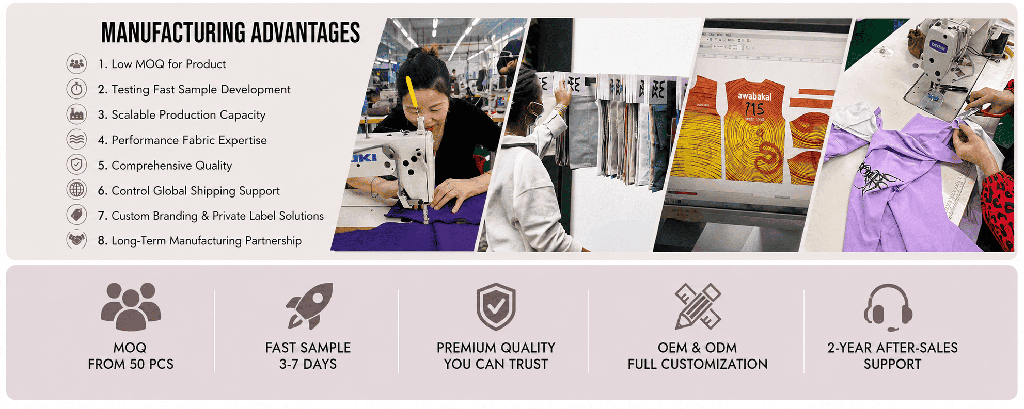
Searching for an outdoor apparel supplier can become more difficult when you start to compare ten manufacturers with similar claims. Most manufacturers can say they provide OEM, ODM, custom products, competitive prices, samples and production capacity. But the more important thing is to understand which claims are really important for your product, and which manufacturer can better match the current business stage and purchasing needs of your brand.
A startup testing its first lightweight outdoor collection does not carry the same sourcing priorities as an established brand ordering technical outerwear in larger volumes. One may care more about manageable MOQ and development flexibility. The other may place greater weight on relevant production evidence, technical specialization, compliance, capacity and supply stability.
The best Top 10 Columbia Sportswear Factory Store Manufacturer choices should be compared by product specialization, relevant factory evidence, technical capability, commercial fit, MOQ structure, quality evidence and suitability for the buyer’s actual order. Chinese manufacturers can be strong options for outdoor apparel brands because of their broad material and manufacturing supply chains, but the best supplier is the one whose strengths match the product and sourcing risks—not simply the factory offering the lowest price.
This difference matters when manufacturers look equally capable on a website. A supplier can have excellent machinery but limited experience with your particular product. Another can advertise a low MOQ that applies only to available fabrics and standard colors. A technically sophisticated factory may be suitable for waterproof outerwear but commercially unnecessary for a straightforward windbreaker.
Outdoor apparel sourcing therefore works better when manufacturer capability and manufacturer suitability are evaluated separately. The objective is not to find the factory with the longest list of advantages. It is to identify which advantages actually reduce risk for your order.
What Does “Columbia Sportswear Factory Store Manufacturer” Mean When Buyers Are Actually Looking for a Supplier?
A Columbia Sportswear Factory Store and an apparel manufacturer serve different purposes. For B2B sourcing, buyers searching for a Columbia Sportswear Factory Store Manufacturer should compare factories capable of producing relevant outdoor apparel categories rather than assuming that a manufacturer is officially connected with Columbia Sportswear. Product specialization, commercial fit and verifiable manufacturing capability are more useful sourcing criteria than implied brand affiliation.
The distinction is important because the search phrase can combine several different intentions. Some users may be looking for a retail store or branded products, while sourcing managers may actually be trying to identify manufacturers capable of supporting their own outdoor apparel programs.
For a buyer, the useful question is therefore not simply:
“Who can make outdoor clothing?”
A better question is:
“Which manufacturer is commercially and technically suitable for the outdoor product my brand actually plans to order?”
That small change produces a much stronger supplier shortlist.
Is a Columbia Sportswear Factory Store the Same as an Apparel Manufacturer?
No. A factory store is primarily a retail channel for finished branded products. A manufacturer is part of the production supply chain and works with product specifications, materials, quantities, quality requirements and commercial terms.
That means B2B buyers need a completely different comparison framework.
Instead of focusing on retail price, product availability or store location, a sourcing team evaluating a Columbia Sportswear Factory Store Manufacturer search should investigate factors such as:
- Relevant product specialization
- OEM, ODM or private label business model
- Factory location and production structure
- MOQ and the conditions behind it
- Product and technical manufacturing capability
- Certifications and compliance evidence
- Available capacity rather than headline capacity alone
- Sample and development terms
- Lead time
- Price transparency
- Quality-control evidence
- Suitability for trial, seasonal or repeat orders
Supplier verification should also extend beyond production capability to responsible sourcing risks, and buyers managing international garment supply chains can use the OECD Due Diligence Guidance for Responsible Supply Chains in the Garment and Footwear Sector as an independent framework for evaluating due diligence across business relationships and supply chains.
These factors tell a buyer much more than a supplier’s marketing language.
The distinction also prevents another sourcing problem: assuming that a manufacturer producing outdoor apparel must have a commercial relationship with a recognizable outdoor brand.
Unless such a relationship is supported by reliable evidence, manufacturing capability and brand affiliation should be evaluated separately.
Why Does This Search Mix Retail, Brand and Manufacturing Intent?
The phrase combines a recognizable outdoor brand, a retail concept and a manufacturing term. Search results can therefore satisfy very different users.
For B2B buyers, this ambiguity becomes useful only after the search is translated into an actual procurement requirement.
Imagine two brands searching for manufacturers.
Brand A needs a relatively straightforward lightweight outdoor jacket for a new collection. Its major concerns may be manageable order commitment, appropriate production experience, cost and the ability to support several related products.
Brand B needs a more technically demanding waterproof outerwear program. It may place much greater weight on specialist equipment, construction experience, relevant technical evidence and testing capability.
Both can search for a Columbia Sportswear Factory Store Manufacturer, but they should not automatically shortlist the same factories.
The product changes the supplier criteria.
So does the buyer’s commercial stage.
A manufacturer can be highly capable and still be the wrong choice because its MOQ, order structure, development model or specialization does not fit the project.
What Type of Manufacturer Are Outdoor Apparel Buyers Usually Trying to Find?
Outdoor apparel sourcing normally leads buyers toward several different manufacturing models rather than one universal type of factory.
Technical outerwear specialists can be relevant when products involve waterproof constructions, laminated materials, seam sealing or other specialized operations.
General outdoor apparel manufacturers may be more suitable for brands developing windbreakers, outdoor pants, fleece, casual outdoor clothing or wider seasonal ranges.
Performance sportswear manufacturers with outdoor capability can fit brands whose collections combine stretch jackets, active layers, performance bottoms and outdoor-inspired sportswear.
OEM manufacturers generally make more sense when a brand already has defined specifications, while buyers that need broader product-development support can compare an OEM sportswear service covering design development, fabric sourcing, sampling, customization and production before deciding whether the supplier model fits the project.
The important distinction is that specialization creates both advantages and trade-offs.
A highly specialized factory may offer deeper expertise for one product category but less flexibility across a broad collection. A multi-category manufacturer can simplify supplier management but needs closer verification when one SKU involves unusually technical construction.
For buyers comparing Columbia Sportswear Factory Store Manufacturer options, the best starting point is therefore not the size of the factory.
It is the product portfolio the factory needs to support.
Which Manufacturing Capabilities Should Buyers Actually Compare?
Manufacturer websites often make capability lists look simple. In practice, the same claim can mean very different things from one supplier to another.
“Custom outdoor apparel,” for example, could mean anything from changing a logo and color on an existing style to producing from a buyer’s complete technical specification.
“Low MOQ” is equally ambiguous. It might refer to one style using available material, while custom colors, specialized trims or different order structures carry separate minimums.
A useful first-stage comparison therefore looks like this:
| Comparison Area | What Buyers Should Actually Compare |
|---|---|
| Product Specialization | Does the factory regularly make your product category? |
| Relevant Evidence | Can the claimed specialization be supported by products, equipment, records or other relevant evidence? |
| Technical Capability | Does the factory have the processes required by your product rather than simply general sewing capability? |
| Custom Level | Is the supplier suitable for OEM, ODM, private label or the level of development you require? |
| MOQ Structure | Is MOQ calculated per style, color, fabric or total order? |
| Commercial Fit | Do order size, payment terms, development charges and production model fit your business? |
| Compliance | Are certifications and reports current, relevant and verifiable? |
| Capacity | How much relevant capacity is actually available during your required production period? |
| Lead Time | Does the stated timeline apply to your real product and materials? |
| Quality Evidence | Can the supplier demonstrate how production quality is controlled rather than simply saying it has QC? |
The distinction between capability and commercial fit deserves particular attention.
Suppose Factory A offers more technical equipment, Factory B accepts a more manageable first order and Factory C has greater monthly capacity.
Which one is best?
There is no useful answer until the product, quantity and risk priorities are known.
For a technically demanding product, Factory A’s specialization may justify higher commercial requirements. For a market-test collection, Factory B may represent lower total risk. For an established replenishment program, Factory C’s available capacity may become more important.
Best should therefore mean best matched, not best advertised.
Who Benefits Most From This Manufacturer Comparison?
Outdoor apparel brands, sourcing teams, private label retailers, importers, distributors and growing performance-apparel companies can use this comparison when the supplier market looks crowded but the differences between factories remain unclear.
It is particularly useful when:
- Several manufacturers appear equally capable online.
- You need to reduce a longlist before paying for samples.
- You are deciding between a specialist and a multi-category factory.
- You want to compare Chinese manufacturers with alternative sourcing countries.
- Different factories are quoting different MOQ structures.
- One quotation looks significantly cheaper but the specifications or commercial terms are not identical.
- Your brand is moving from small test orders toward larger purchasing commitments.
- Supplier claims need to be verified before they influence the final decision.
At this stage, detailed product execution should remain separate from supplier comparison. Once a manufacturer has moved into serious consideration, buyers can examine custom outdoor apparel development with a Columbia Sportswear Factory Store Manufacturer, including functional materials, sampling, customization and scalable production, in greater depth.
For the initial shortlist, however, the job is simpler:
Identify what each manufacturer is genuinely good at, understand the commercial conditions behind the offer, verify the claims that matter, and decide whether those strengths match your order.
The Top 10 Columbia Sportswear Factory Store Manufacturer choices can then be compared as different sourcing options rather than ten interchangeable factories.
Who Are the Top 10 Columbia Sportswear Factory Store Manufacturer Choices in China?
The strongest Columbia Sportswear Factory Store Manufacturer choice depends on what an outdoor brand actually needs to source. Some Chinese manufacturers are more specialized in waterproof shells and ski apparel, while others are better positioned for flexible outdoor sportswear, broader collections or lower-volume market testing. Buyers should compare specialization, MOQ structure, technical evidence, commercial fit and order scale instead of treating all 10 manufacturers as interchangeable suppliers.
The manufacturers below represent different positions within China’s outdoor and performance-apparel supply chain. The order should not be interpreted as a universal quality ranking. A supplier that is highly suitable for a technical shell program may be commercially excessive for a simple windbreaker, while a flexible sportswear manufacturer may fit a growing brand better but require additional verification for highly specialized waterproof construction.
For buyers using Columbia Sportswear Factory Store Manufacturer as a sourcing search, the more useful question is therefore “best for what?” rather than simply “who is number one?”
Top 10 Manufacturer Comparison at a Glance
| Manufacturer | Location | Main Product Focus | Public MOQ Position | Best Fit |
|---|---|---|---|---|
| Pair Fashion | Dongguan, Guangdong | Outdoor sportswear, jackets, performance apparel | From around 100 pcs for regular programs | Growing brands needing flexibility |
| Auming Outdoor | Dongguan, Guangdong | Technical shells, ski jackets, softshells | Confirm by project | Technical outerwear brands |
| Ruiniu | Foshan, Guangdong | Outdoor jackets, ski wear, softshells, insulated outerwear | From 100 pcs/style/color on published core products | Jacket-focused outdoor brands |
| KAIDA Outdoor | Yongzhou, Hunan | Waterproof jackets, functional woven outerwear | Project-dependent | Waterproof outerwear programs |
| PTOUTWEAR | Taizhou, Zhejiang | Hardshells, softshells, ski and rain jackets | Published from 30 pcs/style/color | Small technical-jacket programs |
| JIMTEX | Shaoxing, Zhejiang | Waterproof, insulated, softshell, fleece and outdoor pants | Confirm by RFQ | Multi-category outdoor programs |
| Outdoor Sky | Xiamen, Fujian / international operations | Waterproof-breathable technical outerwear | Project-dependent | Technical shell and specialized outerwear buyers |
| Onroad Sportswear | Dongguan & Jiangxi | Ski wear, fishing apparel, softshell jackets | Confirm by RFQ | Winter and specialist outdoor categories |
| MontForge | Dongguan, Guangdong | Sportswear and urban outdoor apparel | Confirm by product | Active/outdoor crossover brands |
| Yuelei Outdoor | Xiamen, Fujian | Ski jackets, wetsuits and outdoor apparel | Confirm by RFQ | Smaller brands seeking broader outdoor categories |
A comparison table is only a starting point. Published MOQ is not automatically the MOQ a buyer will receive for a specific order, and a manufacturer’s total capacity is not the same as available capacity for a particular product and delivery month. Technical claims, certifications and commercial conditions should be verified against the actual RFQ before the final shortlist is made.
1. Pair Fashion — Best for Flexible Outdoor Sportswear Programs and Growing Brands
Location: Dongguan, Guangdong, China
Founded: 2016
Regular MOQ: Around 100 pieces for regular custom programs; product conditions can affect the final minimum
Sample Reference: Commonly around 3–7 days depending on product complexity
Bulk Lead-Time Reference: Approximately 15–25 working days depending on the approved program
Core Products: Outdoor sportswear, performance jackets, activewear, leggings, sports bras, equestrian apparel, tennis wear and specialized performance clothing
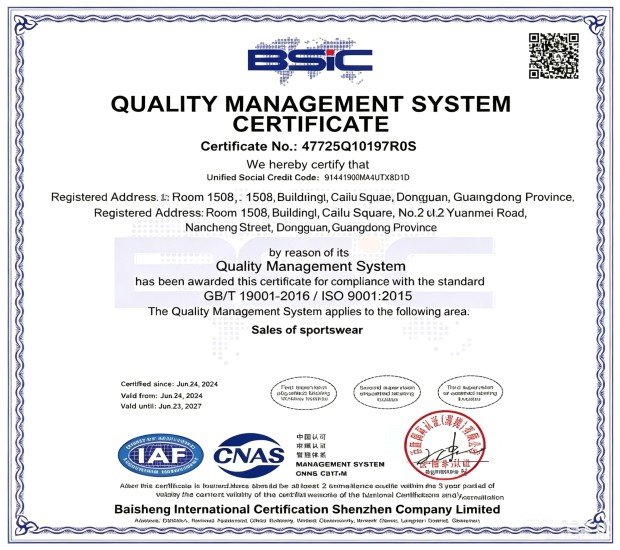
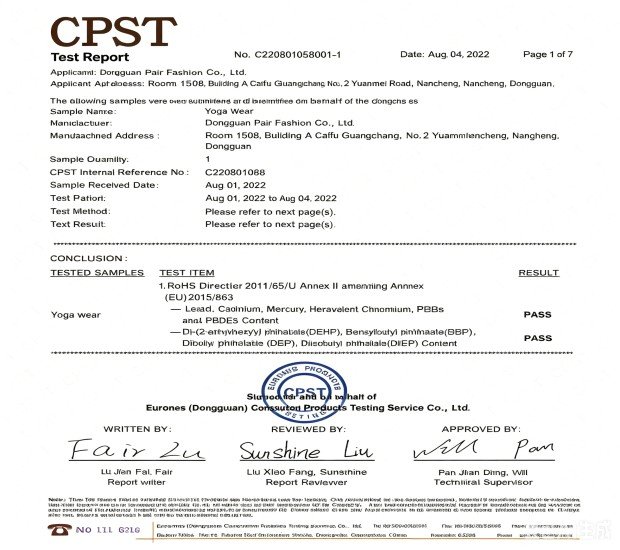
Certifications: ISO 9001, BSCI, GRS, CE and ROHS within the company’s documented certification scope
Best For: Growing brands, product testing, multi-category performance collections and buyers requiring comparatively flexible development
Less Suitable For: Buyers whose only priority is very large-volume commodity outerwear or highly specialized extreme-weather shell production requiring a dedicated technical-shell factory
Pair Fashion takes a broader performance-apparel position than a factory focused exclusively on one type of outdoor jacket. That difference can be useful for brands that need an activewear manufacturer for growing sportswear brands across stretch performance apparel, lightweight jackets, active layers and related performance categories.
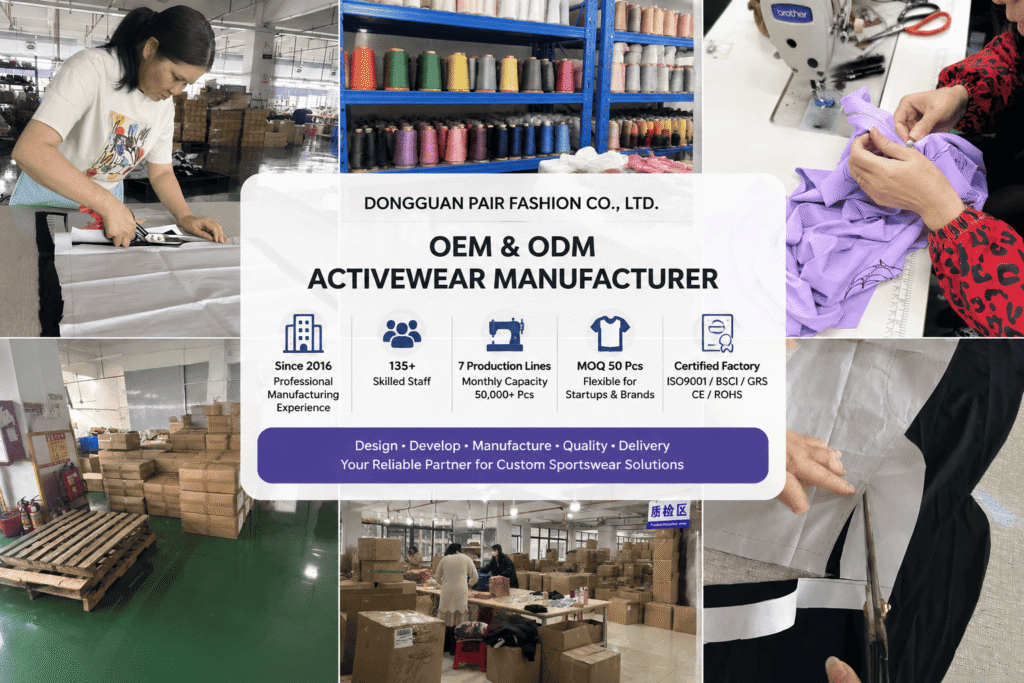
Its production structure includes approximately 135 employees, seven production lines, an 11-person pattern and sample team and a 13-person QC team, with documented stable monthly capacity around 50,000 pieces. For buyers comparing a Columbia Sportswear Factory Store Manufacturer, the practical advantage is not simply factory size. It is the ability to work across several related performance categories without requiring the brand to source every SKU from a different specialist.
Core strengths
- Comparatively flexible order structure for growing brands
- Stronger fit for performance-apparel and outdoor-sportswear crossover collections
- OEM, ODM and private label support
- In-house pattern and sample development resources
- Useful for brands expanding across multiple performance categories
- Dongguan location provides access to a mature apparel and material supply chain
Potential limitation
Pair Fashion should not automatically be treated as the strongest candidate for every extreme-weather technical shell. If a project depends heavily on specialist membrane construction, very high waterproof specifications or unusually complex seam-sealed systems, buyers should compare its project-specific technical evidence directly against factories dedicated almost entirely to technical outerwear.
For a growing brand, however, that specialization trade-off can work in the opposite direction. Paying for manufacturing capability that the product does not actually require can increase commercial complexity without creating meaningful customer value.
2. Auming Outdoor — Best for Technical Outdoor Jackets and Performance Shell Programs
Location: Humen, Dongguan, Guangdong, China
Founded: 2011
MOQ: Project-specific; confirm against the actual product brief
Core Products: Hardshell jackets, ski jackets, softshell jackets, lightweight outdoor jackets and sustainable technical outerwear
Published Technical Direction: Seam-taped waterproof construction, recycled material options and performance outerwear
Certifications Publicly Presented: OEKO-TEX Standard 100, GRS and Sedex SMETA; the company also references ISO 9001/BSCI-related manufacturing standards.
Best For: Brands placing technical outerwear capability above very low MOQ
Less Suitable For: Buyers mainly sourcing simple activewear or broad non-outerwear sportswear categories
Auming Outdoor presents itself as a specialist rather than a general clothing supplier. Its public information states that the company has focused on technical outdoor jackets since 2011 and operates a self-owned facility in Dongguan. It highlights hardshells, ski outerwear, softshells and lightweight jackets, including seam-taped construction and performance-oriented material options.
That specialization is relevant when the product itself justifies it.
A brand sourcing a technical shell should care more about relevant construction experience than the number of unrelated garment categories a factory can produce. Conversely, a buyer developing a broad activewear collection may find a jacket specialist unnecessarily narrow.
Core strengths
- Clear technical-outerwear specialization
- Publicly documented focus on hardshell, ski and softshell categories
- Seam-taping capability
- Sustainability-related material and certification positioning
- Suitable for brands where jacket performance is central to the collection
Potential limitation
The public positioning is strongly concentrated on jackets. Buyers needing leggings, performance tops or a broad sportswear collection should evaluate whether splitting production between specialized suppliers is commercially worthwhile.
This makes Auming a useful Columbia Sportswear Factory Store Manufacturer comparison candidate when technical outerwear carries significant weight in the sourcing decision, but not automatically when collection breadth matters more.
3. Ruiniu — Best for Established Outdoor Jacket Programs With a 100-Piece Published Starting MOQ
Location: Foshan, Guangdong, China
Founded/Experience: Publicly states outdoor apparel manufacturing since 2002 and 24+ years of experience
Published MOQ: From 100 pieces per style/color across multiple core jacket categories
Published Sample Time: Around 7–10 working days on selected products
Core Products: Waterproof jackets, softshells, ski wear, down jackets, puffers, fleece and windbreakers
Published Capacity: Approximately 600,000 pieces annually
Best For: Brands focused primarily on jackets and technical outerwear
Less Suitable For: Buyers seeking an ultra-low garment MOQ below its published core-product minimum or a collection dominated by non-outerwear sportswear
Ruiniu has one of the clearer publicly stated commercial profiles among the manufacturers in this comparison. It publishes a 100-piece per style/color starting MOQ for several categories and identifies Foshan as its manufacturing base. It also publicly reports approximately 600,000 garments of annual output and 7–10 day sample timing.
Its category range is still concentrated enough to maintain an outdoor-jacket identity: waterproof shells, softshells, ski wear, insulated products, fleece and packable windbreakers. The company also highlights seam sealing and waterproof construction.
Core strengths
- Long publicly stated outdoor-apparel history
- Clear 100-piece starting MOQ on major product pages
- Strong jacket-category concentration
- Waterproof and seam-sealed construction positioning
- Suitable mix of technical and commercial information available before RFQ
Potential limitation
A published MOQ can look attractive, but buyers still need to determine what happens when custom materials, colors or components introduce supplier minimums. A 100-piece garment MOQ does not necessarily mean every custom fabric or trim can also be purchased economically at 100 pieces.
That distinction should be checked with any Columbia Sportswear Factory Store Manufacturer candidate before price or flexibility is scored.
4. KAIDA Outdoor — Best for Buyers Who Want Visible Waterproof-Jacket Factory Evidence
Location: Yongzhou, Hunan, China
MOQ: No universal fixed MOQ publicly stated; reviewed by product and project
Core Products: Waterproof jackets and functional woven outerwear
Factory Area: Publicly states 20,000+ m²
Employees: 300+
Production Lines: 7
Published Capacity: 30,000+ jackets per month
Seam-Sealing Equipment: 40–50 machines
QC Team: 15 people
Best For: Buyers prioritizing waterproof-jacket specialization and visible production evidence
Less Suitable For: Buyers wanting a fixed universal MOQ before submitting product specifications
KAIDA’s most distinctive public positioning is not a low price or a very broad catalog. It emphasizes visible manufacturing evidence.
Its factory pages publish a 20,000+ m² facility, 300+ employees, seven production lines, 30,000+ jackets per month, 40–50 seam-sealing machines and a 15-person quality team. Its core focus is waterproof jackets and functional woven garments.
This matters because factory comparison often fails when buyers score claims rather than evidence.
Core strengths
- Strong waterproof outerwear focus
- Large visible seam-sealing setup
- Factory data and production stages publicly documented
- Suitable for buyers who want evidence before supplier qualification
- Concentrated functional-woven manufacturing model
Potential limitation
KAIDA explicitly does not publish one universal MOQ or lead time because it evaluates quantity and timing against product, materials and production requirements.
For an experienced sourcing team, that can actually be a reasonable commercial position. For a buyer trying to shortlist suppliers based on a fixed headline MOQ before sharing specifications, however, it creates less immediate price-and-quantity visibility.
5. PTOUTWEAR — Best for Small Technical Jacket Programs Requiring a Very Low Published MOQ
Location: Sanmen, Taizhou, Zhejiang, China
Founded: 2013
Published MOQ: From 30 pieces per style/color
Sample: One-piece sample publicly offered
Published Bulk Lead Time: Around four weeks after deposit
Workers: 240
Factory Area: Approximately 3,000 m²
Published Annual Capacity: 200,000+ pieces
Core Products: Hardshell, softshell, 3-in-1, ski, rain, windbreaker and insulated jackets
Best For: Smaller programs, teams and buyers testing technical jacket categories
Less Suitable For: Buyers who equate low MOQ with automatically lower unit cost or who require much larger proven scale
PTOUTWEAR stands out because its public commercial offer is unusually specific: 30 pieces per style/color, a one-piece sample and an approximately four-week bulk lead time after deposit. It also states 240 workers, a 3,000 m² facility and more than 200,000 pieces of annual capacity.
For a smaller buyer, the low entry quantity is clearly attractive.
But MOQ should never be scored in isolation.
A low minimum can reduce inventory exposure, yet the buyer should still compare unit price, material availability, customization restrictions and whether the same conditions remain practical when the collection scales.
Core strengths
- Very low publicly stated MOQ
- Clear sample offer
- Technical-jacket focus
- Published factory and capacity data
- Potentially attractive for test programs
Potential limitation
The strongest commercial advantage—low MOQ—is not automatically the strongest long-term sourcing advantage. Brands expecting rapid scale should separately evaluate capacity allocation, repeat-order economics and whether the initial low-volume structure remains competitive at higher quantities.
6. JIMTEX — Best for Multi-Category Functional Outdoor Apparel Programs
Location: Shaoxing, Zhejiang, China
MOQ: Confirm by RFQ
Core Products: Waterproof jackets, insulated jackets, softshell jackets, fleece, mid-layers and outdoor pants
Business Model: OEM and ODM
Best For: Buyers wanting several outdoor apparel categories under one supplier program
Less Suitable For: Buyers who need a published fixed MOQ before project review
JIMTEX positions its manufacturing scope more broadly than a jacket-only specialist. Its public product programs include waterproof outerwear, insulated jackets, softshells, fleece and outdoor pants, which can make it relevant to brands building a coordinated outdoor range rather than sourcing one jacket type.
The commercial benefit of a multi-category manufacturer is straightforward: fewer suppliers can mean easier coordination.
The trade-off is equally important: category breadth should never be assumed to equal equal depth in every category.
Core strengths
- Broad functional outdoor product coverage
- OEM and ODM positioning
- Useful for coordinated outerwear and lower-body programs
- Shaoxing location provides proximity to a major textile supply base
Potential limitation
Buyers should verify technical evidence at the SKU level. If one collection contains a simple fleece, an insulated jacket and a highly technical waterproof shell, the same factory may not necessarily be equally strong in all three products.
7. Outdoor Sky — Best for Waterproof-Breathable Technical Outerwear Programs
China Office: Xiamen, Fujian
MOQ: Project-dependent
Core Products: Waterproof-breathable jackets, pants, ski shells, climbing shells, rainwear, marine apparel and technical workwear
Business Model: OEM/ODM technical outerwear
Best For: Buyers with detailed technical requirements and testing expectations
Less Suitable For: Simple fashion-led outdoor garments where advanced technical construction adds little value
Outdoor Sky presents a particularly technical sourcing model. Its public materials focus on waterproof-breathable outerwear, shell jackets, waterproof pants, ski and climbing applications, seam tape, waterproof zippers and project-specific testing requirements.
Rather than publishing one universal MOQ, its RFQ structure asks buyers to specify product category, target market, size range, order quantity, sample timeline, delivery window and testing needs.
That approach is more suitable for an experienced technical buyer than someone simply asking, “How much is one jacket?”
Core strengths
- Clear technical-shell positioning
- Waterproof-breathable apparel specialization
- Covers jackets and technical lower-body products
- Project intake incorporates testing requirements
- Relevant for demanding outdoor applications
Potential limitation
Technical capability can become unnecessary cost and sourcing complexity when the product itself is simple. A lifestyle windbreaker does not automatically benefit from being sourced through the most technical factory available.
The right Columbia Sportswear Factory Store Manufacturer choice should match the engineering level to the actual end use.
8. Onroad Sportswear — Best for Ski Wear and Winter Outdoor Categories
Manufacturing Locations: Dongguan and Jiangxi, China
Experience: More than 10 years publicly stated in ski-wear manufacturing
Factories: Two self-owned factories
Published Production Area: 5,000+ m² combined
Employees: Approximately 100 skilled workers
Core Products: Ski wear, fishing apparel and softshell jackets
MOQ: Confirm by RFQ
Best For: Winter-sports and specialist outdoor brands
Less Suitable For: Buyers whose range is primarily yoga, gym or lightweight general activewear
Onroad’s clearest differentiation is its ski-wear background. The company publicly states more than a decade in ski-wear manufacturing and a dual-factory setup in Dongguan and Jiangxi covering more than 5,000 m².
That makes it a logical candidate when cold-weather or ski products carry more weight than general sportswear.
Core strengths
- Ski-wear specialization
- Two-factory manufacturing structure
- Relevant winter-apparel experience
- Softshell and fishing categories broaden the outdoor scope
Potential limitation
The publicly visible commercial information is less specific than suppliers that publish fixed MOQ and sample figures. Buyers should obtain project-level data before giving Onroad a commercial score.
9. MontForge — Best for Sportswear and Urban-Outdoor Crossover Collections
Location: Humen, Dongguan, Guangdong, China
Industry Experience: Publicly states 15+ years of manufacturing experience
Employees: Approximately 150
Production Workshops: 2
Production Lines: 10
Published Monthly Capacity: Up to 100,000 pieces overall; around 50,000 pieces for core jackets and sports sets
Core Products: Men’s activewear, sportswear, jackets, sports sets and urban outdoor apparel
MOQ: Confirm by product and project
Best For: Brands combining performance sportswear with urban-outdoor styling
Less Suitable For: Buyers seeking a factory dedicated exclusively to alpine or waterproof technical shells
MontForge sits in a different position from the specialist waterproof manufacturers in this list. It describes itself as a sportswear and urban outdoor apparel manufacturer, with 150 workers, two workshops and ten production lines.
That difference may be valuable for brands whose outdoor collection is commercially closer to active lifestyle apparel than mountaineering equipment.
Core strengths
- Broader sportswear capability
- Urban-outdoor positioning
- Significant published production scale
- Useful for coordinated jackets and performance sportswear
- Dongguan manufacturing location
Potential limitation
Brands requiring highly specialized shell construction should verify the relevant technical equipment and product evidence rather than inferring it from overall sportswear capacity.
A factory producing 100,000 garments per month is not automatically more suitable than a smaller specialist if the specific product requires capabilities outside its strongest category.
10. Yuelei Outdoor — Best for Smaller Brands Exploring Ski, Outdoor and Water-Sports Categories
Location: Xiamen, Fujian, China
Founded: 2021
Factory Area: Approximately 1,600 m²
Employees: 30+
Core Products: Ski jackets, wetsuits, softshell jackets, fleece and technical outdoor apparel
Business Model: OEM and ODM
MOQ: Confirm by RFQ
Best For: Smaller brands looking for a relatively compact manufacturer across several outdoor-sport categories
Less Suitable For: Large buyers whose first priority is extensive production scale and long operating history
Yuelei is substantially younger and smaller than several manufacturers in this comparison. Its public information states a 2021 establishment date, a 1,600 m² facility and more than 30 staff, with ski jackets, wetsuits and outdoor apparel among its main categories.
That should not automatically be treated as a weakness.
A smaller factory can sometimes offer more attention or flexibility to smaller buyers. But it also means the buyer should put greater weight on capacity evidence, production planning and relevant order history before assigning large-volume programs.
Core strengths
- Ski and water-sports category combination
- OEM/ODM customization
- Compact manufacturing structure that may appeal to smaller programs
- Broader outdoor-sport range than a single-category jacket factory
Potential limitation
The company has a shorter publicly stated manufacturing history and smaller facility than several established suppliers on this list. Larger brands should therefore verify capacity, delivery resilience and scaling capability against the actual order.
Which Columbia Sportswear Factory Store Manufacturer Belongs on Your Shortlist?
There is no responsible way to turn these 10 manufacturers into a universal first-to-tenth quality ranking.
Their strongest use cases are different.
For technical waterproof outerwear, factories with visible seam-sealing and shell-specific evidence deserve greater weight.
For small market tests, a lower commercial entry point may matter more.
For multi-category outdoor collections, broader product capability can reduce supplier fragmentation.
For outdoor-activewear crossover brands, a performance sportswear manufacturer may be commercially more appropriate than a highly specialized alpine-shell factory.
For large or repeat programs, available capacity, production evidence and commercial stability become more important than the lowest advertised MOQ.
A practical first shortlist can therefore be built around the actual sourcing problem:
| Buyer Situation | Priority When Shortlisting |
|---|---|
| New outdoor brand testing demand | MOQ structure + commercial flexibility |
| Technical shell brand | Relevant technical evidence + specialization |
| Ski brand | Winter-apparel experience + technical construction |
| Multi-category outdoor brand | Category breadth + supplier coordination |
| Active/outdoor lifestyle brand | Performance sportswear + outerwear capability |
| Established volume buyer | Capacity + evidence + supply stability |
| Price-sensitive buyer | Comparable specification + total commercial commitment |
The strongest Columbia Sportswear Factory Store Manufacturer is ultimately the supplier whose capabilities solve the buyer’s most important risks without adding unnecessary cost or complexity.
A factory should therefore move forward because its product specialization, evidence and commercial conditions match the order—not because it has the longest company history, the largest building, the smallest MOQ or the most impressive marketing language.

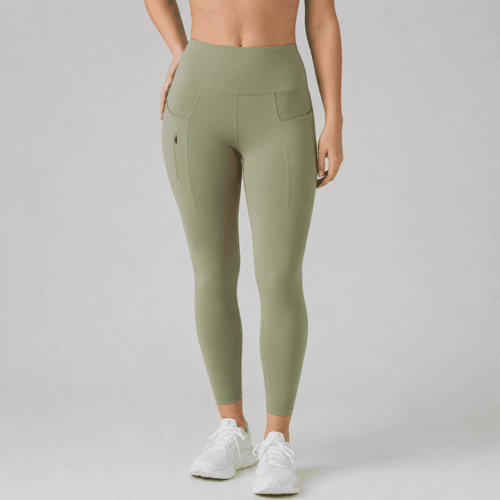
Custom High Waist Pocket Yoga Leggings OEM ODM Workout Pants
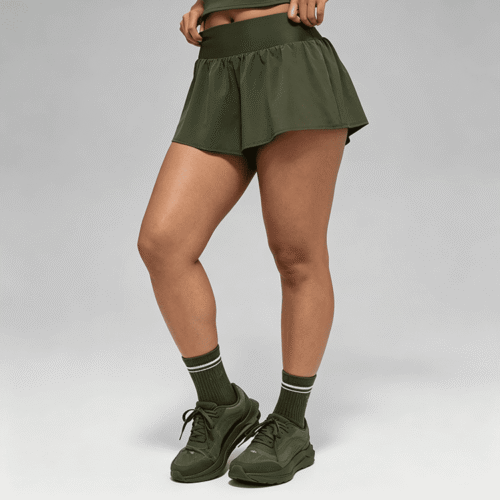
Custom High Waist Tennis Skort with Built-In Shorts OEM ODM
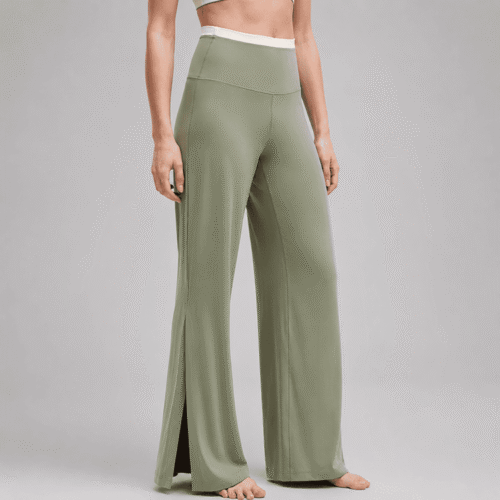
Custom High Waist Wide Leg Yoga Pants OEM ODM Athleisure Trousers
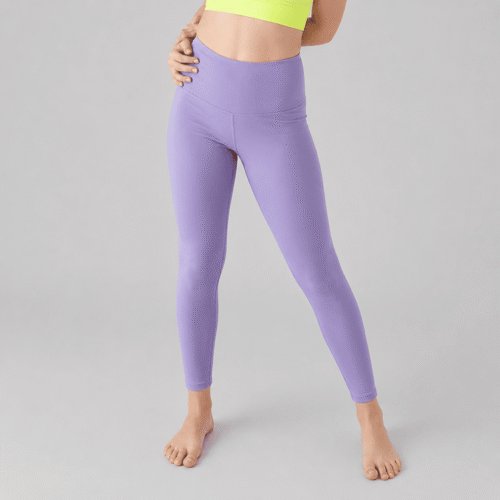
Custom High Waist Yoga Leggings OEM ODM Four-Way Stretch Workout Tights
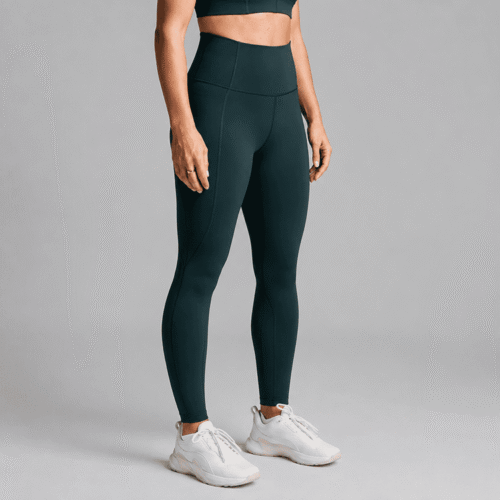
Custom High Waist Yoga Leggings OEM ODM Performance Workout Pants
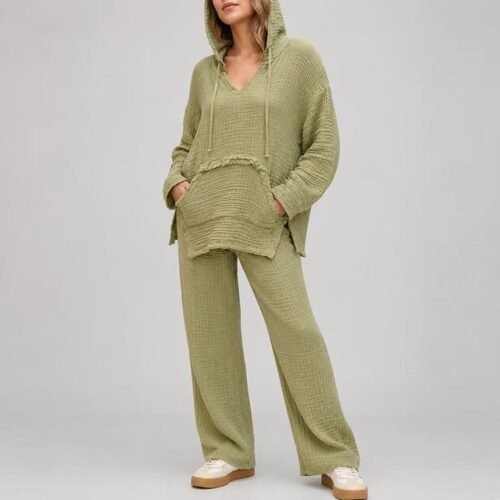
Custom Hooded Modest Activewear Set OEM ODM Muslim Loungewear
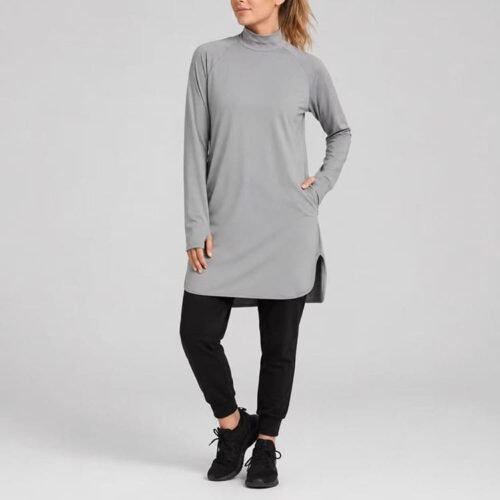
Custom Long Sleeve Modest Sports Tunic OEM ODM Muslim Activewear
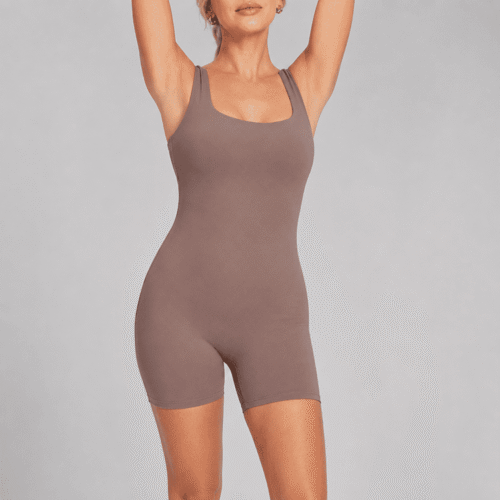
Custom Maternity Activewear Romper OEM ODM Pregnancy Workout Jumpsuit
Why Do Outdoor Apparel Brands Choose Chinese Manufacturers?
Outdoor apparel brands often choose Chinese manufacturers because China combines deep fabric and trim sourcing, experienced performance-apparel production, broad customization capability and strong support for complex or multi-category programs. For buyers comparing a Columbia Sportswear Factory Store Manufacturer, China is especially competitive when the project requires technical materials, multiple components, flexible product development or smaller test orders. However, China is not automatically the best sourcing country for every product, market or order size.
Country selection should come before factory selection.
A buyer can spend weeks comparing individual manufacturers and still make the wrong decision if the underlying sourcing country does not fit the product, target market or commercial model. China, Vietnam and the United States can all be strong sourcing options, but they solve different problems.
Recent apparel sourcing comparisons continue to describe China as particularly strong in supply-chain depth, technical products, development speed and complex manufacturing, while Vietnam is often stronger in large cut-and-sew programs and certain technical outerwear categories at scale.
For a brand evaluating a Columbia Sportswear Factory Store Manufacturer, the useful question is not simply:
“Which country is cheapest?”
It is:
“Which sourcing country gives this product the best balance of technical capability, material access, commercial flexibility, speed, landed cost and supply-chain risk?”
Why Is China Strong for Functional Outdoor Apparel Supply Chains?
China’s biggest advantage is not simply sewing capacity. It is the density of the surrounding supply chain.
An outdoor jacket may require far more than shell fabric and sewing thread. Depending on the product, it can involve:
- Technical woven shell fabrics
- Stretch nylon or polyester
- Laminated membranes
- Insulation
- Mesh or tricot backing
- Waterproof or reverse-coil zippers
- Elastic binding
- Cord locks and adjusters
- Reflective trims
- Seam tape
- Printed or heat-transfer branding
- Custom labels and packaging
When these materials come from many different suppliers, proximity matters.
China’s major apparel regions—including Guangdong, Zhejiang, Fujian and surrounding textile clusters—benefit from dense networks of fabric mills, trim suppliers, finishing facilities, printing specialists and accessory vendors. Current sourcing analyses still identify this integrated ecosystem as one of China’s strongest structural advantages, especially for complex performance garments.
For a simple garment, supply-chain density may not change the sourcing decision very much.
For a jacket with ten or fifteen separate technical components, it can.
A zipper revision, fabric substitution or color-matching issue may be easier to solve when relevant suppliers are geographically close. That can reduce development friction, particularly when several materials need to work together rather than simply look correct individually.
This is one reason a Columbia Sportswear Factory Store Manufacturer search often leads buyers toward Chinese factories when the collection involves multiple performance categories rather than only basic apparel.
But the benefit should not be exaggerated.
A dense supply chain only helps when the manufacturer knows how to use it. A factory surrounded by excellent material suppliers can still make poor sourcing decisions, choose unsuitable components or fail to control specification changes.
Supply-chain access is an advantage. Supply-chain management is the capability buyers still need to verify.
Which Type of Outdoor Products Benefit Most From Chinese Manufacturing?
China tends to become more attractive as the product involves more components, more technical decisions or more customization variables.
Typical examples include:
Technical or semi-technical outerwear
Products involving coated fabrics, stretch structures, specialized zippers, layered construction or other technical components can benefit from China’s broad supplier ecosystem.
Performance outdoor sportswear
Stretch jackets, outdoor training bottoms, lightweight performance layers and active/outdoor crossover products often fit Chinese performance-apparel manufacturing clusters well.
Multi-category collections
A brand developing jackets, pants, tops and related performance products can first review a broader range of custom sportswear product categories to determine whether one manufacturer can support the collection efficiently or whether specialist suppliers are needed for individual technical products.
Custom-material programs
Products requiring specific colors, weights, finishes, trims or branding processes can benefit when multiple material options are available locally.
Early-stage collections requiring several revisions
Where the product specification is still evolving, access to materials and specialist processes can make the development cycle more flexible.
This does not mean every Chinese factory is equally capable of producing these products.
A general sportswear factory cannot automatically replace a technical outerwear specialist just because both are located in China.
Similarly, a technical shell factory may be unnecessary for a brand producing a lightweight lifestyle windbreaker.
The right Columbia Sportswear Factory Store Manufacturer should therefore be selected only after the buyer has defined the level of technical complexity actually required.
China vs USA Outdoor Apparel Manufacturer: Which Is Better for Cost, Flexibility and Development?
Neither country is universally better.
The correct choice depends on what the buyer is trying to optimize.
| Comparison Factor | China | USA |
|---|---|---|
| Supplier ecosystem | Very broad and integrated | More limited by category |
| Functional fabric access | Strong, especially across Asian supply chains | Available, but often at higher material or sourcing cost |
| Complex customization | Generally strong | Possible, but supplier selection is narrower |
| Low-to-mid volume programs | Often commercially workable | Can work well, but labor costs are usually higher |
| Domestic-market proximity | Longer freight route to U.S. customers | Major advantage for U.S. brands |
| Communication/time zone | Requires overseas coordination | Easier for U.S.-based buyers |
| Labor cost | Generally lower | Generally higher |
| Replenishment speed | Strong production speed but international shipping remains | Can be excellent when inputs are locally available |
| Made in USA positioning | No | Strong marketing value for some brands |
| Supply-chain breadth | Major advantage | More fragmented for some technical categories |
For a U.S.-based brand, domestic production may be attractive when speed to market, local oversight, smaller replenishment cycles or Made in USA positioning justify the higher manufacturing cost.
China becomes more competitive when the brand needs broader access to technical materials, trims and multi-process manufacturing.
This comparison becomes even more important when unit price is not the only cost.
A domestic factory may quote a higher sewing cost but reduce freight time, international logistics complexity and inventory planning pressure.
A Chinese factory may offer a lower FOB cost and wider sourcing capability but create longer transport lead times and additional import considerations.
So a serious Columbia Sportswear Factory Store Manufacturer comparison should never stop at factory price.
It should consider:
Factory Cost + Material Cost + Development Cost + Freight + Duty + Inventory Exposure + Speed + Supply Risk
That total commercial picture can produce a different result from the lowest unit quote.
China vs Vietnam Manufacturer: Which Is Better for Technical Outdoor Apparel?
This comparison deserves more nuance than the usual claim that China is “better for quality” and Vietnam is “cheaper.”
Both countries are highly credible apparel manufacturing bases.
Vietnam has developed substantial technical outerwear capability over the past two decades. Current sourcing research highlights Vietnamese strength in waterproof membranes, seam-sealed construction, insulation, ski products and performance outerwear, supported partly by long-term investment from major international outdoor brands.
China, meanwhile, retains a structural advantage in supply-chain integration, specialized material availability, development flexibility and complex product engineering.
The practical comparison looks more like this:
| Buyer Priority | China | Vietnam |
|---|---|---|
| Small test order | Often stronger | Often less flexible |
| Complex product development | Strong | Strong, but factory-dependent |
| Large cut-and-sew volume | Strong | Particularly competitive |
| Technical outerwear | Strong | Also very strong |
| Broad material ecosystem | Major advantage | Improving, but some materials remain imported |
| Fast component sourcing | Strong | Can involve longer upstream sourcing |
| Cost at larger volume | Competitive | Often attractive |
| Multi-SKU development | Strong | Depends more heavily on factory scale |
| Trade agreement advantages | Market-dependent | Strong for several export markets |
| Supply-chain diversification | Less useful if already China-heavy | Strong diversification option |
Vietnam should not be treated as a secondary alternative.
For some technical outerwear programs—especially larger production runs—it can be a very strong first-choice sourcing country.
It also benefits from trade agreements that can improve tariff economics for certain destination markets, including parts of Europe and other CPTPP-linked markets.
China tends to regain the advantage when a brand requires several material variations, unusual trims, rapid specification changes or multiple product categories within one development cycle.
That difference can be summarized simply:
Vietnam can be very strong at executing a defined production program. China is often particularly strong when the supply chain itself needs to participate heavily in solving the product.
That is not an absolute rule, but it is a useful sourcing starting point.
Does China Always Offer the Lowest Outdoor Apparel Price?
No.
China is no longer the automatic low-cost winner for every garment category.
Labor costs have risen, and other manufacturing countries can be more competitive in labor-intensive, stable-volume programs. Recent sourcing comparisons regularly note that Vietnam can offer strong cost efficiency for mid-to-large apparel runs, while China’s value is increasingly tied to supply-chain depth, flexibility and technical complexity rather than simply the lowest labor rate.
That distinction matters for outdoor brands.
Consider two products.
A basic fleece jacket with stable materials and a large annual order may not need China’s deepest component ecosystem.
A more complicated outdoor jacket using several custom trims, technical fabric, unique colors and multiple development changes may benefit from China even if the sewing labor itself is not the cheapest.
The sourcing decision should therefore focus on total product economics, not wage comparisons.
A lower labor rate can disappear quickly if a factory has to import critical materials, extend the development cycle or hold a significantly higher minimum order.
Likewise, a higher FOB price may still be commercially reasonable when it enables a smaller first order and reduces unsold inventory.
This is why buyers evaluating a Columbia Sportswear Factory Store Manufacturer should compare the whole commitment required to launch the product.
When Is China Not the Best Manufacturing Choice?
China should not be chosen simply because it has a strong apparel supply chain.
There are several situations where another location can make more sense.
1. Your product is simple and volume is very large
When construction is standardized and labor represents a large portion of cost, markets with lower labor costs can become more competitive.
2. Your target market receives meaningful tariff advantages from another sourcing country
Trade agreements can materially affect landed cost. Vietnam, for example, benefits from several agreements that can create advantages for certain export markets.
3. Nearshore speed matters more than factory price
If a brand operates on very short replenishment windows, paying more for geographically closer manufacturing may be commercially rational.
4. Country-of-origin marketing is part of the product value
Some brands intentionally choose domestic production because “Made in USA” or another origin claim supports their positioning.
5. Supply-chain diversification is strategically important
A mature brand may deliberately split production across China, Vietnam or other countries to reduce concentration risk.
6. The factory specialization exists elsewhere
A sourcing country should never be chosen before considering where the best category-specific factories actually operate.
This is particularly important in technical outerwear.
Vietnam is not simply a lower-cost substitute for China. It has genuine specialist capability in shells, down products and performance outerwear, and some brands may find a better product fit there.
Choosing China should therefore be the result of a sourcing argument, not a habit.
Why Should Country Choice Come Before Factory Shortlisting?
Because factory comparisons become distorted when suppliers from different countries are judged only by unit price.
Imagine three quotations:
- China Supplier A: medium unit price, lower order flexibility, wide material access
- Vietnam Supplier B: lower unit price at scale, higher opening quantity
- USA Supplier C: highest factory price, shortest domestic replenishment path
Which is best?
Without knowing the buyer’s product and business model, the answer is meaningless.
For a new brand, avoiding excess inventory may matter more than saving $2 per jacket.
For an established retailer, a lower unit price at 20,000 pieces may matter far more.
For a technical brand, material access and construction capability may outweigh both.
For a domestic premium label, local production could support brand positioning strongly enough to justify the price.
A strong Columbia Sportswear Factory Store Manufacturer shortlist therefore follows this order:
1. Define the product
2. Define the target market
3. Define the order scale
4. Identify the sourcing countries that fit
5. Compare relevant factories within those countries
6. Standardize specifications before comparing commercial offers
Starting with a list of factories and asking which one is cheapest reverses the logic.
The sourcing country sets many of the conditions surrounding the factory: labor cost, material ecosystem, freight, trade exposure, minimum order expectations and production specialization.
The factory decision should come after those conditions are understood.
A Practical Country-Sourcing Matrix for Outdoor Apparel Buyers
| Sourcing Situation | China | Vietnam | USA |
|---|---|---|---|
| Early-stage outdoor brand | Strong | Moderate | Moderate |
| Small market-test program | Strong | Moderate | Strong where local small-batch capacity exists |
| Complex technical development | Strong | Strong | Supplier-dependent |
| High-volume stable outerwear | Strong | Strong | Limited by cost |
| Multi-category performance range | Strong | Strong | Supplier-dependent |
| Technical shell program | Strong | Strong | Specialist-dependent |
| Lowest labor-cost priority | Moderate | Strong | Weak |
| Domestic U.S. replenishment | Weak | Weak | Strong |
| Broad trim/material sourcing | Strong | Moderate–Strong | Moderate |
| Supply-chain diversification | Useful as primary base | Strong alternative | Useful for nearshore/domestic strategy |
The purpose of this matrix is not to declare one country the winner.
It is to reduce the number of factories that should be compared in the first place.
For many growing outdoor brands, China remains attractive because it combines product breadth, technical sourcing, customization flexibility and a dense supply chain. For larger and more standardized outerwear programs, Vietnam can be equally compelling or better. For U.S. brands where local speed and origin positioning matter, domestic manufacturing may justify its higher cost.
A Columbia Sportswear Factory Store Manufacturer should therefore be shortlisted only after the brand understands which manufacturing country fits its sourcing priorities.
The strongest sourcing decision is rarely “China is best” or “Vietnam is cheaper.”
It is:
“This country fits this product, at this volume, for this market, at this stage of the brand.”
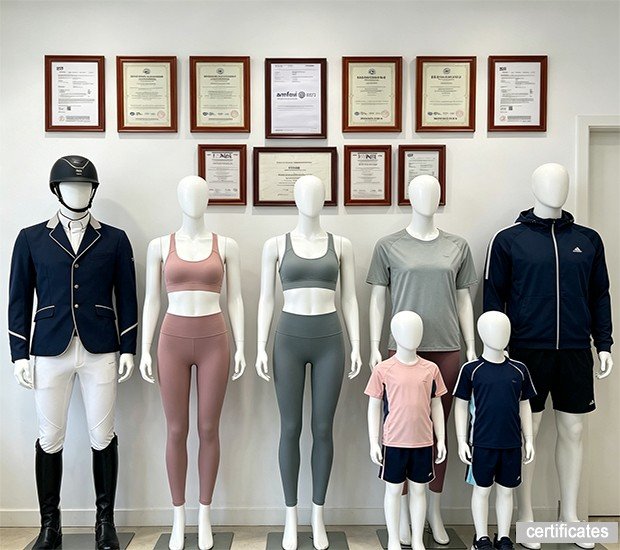
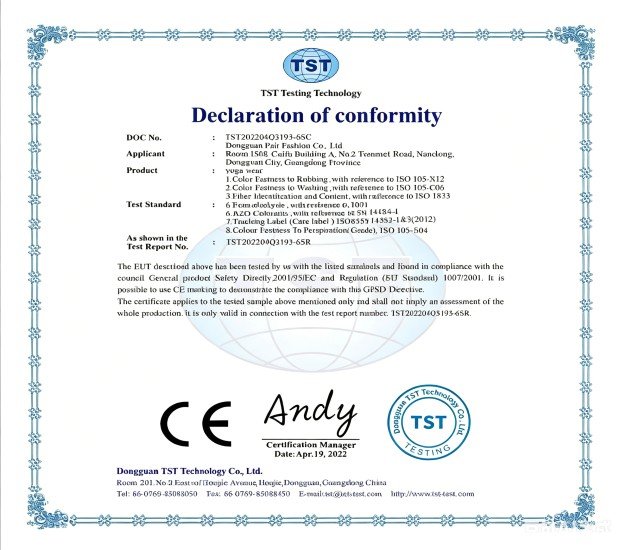
Trusted Manufacturing Standards For Global Sportswear Brands
We operate under internationally recognized quality, sustainability, and ethical manufacturing standards. Our certifications help ensure consistent product quality, responsible sourcing, and reliable production for global sportswear brands.
- 20+ Countries Served
- 6000+ Styles Developed
- 50,000 PCS Monthly Capacity
- 3-Day Sample Development
How Should Buyers Compare Price, MOQ and Commercial Terms Across Manufacturers?
Buyers should compare price and MOQ only after manufacturers are quoting the same product specification, quantity, color breakdown, customization level, packaging and delivery terms. For a Columbia Sportswear Factory Store Manufacturer comparison, the lowest unit price is meaningful only when the commercial conditions are equivalent. A low MOQ can reduce inventory risk, while a lower unit price can reduce purchasing cost, but neither should be evaluated without considering total order commitment.
Price is one of the easiest numbers to compare and one of the easiest numbers to misunderstand.
Two factories may quote the same jacket at very different prices, yet both quotations can be reasonable if they are based on different assumptions.
One supplier may be quoting:
- available fabric;
- standard zipper;
- simple heat-transfer logo;
- one color;
- standard packaging.
Another may be quoting:
- custom-dyed fabric;
- branded zipper;
- multiple colors;
- technical trims;
- custom labels;
- retail-ready packaging.
The unit prices cannot be compared fairly until those conditions are aligned.
For buyers evaluating a Columbia Sportswear Factory Store Manufacturer, the first commercial rule should therefore be:
Standardize the input before comparing the output.
Why Should Buyers Standardize Specifications Before Comparing Factory Prices?
Because the same product name can describe very different cost structures.
“Outdoor jacket” is not a specification.
Neither is “softshell,” “windbreaker” or “waterproof jacket.”
A useful comparison requires the factories to quote against the same commercial and technical baseline.
At minimum, buyers should align:
- Product style
- Target fabric
- Fabric weight
- Color quantity
- Size range
- Total order quantity
- Quantity per color
- Branding method
- Labels
- Packaging
- Trim standard
- Delivery term
- Testing requirement
- Target delivery window
If one supplier quotes 500 pieces in one color, but another supplier quotes the same 500 pieces divided into five colors, the second supplier may have more material loss, more production setup time and higher minimum requirements for some components.
If one factory includes custom packaging in the quotation, while another factory only includes normal polybags, the lower price may simply mean that the product specification and service scope are different.
For buyers comparing a Columbia Sportswear Factory Store Manufacturer, the first step should be to make sure all suppliers are quoting under the same commercial conditions before
What Does a Manufacturer’s MOQ Actually Include?
MOQ is rarely one number.
A factory may say:
“MOQ: 100 pieces.”
But the buyer still needs to ask:
100 pieces of what?
MOQ can be structured by:
- Total order
- Style
- Color
- Fabric
- Logo method
- Custom-dyed material
- Custom trim
- Packaging component
Consider this example:
Supplier A
100 pieces per style using available fabric colors.
Supplier B
100 pieces per style, minimum 50 pieces per color.
Supplier C
300 pieces when custom dyeing is required.
Supplier D
100-piece garment MOQ, but the branded zipper supplier requires 1,000 pieces.
All four factories can truthfully advertise a relatively low MOQ.
But the buyer’s actual commercial commitment is very different.
For this reason, buyers comparing a Columbia Sportswear Factory Store Manufacturer should separate:
Garment MOQ
from
Material MOQ
from
Component MOQ
from
Color MOQ.
The headline number alone does not describe the real order structure.
Low MOQ vs Lower Unit Price: Which Is Better for Your Brand Stage?
Neither is always better.
The correct answer depends on the financial risk of unsold inventory.
For an early-stage outdoor brand, a lower MOQ can be worth paying a higher unit price.
Imagine:
Option A:
100 jackets at $24 each = $2,400
Option B:
500 jackets at $18 each = $9,000
Option B is cheaper per piece.
But if the product has not been tested, the brand is committing an extra $6,600 before knowing whether customers will buy it.
The apparent saving is therefore not really:
$6 per jacket
It is a trade between:
Lower Unit Cost vs Higher Inventory Exposure
For an established product with stable sales, the opposite may be true. A brand already selling hundreds of units per month may benefit much more from the lower unit cost.
This is why the best Columbia Sportswear Factory Store Manufacturer for a startup can be different from the best supplier for an established retailer.
A practical way to think about it is:
| Brand Stage | Priority |
|---|---|
| New product test | Lower inventory commitment |
| Early growth | Balance MOQ and unit economics |
| Stable product | Lower unit price becomes more important |
| High-volume repeat program | Capacity, price and supply stability dominate |
The buyer should optimize for the next business stage, not simply the lowest number on the quotation.
Why Can Two Factories Quote Very Different Prices for the Same Jacket?
Because they may not actually be quoting the same jacket.
Differences can come from:
- Fabric source
- Fabric composition
- Fabric weight
- Coating or membrane
- Trims
- Zipper brand
- Lining
- Stitching complexity
- Seam-sealing requirement
- Printing or embroidery
- Packaging
- Testing
- Order quantity
- Factory overhead
- Quality-control level
One supplier may also be quoting aggressively to win the order while planning to substitute materials later.
Another may build a more conservative quotation around the exact specification.
This is why extreme price gaps deserve investigation.
A quotation that is 5% lower may simply reflect normal commercial competition.
A quotation that is 35% lower should trigger questions.
The buyer should ask:
- Is the fabric identical?
- Is the fabric weight identical?
- Are trims equivalent?
- Are all branding elements included?
- Is packaging included?
- Are testing costs included?
- Are duties or freight included?
- Is the price valid for the actual quantity?
- Are there later setup or customization charges?
A low quotation is useful only when it represents the product the buyer intends to purchase.
How Should Buyers Compare Sample Fees Without Comparing Sample Quality Yet?
Sample charges should be separated into categories before the buyer decides whether one supplier is expensive.
A manufacturer may charge for:
- Pattern development
- Sample sewing
- Custom fabric
- Custom-dyed fabric
- Logo mold or setup
- Special trims
- Courier freight
Another supplier may bundle some of these into one sample fee.
A third may refund part of the charge after a bulk order.
So a $150 sample fee is not automatically more expensive than a $90 sample fee.
The buyer should ask:
What does the fee include?
For a Columbia Sportswear Factory Store Manufacturer comparison, sample pricing is useful mainly as a commercial transparency signal at the shortlist stage.
The sample itself should be evaluated separately later.
At this stage, buyers should compare:
- What is included
- Whether revisions are included
- Whether custom materials are charged separately
- Whether sample fees are refundable
- Whether freight is included
- Whether additional patterns or colorways require new charges
A transparent higher fee can be commercially safer than a low fee followed by multiple unexpected charges.
Which Extra Costs Can Make a Low Factory Price Misleading?
The unit garment price may be only part of the launch cost.
Additional costs can include:
- Pattern or development fees
- Custom fabric minimums
- Lab dips
- Custom dyeing
- Special zipper minimums
- Logo setup fees
- Printing screens
- Embroidery setup
- Label minimums
- Packaging minimums
- Testing
- Inspection
- Freight
- Duty
- Import brokerage
- Warehousing
Suppose Factory A quotes:
$19.00 per jacket
Factory B quotes:
$21.00 per jacket
At first glance, Factory A wins.
But if Factory A also requires:
- $400 custom-color charge
- $250 zipper minimum
- $180 packaging minimum
- $300 testing fee
while Factory B includes most of these items, the ranking can reverse quickly.
This is why experienced buyers look at total launch commitment rather than unit cost alone.
The most useful question is:
How much cash does my brand need to commit before the first sale can happen?
That number is often more important than the quoted price per garment.
FOB vs DDP vs Landed Cost: Which Price Should Buyers Compare?
The answer depends on the buyer’s logistics model.
FOB normally covers the product and export delivery to the agreed port point.
DDP includes much more of the transport and import process to the destination.
Landed cost is the buyer’s real total cost after product, freight, duties and import-related charges.
These are not interchangeable numbers.
If one factory quotes FOB and another quotes DDP, the prices should not be compared directly.
A simplified example:
| Cost Element | Factory A | Factory B |
|---|---|---|
| Garment Price | $18.00 | $20.00 |
| Freight | $3.50 | Included |
| Duty | $2.20 | Included |
| Brokerage / Handling | $0.80 | Included |
| Estimated Landed Cost | $24.50 | $20.00 |
Factory A appears cheaper until logistics are added.
The reverse can also happen.
A DDP quotation may include a significant logistics margin, making a buyer’s own freight solution more economical.
For a Columbia Sportswear Factory Store Manufacturer comparison, buyers should therefore compare factories using the same Incoterm whenever possible, then calculate landed cost separately.
What Is a Better Formula Than “Lowest Price Wins”?
A practical sourcing comparison can use:
Total Commercial Commitment = Product Cost + Development Charges + Material Minimums + Customization Costs + Testing + Packaging + Freight + Import Cost + Inventory Exposure
Inventory exposure deserves special attention because it is often ignored.
Imagine two options:
Factory A
MOQ 100
Landed cost $25
Total stock commitment = $2,500
Factory B
MOQ 500
Landed cost $20
Total stock commitment = $10,000
Factory B saves $5 per garment.
But the buyer must commit an additional $7,500.
If demand is proven, that may be an excellent decision.
If demand is uncertain, Factory A may create much lower business risk.
The best Columbia Sportswear Factory Store Manufacturer therefore cannot be selected from unit price alone.
How Should Startups Compare Commercial Terms?
Startups should usually place more weight on:
- Manageable MOQ
- Clear development charges
- Limited material commitments
- Flexible color quantities
- Price transparency
- Ability to scale after validation
- Reasonable payment structure
The cheapest high-volume supplier may be the wrong partner if it forces the brand to buy too much inventory before demand is proven.
A startup also needs to watch for artificially attractive low MOQ claims.
A factory may accept 50 or 100 garments but only if the buyer uses:
- stock fabric;
- existing colors;
- standard trims;
- simplified packaging.
That can still be commercially useful.
But the buyer should understand the trade-off.
Low MOQ usually works because something else is standardized.
How Should Growing Brands Compare Commercial Terms?
Growing brands face a different problem.
They have some sales evidence, but they still need flexibility.
Their priorities may include:
- Better unit pricing as volume increases
- More color options
- Repeat-order support
- Multiple SKU coordination
- Stable material sourcing
- More predictable lead times
- Better payment terms
- Ability to reserve production capacity
At this stage, the best factory may not be the one with the lowest first-order MOQ.
The better partner may be the factory whose commercial structure improves as the buyer grows.
For example:
100 pcs: $24
300 pcs: $21
1,000 pcs: $18.50
A clear volume structure gives the brand visibility into how product economics can improve.
That can be more valuable than a supplier offering a low starting MOQ but little price advantage at scale.
How Should Established Brands Compare Commercial Terms?
Established buyers should usually reduce the weight given to headline MOQ.
Their priorities shift toward:
- Volume pricing
- Capacity availability
- Delivery reliability
- Material continuity
- Commercial consistency
- Payment terms
- Supply stability
- Long-term cost control
A $0.50 difference can become meaningful at 50,000 units.
But even then, the cheapest quotation should not override supply risk.
A delayed product launch or large quality failure can cost far more than a small unit-price saving.
For high-volume buyers, price becomes more important—but only after supplier capability and stability have been established.
Commercial Comparison Example: Three Factories, Three Very Different Offers
Consider a brand sourcing a new outdoor jacket.
| Factor | Supplier A | Supplier B | Supplier C |
|---|---|---|---|
| MOQ | 100 pcs | 300 pcs | 500 pcs |
| Unit Price | $25 | $21 | $18 |
| Custom Fabric | Stock only | Custom available | Custom available |
| Color Split | 50 pcs/color | 100 pcs/color | 250 pcs/color |
| Sample Fee | $120 | $180 | $250 |
| Packaging | Basic | Custom included | Custom charged separately |
| Estimated First Order Commitment | Low | Medium | High |
Which supplier is best?
For a startup testing one new product, Supplier A may make the most sense.
For a growing brand with some demand evidence, Supplier B may offer the strongest balance.
For an established retailer already confident in volume, Supplier C may offer the best economics.
No supplier changed.
Only the buyer changed.
That is why a Columbia Sportswear Factory Store Manufacturer ranking should never treat commercial conditions as universal advantages.
What Commercial Red Flags Should Buyers Watch For?
Several quotation patterns deserve closer investigation.
1. A dramatically lower price with no explanation
There may be a specification difference.
2. MOQ changes repeatedly during negotiation
The initial number may have been primarily a sales tactic.
3. Important costs appear only after the sample is approved
The commercial structure was not transparent.
4. The supplier cannot explain what triggers different MOQs
This can indicate weak material planning.
5. Quote validity is unusually vague
Material costs may not be locked.
6. Payment terms are unclear
This creates avoidable commercial risk.
7. The supplier refuses to break out major optional costs
It becomes difficult to compare alternatives.
None of these automatically proves a supplier is unreliable.
They simply deserve more questions before the factory receives a high commercial score.
How Should Commercial Fit Be Scored?
A practical score can separate five questions:
| Commercial Criterion | Suggested Questions |
|---|---|
| MOQ Fit | Can the brand order a commercially sensible quantity? |
| Price Fit | Is the quote competitive for the same specification? |
| Cost Transparency | Are major additional charges clearly identified? |
| Scalability | Do economics improve as volume increases? |
| Commitment Risk | How much inventory and cash must be committed? |
A startup may give Commitment Risk the highest weight.
A mature brand may give Price Fit and Scalability more weight.
A seasonal outdoor brand may increase the importance of delivery timing and capacity reservation.
The score should follow the business model.
Which Columbia Sportswear Factory Store Manufacturer Has the Best Commercial Offer?
The correct answer is the manufacturer whose commercial terms fit the buyer’s current stage without creating unnecessary inventory, cost or operational risk.
That may be:
- a higher-priced low-MOQ supplier for a first test;
- a mid-priced flexible supplier for a growing collection;
- or a lower-priced high-volume factory for an established program.
Buyers should therefore avoid asking:
“Who has the lowest price?”
A stronger question is:
“Which offer gives us the best economics for the amount of risk we are ready to take?”
That question accounts for the realities of product launches, inventory and growth.
The best Columbia Sportswear Factory Store Manufacturer is not simply the supplier offering the smallest number on the quotation.
It is the supplier whose price, MOQ, customization conditions and total order commitment make commercial sense for the brand that is actually placing the order.
Which Type of Manufacturer Is Best for Your Outdoor Apparel Product?
The best manufacturer type depends on the technical difficulty, construction, order size and commercial role of the product. Buyers comparing a Columbia Sportswear Factory Store Manufacturer should not use the same factory criteria for a lightweight windbreaker, waterproof shell, softshell jacket and insulated outerwear. A specialist technical factory becomes more valuable as construction risk increases, while a broader sportswear manufacturer can offer better commercial flexibility when the collection contains simpler or multiple performance categories.
A common sourcing mistake is to shortlist manufacturers before separating products by manufacturing difficulty.
The words “outdoor apparel manufacturer” cover factories with very different strengths. One supplier may specialize in seam-sealed waterproof shells. Another may be stronger in stretch performance garments. A third may handle a wider collection efficiently but have little reason to invest in specialist equipment required by highly technical outerwear.
This creates an important purchasing principle:
Do not buy more factory capability than the product needs—but do not buy less capability than the product requires.
A highly specialized factory can add unnecessary cost or commercial restrictions to a straightforward product. A general manufacturer can create a much larger risk when the garment depends on technical processes outside its normal production experience.
For buyers comparing Columbia Sportswear Factory Store Manufacturer options, matching the product to the factory type should therefore happen before price comparison.
Waterproof Jacket Factory vs General Sportswear Manufacturer: Which Should You Choose?
A waterproof jacket manufacturer becomes the stronger choice when waterproof performance depends on the complete garment construction rather than the shell fabric alone.
This distinction is easy to miss.
A supplier may have access to a waterproof fabric, but that does not automatically mean it is experienced in manufacturing a waterproof garment.
A technical shell can involve several manufacturing considerations:
- Laminated or coated materials
- Seam-sealing capability
- Waterproof zipper applications
- Hood and opening construction
- Multiple-layer structures
- Specialist machinery
- Technical workmanship standards
- Performance verification requirements
The more these elements affect the product’s intended use, the more relevant specialist factory experience becomes.
A general sportswear manufacturer can still be suitable for a water-resistant lifestyle jacket, lightweight training shell or straightforward windbreaker where full waterproof construction is not the central product promise.
The sourcing mistake happens when these products are treated as technically equivalent.
Consider two briefs:
Product A: Lightweight city-to-trail windbreaker, simple zipper, no seam sealing, basic weather resistance.
Product B: Waterproof hiking shell, laminated material, waterproof zippers, taped seams and specific performance requirements.
Both are “outdoor jackets.”
They should not necessarily be sourced from the same type of factory.
For Product A, flexibility, cost and garment experience may carry more weight.
For Product B, relevant technical evidence should carry significantly more weight than headline MOQ or the lowest quotation.
A Columbia Sportswear Factory Store Manufacturer should therefore be evaluated against the performance promise the brand intends to make to its customer.
If the product claim becomes more technical, the manufacturing evidence should become more technical too.
Which Manufacturer Type Is Best for Lightweight Windbreakers?
Lightweight windbreakers usually give buyers more supplier flexibility than highly technical shells.
The strongest candidate may be a woven sportswear manufacturer, general outdoor apparel factory or performance-apparel manufacturer with proven lightweight jacket experience rather than a factory dedicated exclusively to advanced waterproof outerwear.
That broader supplier pool can improve commercial choice.
Buyers can place more weight on:
- Lightweight woven-garment experience
- Consistent sewing on thin fabrics
- Commercial MOQ
- Price structure
- Product appearance
- Relevant jacket experience
- Order flexibility
- Collection compatibility
A technical-shell specialist may still manufacture an excellent windbreaker. The question is whether its additional specialization creates enough value to justify its commercial conditions.
This is where “best factory” rankings can become misleading.
Suppose:
Factory A is technically sophisticated, specializes in waterproof shells and has a relatively high commercial threshold.
Factory B produces lightweight woven sportswear regularly, offers suitable construction capability and has more flexible order conditions.
For a straightforward windbreaker, Factory B may be the better sourcing decision even if Factory A has more advanced equipment.
Unused capability does not automatically create product value.
The best Columbia Sportswear Factory Store Manufacturer for a windbreaker is therefore not necessarily the most technical manufacturer on the shortlist. It is the factory whose normal production capability closely matches the garment being purchased.
Who Is Better for Softshell and Stretch Outdoor Jackets?
Softshell and stretch outdoor products sit between traditional sportswear and technical outerwear, so the strongest supplier depends heavily on the product’s intended performance level.
A casual stretch jacket may fit a performance-sportswear manufacturer very well.
A more demanding softshell intended for hiking, skiing or cold-weather use may justify a supplier with deeper outerwear specialization.
Buyers should therefore classify the product before classifying the factory.
For outdoor products where fabric durability and real-use performance influence supplier selection, buyers can also review recognized textile evaluation references such as ASTM D3181, Standard Guide for Conducting Wear Tests on Textiles, rather than relying only on a manufacturer’s general claim that a fabric is suitable for performance apparel.
A useful distinction is:
| Softshell Program | Manufacturer Type to Prioritize |
|---|---|
| Lifestyle stretch jacket | Performance sportswear manufacturer |
| Lightweight outdoor softshell | Outdoor apparel manufacturer |
| Hiking softshell | Outdoor/technical outerwear specialist |
| Ski-oriented softshell | Ski or technical outerwear manufacturer |
| Multi-category active/outdoor collection | Performance manufacturer with outerwear capability |
The difference is not just product terminology.
A sportswear supplier may be excellent at stretch garments, movement and lighter constructions but have less relevant evidence in structured weather-protection products.
A technical outerwear supplier may have stronger jacket construction knowledge but be less commercially flexible for a collection dominated by leggings, tops and lighter performance garments.
For buyers comparing a Columbia Sportswear Factory Store Manufacturer, softshell is therefore a good example of why supplier specialization should be evaluated on a spectrum rather than through a simple “technical vs non-technical” label.
Which Factory Type Fits Insulated and Cold-Weather Apparel?
Insulated products usually benefit from manufacturers with relevant experience in layered outerwear, insulation handling and cold-weather garment construction.
The category can include:
- Insulated outdoor jackets
- Puffer jackets
- Ski jackets
- Cold-weather training jackets
- Lightweight synthetic-insulation pieces
- Multi-layer winter outerwear
The more complex the garment becomes, the less useful a general statement such as “we make jackets” becomes.
A buyer should instead investigate whether insulated outerwear is a routine production category or an occasional capability.
That difference matters.
A factory that regularly handles insulated products is more likely to have relevant production organization, machinery and workforce familiarity. A factory that mainly produces lightweight activewear may technically be able to sew an insulated jacket but still require a much steeper learning curve.
For smaller brands, there is another commercial issue.
A highly specialized winter-outdoor manufacturer may be technically attractive but have order requirements designed around larger seasonal programs. A broader manufacturer may provide more flexibility but require stronger verification of its cold-weather product experience.
The decision should therefore balance:
Technical Relevance × Order Scale × Commercial Fit
not technical capability alone.
When Does Technical Construction Require a Specialist Manufacturer?
A specialist manufacturer becomes increasingly valuable when failure in one manufacturing operation can undermine the main performance claim of the product.
This is a useful way to think about specialization.
If a decorative detail is imperfect, the garment may still function.
If seam sealing is inconsistent on a jacket sold around waterproof performance, the problem affects the core reason the customer purchased the product.
The same principle can apply to other technically important operations.
A specialist deserves more weight when the product relies on:
- Extensive seam sealing
- Complex laminated constructions
- Waterproof zipper systems
- Bonded or specialized seams
- Technical insulation structures
- Advanced multi-layer outerwear
- Specialist weather-protection requirements
- Category-specific performance testing
This does not mean every factory must own every process internally.
Some manufacturing models use qualified specialist partners.
What matters for supplier selection is whether the manufacturer can provide credible evidence that the required process is routine, controlled and commercially repeatable.
For a Columbia Sportswear Factory Store Manufacturer comparison, buyers can use a simple rule:
The closer a manufacturing operation is to the product’s main performance promise, the stronger the evidence required before that supplier receives a high score.
That prevents buyers from being impressed by long capability lists that contain little evidence relevant to the actual order.
Specialist Factory vs Multi-Category Manufacturer: Which Is Better?
Neither manufacturing model is automatically better.
A specialist concentrates expertise.
A multi-category manufacturer concentrates coordination.
The right choice depends on what creates more value for the buyer.
| Factor | Specialist Factory | Multi-Category Manufacturer |
|---|---|---|
| Technical depth in core category | Usually stronger | Varies by product |
| Product breadth | Narrower | Broader |
| Complex technical products | Often attractive | Requires verification |
| Collection coordination | Can require multiple suppliers | Often easier |
| Small mixed collections | May be less convenient | Often attractive |
| Specialized equipment | More likely in core category | Product-dependent |
| Supplier-management workload | Higher if several specialists are used | Potentially lower |
| Commercial flexibility | Factory-dependent | Can be stronger for broader programs |
Imagine a brand launching:
- One technical waterproof shell
- One lightweight jacket
- Two performance tops
- One stretch outdoor pant
There are at least two reasonable sourcing strategies.
Strategy A: Specialist Model
Place the waterproof shell with a technical outerwear factory and the remaining garments with a performance-apparel manufacturer.
This can maximize specialization.
But it also means more quotations, samples, payment relationships, quality coordination and logistics.
Strategy B: Consolidated Model
Use one capable multi-category manufacturer for the entire collection.
This can simplify management and may improve order coordination.
But the buyer needs stronger evidence that the supplier can handle the most technically demanding SKU.
The answer therefore depends on the cost of supplier fragmentation vs the risk of capability dilution.
That trade-off is rarely discussed in basic manufacturer lists, but it becomes important once a brand moves beyond one or two products.
Which Manufacturer Type Fits a Multi-Category Outdoor Collection?
Multi-category collections require buyers to think beyond individual SKU capability.
A supplier may be excellent at one jacket but poorly suited to the rest of the range.
For example, an outdoor brand might sell:
Outerwear: windbreakers, softshells and insulated jackets
Performance layers: stretch tops and mid-layers
Bottoms: outdoor pants or performance leggings
Accessories or related categories: depending on the collection
The buyer then needs to decide whether the operational benefit of using fewer suppliers outweighs the technical benefit of using category specialists.
A useful starting framework is:
70–80% similar manufacturing needs:
A broader manufacturer may make commercial sense.
One highly technical hero product + several simpler products:
Consider splitting the hero product to a specialist.
Several technically demanding outerwear SKUs:
A technical outdoor specialist becomes more attractive.
Mostly performance sportswear + a small outdoor capsule:
A sportswear manufacturer with relevant jacket capability may offer the better overall fit.
This is especially important for growing brands because supplier count creates hidden costs.
Every additional manufacturer means another:
- Commercial negotiation
- Production calendar
- Payment relationship
- Quality system to understand
- Shipment to coordinate
- Communication channel
- Supply risk to monitor
Specialization has value, but supplier fragmentation also has a cost.
Product-to-Factory Matching Matrix
A practical first shortlist can be built by matching the product’s dominant risk with the manufacturing model most likely to control it.
| Product Type | Manufacturer Type to Prioritize | Main Capability to Verify | Commercial Risk to Check |
|---|---|---|---|
| Lightweight Windbreaker | Woven sportswear / outdoor apparel factory | Lightweight jacket experience | Paying for unnecessary technical capability |
| Water-Resistant Jacket | Outdoor apparel manufacturer | Relevant woven outerwear construction | Overstated performance claims |
| Waterproof Shell | Technical outerwear specialist | Seam sealing and technical shell evidence | Higher MOQ or commercial threshold |
| Softshell Jacket | Outdoor/performance manufacturer | Stretch outerwear experience | Factory strength may sit between categories |
| Ski Jacket | Ski/technical outerwear specialist | Winter outerwear specialization | Seasonal capacity and order commitment |
| Insulated Jacket | Outerwear specialist | Insulated construction experience | Material and order complexity |
| Outdoor Performance Pants | Performance/outdoor manufacturer | Bottoms specialization | Fit and category experience |
| Active-Outdoor Collection | Multi-category performance manufacturer | Breadth across related categories | Uneven technical depth |
| Technical Outdoor Collection | Specialist or hybrid sourcing model | Category-specific evidence | Supplier fragmentation |
| Early Market-Test Collection | Flexible multi-category manufacturer | Commercial fit | Choosing capability the order does not need |
This matrix should not replace factory verification.
It should improve the quality of the shortlist before buyers invest time in deeper verification.
How Should Product Complexity Change the Supplier Score?
A manufacturer scorecard should not use identical weighting for every outdoor garment.
Consider three products.
Product 1: Basic Lightweight Windbreaker
A reasonable sourcing priority might be:
- Product experience — High
- Commercial fit — High
- MOQ — High
- Technical specialization — Moderate
- Advanced technical equipment — Low
Product 2: Waterproof Technical Shell
The weighting changes:
- Technical specialization — Very High
- Relevant manufacturing evidence — Very High
- Quality evidence — High
- MOQ — Moderate
- Lowest price — Lower priority
Product 3: Multi-Category Outdoor Sportswear Collection
The priorities change again:
- Category breadth — High
- Commercial flexibility — High
- Supplier coordination — High
- Relevant technical capability — Product-dependent
- Specialist equipment — Required only for technical SKUs
This is why one Columbia Sportswear Factory Store Manufacturer can score highly for one buyer and poorly for another without either assessment being wrong.
The score should reflect the order.
The order should not be changed simply to fit the factory.
What Is the Best Manufacturer Type for Your Outdoor Brand?
Start with the product that creates the greatest manufacturing risk.
If the collection contains a technically demanding waterproof shell, that SKU may determine whether specialist capability is required.
If the entire range consists of lightweight jackets, stretch bottoms and performance tops, a broader outdoor-sportswear manufacturer may create better commercial efficiency.
If the brand is testing demand with several low-volume SKUs, MOQ structure and collection flexibility may deserve more weight than specialist capacity that will remain unused.
If the brand already sells large quantities of technical outerwear, the priorities can shift toward relevant specialization, production evidence, available capacity and supply stability.
The best Columbia Sportswear Factory Store Manufacturer should therefore sit at the intersection of four factors:
Product Complexity → Relevant Factory Specialization → Commercial Fit → Buyer Stage
Missing any one of these can distort the decision.
A technically capable factory with the wrong commercial model is still the wrong supplier.
A commercially flexible factory without the required product capability is also the wrong supplier.
The strongest shortlist contains manufacturers that satisfy both sides of the equation.

How Can Buyers Verify Manufacturer Claims Before Building a Shortlist?
Buyers should verify manufacturer claims with evidence that is relevant to the actual product, order size and technical requirements. When comparing a Columbia Sportswear Factory Store Manufacturer, a real factory is not automatically the right factory, and a long list of certifications is not automatically proof of product capability. Strong supplier screening combines factory identity, product specialization, technical evidence, commercial transparency and capacity relevance before sampling begins.
Supplier websites are designed to present strengths. That is normal.
The buyer’s job is not to distrust everything a factory says. It is to separate marketing claims from decision-grade evidence.
A manufacturer may say:
“We specialize in technical outdoor apparel.”
The useful follow-up is:
What evidence supports that claim?
Another may say:
“We have 100,000 pieces of monthly capacity.”
The better question is:
How much of that capacity is relevant and available for my product during my delivery window?
A third may say:
“Low MOQ.”
The buyer still needs to ask:
Under which fabric, color, trim and customization conditions?
For a Columbia Sportswear Factory Store Manufacturer comparison, this shift from claims to evidence can remove unsuitable suppliers before time and money are spent on deeper development.
How Do You Verify Whether a Supplier Is a Real Manufacturer?
Factory identity is the first check, but it should not be the final one.
A buyer can begin by reviewing:
- Legal company name
- Registered business information
- Factory address
- Production photos or videos
- Factory audit reports
- Production equipment
- Employee structure
- Workshop layout
- Sample room or pattern capability
- Export history where verifiable
- Certification documents tied to the legal factory entity
Video calls can also help.
A live walkthrough showing cutting, sewing, finishing, sample development and warehouse areas can reveal more than polished marketing photos.
But buyers should avoid turning “real factory verification” into the entire sourcing decision.
A factory can be completely legitimate and still be unsuitable for your order.
This creates a useful distinction:
Real Factory = The supplier genuinely manufactures garments.
Right Factory = The supplier genuinely manufactures the type of garments your brand needs, under commercial conditions that fit your order.
For a Columbia Sportswear Factory Store Manufacturer shortlist, the second question is far more important.
What Evidence Supports a Manufacturer’s Claimed Product Specialization?
A supplier’s category pages are useful, but they are weak evidence on their own.
If a manufacturer claims to specialize in outdoor jackets, buyers can look for several layers of supporting evidence.
Product evidence
Does the factory show several relevant products, or only one generic jacket repeated across its website?
Construction evidence
Can it explain the manufacturing requirements that distinguish the target product from general sportswear?
Equipment evidence
Does its production setup support the processes the product requires?
Material evidence
Does it regularly work with the fabrics, trims and components used in the category?
Order evidence
Can the supplier discuss previous projects at a level that shows genuine familiarity with the product without revealing confidential customer information?
Team evidence
Does the sample room, technical team or merchandising team demonstrate category-specific knowledge?
Suppose two manufacturers both say:
“We make waterproof jackets.”
Supplier A can discuss relevant shell structures, specialized equipment and category-specific production challenges.
Supplier B can show only a few catalog images and gives vague answers when technical questions become more specific.
The websites may look similar.
The evidence is not.
This is why relevant specialization should carry more weight than product count.
A factory listing 200 garment categories is not automatically more capable than one focusing deeply on five.
Which Certifications Matter, and Which Are Only Supporting Evidence?
Certifications are important, but buyers often use them incorrectly.
A certification can support confidence in a specific area, but it usually does not prove that the factory is the best manufacturer for a particular garment.
For example:
ISO 9001 can support confidence in quality-management systems.
BSCI or SMETA-related audits can provide social-compliance evidence.
GRS can be relevant when recycled materials and chain-of-custody requirements are part of the program.
OEKO-TEX-related certification or reports can support material-safety requirements where applicable.
But none of these independently proves that a supplier is excellent at technical waterproof outerwear.
A factory can have strong social-compliance documentation and weak category specialization.
Another can be technically strong but lack a certification required by a particular retailer.
For buyers evaluating a Columbia Sportswear Factory Store Manufacturer, certifications should therefore be classified into three groups:
| Evidence Type | What It Helps Verify | What It Does Not Automatically Prove |
|---|---|---|
| Quality-system certification | Management framework | Product specialization |
| Social audit | Labor/compliance practices | Technical garment capability |
| Recycled-content certification | Chain of custody / material compliance | Overall garment quality |
| Product/material testing | Specific performance or safety results | Factory-wide consistency |
| Customer audit | Buyer-specific compliance | Suitability for every future order |
A certification is strongest when it answers a question the buyer actually needs to solve.
Collecting certificates without understanding their relevance creates the appearance of due diligence without necessarily reducing sourcing risk.
How Can Buyers Verify Capacity Claims Instead of Trusting Website Numbers?
Capacity is one of the most misunderstood supplier claims.
A factory may publish:
50,000 pieces per month
or
100,000 pieces per month.
Those numbers can be real and still be commercially irrelevant to your order.
Buyers should ask:
- Is that total factory capacity or current available capacity?
- Does it apply to simple garments or technical outerwear?
- How many production lines can handle my product type?
- What percentage is already committed during my target month?
- Does the number include subcontracted production?
- Does capacity change during peak season?
- What order size can the factory absorb without disrupting existing programs?
A factory producing 80,000 simple sportswear pieces per month may not have the same effective capacity for seam-sealed jackets.
The relevant number is not:
Total Factory Output
It is:
Available Relevant Capacity
This distinction becomes especially important for established brands planning launches around fixed seasonal windows.
A high theoretical capacity with no available production slot can be less useful than a smaller factory with dedicated capacity for the order.
For a Columbia Sportswear Factory Store Manufacturer comparison, buyers should therefore score capacity relevance, not capacity size alone.
What Should Buyers Ask to See Before Paying for a Sample?
Before paying a sample fee, buyers should have enough evidence to believe that the supplier is worth testing.
This does not require a full factory audit.
But a reasonable pre-sample evidence package can include:
- Factory or workshop video
- Relevant product images
- Product-category information
- Applicable certification documents
- Basic sample terms
- MOQ conditions
- Estimated bulk lead-time range
- Factory location
- Relevant machinery or process evidence
- Written clarification of important commercial conditions
The objective is simple:
Do not use paid sampling to answer questions that could have been answered before sampling.
A sample should test execution.
It should not be the first time the buyer discovers that the supplier has never handled the relevant category.
This distinction improves sourcing efficiency.
Imagine five potential suppliers.
If basic evidence removes two before sampling, the buyer can spend more attention and budget evaluating the remaining three.
That is a much more disciplined use of development resources.
Why Is One Good Sample Not Enough to Rank a Manufacturer?
Because one sample answers only part of the supplier-selection question.
A good sample shows that the manufacturer can produce that sample under those conditions.
It does not automatically prove:
- Stable available capacity
- Competitive bulk economics
- Reliable communication over a longer order cycle
- Consistent material access
- Large-order suitability
- Repeat-order stability
- Good commercial transparency
- Delivery reliability
This does not make sampling less important.
It simply prevents sampling from being overinterpreted.
A beautiful sample from a commercially unsuitable factory is still a sourcing problem.
Likewise, a supplier with excellent pricing and capacity but weak sample execution should not progress simply because the commercial offer looks attractive.
The correct logic is cumulative:
Commercial Evidence + Relevant Capability + Sample Execution + Order Fit
not:
Good Sample = Good Supplier
For buyers comparing a Columbia Sportswear Factory Store Manufacturer, this distinction is particularly useful because many suppliers can make a presentable first sample. Fewer suppliers will remain equally attractive once commercial fit, category evidence and scaling requirements are considered together.
How Should Buyers Check Product Evidence Without Violating Brand Confidentiality?
Professional manufacturers may not be able to disclose customer names, order quantities or confidential technical files.
That should not automatically be treated as a red flag.
In fact, a supplier that casually shares confidential client information can create a different concern.
Buyers can still request non-confidential evidence such as:
- Anonymous product examples
- Factory-floor product categories
- Material types handled
- Construction details
- Generic production records
- Equipment
- Sample-room examples
- Testing capability
- Category-specific workflows
The objective is not to collect famous brand names.
It is to confirm that the factory understands the manufacturing category.
This is particularly important for buyers using recognizable brand names in searches.
A supplier saying “we work with Brand X” is not automatically stronger than a supplier that refuses to disclose confidential customers but can demonstrate clear product capability.
Brand-name claims are weak evidence unless they can be verified appropriately.
What Does a Strong Manufacturer Answer Sound Like?
The quality of supplier communication can reveal how well the factory understands the order.
Consider this question:
“Can you make a waterproof outdoor jacket?”
A weak answer might be:
“Yes, no problem. We can make everything.”
A stronger answer is more likely to ask:
- What level of waterproof performance is required?
- What type of construction is planned?
- Is seam sealing required?
- What is the target quantity?
- Is the fabric specified already?
- What target market is the product for?
- Are there testing requirements?
The stronger answer does not necessarily mean the factory is better.
But it indicates that the supplier understands that the word “waterproof” does not describe one universal product.
Experienced suppliers tend to identify missing information before making absolute promises.
This creates another useful screening principle:
The quality of the supplier’s questions can be as informative as the quality of its answers.
What Red Flags Should Remove a Supplier From the Shortlist?
One red flag alone does not always justify immediate rejection.
A pattern of red flags does.
1. The Supplier Claims to Make Almost Everything
A broad product range is possible.
But when a supplier claims equal expertise in dozens of unrelated categories without supporting evidence, buyers should ask where its real specialization lies.
2. Every Technical Question Receives “No Problem”
Experienced manufacturers normally identify limitations, conditions and trade-offs.
Absolute agreement can indicate weak technical evaluation.
3. MOQ Changes After Basic Requirements Are Shared
Sometimes this is legitimate because the original number was based on standard conditions.
The problem is when the supplier cannot explain why the MOQ changed.
4. Capacity Claims Are Large but Vague
“100,000 pieces monthly” means little without category relevance and available capacity.
5. Certification Documents Cannot Be Matched to the Factory Entity
Buyers should check names, dates and scope.
6. The Factory Refuses Reasonable Verification
Confidential information may be restricted.
Basic factory verification should not be.
7. Prices Are Far Below the Market Without a Clear Cost Explanation
The quote may be based on different assumptions.
8. The Supplier Pushes for Deposit Before Important Terms Are Clear
Commercial pressure should not replace specification clarity.
9. Company Information Is Inconsistent Across Documents
Different company names, addresses or bank-account entities deserve explanation.
10. Famous Customer Logos Are Used as the Main Proof of Capability
Brand logos are marketing claims unless the relationship can be verified.
A strong Columbia Sportswear Factory Store Manufacturer should survive reasonable verification without needing exaggerated claims.
Real Factory vs Right Factory: A Better Verification Framework
A practical supplier screen can use five layers.
| Verification Layer | Main Question |
|---|---|
| Identity | Is the supplier genuinely operating the manufacturing business it claims? |
| Relevance | Does it regularly make products similar to mine? |
| Evidence | Can important capability claims be supported? |
| Commercial Fit | Do MOQ, price structure, timing and order model fit my business? |
| Risk Fit | Are the supplier’s weaknesses acceptable for this particular order? |
This last category matters.
Every manufacturer has weaknesses.
The objective is not to find one with none.
It is to identify whether those weaknesses intersect with the biggest risks in the order.
A manufacturer may have:
- excellent technical capability;
- higher MOQ;
- strong factory evidence;
- limited flexibility.
For a mature technical brand, that combination may be ideal.
For a startup, it may be commercially unsuitable.
Another supplier may have:
- moderate technical capability;
- flexible quantities;
- broad performance-apparel range;
- less specialization in extreme outdoor products.
For a lighter outdoor collection, that profile could be the better choice.
The supplier itself did not become stronger or weaker.
The order changed the meaning of its strengths.
Which Claims Deserve the Most Verification?
Not every claim deserves equal effort.
Buyers should spend verification time where failure would create the greatest damage.
For example:
Low-risk claim:
“We can provide custom hangtags.”
This is easy to verify and unlikely to determine the success of a technical jacket.
Higher-risk claim:
“We specialize in seam-sealed technical outerwear.”
If waterproof performance is central to the product, this claim deserves much stronger evidence.
A useful principle is:
Verification Effort Should Follow Commercial and Technical Risk
The higher the potential cost of a false claim, the stronger the verification should be.
That means technical capability, capacity, relevant specialization and major compliance requirements usually deserve more attention than minor customization options.
How Many Manufacturers Should Survive the Evidence Stage?
A longlist of 10 suppliers should normally become smaller before extensive sampling.
A practical example is:
10 Manufacturers Identified
↓
7 Pass Basic Identity and Category Review
↓
5 Pass Evidence and Commercial Screening
↓
3 Move to Serious Sample Evaluation
This is not a fixed formula.
A technically complex product may justify more early research and fewer samples.
A straightforward product may allow faster screening.
The important point is that sampling should not replace supplier qualification.
For buyers comparing a Columbia Sportswear Factory Store Manufacturer, the strongest candidates are those that remain credible after the marketing language has been translated into verifiable sourcing facts.
At that stage, the shortlist is no longer based on who has the best website.
It is based on who can support the most important claims with relevant evidence and whose commercial model still fits the order.
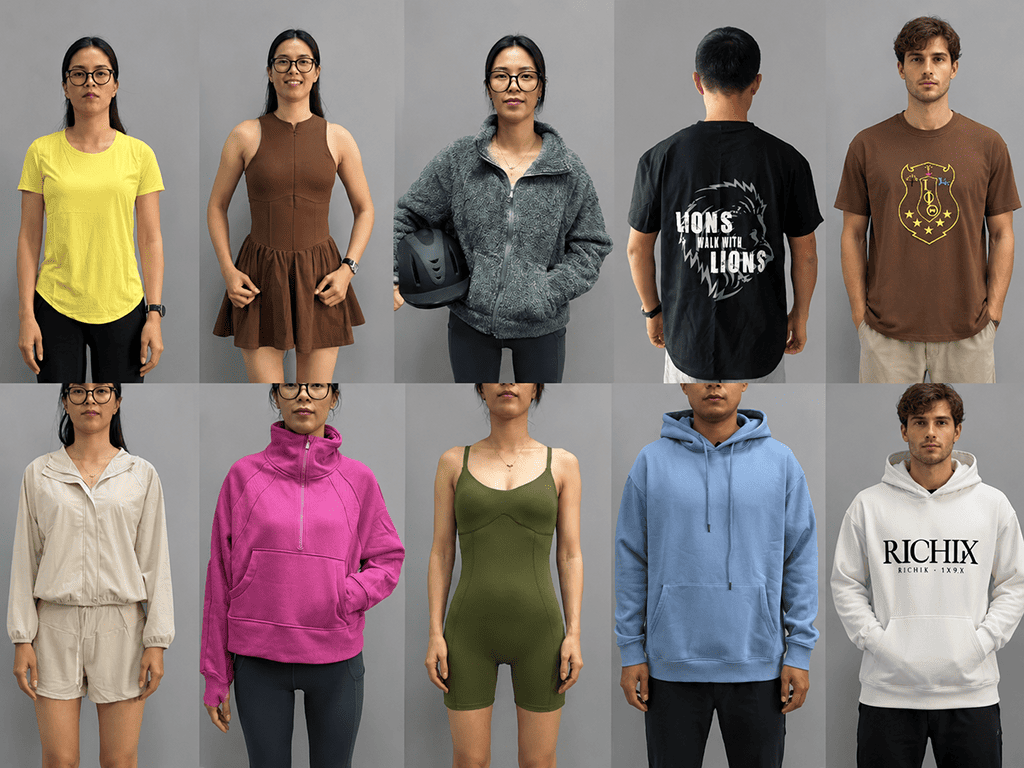
How Do You Choose the Best Manufacturer? Use a Weighted Supplier Scorecard
The best Columbia Sportswear Factory Store Manufacturer does not need to get the highest score in every area. Buyers should use a weighted supplier scorecard based on the product complexity, order quantity, current brand stage and possible sourcing risks. Product specialization, real manufacturing evidence, technical capability, commercial conditions and supply stability should usually have more importance than only one attractive point, such as a low price or low MOQ.
A supplier scorecard is useful because manufacturer selection is rarely decided by one variable.
One factory may have:
- the lowest price;
- a low MOQ;
- fast replies;
but limited technical evidence.
Another may have:
- higher pricing;
- stronger specialization;
- better factory evidence;
- clearer commercial terms.
A third may offer:
- large capacity;
- strong certifications;
- long company history;
but be less flexible for smaller orders.
Without a structured framework, buyers can easily allow one attractive factor to dominate the decision.
That is why a Columbia Sportswear Factory Store Manufacturer comparison should convert supplier information into weighted criteria instead of relying on instinct alone.
Which Criteria Should Be Included in an Outdoor Apparel Manufacturer Scorecard?
A practical scorecard should include only factors that materially affect the order.
The following framework works well for many outdoor-apparel sourcing projects:
| Criterion | Suggested Base Weight | What It Measures |
|---|---|---|
| Product Specialization | 20% | How closely the factory’s normal product focus matches your category |
| Relevant Manufacturing Evidence | 15% | Whether important capability claims can be supported |
| Technical Capability | 15% | Whether the supplier can handle the processes required by the product |
| Commercial Fit | 15% | MOQ, pricing structure, payment and order conditions |
| Quality-Control Evidence | 10% | Whether quality systems can be demonstrated credibly |
| Supply Stability | 10% | Capacity, delivery reliability and ability to support ongoing orders |
| Price Transparency | 5% | How clearly costs and extra charges are explained |
| Capacity & Lead Time | 5% | Whether relevant capacity fits the required delivery window |
| Communication | 5% | Accuracy, response quality and ability to identify missing information |
Total:
100%
This should not be treated as a universal formula.
The value of the scorecard comes from adjusting the weights to reflect the buyer’s actual sourcing problem.
Why Should Product Specialization Carry a High Weight?
Because category experience reduces uncertainty.
A factory that regularly manufactures products similar to yours is more likely to understand the practical production risks involved.
For a technical outdoor jacket, that may include:
- relevant shell construction;
- seam sealing;
- technical zippers;
- multi-layer structures;
- specialist material handling.
For a lightweight active-outdoor collection, the priorities may be different.
The mistake is giving the same specialization score to every factory simply because all of them produce “sportswear.”
For buyers comparing a Columbia Sportswear Factory Store Manufacturer, specialization should be judged against the actual product category—not against the size of the supplier’s catalog.
A factory with fewer product categories but deeper experience in your exact product can deserve a higher score than a larger generalist.
What Is the Difference Between Specialization and Technical Capability?
The two are related, but they are not identical.
Specialization asks:
Does this factory regularly work in my product category?
Technical capability asks:
Can this factory execute the specific manufacturing requirements my product depends on?
A factory can specialize in outdoor apparel without being equally strong in every technical process.
For example, a supplier may have extensive experience with:
- windbreakers;
- softshells;
- outdoor pants;
but limited evidence in fully seam-sealed waterproof shells.
It still has outdoor specialization.
Its technical capability score for a highly demanding shell program may simply be lower.
This distinction makes the scorecard more useful.
Without it, buyers risk overrating a supplier based on category familiarity while ignoring whether the specific processes are routine for that factory.
How Should Buyers Score Relevant Manufacturing Evidence?
Claims should receive points only when they are supported by evidence that matters to the order.
A simple scoring scale can be:
5 – Strong evidence
Multiple relevant products, equipment, category-specific knowledge and verifiable factory information.
4 – Good evidence
Clear product experience and supporting manufacturing information, with only minor gaps.
3 – Moderate evidence
Some relevant products and claims, but limited technical proof.
2 – Weak evidence
Mostly marketing language with little project-specific support.
1 – Very weak evidence
Claims are inconsistent, unclear or difficult to verify.
This scoring category is especially useful when manufacturers appear similar online.
Two suppliers may both say:
“15 years of outdoor apparel experience.”
But one can support that with relevant category history, product examples, factory evidence and technical answers.
The other may simply repeat the claim across several pages.
The score should reward the evidence, not the wording.
Price vs Technical Capability vs MOQ: Which Should Carry More Weight?
It depends on the product and business stage.
For a technically demanding product, technical capability normally deserves more weight than MOQ.
For a simple product being tested by a startup, commercial fit may matter more.
A useful rule is:
The higher the product risk, the more weight should move away from price and toward capability.
Consider three sourcing situations.
Case 1: Simple Windbreaker
Suggested emphasis:
- Product specialization — 20%
- Commercial fit — 20%
- Price — 15%
- Evidence — 15%
- Technical capability — 10%
- Remaining factors — 20%
Case 2: Technical Waterproof Shell
Suggested emphasis:
- Technical capability — 25%
- Relevant evidence — 20%
- Product specialization — 20%
- Quality evidence — 15%
- Commercial fit — 10%
- Remaining factors — 10%
Case 3: High-Volume Reorder Program
Suggested emphasis:
- Supply stability — 20%
- Capacity & lead time — 15%
- Product specialization — 15%
- Quality evidence — 15%
- Commercial fit — 15%
- Technical capability — 10%
- Remaining factors — 10%
The product changes the weighting.
The supplier does not need to score highest in every category.
How Should a Startup Score Manufacturers?
Startups should usually increase the importance of Commercial Fit.
That can include:
- manageable MOQ;
- clear sample and development charges;
- limited material minimums;
- transparent pricing;
- reasonable payment terms;
- flexibility across small product ranges.
A useful startup weighting might be:
| Criterion | Startup Weight |
|---|---|
| Product Specialization | 15% |
| Relevant Evidence | 15% |
| Technical Capability | 10% |
| Commercial Fit | 25% |
| Quality Evidence | 10% |
| Supply Stability | 5% |
| Price Transparency | 10% |
| Capacity & Lead Time | 5% |
| Communication | 5% |
The lower weight on supply stability does not mean stability is unimportant.
It simply reflects the fact that a startup usually does not need the same capacity profile as a mature retailer ordering tens of thousands of pieces.
A Columbia Sportswear Factory Store Manufacturer that is commercially flexible may therefore rank higher for a startup than a technically stronger factory with a much larger minimum commitment.
How Should a Growing Brand Change the Weighting?
Growing brands should start shifting away from pure MOQ flexibility and toward scalability.
Their questions become:
- Can the factory support more SKUs?
- Does pricing improve with volume?
- Can the supplier support repeat orders?
- Is lead time predictable?
- Does the factory have enough capacity for seasonal growth?
- Can product quality stay consistent as volume increases?
A balanced growing-brand scorecard might look like this:
| Criterion | Growing Brand Weight |
|---|---|
| Product Specialization | 20% |
| Relevant Evidence | 15% |
| Technical Capability | 15% |
| Commercial Fit | 15% |
| Quality Evidence | 10% |
| Supply Stability | 10% |
| Price Transparency | 5% |
| Capacity & Lead Time | 5% |
| Communication | 5% |
This is close to the base model because growing brands usually need balance more than extremes.
They still need flexibility.
But they also need evidence that the supplier can grow with them.
How Should Established Buyers Evaluate Capacity and Supply Stability?
Established brands should usually increase the weight on:
- Available capacity
- Delivery reliability
- Material continuity
- Quality consistency
- Repeat-order stability
- Long-term commercial structure
At scale, small operational problems become expensive.
A $0.30 unit saving can disappear quickly if:
- delivery slips by several weeks;
- part of the order needs rework;
- materials change unexpectedly;
- capacity becomes unavailable during peak season.
A mature-buyer weighting could look like this:
| Criterion | Established Buyer Weight |
|---|---|
| Product Specialization | 15% |
| Relevant Evidence | 15% |
| Technical Capability | 15% |
| Commercial Fit | 10% |
| Quality Evidence | 15% |
| Supply Stability | 15% |
| Price Transparency | 5% |
| Capacity & Lead Time | 10% |
| Communication | 0–5% depending on buyer structure |
Communication should still matter, but established buyers often have stronger internal sourcing teams and formal systems, so they may place more weight on measurable execution than conversational convenience.
For a large Columbia Sportswear Factory Store Manufacturer comparison, capacity should be judged by relevant available capacity, not the largest headline number.
Why Is the Highest Total Score Not Automatically the Best Supplier?
Because weighted scores summarize information; they do not eliminate judgment.
Suppose:
Supplier A scores 86/100
Strong in every category, but its MOQ is 1,000 pieces per color.
Supplier B scores 82/100
Slightly lower technical score, but accepts a commercially workable first order.
A startup requiring 150 pieces may still prefer Supplier B.
The numerical score is not wrong.
It simply cannot override a commercial constraint that makes Supplier A unusable.
The same issue can occur with certifications, location, lead time or payment terms.
A supplier can have the highest overall score while failing one non-negotiable requirement.
So the scoring process should use two layers:
Layer 1: Knockout Criteria
Examples:
- Required certification
- Maximum acceptable MOQ
- Mandatory technical process
- Delivery deadline
- Destination-market compliance
If a supplier fails a genuine knockout requirement, it should not continue regardless of total score.
Layer 2: Weighted Comparison
Only suppliers that pass the knockout criteria should be scored against each other.
This prevents the scorecard from producing a mathematically attractive but commercially impossible answer.
What Are Knockout Criteria, and Why Do They Matter?
Knockout criteria are requirements that cannot be traded against other strengths.
For example:
If a retailer requires a specific social-compliance standard, an attractive price cannot replace it.
If the product requires a technical process the factory does not have or cannot reliably control, a low MOQ cannot compensate.
If the launch date is fixed and the supplier cannot meet it, strong product specialization does not solve the problem.
Typical knockout criteria can include:
- Mandatory compliance
- Specific technical process
- Maximum order commitment
- Required testing
- Fixed launch timing
- Restricted sourcing country
- Required production location
- Minimum proven capacity
The scorecard works best after these conditions are established.
How Should Buyer-Specific Risk Change the Final Decision?
The same supplier weakness can matter very differently to different buyers.
Consider a factory with:
- strong technical capability;
- good evidence;
- high MOQ;
- slower sample communication.
For a mature outdoor brand placing a large established order, the MOQ may not matter and slower sample communication may be manageable.
For a startup developing its first collection, those weaknesses can become major commercial barriers.
Now consider another supplier with:
- moderate technical capability;
- flexible MOQ;
- fast communication;
- less evidence in extreme-weather products.
That supplier may be excellent for a lifestyle outdoor collection but unsuitable for a technical alpine shell.
This leads to one of the most important principles in supplier selection:
A weakness is only important when it intersects with the risk profile of the order.
The objective is not to find a manufacturer with no weaknesses.
It is to find one whose weaknesses are acceptable.
Weighted Supplier Score Example
Consider three fictional suppliers for a softshell jacket program.
| Criterion | Weight | Supplier A | Supplier B | Supplier C |
|---|---|---|---|---|
| Product Specialization | 20% | 5 | 4 | 3 |
| Relevant Evidence | 15% | 5 | 4 | 3 |
| Technical Capability | 15% | 5 | 4 | 3 |
| Commercial Fit | 15% | 2 | 5 | 4 |
| Quality Evidence | 10% | 5 | 4 | 3 |
| Supply Stability | 10% | 5 | 4 | 3 |
| Price Transparency | 5% | 4 | 5 | 4 |
| Capacity & Lead Time | 5% | 5 | 4 | 3 |
| Communication | 5% | 3 | 5 | 4 |
Supplier A is technically strongest.
Supplier B is commercially strongest.
Supplier C is balanced but less differentiated.
For a mature technical brand, Supplier A may win.
For a growing DTC brand testing a new softshell line, Supplier B may create lower total risk.
Again, there is no universal winner.
How Should Buyers Avoid “Scorecard Theater”?
A scorecard becomes useless when buyers assign numbers without evidence.
Giving a supplier:
Technical Capability = 5/5
because its website says “professional manufacturer” does not improve the decision.
Every score should have a reason.
A practical internal note can be as short as:
4/5 — Regularly manufactures softshells, relevant factory examples visible, but no strong public evidence for advanced bonded construction.
or:
2/5 — Low MOQ is attractive, but technical-shell evidence is limited.
This creates an auditable decision.
It also prevents the team from changing its reasoning later simply because one salesperson is more persuasive.
For a serious Columbia Sportswear Factory Store Manufacturer comparison, the scorecard should make decision logic clearer—not merely make the spreadsheet look professional.
What Should Buyers Do When Two Manufacturers Score Almost the Same?
A close score is normal.
At that point, buyers should not invent precision.
An 83.5 supplier is not meaningfully “better” than an 82.8 supplier simply because a spreadsheet says so.
Instead, compare the differences that matter most.
Ask:
- Which supplier has the stronger evidence in the highest-risk area?
- Which supplier creates lower inventory risk?
- Which commercial conditions are easier to manage?
- Which weakness would be harder to correct later?
- Which supplier is more suitable if the product grows?
A useful tie-breaker is:
Choose the supplier whose weakness is easier for your business to absorb.
For example:
Factory A may be slightly more expensive.
Factory B may have weaker technical evidence.
Price can sometimes be managed.
Missing technical capability may be harder to fix after the order begins.
In another project, MOQ might be the decisive issue.
The answer depends on the order.
Which Factors Should Never Dominate the Entire Decision?
Several factors are useful but dangerous when given too much weight.
Lowest Price
Important, but only after specifications are aligned.
Lowest MOQ
Useful for testing, but it does not prove technical or commercial strength.
Fastest Sample
Speed is valuable, but accuracy matters more than speed alone.
Longest Company History
Experience is helpful, but old companies can still be poorly matched to a new product category.
Largest Capacity
Capacity matters only when it is relevant and available.
Most Certifications
Certifications support specific requirements; they do not replace product capability.
Famous Customer Logos
These are weak sourcing evidence unless properly verified.
The scorecard prevents one impressive variable from controlling the whole decision.
A Practical Final Manufacturer Scorecard
Before selecting a Columbia Sportswear Factory Store Manufacturer, buyers can use the following working structure:
| Category | Score 1–5 | Weighted Score | Key Evidence | Main Risk |
|---|---|---|---|---|
| Product Specialization | ||||
| Relevant Manufacturing Evidence | ||||
| Technical Capability | ||||
| Commercial Fit | ||||
| Quality Evidence | ||||
| Supply Stability | ||||
| Price Transparency | ||||
| Capacity & Lead Time | ||||
| Communication | ||||
| Total | /100 |
Then add three final questions:
1. Did the supplier pass every knockout criterion?
2. What is the biggest weakness in this supplier profile?
3. Does that weakness matter to this specific order?
Those three questions can be more valuable than the final numerical score.
Which Columbia Sportswear Factory Store Manufacturer Is Actually the Best?
The best supplier is the one whose strongest capabilities align with the buyer’s highest-risk requirements while its weaknesses remain commercially manageable.
That means:
A startup may favor flexibility.
A technical outdoor brand may favor specialization.
A growing brand may favor balanced capability and scalability.
An established retailer may favor supply stability and capacity.
The scorecard should make these trade-offs visible.
It should not pretend they do not exist.
A strong Columbia Sportswear Factory Store Manufacturer decision is therefore not:
“Supplier A scored highest, so Supplier A wins.”
It is:
“Supplier A or B best matches the product, risk profile and commercial stage of this order, and the evidence supports that conclusion.”
That is the point where a manufacturer comparison becomes a sourcing decision.
1. Product Development
Regular monthly product development ensures consistent updates to your brand line.
2. Fabric Sourcing
Regular monthly product development ensures consistent updates to your brand line.
3. Sample Making
Regular monthly product development ensures consistent updates to your brand line.
4. Bulk Production
Regular monthly product development ensures consistent updates to your brand line.
5. Packaging & Delivery
Regular monthly product development ensures consistent updates to your brand line.
What Should Buyers Do After Comparing the Top 10 Columbia Sportswear Factory Store Manufacturer Choices?
After comparing the Top 10 Columbia Sportswear Factory Store Manufacturer choices, buyers should narrow the longlist through evidence, standardized RFQs, commercial comparison and product-relevant evaluation rather than immediately selecting the lowest-priced factory. A practical sourcing funnel can reduce 10 manufacturers to five qualified suppliers, three serious sample candidates, two commercial finalists and one trial-order supplier before a long-term manufacturing relationship is considered.
The purpose of a manufacturer list is not to produce ten quotations.
It is to reduce uncertainty until the buyer has enough evidence to make a commercially sensible decision.
That distinction matters because supplier selection becomes expensive as the process moves forward. Contacting ten factories is relatively inexpensive. Developing products with ten factories, comparing ten sets of samples and managing ten technical conversations is not.
The shortlist should therefore become smaller as the required investment becomes larger.
A practical sourcing funnel looks like this:
10 Manufacturers Identified
↓
5 Evidence-Qualified Suppliers
↓
3 Serious Sample Candidates
↓
2 Commercial Finalists
↓
1 Trial-Order Supplier
↓
Performance Review
↓
Long-Term Manufacturing Partner
The numbers are not fixed rules. A simple product may require fewer stages, while a technically demanding outerwear program may justify deeper comparison.
The principle is more important:
Increase commitment only as confidence increases.
How Many Manufacturers Should Move From Longlist to Shortlist?
For many outdoor apparel projects, narrowing 10 manufacturers to approximately four or five serious candidates is a practical first step.
At this stage, buyers are not trying to determine who can sew clothing.
They are trying to remove suppliers whose profiles clearly do not fit the order.
A manufacturer can be removed because:
- Product specialization is too weak
- MOQ is commercially unrealistic
- Required certifications are unavailable
- Relevant technical evidence is insufficient
- Target delivery timing cannot be supported
- The supplier’s strongest categories do not match the product
- Commercial terms are unclear
- Important company information cannot be verified
- Communication reveals repeated misunderstanding of basic requirements
This first supplier selection should be relatively objective.
For example, if the product needs a special technical process but one factory cannot show enough relevant capability, there is no need to keep this factory on the shortlist only because its quotation looks attractive.
In the same way, if a brand can only accept an order quantity of 200 pieces, but the supplier requires 1,000 pieces per color, this factory may have very good capability, but its commercial conditions are still not suitable for this brand.
A strong Columbia Sportswear Factory Store Manufacturer shortlist therefore excludes factories for reasons that matter to the order rather than because one supplier simply “feels better.”
Which Suppliers Should Receive the Same RFQ?
Suppliers that survive initial qualification should receive substantially the same RFQ.
This is one of the simplest ways to improve manufacturer comparison.
If Factory A receives:
“Please quote 300 waterproof jackets.”
while Factory B receives a detailed specification, color breakdown, packaging requirement and delivery term, their quotations are not comparable.
A useful RFQ should align the commercial inputs that influence the decision.
That normally includes:
- Product type
- Target quantity
- Quantity per color
- Size range
- Specification or reference information
- Required customization level
- Branding requirements
- Packaging expectations
- Required certifications or compliance
- Testing requirements where applicable
- Destination
- Requested Incoterm
- Target delivery window
The objective is not to make every supplier use the same internal manufacturing solution.
Some differences between supplier proposals can be valuable.
The objective is to ensure that price, MOQ and commercial terms are responding to substantially the same purchasing requirement.
Without that alignment, the buyer may unknowingly compare a basic offer from one factory with a more complete offer from another.
How Should Buyers Compare Manufacturers When Their Proposals Are Not Identical?
Perfect uniformity is not always possible.
One manufacturer may recommend a different material structure. Another may identify a construction issue. A third may suggest an alternative component that improves commercial feasibility.
Those differences should not automatically be removed.
They can reveal useful supplier knowledge.
The buyer should separate the comparison into two layers.
Layer 1: Comparable Baseline
Ask every supplier to quote the same core requirement wherever possible.
This creates a reference point for:
- Price
- MOQ
- Lead time
- Commercial terms
- Basic capability
Layer 2: Supplier Alternative
Allow manufacturers to propose an alternative where they believe it creates a meaningful advantage.
Then compare:
Original Requirement vs Supplier Proposal
This prevents a common sourcing mistake.
If three factories propose three different products, choosing the lowest quotation tells the buyer very little about which factory is actually more competitive.
A Columbia Sportswear Factory Store Manufacturer should receive credit for proposing a better solution only when the buyer can clearly see what changed and why.
How Many Factories Should Move to the Sample Stage?
For many projects, two or three serious candidates are enough.
Sampling too many factories creates several problems:
- Higher development cost
- More courier charges
- More technical communication
- More revisions to track
- More inconsistent specifications
- Longer decision cycles
- Greater risk of comparing samples made from different inputs
The objective is not to collect as many samples as possible.
It is to test the manufacturers that have already passed the most important commercial and capability filters.
A supplier should normally reach this stage because it has already demonstrated a reasonable combination of:
Product Relevance + Evidence + Commercial Fit + Communication + Feasible Timing
This approach also changes what a sample means.
The sample is no longer being used to discover whether the supplier belongs on the longlist.
It is being used to help differentiate suppliers that have already earned serious consideration.
That is a much more efficient sourcing process.
When Should Price Become Part of the Final Decision?
Price should be considered throughout sourcing, but it should become decisive only after buyers understand what each quotation actually represents.
There is no benefit in finding the technically perfect supplier if its price makes the product commercially impossible.
There is equally little benefit in selecting the cheapest factory if its offer is based on a weaker specification or creates unacceptable execution risk.
The final commercial comparison should therefore ask:
- Are specifications substantially aligned?
- Are quantities aligned?
- Are color quantities aligned?
- Are packaging conditions aligned?
- Are major customization costs included?
- Are Incoterms comparable?
- Are major material assumptions clear?
- Are required testing and compliance costs included?
- Are additional supplier minimums identified?
Only then does the price difference become meaningful.
Suppose the final two suppliers quote:
Supplier A: $21.80
Supplier B: $20.90
The $0.90 difference may matter.
But it should be interpreted alongside:
- MOQ
- Relevant technical evidence
- Capacity
- Delivery timing
- Commercial transparency
- Supplier weaknesses
The purpose is not to make price unimportant.
It is to make price comparable.
Which Supplier Should Receive a Trial Order?
The supplier that receives the trial order should normally be the candidate with the strongest risk-adjusted fit, not simply the highest theoretical capability.
A trial order is especially useful when:
- The product is new to the brand
- Demand is not fully proven
- The manufacturer relationship is new
- The supplier is entering a new product category for the buyer
- Commercial quantities allow a controlled first commitment
The buyer should ask:
What are we trying to learn from this first order?
For a new product, the answer may include market demand and product economics.
For a new supplier, the answer may include communication, timing, commercial reliability and execution against agreed requirements.
For a growing brand, the question may be whether the supplier can become part of a larger sourcing program.
A low-risk first order does not mean making the order artificially small.
If the quantity becomes commercially inefficient or falls below realistic material minimums, the test may no longer represent normal production conditions.
The objective is:
Meaningful Order + Controlled Exposure
rather than:
Smallest Possible Order
For buyers comparing a Columbia Sportswear Factory Store Manufacturer, this distinction prevents low MOQ from becoming the only definition of low risk.
What Should Be Confirmed Before the Trial Order Is Placed?
Before increasing commercial commitment, buyers should confirm that the important purchasing assumptions are no longer ambiguous.
The exact documents will vary by project, but commercially important points usually include:
- Final product reference
- Quantity
- Color breakdown
- Size breakdown
- Agreed unit price
- Payment terms
- Packaging requirement
- Applicable testing or certification requirements
- Incoterm
- Delivery timing
- Approved customization scope
- Responsibility for major additional charges
The purpose is not paperwork for its own sake.
It is to prevent the buyer and supplier from entering the same order with different assumptions.
Many sourcing disputes begin with sentences such as:
“We thought that was included.”
or:
“We assumed you wanted the standard version.”
Commercial clarity before commitment is usually cheaper than resolving ambiguity later.
How Should Buyers Evaluate a Manufacturer After the First Order?
A first order should create more than inventory.
It should create supplier evidence.
The buyer now has information that was impossible to obtain from a website, quotation or sales conversation.
A practical post-order supplier review can consider:
| Area | Question |
|---|---|
| Specification Accuracy | Did the delivered order reflect what was commercially agreed? |
| Communication Accuracy | Were important changes and issues communicated clearly? |
| Timing | Did actual timing match the agreed schedule reasonably well? |
| Commercial Consistency | Did unexpected charges or conditions appear? |
| Problem Handling | How did the supplier respond when something went wrong? |
| Order Coordination | Was the program manageable from confirmation through shipment? |
| Scalability | Would the same supplier still make sense at a larger quantity? |
The problem-handling category deserves particular attention.
No manufacturing relationship is completely free of problems.
A factory that identifies an issue early, communicates it clearly and proposes a workable response may be a safer long-term supplier than one that promises perfection but hides problems until they become expensive.
The question is not:
“Did anything go wrong?”
A better question is:
“When something changed or went wrong, how did the supplier handle it?”
That behavior becomes valuable evidence for future sourcing decisions.
When Is a Manufacturer Ready for Long-Term Cooperation?
One successful sample is not enough.
One successful order is stronger evidence, but even that may not justify immediately concentrating a large percentage of purchasing with the supplier.
Confidence should grow progressively.
A practical relationship can move through stages:
Supplier Qualification
↓
Sample Candidate
↓
Trial Supplier
↓
Repeat-Order Supplier
↓
Core Manufacturing Partner
The criteria become more demanding at each stage.
At the beginning, the buyer asks:
Can this factory make the product?
Later:
Can this factory support the order commercially?
Then:
Can this factory perform reliably across real orders?
Finally:
Can this supplier support our business as volume, SKU count and market requirements increase?
A long-term Columbia Sportswear Factory Store Manufacturer should therefore demonstrate more than one successful transaction.
The relationship becomes stronger when evidence accumulates across different orders and business conditions.
Should Buyers Keep a Second Supplier After Choosing the Winner?
For commercially important products, often yes.
A backup supplier can reduce dependence on one manufacturing source.
This does not mean splitting every order.
It means keeping enough knowledge about a second qualified manufacturer that the brand has an alternative if circumstances change.
A second supplier can become useful when:
- Capacity becomes unavailable
- Lead times extend unexpectedly
- Commercial terms change
- Material sourcing changes
- The brand enters a different product category
- Geographic diversification becomes important
- Volume exceeds one supplier’s comfortable capacity
However, dual sourcing also creates cost.
Two factories can mean:
- More supplier management
- Smaller volume per supplier
- Potentially weaker price leverage
- Greater consistency challenges
- More coordination
So backup sourcing should be proportional to risk.
A small startup with one 100-piece product does not need the same supplier-diversification strategy as a retailer purchasing tens of thousands of jackets.
What Should Buyers Do With Manufacturers That Do Not Win the First Order?
Not every qualified supplier needs to be permanently rejected.
Suppose Supplier A is technically strongest but commercially unsuitable at the current order size.
Supplier B wins because its MOQ and price structure fit the first launch better.
If the brand grows, Supplier A may become more attractive later.
Similarly, a specialist factory that is unnecessary for a lightweight collection may become valuable when the brand launches a technical outerwear category.
Supplier selection should therefore distinguish between:
Rejected Supplier
and
Not Suitable Yet
That distinction creates a stronger sourcing database over time.
The best factory for today’s 150-piece market test may not be the best factory for next year’s 5,000-piece program.
How Long Does It Take to Choose an Outdoor Apparel Manufacturer?
There is no reliable universal timeline because supplier selection depends on product complexity, information quality, sample requirements and how quickly both sides communicate.
A simple product with a clear specification and a small number of qualified candidates can move relatively quickly.
A technical outerwear program involving several factories, specialized materials and deeper verification can take considerably longer.
Buyers should be cautious about optimizing only for speed.
A sourcing process that saves one week but selects the wrong supplier can create months of commercial difficulty.
At the same time, unnecessary comparison can also become expensive.
If three manufacturers have clearly separated themselves from the other seven, continuing to sample every supplier rarely improves the decision.
The practical objective is:
Enough Evidence to Make a Defensible Decision—Without Extending the Comparison After the Useful differences are already clear.
From Top 10 to One Supplier: A Practical Decision Funnel
The complete sourcing path can be summarized as follows:
| Stage | Supplier Count | Main Decision |
|---|---|---|
| Market Scan | 10 | Who appears relevant? |
| Evidence Screening | 5–7 | Which claims are credible and relevant? |
| Commercial Shortlist | 4–5 | Which suppliers fit the order structure? |
| Serious Sample Candidates | 2–3 | Which suppliers deserve development investment? |
| Commercial Finalists | 2 | Which offers remain strongest after comparison? |
| Trial Supplier | 1 | Which supplier offers the best risk-adjusted fit? |
| Post-Order Review | 1 + backup | Did real performance support the original decision? |
| Long-Term Partner | Ongoing | Can the relationship support future growth? |
This funnel solves a common problem with manufacturer rankings.
A Top 10 list tells buyers where to look.
It should not pretend to tell every buyer who to choose.
The final decision still depends on the product, quantity, target market, technical requirements and commercial stage of the brand.
Which Columbia Sportswear Factory Store Manufacturer Should You Choose?
The best Columbia Sportswear Factory Store Manufacturer is the supplier that remains attractive after each layer of the decision becomes more demanding.
It should survive:
Product Matching
↓
Country and Supply-Chain Fit
↓
Commercial Comparison
↓
Evidence Verification
↓
Weighted Scoring
↓
Sample Evaluation
↓
Trial-Order Performance
A supplier that looks impressive at the beginning may become less attractive when MOQ conditions are clarified.
A lower-profile manufacturer may become stronger once relevant product evidence is examined.
The cheapest factory may lose its advantage after total commercial commitment is calculated.
The most technical factory may turn out to offer capability the product does not need.
This is why outdoor apparel sourcing should not end with a ranking.
It should end with a defensible supplier decision.
For a startup, that may mean choosing flexibility and controlling inventory exposure.
For a growing brand, it may mean finding the strongest balance between product capability and scalability.
For an established buyer, supply stability, available capacity and long-term commercial performance may carry more weight.
The right Columbia Sportswear Factory Store Manufacturer is therefore not the factory that wins every category.
It is the manufacturer whose strong points can match the most important requirements of the order, whose weak points are still acceptable for the project, and whose commercial conditions can support the brand when it moves to the next realistic stage of growth.
Lorem ipsum dolor sit amet, consectetur adipiscing elit. Ut elit tellus, luctus nec ullamcorper mattis, pulvinar dapibus leo.
- Yoga Pant
- Sports Bras
- Tank Tops
- Gym Shorts
- Men & Kids Sportswear
- Riding Tops
- Breeches
- Competition Wear
- Jackets
- Man & Kids Equestrian
- Joggers
- Sweatshirt & Hoodies
- Sweaters
- Coat & Jacket
- Men & Kids Loungewear
Other OEM Apparel
- Tennis Clothing
- Jumpsuit
- Dress & Skirts
- Plus Size Activewear
- Maternity Activewear