OEM/ODM Sportswear Manufacturer | 3-Day Sampling | Low MOQ | 50K Monthly Capacity | ISO9001 & BSCI Certified
Top 10 Equestrian Companies: Business Models, Market Focus & Buyer Guide
Compare 10 equestrian companies and Chinese manufacturers by product focus, MOQ, sample process, custom capability, buyer fit and supply model. Learn how to shortlist the right equestrian partner for private label and long-term sourcing.
Top 10 Equestrian Companies: How Buyers Compare Business Models, Market Focus and Partnership Potential
Searching for the best equestrian companies sounds straightforward until you start comparing them. One company may be an established riding brand selling finished products, another may be a specialist equestrian manufacturer, and another may be a broader sportswear factory with an equestrian product line. They can all appear relevant in a search result, but they do not necessarily solve the same problem for a buyer.
For brands, retailers, distributors and sourcing teams, this distinction matters. A well-known consumer brand may be an excellent market benchmark but offer no private label manufacturing. A factory with an attractive price may accept custom orders but have limited experience with riding-specific fit, silicone grip or saddle-contact construction. A highly specialized manufacturer may offer stronger technical knowledge but be less suitable for a buyer who needs several sports categories from one supplier.
The useful question is therefore not simply, “Which company is the biggest or cheapest?” It is, “Which business model fits the product I am developing, the market I am selling to and the level of supply-chain support I actually need?”
The best equestrian companies for B2B buyers are those whose product specialization, business model, custom development capability, commercial terms and production system match the buyer’s actual requirements. A startup testing 100 pieces does not need exactly the same supplier as an established retailer planning several seasonal collections. Buyers should first identify what each company actually does, then compare relevant product experience, MOQ conditions, sample execution, manufacturing evidence, quality control, price structure and the ability to reproduce an approved product reliably in future orders.
This guide compares ten China-based equestrian companies and manufacturers from the sourcing point of view. Instead of seeing every supplier as the same, it compares what each company is stronger at, what kind of buyers they are more suitable for, what limitations still need to be checked, and what information buyers should confirm directly before making the final purchasing decision.
Top 10 Equestrian Companies and Chinese Manufacturers for B2B Buyers
The most useful Top 10 list is not a ranking from “best” to “worst.” These equestrian companies operate with different product ranges, production models and commercial strengths, so buyers should treat the list as a shortlist rather than a finishing order. Compare what each manufacturer actually specializes in, what it publicly demonstrates, and whether its MOQ, development process and production model fit your planned collection.
A manufacturer that is excellent for a 100-piece private label launch may not be the strongest choice for a large outerwear program. Likewise, a supplier with broad equestrian equipment capability may offer advantages to a distributor but unnecessary complexity to a brand developing only riding tights.
The following profiles focus on commercial fit, not marketing popularity.
Quick Comparison of the Top 10 Equestrian Companies
| Company | Location | Equestrian Focus | Public MOQ Indication | Development Positioning | Best-Fit Buyer |
|---|---|---|---|---|---|
| Pair Fashion | Dongguan, Guangdong | Breeches, riding leggings, tops, jackets, competition apparel | From 100 pcs for regular programs | OEM/ODM, private label, development-to-bulk support | Startups, growing brands, private label buyers |
| Run Equestrian | China | Breeches, jodhpurs, shirts, competition wear and broader riding products | From 100 pcs | Specialist OEM/ODM | Riding brands, schools, retailers |
| Zest Equestrian | Dongguan, Guangdong | Rider apparel plus horse equipment and accessories | Flexible; confirm by product | OEM/ODM, private label, sourcing | Brands wanting a broader equestrian range |
| Equifactory | China | Riding apparel and equestrian equipment | From 100 pcs publicly stated | Custom development and OEM/ODM | Medium-to-large brands and distributors |
| Dongguan SGL Sports | Dongguan, Guangdong | Breeches, leggings, jackets, tops, tights | Low MOQ promoted; confirm by style | Multi-category sportswear + equestrian | Brands combining equestrian and activewear |
| Dongguan Shuyu Activewear | Dongguan, Guangdong | Breeches, base layers, jackets, activewear | Typically 100–200 pcs/design/color on published product information | OEM/custom sportswear | Growing brands and multi-sport buyers |
| Quanzhou UBI Garments | Shishi, Fujian | Show jackets, riding tops, pants and technical outerwear | Confirm by style | OEM/ODM and outerwear production | Outerwear-led equestrian collections |
| Dongguan RW Equestrian | Dongguan, Guangdong | Breeches, tops, jackets, saddle pads and accessories | Many public listings start around 100 pcs | Equestrian-focused OEM | Apparel brands wanting riding-specific development |
| VeloSpan | Guangzhou, Guangdong | Breeches and performance riding apparel | Flexible low MOQ promoted | OEM/ODM | Breeches-focused brands and smaller programs |
| Dongguan OPE Equestrian | Dongguan, Guangdong | Breeches, riding wear, jackets, saddle pads and horse products | Many public listings around 100 pcs | Equestrian apparel and equipment | Buyers seeking apparel plus adjacent horse products |
Important: Published MOQs and lead times are useful for initial screening, but they should not be treated as guaranteed quotation terms. Fabric minimums, custom dyeing, silicone artwork, trims, color breakdown, size ratios and packaging can all change the commercial minimum for a real order.
1. Dongguan Pair Fashion Co., Ltd. — Best for Custom Development and Flexible Brand Growth
Location: Dongguan, Guangdong, China
Established: 2016
Business Model: OEM / ODM / Private Label Manufacturer
Regular MOQ: From 100 pcs for standard programs
Sample Capability: As fast as 3 days for suitable projects; standard development depends on complexity
Bulk Lead Time: Fast programs can begin around 15 working days; standard production is commonly planned around 20–25 working days
Monthly Capacity: Approximately 50,000 pieces under normal production planning
Core Products: Riding breeches, riding leggings, equestrian tops, jackets, competition apparel and functional sportswear
Certifications Listed: ISO9001, BSCI, GRS, CE and ROHS
Buyers comparing sustainability claims across equestrian companies can also review the broader Textile Exchange standards to understand which certification framework applies to recycled, organic, wool, down and other material categories.
Pair Fashion is a Dongguan-based functional sportswear manufacturer with a dedicated equestrian apparel capability. Its production structure includes seven production lines, including three lines dedicated to equestrian apparel, together with an 11-person pattern and sample development team and 13-person QC team.
Its strongest fit is not simply a buyer asking, “Can you sew this breech?” The more relevant use case is a brand that needs support moving from idea, reference garment, sketch or Tech Pack into a controlled production specification.
The development scope can include pattern development, fabric selection, size grading, functional details, logo application, labels, trims and packaging. This makes the company particularly relevant to private label buyers who need more than cut-and-sew capacity.
For equestrian brands, the product range includes riding breeches, leggings, riding tops, jackets and competition-related apparel. Buyers developing a broader collection can also use the company’s functional activewear experience for products that share stretch, moisture-management and body-movement requirements.
Best suited to:
- Startup brands requiring development support before their first production run
- Growing DTC equestrian brands launching several related apparel styles
- Private label retailers needing custom labels, trims and packaging
- Buyers requiring riding apparel plus adjacent functional sportswear
- Brands that want a supplier to retain patterns and approved production references for repeat orders
Potential limitation: Pair Fashion is primarily an apparel manufacturer, so buyers whose sourcing program is dominated by saddlery, helmets, hard protective equipment or extensive horse hardware should compare suppliers with a broader equestrian equipment specialization.
For buyers specifically developing riding apparel, you can explore Pair Fashion’s equestrian clothing manufacturer capabilities for product development, sampling, private label customization and bulk production.
2. Run Equestrian — Best for Specialist Riding-Wear Programs
Location: China
Established: Publicly positions its equestrian manufacturing history from 2009
Business Model: Specialist Equestrian OEM/ODM Manufacturer
MOQ: From 100 pcs
Sample Time: Around 7 days on its custom-development information
Production: Public information indicates approximately 15–25 days for standard production, with program-specific variations
Core Products: Breeches, jodhpurs, riding shirts, competition wear and additional equestrian products
Quality Information: ISO 9001 and AQL-based quality-control claims are published on its website
Run Equestrian positions itself much more narrowly around the equestrian category than a general sportswear supplier. That can be useful when the buyer’s primary requirement is riding wear and the development conversation needs to move quickly into details such as breech construction, silicone grip, stretch fabric and competition apparel.
The company publicly states a 100-piece starting MOQ and promotes a structured OEM/ODM service. It also publishes information on fabric choices, silicone grip options and custom design support.
This specialization is potentially valuable because equestrian pants should not be evaluated exactly like ordinary leggings. Saddle contact, knee movement, waistband stability and grip placement can all change the performance of the finished garment.
Best suited to:
- Riding-apparel-focused brands
- Retailers requiring breeches and jodhpurs
- Riding schools and equestrian clubs
- Buyers that prefer a specialist rather than a broad activewear supplier
Potential limitation: Buyers should still verify whether the published commercial terms apply to their exact fabric, color, grip artwork, size breakdown and order quantity. A headline MOQ is not the same thing as a confirmed production MOQ for every custom specification.
3. Zest Equestrian — Best for Brands Wanting Apparel and Horse Products Under a Broader Program
Location: Dongguan, Guangdong, China
Experience: Publicly states 16+ years of textile/equestrian experience
Business Model: OEM / ODM / Private Label
MOQ: Flexible; exact minimum should be confirmed by product
Sample Time: Approximately 7–15 days according to its private label information
Production Lead Time: Approximately 25–45 days publicly stated
Core Products: Breeches, jodhpurs, show shirts, jackets, saddle pads, halters, bell boots, leg wraps, bags and accessories
Certification Claim: CE certification is highlighted publicly
Zest Equestrian stands out because its scope goes beyond riding apparel. Its published product range covers both the rider side and horse-product side of the category.
That creates a different business case. A brand selling only riding leggings may not need such a wide sourcing scope. A distributor, established equestrian label or retailer trying to coordinate apparel, saddle pads, horse protection and accessories, however, may value having fewer supplier relationships.
Its private label information also identifies material sourcing, Pantone color matching, packaging and branding as part of the service.
Best suited to:
- Equestrian brands expanding beyond clothing
- Retailers and distributors building a broader assortment
- Private label programs requiring apparel, horse products and accessories
- Buyers interested in sustainable material options
Potential limitation: A broad product range should never automatically be interpreted as equal technical depth in every category. Buyers should verify the specific production site, process, material expertise and QC method for the exact item being purchased.
4. Equifactory — Best for Broad Equestrian Product Development
Location: China
Business Model: Equestrian OEM/ODM and Custom Manufacturing
MOQ: Publicly states a flexible MOQ around 100 pieces
Core Products: Breeches, leggings, jackets, coats and equestrian equipment
Development Services: Design support, branding, labels, packaging and small-batch trial production
Equifactory presents itself as a broad equestrian manufacturing solution rather than a single-product specialist. Its public information emphasizes custom product development for brand owners and services for equestrian clubs.
The company is potentially attractive to buyers who want to coordinate multiple equestrian categories and prefer a supplier that can support design adjustments, private label details and packaging.
Its public materials also emphasize rapid proofing and trial production, although buyers should obtain an order-specific timeline rather than assuming the same development speed for every product.
Best suited to:
- Medium-sized and established equestrian brands
- Distributors seeking multiple riding categories
- Equestrian clubs
- Buyers that need coordinated branding and packaging
Potential limitation: Publicly presented scale and performance figures should be verified during due diligence. For any supplier, buyers should distinguish between company-level marketing claims and order-level manufacturing evidence.
5. Dongguan SGL Sports Clothing Co., Ltd. — Best for Multi-Sport Brands Adding Equestrian Apparel
Location: Dongguan, Guangdong, China
Business Model: Custom Sportswear Manufacturer
Factory Information: Publicly states a 3,500 m² facility, 200+ technical workers and approximately 150,000 units of monthly bulk capacity
MOQ: Low MOQ is promoted; exact style-level minimum requires confirmation
Core Equestrian Products: Breeches, leggings, jackets, T-shirts and tights
Other Categories: Activewear, yoga clothing, outdoor apparel and additional sportswear
SGL Sports sits in a useful middle position between a dedicated equestrian supplier and a broad functional sportswear manufacturer.
This can make sense for a brand whose collection crosses category boundaries. For example, a business may sell riding tights and base layers but also want gym wear, yoga-inspired pieces or outdoor products using related stretch and performance fabrics.
SGL publicly emphasizes design, R&D and production support and lists multiple equestrian apparel categories.
Best suited to:
- Multi-sport apparel brands
- Equestrian lifestyle brands influenced by activewear
- Buyers requiring several functional apparel categories
- Brands expecting larger production volumes
Potential limitation: Buyers seeking highly specialized equestrian development should verify how much of the factory’s actual production is dedicated to equestrian products rather than assuming broad sportswear capability automatically equals riding-specific expertise.
6. Dongguan Shuyu Activewear Co., Ltd. — Best for Equestrian and Activewear Crossover Collections
Location: Dongguan, Guangdong, China
Factory History: Predecessor factory states operations from 2012
Business Model: Manufacturing and custom development
Published MOQ: Commonly 100–200 pieces per design/color on published product information
Sample Time: Approximately 7–18 days on published product pages
Delivery: Approximately 25–35 days after PP sample confirmation on published product information
Core Products: Riding breeches, riding base layers, equestrian tops, jackets, activewear and other sportswear
Shuyu is another supplier whose relevance comes from the overlap between equestrian apparel and activewear manufacturing.
This is commercially interesting because modern riding collections increasingly borrow fabric hand feel, compression, pocket construction and styling cues from performance activewear. However, the crossover should be used carefully: a good yoga legging pattern does not automatically become a good riding tight.
Shuyu publicly promotes design, development, production and OEM services and offers customization from customer designs.
Best suited to:
- Brands combining riding and fitness aesthetics
- Smaller and growing private label programs
- Buyers developing breeches, base layers and general activewear together
Potential limitation: Buyers should establish riding-specific fit and grip requirements during sampling rather than relying on general activewear experience alone.
7. Quanzhou UBI Garments Co., Ltd. — Best for Equestrian Jackets and Outerwear-Led Collections
Location: Shishi, Quanzhou, Fujian, China
Established: 2007
Business Model: OEM/ODM Garment Manufacturer
Factory Information: Publicly states four production lines, more than 4,000 m² and 100+ workers on its current English site
Sample Time: Approximately 10 days after receiving a Tech Pack or original sample
Production Lead Time: Commonly 20–50 days depending on style and quantity; some individual product pages show longer schedules
Core Products: Show jackets, equestrian tops and pants, equestrian jackets, down jackets, padded jackets and technical outerwear
UBI has a particularly relevant advantage for buyers whose equestrian collection is outerwear-heavy.
A riding jacket presents different manufacturing problems from a pair of stretch breeches. Shell construction, insulation, lining, seam handling, weather protection and hardware can become more important than silicone grip or compression.
UBI’s published factory information shows a broader background in technical jackets alongside equestrian garments, making it worth considering when outerwear is a major part of the range.
Best suited to:
- Brands developing riding jackets and show jackets
- Cold-weather or seasonal equestrian collections
- Buyers requiring padded, softshell or technical outerwear capability
Potential limitation: Buyers building a breeches-first collection should compare UBI’s riding-bottom development depth against factories that make breeches a more central specialization.
8. Dongguan RW Equestrian Co., Ltd. — Best for Focused Equestrian Apparel and Accessories
Location: Chang’an, Dongguan, Guangdong, China
Established: 2019
Business Model: Equestrian Factory / OEM
Published MOQ: Many public apparel listings begin around 100 pieces; some products may require 200 pieces
Core Products: Breeches, riding tops, jackets, base layers, jodhpurs, saddle pads and riding socks
Development: Own factory and design-team capability is publicly stated
RW Equestrian is more tightly focused on the equestrian category than many multi-sport factories. Its public supplier information covers both rider apparel and selected horse/riding accessories.
For a buyer, the attraction is category relevance: the supplier already speaks the language of breeches, base layers, riding jackets and saddle pads rather than approaching the order purely as generic sportswear.
Best suited to:
- Small-to-medium riding brands
- Buyers building apparel around breeches and tops
- Private label programs needing selected matching accessories
Potential limitation: As a comparatively younger company, buyers planning large or complex programs should verify current capacity, quality systems, export records and repeat-order controls directly rather than relying only on product listings.
9. VeloSpan — Best for Breeches-Focused Performance Collections
Location: Guangzhou, Guangdong, China
Experience: Publicly states 13+ years of manufacturing expertise
Business Model: OEM/ODM Manufacturer
MOQ: Flexible low MOQ promoted; confirm exact quantity by specification
Sample Time: Approximately 10–15 days
Bulk Lead Time: Approximately 20–25 days
Core Products: Riding breeches and performance equestrian apparel
QC Claim: Publicly states manual inspection for orders
VeloSpan is particularly relevant for buyers whose hero category is the riding bottom.
This matters because a focused collection often benefits more from deep execution in one commercially important product than from access to a very large catalog. Breeches require coordination between fabric recovery, waistband construction, pocket placement, seam comfort, grip position and rider movement.
The company promotes OEM/ODM development and flexible support for both newer and established brands.
Best suited to:
- Breeches-first equestrian brands
- Private label riding-pants projects
- Buyers testing a focused performance collection
Potential limitation: Brands requiring a very broad horse-equipment assortment should compare suppliers with a wider category range.
10. Dongguan OPE Equestrian Co., Ltd. — Best for Buyers Exploring Apparel Plus Horse Products
Location: Dongguan, Guangdong, China
Business Model: Equestrian Manufacturer/Supplier
Published MOQ: Public product listings commonly show around 100 pieces for selected garments
Core Products: Breeches, riding jackets, riding wear, saddle pads, fly masks and related equestrian products
Published Delivery Indicator: Selected public supplier information indicates fast-delivery programs within approximately 15 working days
OPE Equestrian is relevant for buyers that do not want to limit their sourcing program to rider apparel alone. Its public product listings span clothing and horse-related products, creating potential for broader category sourcing.
That range can be useful for retailers and equestrian businesses trying to build coordinated collections, but buyers should evaluate each category separately.
Best suited to:
- Equestrian retailers
- Club and private label programs
- Buyers wanting apparel plus selected horse products
Potential limitation: Public marketplace information does not provide the same depth of manufacturing detail for every product. Before placing a meaningful order, buyers should verify the production facility, sample process, QC records, certification requirements and actual lead time for the selected category.
What Does This Top 10 Comparison Actually Tell a Buyer?
The list shows why choosing between equestrian companies should not begin and end with a spreadsheet of MOQ and unit price.
Consider three hypothetical offers:
- Supplier A: 100 pieces using an available fabric and stock color.
- Supplier B: 200 pieces with custom Pantone dyeing and a new silicone grip artwork.
- Supplier C: 300 pieces using a specially developed fabric, branded trims and retail packaging.
Supplier A appears more flexible, but the three factories are not quoting the same manufacturing input. The buyer has learned almost nothing until the specifications are aligned.
The same applies to sample speed. A seven-day sample built from available fabric is not directly comparable with a fifteen-day sample that requires custom-dyed fabric, a new pattern, silicone testing and special trims.
A useful shortlist therefore asks three questions before deciding who is “best”:
- Can this company make the product we actually need?
- Can it prove that capability through relevant samples, production systems and technical evidence?
- Do its commercial conditions fit the way our business needs to launch, reorder and grow?
That distinction becomes increasingly important when moving from a first sample to repeat production. A beautiful sample proves that a supplier can make one acceptable garment. It does not automatically prove that the same supplier can reproduce the approved measurements, fabric, grip, colors, construction and branding across hundreds or thousands of pieces.
For brands developing a complete riding collection rather than simply comparing names on a supplier list, working with an experienced equestrian clothing manufacturer can help connect product development, sampling, material selection, quality control and repeat production under one manufacturing process.

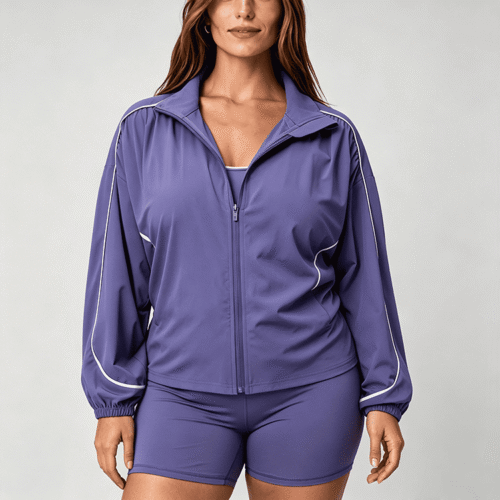
Custom Plus Size Activewear Set OEM ODM Zip-Up Workout Tracksuit
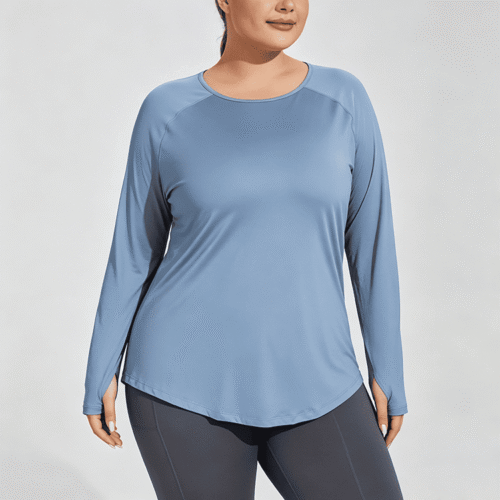
Custom Plus Size Activewear Top OEM ODM Long Sleeve Workout Shirt
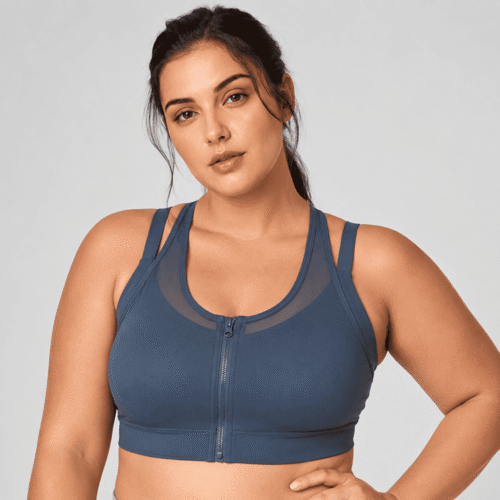
Custom Plus Size Front Zip Sports Bra OEM ODM High Support Activewear
Custom Plus Size High Waist Biker Shorts OEM ODM Activewear
Custom Plus Size High Waist Biker Shorts OEM ODM Workout Shorts
Custom Plus Size High Waist Biker Shorts OEM ODM Yoga Shorts
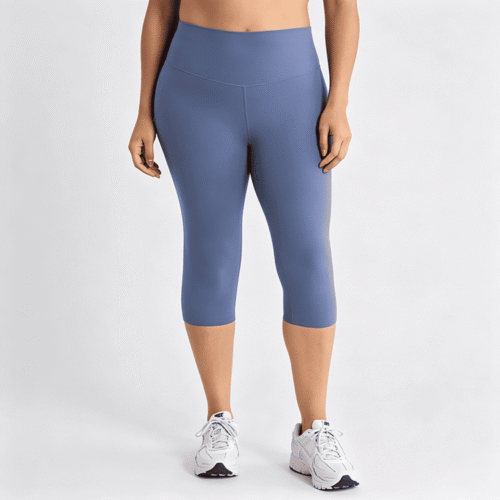
Custom Plus Size High Waist Capri Leggings OEM ODM Yoga Pants
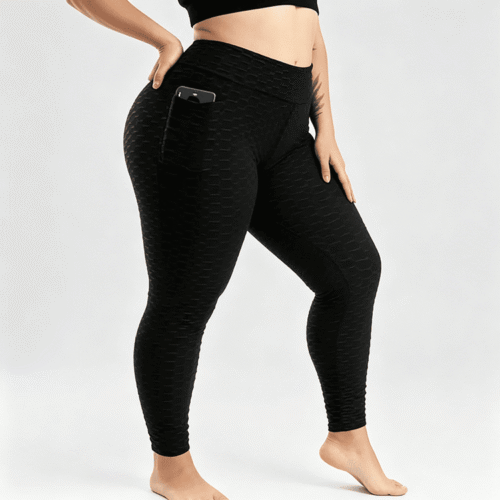
Custom Plus Size Pocket Yoga Leggings OEM ODM High Waist Workout Pants
What Type of Equestrian Company Are You Actually Buying From?
Equestrian companies can operate as consumer brands, specialist manufacturers, direct factories, trading companies or broader activewear suppliers with an equestrian division. These business models are not interchangeable. Before comparing MOQ, price or sample lead time, buyers should identify who develops the product, who controls production, where technical responsibility sits and whether the company actually supports custom manufacturing. This first distinction can prevent buyers from comparing suppliers that perform completely different roles.
A search for equestrian companies can produce businesses that look surprisingly similar online. Most show polished riding apparel, technical fabrics and professional equestrian imagery. Behind those websites, however, the commercial structures may be very different.
One company may design and sell its own branded riding products but have no interest in manufacturing for another label. Another may operate production lines and accept OEM projects from a Tech Pack. A third may coordinate orders through partner factories. A fourth may be a general performance-apparel manufacturer capable of making riding products but without a dedicated equestrian production system.
None of these models is automatically good or bad.
The important question is whether the model matches what you are actually trying to buy.
Equestrian Brand vs Manufacturer vs Factory vs Trading Company: What Is the Difference?
An equestrian brand primarily creates and markets products under its own identity. Its value may come from design, community, retail distribution, rider sponsorship or market reputation. Buyers can study successful brands for product positioning and market direction, but that does not mean those brands provide private label manufacturing.
An equestrian manufacturer develops or produces products for other businesses. Depending on its structure, it may offer pattern development, material sourcing, sampling, OEM, ODM, private label production and bulk manufacturing.
A factory refers more specifically to the physical production operation. Buyers should still ask what processes happen inside that facility. Having sewing machines does not mean every process shown in a catalog is completed internally.
A trading company normally coordinates sourcing between buyers and one or more factories. This model can be useful when the buyer needs a broad product range, multiple material sources or consolidated purchasing. The disadvantage is that the buyer may have less direct visibility into the production source unless the supply chain is transparent.
There is also a fifth model that matters in modern riding apparel: the multi-category functional sportswear manufacturer.
These suppliers may produce yoga leggings, running apparel, jackets and equestrian clothing within the same manufacturing organization. For certain products, that crossover can be valuable because riding apparel increasingly uses performance fabrics and construction methods that also appear in premium activewear.
The mistake is assuming that every company using the word “equestrian” provides the same capability.
Which Type of Equestrian Companies Actually Develop Riding Apparel?
For a custom riding-apparel project, buyers should look for equestrian companies that can demonstrate relevant product development rather than simply display finished garments.
Useful evidence may include:
Existing breeches, riding tights, base layers, riding tops or jackets
Pattern and size-grading capability
Knowledge of high-stretch performance fabrics
Experience with knee grip and full-seat silicone applications
Riding-specific pocket and waistband construction
Sample fitting and revision procedures
Custom labels, trims and packaging
PP sample approval before production
In-line and final quality inspection
Records that can support repeat production
The distinction between selling a riding garment and developing one is important.
Suppose a buyer wants a pair of full-seat breeches with a high-rise waistband, two phone pockets, custom silicone artwork and a specific nylon-elastane fabric. The project is not solved by finding a supplier with a visually similar pair of pants.
The manufacturer has to translate those requirements into a reproducible specification.
Pocket position needs to work with riding movement. Grip artwork needs to be positioned consistently. Fabric recovery needs to support the intended fit. Waistband construction must remain stable when the rider bends at the hip. Stitching has to tolerate repeated stretch.
These are development questions, not catalog questions.
Manufacturer vs Brand: Who Controls Product Development and Production?
A strong consumer brand can be an excellent reference for understanding what riders currently buy. It does not automatically make that company the right sourcing partner.
This is particularly important when researching well-known equestrian companies online. Brand popularity measures market success; it does not directly measure OEM capability.
For a B2B sourcing project, ask where responsibility sits for five functions:
Function What the Buyer Should Establish
Product Development Who creates or modifies the pattern and construction?
Material Sourcing Who controls fabric, grip, trims and replacement materials?
Sampling Who makes the sample and manages revisions?
Bulk Production Which facility actually produces the order?
Quality Control Who checks the product and records corrective actions?
This information becomes especially important when something changes.
Imagine that an approved fabric becomes unavailable before a repeat order. Who proposes the replacement? Who checks whether its stretch and recovery affect the fit? Who approves the new material before production?
Or suppose the bulk grip begins peeling during an in-line test. Who has the authority to stop the process and correct the application parameters?
The more customized the product becomes, the more important these responsibilities are.
When Is a General Activewear Factory Suitable for Equestrian Products?
A general functional-apparel manufacturer can be a practical choice when its existing technical capability overlaps strongly with the riding product being developed.
This is especially relevant to riding leggings, training tops, base layers, lightweight jackets and other performance-led products.
Modern riding tights share several manufacturing requirements with high-performance leggings:
- Four-way stretch
- Strong fabric recovery
- Moisture management
- Flat or low-bulk seams
- Secure phone pockets
- Waistband stability
- Body-contoured patterns
- Stretch-compatible branding
A capable activewear manufacturer may already understand these materials and construction methods.
Brands developing riding tights as a core category can also review how a specialized Horse Leggings Manufacturer approaches riding-specific fit, fabric recovery, grip development, pocket placement and private label production.
However, there is an important boundary.
Riding tights are not simply yoga leggings with silicone added.
The rider spends extended periods with the hip and knee flexed. The inner leg interacts with the saddle. Phone-pocket placement can affect comfort. Grip distribution changes saddle contact. Lower-leg construction has to work inside riding boots.
A general sportswear factory therefore becomes a stronger candidate only when it can adapt its technical knowledge to riding-specific movement and contact conditions.
For buyers developing equestrian apparel alongside fitness or lifestyle products, a multi-category manufacturer can offer another advantage: fewer supply-chain relationships. One development team may be able to coordinate riding leggings, training tops, sports bras, jackets and other functional apparel while maintaining related fabric and branding directions.
The trade-off is specialization. Buyers should verify actual equestrian samples and production experience instead of assuming that good activewear automatically means good riding apparel.
When Does a Specialist Equestrian Manufacturer Make More Sense?
A specialist manufacturer becomes more valuable as the product moves further away from general activewear construction.
Consider:
Competition breeches with complex grip placement.
Fit, saddle contact and traditional riding proportions become central.
Structured show jackets.
The manufacturer must understand tailoring, shoulder movement, sleeve position and how the jacket behaves while the rider is mounted.
Buyers developing technical outerwear can further compare how a Jackets for Riding Horses Manufacturer manages riding posture, weather protection, fabric selection, layering requirements and movement before approving the final jacket specification.
Collections combining rider and horse products.
A specialist supplier with saddle pads, horse boots or other adjacent products may simplify category sourcing.
Specialization is particularly useful when a buyer does not yet know every technical answer.
If a detailed Tech Pack already specifies every measurement, material, seam and tolerance, a technically disciplined factory may be able to execute it even if its equestrian specialization is narrower.
If the buyer arrives with only a reference image and says, “We want premium full-seat breeches for European riders,” more category-specific development knowledge is required.
That difference should influence supplier selection.
Why Should Buyers Identify the Business Model Before Comparing Price?
Because price is meaningful only when the buyer understands what is included in it.
Consider three quotations for what appears to be the same riding tight:
| Supplier | Unit Price | What Is Included |
|---|---|---|
| Supplier A | $14.80 | Existing pattern, available fabric, stock color, standard packaging |
| Supplier B | $17.20 | Pattern adjustment, Pantone color, custom grip, private label package |
| Supplier C | $19.50 | New pattern, custom-developed fabric, testing, custom trims, retail packaging |
Supplier A looks like the cheapest choice from the quotation.
But if the brand actually needs the product specification shown under Supplier C, then Supplier A is not quoting based on the same product requirements.
This is why experienced buyers should first compare whether the commercial inputs are the s
Before treating one quotation as cheaper, align:
Product specification → Fabric → Color → Construction → Grip → Branding → Packaging → Quantity → Size ratio → Testing → Delivery terms
Only then does the unit price become useful.
The same principle applies to MOQ. One of the equestrian companies on a shortlist may offer 100 pieces when the buyer uses available fabric colors but require 300 pieces for custom dyeing. Another may allow 100 pieces per style but require 50 pieces per color. A third may accept a low garment quantity while a custom zipper or silicone component carries its own supplier minimum.
The headline number does not tell the whole story.
For B2B buyers, understanding the company type first creates a much cleaner comparison of price, MOQ, sample responsibility and manufacturing risk.
Why Are Buyers Choosing Chinese Equestrian Manufacturers?
Buyers choose Chinese equestrian manufacturers not only for price, but for access to established apparel supply chains that can combine technical fabrics, pattern development, silicone grip, trims, branding, packaging and scalable production. China can be particularly suitable for private label and growing brands when the manufacturer offers relevant equestrian experience, flexible development support and commercial terms that match the order. The advantage depends on supply-chain fit, not simply country of origin.
China has become deeply integrated into the global performance-apparel supply chain, but “made in China” is too broad to function as a sourcing strategy.
A buyer still needs to determine where the factory is strong, which products it routinely makes, which processes it controls and whether its commercial model fits the brand.
This matters because the requirements of an equestrian collection can be surprisingly diverse. One style may need high-recovery stretch fabric and silicone grip. Another may require softshell fabric, water resistance and technical zippers. Competition apparel may place greater emphasis on fit, structure and finishing.
The advantage appears when a manufacturer can coordinate these requirements without forcing the buyer to manage every material and subcontracting relationship separately.
Why Does China Have an Advantage in Custom Equestrian Apparel Supply Chains?
One practical advantage is supplier density.
Major garment-production regions such as Guangdong and Fujian connect garment factories with fabric mills, dyeing facilities, printing and embroidery suppliers, trim producers, packaging companies and export logistics networks.
For a custom brand, this can reduce friction during development.
A typical riding-apparel project may involve:
Pattern → Fabric → Color → Grip → Sewing → Logo → Labels → Packaging → Inspection → Shipping
Each arrow represents a possible point of delay or miscommunication.
A manufacturer with established relationships across these stages can coordinate them more efficiently than a buyer sourcing every component independently.
For example, Pair Fashion operates from Dongguan and integrates fabric sourcing, pattern and sample development, custom trims, printing and embroidery, production, QC, packaging and international logistics within its service structure. Brands that need this type of coordinated development can work with an experienced custom equestrian apparel manufacturer rather than managing each stage through separate suppliers.
The value is not that every process must physically happen under one roof. In apparel manufacturing, specialized processes are often handled by established partner facilities.
The important question is:
Who controls the specification and takes responsibility for the finished result?
What Types of Equestrian Clothing Can Chinese Manufacturers Produce?
The range can extend from relatively simple training pieces to highly technical riding apparel.
Common categories include:
- Riding breeches
- Full-seat and knee-grip breeches
- Riding tights and leggings
- Jodhpurs
- Competition shirts
- Training tops and base layers
- Polo shirts
- Show jackets
- Softshell riding jackets
- Insulated winter jackets
- Wind-resistant riding outerwear
- Riding vests
- Children’s riding apparel
- Club and team clothing
Buyers who are still deciding between breeches, jodhpurs and riding tights can first understand What Are Horseback Riding Pants Called and how each riding-pants type affects fit, fabric, grip and product development requirements.
The more important question is not whether a supplier says it can produce a category.
It is whether it can demonstrate the relevant construction knowledge for the exact product.
For riding breeches, ask about fabric recovery, seam placement, waistband structure and grip.
For a show jacket, ask about shoulder mobility, sleeve angle, back-hem behavior and structured construction.
For winter outerwear, ask about shell fabric, insulation, breathability, weather protection and movement.
Different products require different manufacturing evidence.
China vs Europe: Which Manufacturing Model Fits Different Equestrian Brands?
The useful comparison is not China good, Europe bad or the reverse.
European production may be attractive when a brand values geographic proximity to its core market, specific regional craftsmanship, shorter physical communication distances or a particular country-of-origin positioning.
China can become attractive when the brand needs broader material sourcing, flexible custom development, integrated trims and branding, competitive scaling economics and access to established performance-apparel production clusters.
The correct decision depends on the business.
A premium European label producing a small, locally marketed heritage collection may value nearby specialist manufacturing more than unit economics.
A growing DTC brand selling internationally may place more weight on custom development, material options, repeat-order capacity and the ability to scale from a controlled trial order.
A retailer sourcing multiple private label categories may value supplier consolidation.
Country comparison should therefore come after the product and commercial requirements are defined, not before.
How Do Fabric, Grip, Trims, Labels and Packaging Affect Supplier Choice?
A garment manufacturer does not work in isolation.
This becomes obvious as soon as a buyer moves beyond a basic blank product.
Take a custom riding breech:
The buyer chooses a nylon-elastane fabric. The fabric needs the right weight, stretch and recovery. A Pantone color may require dyeing. The silicone grip needs artwork, placement and adhesion testing. The waistband may require internal elastic. Pockets need stable openings. A heat-transfer logo must stretch without cracking. Care labels, size labels and hangtags must follow the brand system. The finished product then needs retail or e-commerce packaging.
Each decision creates another specification that has to survive the transition from sample to bulk production.
Strong equestrian companies do not simply say, “Yes, we can customize.”
They clarify what is being customized, what minimum applies, what needs approval and how the approved specification will be controlled in production.
This is also why private label should not be reduced to adding a logo.
A serious private label program can include:
- Custom pattern and fit
- Fabric composition and weight
- Pantone color
- Grip pattern
- Pocket configuration
- Stitching details
- Zippers and hardware
- Heat-transfer or embroidered branding
- Main label and care label
- Hangtags
- Polybags or retail packaging
- Carton markings
For textile safety requirements, buyers can also use OEKO-TEX® STANDARD 100 as an external reference when evaluating whether textile materials and garment components have been tested for harmful substances.
The more of these variables change, the more important the development process becomes.
Is China Always the Lowest-Price Manufacturing Option?
No.
A Chinese quotation can be highly competitive, but the lowest unit price should never be assumed before the product specification and order structure are known.
Small custom orders can carry higher per-piece costs because development, cutting, setup, printing and quality-control work are spread across fewer garments.
Custom-dyed fabric may introduce a mill minimum. Special hardware may need a supplier MOQ. Complex grip can add tooling or application cost. Recycled or tested technical fabrics can cost more than basic stock materials.
Shipping, duties, testing and inventory exposure also matter.
A useful comparison therefore looks at total commercial commitment, not only FOB unit price.
That may include:
Sample charges + Product cost + Fabric minimums + Customization + Testing + Packaging + Freight + Duties + Inventory risk
A supplier offering a garment at $1 less per piece may not be cheaper if the order requires substantially more inventory than the brand can sell.
Likewise, paying slightly more per piece can be commercially sensible when it allows a new brand to test demand with a smaller, better-controlled first order.
When Does a Chinese Manufacturer Make More Sense for Private Label?
Chinese manufacturing becomes particularly relevant when a buyer needs several of the following at the same time:
- Custom product development rather than stock wholesale
- Multiple technical fabric options
- Private label trims and packaging
- Low-to-medium initial quantities
- Several related styles
- OEM or ODM flexibility
- Repeat-order scalability
- Export experience
- Coordinated sourcing
- Cost optimization across different materials and processes
For a new brand, the ideal supplier may help turn a concept into a production-ready product.
For a growing brand, the priority may shift toward repeatability, replenishment and capacity.
For a mature buyer, the focus may move further toward quality records, annual production planning, supplier consolidation and risk management.
This is why the same manufacturer can be a strong partner at one business stage and an unsuitable partner at another.
Why Do Growing Brands Need More Than a Low Factory Price?
Because the cost of a sourcing failure can quickly exceed the saving from a cheaper quotation.
Imagine a brand saves $1.20 per pair on 500 riding breeches.
The apparent saving is $600.
Now imagine the waistband measurement changes during bulk production and 15% of the order generates returns or customer complaints. The financial effect can include:
- Unsellable inventory
- Return shipping
- Refunds
- Customer-service time
- Discounting
- Replacement production
- Missed launch dates
- Damage to product reviews
- Lost repeat customers
The original $600 saving becomes irrelevant.
This is why experienced buyers gradually move from asking:
“What is your best price?”
to asking:
“Can you reproduce what we approved?”
The stronger equestrian companies support this through controlled references such as an approved sample, PP sample approval, locked measurements and materials, in-line inspection, final quality records and retained product specifications for repeat orders.
A manufacturer does not need the most sophisticated digital system in the industry to achieve this. What matters is whether the control loop actually works:
Requirement → Approval → Production Check → Record → Correction → Recheck
For brands planning more than one order, this repeatability can be more valuable than a small difference in initial unit price.
The right sourcing decision therefore combines product capability, commercial fit and production control. Price remains important, but it belongs inside that decision rather than controlling it.
When a brand needs to move from product concept through sampling and into repeatable private label production, an experienced equestrian apparel manufacturing partner can help connect development decisions with the controls required for bulk manufacturing.

Which Equestrian Companies Fit Different Markets and Business Models?
The best equestrian companies depend on how the buyer sells, what product is being developed and how quickly the business needs to scale. Startups often need flexible MOQ and stronger development support, while established brands may prioritize bulk repeatability, capacity and supply stability. Wholesalers usually value product breadth and replenishment, whereas premium riding brands may give greater weight to technical fabrics, fit, construction and product differentiation.
A supplier can be technically capable and still be commercially wrong for a particular buyer.
This is one of the most overlooked parts of supplier selection. Buyers often create a shortlist based on similar products, request quotations and then rank suppliers by price. But two factories that can both make riding breeches may be designed to serve very different customers.
One may work efficiently with small private label launches. Another may be structured around larger recurring programs. A third may be particularly strong in technical outerwear but less attractive for a simple riding-legging collection.
The useful question is not just “Can this factory make it?”
It is also:
“Does this supplier’s operating model fit the way our business buys, launches, sells and reorders products?”
Which Equestrian Company Is Best for a Startup Brand?
A startup normally benefits from a manufacturer that can work with incomplete product information, controlled first-order quantities and a realistic development process.
New brands frequently begin with a concept rather than a complete technical package. They may have reference images, a preferred silhouette, fabric ideas and a target retail price but still need help translating these inputs into measurements, construction details and production specifications.
For this buyer, development support can be more valuable than a very large production capacity.
Useful capabilities include:
- Development from sketches, reference images or original samples
- Fabric recommendations based on product use
- Pattern development and fit adjustment
- Clear sample revision procedures
- Private label and packaging support
- A manageable first-order MOQ
- The ability to scale successful products later
MOQ deserves particular attention.
A startup should not automatically choose the smallest advertised MOQ. If a supplier accepts 50 pieces but requires the buyer to use a fixed pattern, stock fabric and standard color, while another accepts 100 pieces with meaningful fit and branding customization, the second offer may provide greater value for a brand trying to create a differentiated product.
The better first order is usually one that gives the buyer enough customization to test the intended product without creating unnecessary inventory exposure.
For this reason, some equestrian companies are better suited to startup development than others even when their unit prices are similar.
Which Manufacturer Fits a Growing DTC Equestrian Brand?
A growing DTC brand faces a different problem.
The question is no longer simply whether it can launch a product. It needs to launch again and again without losing the characteristics that made the original product successful.
Suppose a riding tight performs well through a Shopify store. Customer feedback confirms that riders like the waistband, phone-pocket position, fabric hand feel and grip level.
The next order needs to reproduce those features.
At this stage, supplier selection should place more weight on:
Approved specifications → Material references → Pattern retention → Color consistency → Production records → Replenishment lead time
The manufacturer should also be able to manage product evolution.
A successful riding tight may lead to a second color, a winter-weight version, a matching base layer or a revised pocket. Growing brands therefore benefit from suppliers that can distinguish between controlled product extension and unnecessary redevelopment.
If every reorder starts from zero, growth becomes slow and expensive.
A manufacturer that retains approved patterns, specifications and material references can reduce this friction. Pair Fashion, for example, maintains product development and pattern records to support subsequent production, while its business model covers sample development, bulk manufacturing and repeat-order programs.
For a DTC buyer comparing equestrian companies, this type of continuity may matter more than saving a small amount on the first quotation.
What Should Established Equestrian Brands Look For?
Established brands normally have clearer standards and less tolerance for production variability.
They may already provide:
- Complete Tech Packs
- Graded measurement charts
- Approved material specifications
- Color standards
- Construction requirements
- Packaging instructions
- Testing requirements
- Inspection criteria
- Delivery windows
The supplier’s job is therefore different.
An established buyer may not need a factory to explain what a Tech Pack is. It needs the factory to follow the Tech Pack accurately, identify risks before production and document deviations when they occur.
Capacity also becomes more important.
A manufacturer may produce an excellent 200-piece order but struggle when several styles enter production at the same time. Buyers planning seasonal launches should ask how capacity is allocated, how peak periods are managed and whether one delayed material can disrupt the entire production schedule.
The stronger supplier is not necessarily the factory claiming the highest theoretical monthly capacity. Buyers should look for usable capacity for their specific product at the time they need it.
For mature brands, production discipline often matters more than development enthusiasm.
Which Supplier Model Works for Wholesalers and Regional Distributors?
Wholesalers usually face a different commercial equation from DTC brands.
A DTC company can build a collection around a few hero products. A distributor may need enough range to supply several retail customers with different price points and product preferences.
That increases the value of:
- Broader product coverage
- Multiple material and price options
- Efficient repeat orders
- Stable sizing
- Commercial packaging
- Consolidated production
- Reliable seasonal delivery
A distributor may also prefer a supplier that can offer an entry-level, mid-range and higher-specification version of a similar product.
For example, three riding-breech programs could use different fabric, grip and finishing specifications while sharing a related silhouette. This allows the distributor to serve several customer segments without building completely separate supply chains.
However, broad catalogs create another risk.
More products do not automatically mean deeper manufacturing capability.
Wholesalers should ask which categories are produced regularly, which are sourced through partners and which have enough repeat-order history to support reliable replenishment.
This is particularly important when comparing broad equestrian companies with specialist apparel manufacturers.
What Do Riding Clubs and Competition Programs Need?
Clubs often value consistency, identification and practical ordering more than extensive fashion development.
Typical requirements may include:
- Team colors
- Embroidered or printed club logos
- Riding tops
- Competition shirts
- Jackets or vests
- Breeches
- Size ranges for multiple riders
- Repeat orders for new members
The commercial challenge is that club orders can involve many sizes and relatively few units per size.
A supplier may accept the total order quantity but still have minimums for each color, fabric or custom trim. These conditions should be confirmed before the club finalizes the design.
Competition-oriented programs can also have more specific fit and appearance requirements than everyday training apparel. A manufacturer should understand which elements are purely visual and which affect movement or competition use.
Which Manufacturer Fits Premium vs Mid-Market Riding Apparel?
Target retail price should influence supplier selection before sampling begins.
A premium product may justify:
- Higher-grade nylon or recycled performance fabric
- More refined fabric hand feel
- Complex silicone artwork
- Higher-quality zippers and trims
- Detailed embroidery or heat-transfer branding
- More sample revisions
- Functional testing
- Premium retail packaging
Brands sourcing recycled performance fabrics can refer to the Global Recycled Standard when they need a recognized framework for recycled-material verification, chain of custody and related processing requirements.
A mid-market product may use a simpler specification while still maintaining reliable fit, construction and durability.
Neither strategy is inherently better.
The mistake is developing a premium specification and then forcing the manufacturer to meet a budget designed for a basic product.
A useful development discussion connects three variables:
Target Customer ↔ Product Specification ↔ Target Cost
If one changes, at least one of the others may need adjustment.
For example, replacing a premium custom-dyed fabric with an available color may reduce cost without changing the pattern. Simplifying silicone artwork may reduce processing expense. Using standard packaging may preserve money for a better fabric.
A capable supplier should help the buyer understand these trade-offs rather than simply remove quality until the quotation reaches the requested price.
How Does Your Sales Channel Change the Best Supplier Choice?
The same riding garment can require a different supply model depending on where it is sold.
DTC e-commerce often benefits from smaller launches, frequent product updates and fast replenishment.
Wholesale may require stronger size consistency, commercial pricing and predictable delivery windows.
Boutique retail may prioritize distinctive materials, details and smaller curated collections.
Regional chains may require structured packaging, testing documentation and more formal quality procedures.
Clubs and teams may prioritize customization and repeat access to the same product.
This is why the word best should always have a buyer attached to it.
The best manufacturer for a 120-piece DTC launch may not be the best manufacturer for a retailer ordering 8,000 pieces across several colors.
When evaluating equestrian companies, buyers should therefore score commercial compatibility separately from technical capability.
A supplier can score highly on both, but they are not the same thing.
How Should Buyers Compare Price, MOQ, Sample and Custom Capability?
Buyers should compare price and MOQ only after equestrian companies are quoting the same product specification, quantity, materials, colors, branding, packaging and delivery terms. Sample quality should then be evaluated against the intended bulk standard, not simply appearance. The strongest commercial offer is the one that balances total order commitment, useful customization, sample execution, production risk and repeat-order potential rather than presenting the lowest headline price.
Price, MOQ and lead time are easy to place in a spreadsheet.
That is exactly why they can become misleading.
A number looks objective even when the conditions behind it are different.
The most reliable supplier comparison therefore starts by standardizing the input before comparing the output.
What Is a Reasonable MOQ for Custom Equestrian Apparel?
There is no single correct MOQ for custom equestrian clothing.
The commercial minimum depends on what the buyer is asking the supplier to customize.
A relatively simple order using an existing fabric, available color and established pattern can often support a lower quantity than a project requiring custom dyeing, new fabric development, exclusive hardware or complex silicone artwork.
Consider this example:
| Order Structure | Example MOQ | Why It Changes |
|---|---|---|
| Existing fabric + available color | 100 pcs | Minimal material development |
| Existing fabric + multiple colors | 150–200 pcs | Color allocation affects cutting and material planning |
| Custom Pantone dyeing | 300 pcs | Fabric mill minimum becomes relevant |
| Custom-developed fabric | 500+ pcs | Yarn, knitting or finishing minimums may apply |
These quantities are illustrative rather than universal factory rules, but they show why asking only “What is your MOQ?” produces an incomplete answer.
A better question is:
“What is the MOQ for this specification, and which part of the specification creates that minimum?”
That second question tells the buyer whether the MOQ can be reduced intelligently.
Why Can the Same Factory Have Different MOQs for Different Orders?
Because garment MOQ and material MOQ are not always the same.
A factory may be willing to cut and sew 100 pieces, while the fabric mill requires enough material for 300 pieces when producing a custom color.
The same problem can occur with:
- Custom zippers
- Branded elastic
- Metal hardware
- Silicone grip artwork
- Special reflective trims
- Custom packaging
- Exclusive fabric finishes
This does not necessarily mean the garment factory is being inflexible.
It may mean a component supplier further upstream has its own production minimum.
Buyers should therefore separate:
Garment MOQ / Color MOQ / Fabric MOQ / Trim MOQ
This gives a much clearer view of the real commitment.
It also creates room for practical solutions.
A brand might use an available fabric color for the first trial order and move to custom dyeing after demand is proven. Several styles may share one fabric to reach a mill minimum. A custom trim may be replaced with a standard component while keeping the visible branding unique.
Good sourcing decisions often come from understanding which requirement is creating the cost or minimum.
How Should Buyers Compare Price Between Equestrian Manufacturers?
Start by giving shortlisted factories the same commercial input.
At minimum, quotations should align on:
- Product specification
- Fabric composition and weight
- Required functional properties
- Color
- Quantity
- Quantity per color
- Size ratio
- Grip type and artwork
- Logo method
- Labels
- Trims
- Packaging
- Testing
- Incoterm
- Delivery destination or shipping basis
Without this alignment, the quotation comparison can produce false conclusions.
Suppose three equestrian companies quote the same riding breech:
| Supplier | Price | Quantity | Fabric | Grip | Branding |
|---|---|---|---|---|---|
| A | $16.20 | 100 | Stock fabric | Standard knee grip | Heat-transfer logo |
| B | $18.40 | 200 | Custom Pantone | Custom full seat | Labels + logo |
| C | $19.10 | 300 | Premium recycled fabric | Custom full seat | Full private label package |
Calling Supplier A “the cheapest” is technically true and commercially almost meaningless.
The buyer has not compared the same product.
The correct sequence is:
Align specification → Align commercial terms → Compare quotations
Only then should price become a major selection factor.
What Is Included in a Custom Equestrian Clothing Price?
A quotation can include much more than sewing.
Depending on the project, cost may reflect:
Fabric + Trims + Cutting + Sewing + Grip + Branding + Washing/Finishing + QC + Packaging + Production Overhead
The development cost may be quoted separately.
The sample fee may include pattern making, material sourcing, individual cutting, logo setup and courier cost. These costs are usually higher for one sample because sample production cannot get the same production efficiency as bulk orders.
Buyers should also clearly confirm what costs are not included in the quotation.
Common exclusions can include:
- Laboratory testing
- Custom fabric development
- Mold or artwork setup
- Premium packaging
- Third-party inspection
- Freight
- Duties and taxes
A low quotation can become expensive once these costs are added.
How Much Do Fabric and Grip Customization Affect Cost?
For riding bottoms, fabric and grip can materially change both cost and performance.
Fabric price is influenced by composition, weight, knitting structure, finishing, recycled content, testing and order volume.
But buying the most expensive fabric is not automatically the right decision.
The fabric needs to match the product.
A summer riding tight may prioritize breathability, low weight and moisture management. A competition breech may need a more structured appearance and stable recovery. A winter tight may need brushed warmth while maintaining enough stretch for riding movement.
Grip creates another layer.
The buyer needs to decide:
Knee grip or full seat?
Then:
How much grip? Where? What pattern? What silicone quality? What visual finish?
Too little grip may provide limited function. Too much can feel restrictive. A visually attractive grip pattern can still fail if adhesion or stretch compatibility is poor.
The manufacturer should therefore treat grip as a functional component integrated with fabric and fit, not simply a decorative print added at the end.
How Long Does an Equestrian Apparel Sample Take?
A relatively straightforward custom sample can often be developed within approximately one to two weeks, while more complex projects may take longer.
The more useful question is:
What has to happen before the sample is ready?
A sample based on an existing pattern and available fabric can move quickly.
A new product may require:
- Requirement review
- Pattern development
- Fabric sourcing
- Custom color or trim preparation
- Sample cutting and sewing
- Grip or logo application
- Internal inspection
- Shipment to the buyer
- Fit evaluation
- Revision
Fast sampling is valuable when the development input is clear.
Fast sampling is much less valuable when the supplier rushes an incomplete specification into a garment and creates another revision cycle.
The goal should therefore be fast, controlled sampling, not simply the lowest number of days.
What Should a Custom Sample Prove Before Bulk Production?
A sample should answer questions that photographs cannot.
For riding bottoms, buyers should evaluate:
- Waistband stability
- Front and back rise
- Hip and thigh fit
- Knee movement
- Inner-leg comfort
- Saddle-contact areas
- Pocket accessibility
- Phone security
- Grip position
- Grip level
- Lower-leg fit inside boots
- Fabric opacity under stretch
- Fabric recovery after wear
- Seam comfort
The sample should also establish a reference for production.
Once approved, key information should be recorded:
Measurements → Fabric → Color → Construction → Grip → Branding → Trims → Packaging
This becomes the basis for the PP sample and bulk production.
A common sourcing mistake is approving a sample visually while leaving several production details unresolved.
The garment looks right, so the buyer says “approved.”
But the zipper supplier is not confirmed. The bulk fabric lot has not been checked. The grip artwork is still being adjusted. The packaging has not been finalized.
That is not a fully locked production reference.
Do Low MOQ and Low Price Always Mean Lower Sourcing Risk?
No. Sometimes they reduce financial exposure; sometimes they simply move risk somewhere else.
A lower MOQ can be excellent for testing a new product because the brand carries less inventory.
But a very small production run may also result in:
- Higher unit cost
- Fewer custom material options
- Greater reliance on stock fabrics
- Less efficient cutting
- Higher trim costs
- Limited color flexibility
Similarly, a low unit price can protect margin, but only if the product remains sellable.
The better calculation is not:
Which factory has the lowest price?
It is:
What is the total risk-adjusted commitment required to launch this product successfully?
For a startup, inventory risk may deserve the highest weight.
For an established brand, inconsistent bulk quality may be a much larger risk.
For a retailer with a fixed launch date, delivery reliability may outweigh both.
This is why serious comparisons between equestrian companies should treat MOQ and price as decision variables rather than automatic winners.
What Does a Better Commercial Comparison Look Like?
A useful comparison can be reduced to five questions:
- Are all suppliers quoting the same product?
- What total quantity and cash commitment does each offer require?
- What customization is actually included?
- What does the sample prove about the intended bulk product?
- Can the supplier reproduce the approved result when the order scales?
A supplier does not need to win every category.
A manufacturer may have a slightly higher unit price but offer a lower practical inventory commitment. Another may require more units but provide stronger material options and better economics at scale.
The best equestrian companies are not necessarily those with the lowest MOQ, fastest sample or cheapest quotation. They are the suppliers whose commercial structure supports the product at its current stage while leaving a realistic path for future orders.
That is the difference between finding a factory for one purchase and finding a manufacturing partner that can support a product after customers start asking for it again.

How Do You Choose the Best Chinese Equestrian Company for a Long-Term Partnership?
Choosing the best Chinese equestrian company requires more than comparing catalogs, samples and quotations. Buyers should define the product and commercial requirements first, shortlist manufacturers with relevant evidence, align specifications before comparing price, test sample execution, verify bulk-production controls and then evaluate long-term scalability. The best partner is usually not the supplier that wins every category, but the one whose strongest capabilities match the requirements that carry the greatest commercial risk for your particular order.
By this stage, a buyer may have three or four apparently qualified suppliers.
All can make the product.
All have returned quotations.
Their samples may all look acceptable.
This is where supplier selection becomes more difficult.
A factory with the lowest price may require more inventory. A highly specialized manufacturer may have less flexibility. A supplier offering excellent development support may not have the capacity required two years later. Another may be designed for large programs but be inefficient for the buyer’s current order size.
The final decision therefore needs to connect today’s order with tomorrow’s realistic business requirements.
A structured eight-step process can make that decision more disciplined.
Step 1 — Define the Product, Customer, Market and Target Price
Do not begin by asking ten factories for their “best price.”
Begin with the product.
A useful sourcing brief should explain:
- Product type
- Intended rider or customer
- Target market
- Expected retail price
- Target quantity
- Size range
- Main functional requirements
- Fabric direction
- Branding requirements
- Packaging
- Target launch date
- Testing or compliance requirements
This does not mean every buyer needs a perfect Tech Pack before speaking with a manufacturer.
Early-stage brands may still be working from sketches, reference images, an existing garment or an initial concept. In that situation, the sourcing brief should clearly separate what is already decided from what still requires development.
For example:
Locked: High-rise full-seat riding breeches for women.
Preferred: Nylon-elastane fabric around a specific weight range.
Open for Development: Exact waistband construction, pocket dimensions and silicone pattern.
This helps manufacturers understand where they should follow instructions and where they are expected to contribute technical solutions.
It also makes quotations from different equestrian companies easier to interpret.
Step 2 — Shortlist Companies With Relevant Product Evidence
The first reduction should be relatively objective.
If the project requires a specialist process and one factory cannot demonstrate relevant capability, there is little value in keeping it on the shortlist simply because its quotation is attractive.
For riding breeches, evidence might include:
- Similar riding-bottom products
- Stretch-fabric experience
- Full-seat or knee-grip applications
- Appropriate pocket construction
- Relevant pattern development
- Riding-specific fit understanding
For a technical riding jacket, the evidence changes:
- Softshell or technical outerwear experience
- Zipper and hardware construction
- Weather-resistant materials
- Lining or insulation capability
- Riding-position mobility
- Sleeve and back-hem construction
This is why buyers should avoid a generic factory score.
Relevant capability matters more than total capability.
A factory may be excellent at producing 500,000 cotton T-shirts a month and still be the wrong manufacturer for a technically demanding equestrian jacket.
Step 3 — Verify the Business Model and Manufacturing Role
Once a supplier appears technically relevant, determine what role it actually performs.
Ask:
- Is this a direct manufacturer?
- Which facility will produce my order?
- Is product development internal?
- Who makes the pattern?
- Who sources the fabric?
- Which processes are subcontracted?
- Who controls subcontracted processes?
- Who performs final inspection?
- Who is responsible if the approved specification changes?
Subcontracting is not automatically a problem.
Modern garment manufacturing often relies on specialist partners for dyeing, printing, embroidery, silicone application, washing or testing.
The risk comes from unclear responsibility.
If silicone grip is outsourced, for example, the buyer should know who approves the artwork, who controls placement, who verifies adhesion and who responds if the bulk result differs from the approved sample.
The manufacturer does not need to own every machine.
It does need to control the finished product.
Step 4 — Align Specifications Before Comparing Quotations
Once the shortlist has been reduced, ask the remaining suppliers to quote the same commercial input.
A useful quotation comparison should align:
Style + Fabric + Color + Quantity + Size Ratio + Construction + Grip + Branding + Trims + Packaging + Testing + Incoterm
If one supplier quotes 500 pieces using available black fabric and another quotes 500 pieces using custom Pantone dyeing, the prices are not directly comparable.
If one quotation includes custom labels, hangtags and retail packaging while another includes only a plain polybag, they are not directly comparable.
If one price is EXW and another is FOB, they are not directly comparable.
This sounds basic, but quotation misalignment is one of the easiest ways for a buyer to choose the wrong supplier.
A lower number can appear more attractive simply because less product is included in the number.
When comparing equestrian companies, normalize the quotation first.
Then compare price.
Step 5 — Develop and Evaluate Samples
The sample stage should test both the product and the supplier.
The product test asks:
Does the garment meet the requirement?
The supplier test asks:
Can this company manage development in a controlled way?
Watch what happens when the first sample is not perfect.
That is often more revealing than a first sample that happens to go well.
Does the supplier understand the feedback?
Does it distinguish measurement changes from pattern changes?
Does it update the specification?
Does the second sample correct the first problem without creating three new ones?
Does it warn the buyer when a requested change creates another technical risk?
A good development partner does not simply say “yes” to every request.
Sometimes the professional answer is:
“We can do this, but it may affect stretch.”
or
“This pocket position may interfere with the saddle-contact area.”
or
“This fabric can achieve the hand feel, but the MOQ will increase because it requires custom dyeing.”
That kind of response helps the buyer make a better product.
For brands needing support from concept through sampling and bulk production, working with a specialist equestrian clothing manufacturer can reduce the gap between the original design intention and the production-ready specification.
Step 6 — Compare MOQ, Price and Commercial Conditions
At this point, the buyer has enough information to compare the commercial offer properly.
Do not evaluate MOQ and price separately.
Look at them together.
Consider three suppliers:
| Supplier | MOQ | Unit Price | Total Product Commitment | Commercial Situation |
|---|---|---|---|---|
| A | 100 pcs | $21.50 | $2,150 | Lower inventory risk |
| B | 300 pcs | $18.80 | $5,640 | Better unit economics |
| C | 500 pcs | $17.40 | $8,700 | Stronger scale economics |
Which is best?
There is no universal answer.
For a startup testing a new style, Supplier A may be commercially safer even though it has the highest unit price.
For a proven bestseller with reliable monthly demand, Supplier C may create better margin.
This is why low MOQ and low price solve different problems.
MOQ affects inventory exposure.
Unit price affects product margin.
The correct balance depends on sales confidence.
Buyers should also include:
- Sample fees
- Pattern charges
- Fabric minimums
- Color minimums
- Trim minimums
- Testing costs
- Packaging
- Freight
- Payment terms
A slightly higher unit price can be a better commercial offer if it substantially reduces the total cash commitment required to test a product.
Step 7 — Verify Bulk Quality and Supply Stability
Before scaling an order, determine how the approved sample becomes a controlled production reference.
A practical sequence is:
Approved Sample → PP Sample Approval → Locked Specifications → Bulk Materials → Production → In-Line Inspection → Final Inspection → Packing
The exact terminology varies between equestrian companies, but the principle is important.
The factory needs a stable answer to:
“What exactly are we reproducing?”
This can include:
- Approved pattern
- Measurement chart and tolerances
- Fabric article
- Approved bulk color
- Grip artwork and position
- Stitching
- Logo
- Labels
- Trims
- Packaging
If any of these change after approval, the change should be controlled.
Supply stability also deserves separate attention.
Ask what happens when:
- Bulk fabric is delayed
- Fabric color differs from approval
- A zipper becomes unavailable
- A sewing problem appears mid-production
- Grip fails an internal check
- A production line becomes overloaded
- A repeat order is placed six months later
The buyer is looking for evidence that the supplier can identify a problem, respond to it and prevent an uncontrolled product from continuing through production.
Step 8 — Score Long-Term Partnership Potential
Once technical, commercial and production evidence has been collected, a weighted scorecard can prevent one attractive factor from controlling the entire decision.
A useful starting framework is:
| Decision Factor | Suggested Weight | What Buyers Should Evaluate |
|---|---|---|
| Product Relevance | 20% | Experience with the exact product and construction |
| Development Capability | 15% | Pattern, fabric, technical problem-solving and customization |
| Sample Execution | 15% | Accuracy, revision quality and development discipline |
| Bulk Repeatability | 15% | Ability to reproduce approved specifications |
| Commercial Fit | 15% | MOQ, price, payment terms and order flexibility |
| Supply Reliability | 10% | Capacity, lead time, materials and delivery control |
| Communication | 5% | Accuracy, response quality and problem escalation |
| Growth Potential | 5% | Ability to support larger and more complex future programs |
| Total | 100% |
These weights should not be fixed for every buyer.
The value of a scorecard is not the mathematical appearance of precision. It is the discipline of deciding what matters before seeing which supplier scores highest.
How Should Different Buyers Change the Scorecard?
A startup may increase:
Development Capability + Commercial Fit
because the biggest risks are often product development and inventory exposure.
A premium technical brand may increase:
Product Relevance + Sample Execution + Bulk Repeatability
because a small deviation in fabric, fit or construction can undermine the product proposition.
A mature retailer may increase:
Bulk Repeatability + Supply Reliability
because the product is already proven and the larger risk is failing to deliver consistent volume.
A price-sensitive wholesaler may increase:
Commercial Fit
but should still set a minimum acceptable threshold for quality and production evidence.
This creates an important rule:
A high total score should never compensate for failure in a non-negotiable category.
Suppose Supplier A scores 86/100 overall but cannot meet a mandatory compliance requirement.
Supplier B scores 82/100 and meets it.
Supplier A does not become suitable simply because the spreadsheet total is higher.
What Does a Weighted Supplier Comparison Look Like?
Consider three hypothetical manufacturers:
| Factor | Weight | Supplier A | Supplier B | Supplier C |
|---|---|---|---|---|
| Product Relevance | 20% | 9 | 8 | 7 |
| Development Capability | 15% | 9 | 7 | 8 |
| Sample Execution | 15% | 8 | 9 | 7 |
| Bulk Repeatability | 15% | 7 | 9 | 9 |
| Commercial Fit | 15% | 9 | 7 | 8 |
| Supply Reliability | 10% | 7 | 9 | 9 |
| Communication | 5% | 9 | 8 | 7 |
| Growth Potential | 5% | 7 | 9 | 9 |
Supplier A looks attractive for a newer brand because it combines relevant product knowledge, development support and commercial flexibility.
Supplier B becomes more attractive when the buyer values bulk repeatability and supply reliability.
Supplier C may fit a growing program that needs strong scale potential but does not require intensive early-stage development.
The purpose is not to declare one factory objectively superior.
It is to make the trade-offs visible.
Which Supplier Weaknesses Are Acceptable?
This question is often more useful than asking which supplier has the most strengths.
Suppose a manufacturer has an MOQ of 300 pieces.
For an untested startup product, that may be a serious weakness.
For a retailer already selling 1,500 pieces per season, it may be irrelevant.
Suppose another manufacturer needs 14 days for a sample instead of seven.
For an urgent launch, that matters.
For a product planned six months ahead, it may not.
Supplier weaknesses become meaningful only when connected to the order.
A practical final review can classify each weakness as:
Acceptable / Manageable / High Risk / Disqualifying
This prevents buyers from rejecting a strong supplier over a minor disadvantage while overlooking a weakness that could actually damage the order.
Is the Best Manufacturer Always the Highest-Scoring Supplier?
No.
A weighted scorecard improves decision discipline, but it cannot create certainty.
Some risks are difficult to convert into numbers.
A supplier may respond exceptionally well when a sample problem occurs. Another may communicate perfectly during sales discussions but become slow once the deposit is paid. A third may score slightly lower overall but demonstrate unusually strong understanding of the buyer’s most technically difficult product.
The final decision should therefore combine:
Score + Evidence + Non-Negotiable Requirements + Product Risk + Commercial Judgment
The best manufacturer is not the supplier with the highest score in every category.
It is the manufacturer whose strengths match the requirements that matter most, whose weaknesses are acceptable for the order, and whose commercial model can support the next realistic stage of the brand.
How Do You Know Whether an Equestrian Company Has Long-Term Partnership Potential?
Long-term partnership potential becomes visible when a supplier can do more than complete the first purchase order.
A strong manufacturing relationship should become more efficient over time.
The supplier begins to understand:
- Your fit standards
- Your preferred fabrics
- Your branding rules
- Your packaging
- Your inspection expectations
- Your price architecture
- Your launch calendar
- Your recurring quality concerns
The buyer should also become better at providing forecasts, approvals and development information.
This creates a two-way improvement.
A good manufacturing partnership is therefore not based on the factory saying “We want long-term cooperation.”
It is demonstrated through repeatable behavior:
Accurate development → Controlled approval → Stable bulk production → Clear problem solving → Reliable reorder
For buyers comparing equestrian companies, this history is more valuable than a sales promise.
When Should Buyers Start With a Trial Order?
A trial order makes sense when the supplier has passed technical and sample evaluation but the buyer still needs evidence of bulk execution.
The quantity should be commercially meaningful without creating unnecessary exposure.
A trial order can test:
- Bulk fabric consistency
- Size grading
- Production-line execution
- Grip consistency
- Color control
- In-line QC
- Final inspection
- Packing accuracy
- Delivery performance
- Communication when problems occur
The objective is not simply to order fewer pieces.
It is to learn something before increasing commitment.
If the trial order performs well, the buyer has stronger evidence for the next order.
If problems appear, the important question becomes:
How does the supplier respond?
A production issue that is identified, documented, corrected and prevented from recurring can reveal a stronger quality system than a supplier that simply hides problems.
When Should a Buyer Scale the Order?
Scale after the supplier has demonstrated repeatability, not merely after the first sample looks good.
A sensible progression might be:
Development Sample → PP Sample → Trial Order → Bulk Review → Repeat Order → Larger Program
Not every business needs every stage, but the principle is useful.
Commitment should increase as evidence increases.
This is especially important for growing brands.
Moving directly from a good sample to a very large order may produce attractive unit economics, but it also concentrates risk before the supplier’s bulk performance has been tested.
Likewise, remaining at tiny quantities forever can prevent the brand from accessing better material economics and production efficiency.
The goal is controlled scaling.
How Should Buyers Make the Final Decision Between Equestrian Companies?
Before selecting the supplier, return to the original sourcing brief.
Ask:
Can they make the required product?
Can they prove relevant experience?
Did the sample meet the important requirements?
Are MOQ and price commercially workable?
Can they reproduce the approved standard in bulk?
Can they support realistic future order growth?
Are their weaknesses acceptable for this project?
If the answer to all seven is reasonably clear, the buyer has moved far beyond a superficial supplier comparison.
The final choice between equestrian companies should not be controlled by one impressive sample, one certificate, one low MOQ or one attractive quotation.
It should be based on how well the complete manufacturing system fits the product and the business behind it.
For brands planning custom breeches, riding tights, tops, jackets or broader private label collections, an experienced equestrian apparel manufacturing partner can support this progression from development and sampling through controlled bulk production and future repeat orders.
The strongest partnership is not necessarily the one that begins with the lowest price.
It is the one that makes the product easier to reproduce, the risks easier to manage and successful orders easier to repeat.
Trusted Manufacturing Standards For Global Sportswear Brands
We operate under internationally recognized quality, sustainability, and ethical manufacturing standards. Our certifications help ensure consistent product quality, responsible sourcing, and reliable production for global sportswear brands.
- 20+ Countries Served
- 6000+ Styles Developed
- 50,000 PCS Monthly Capacity
- 3-Day Sample Development
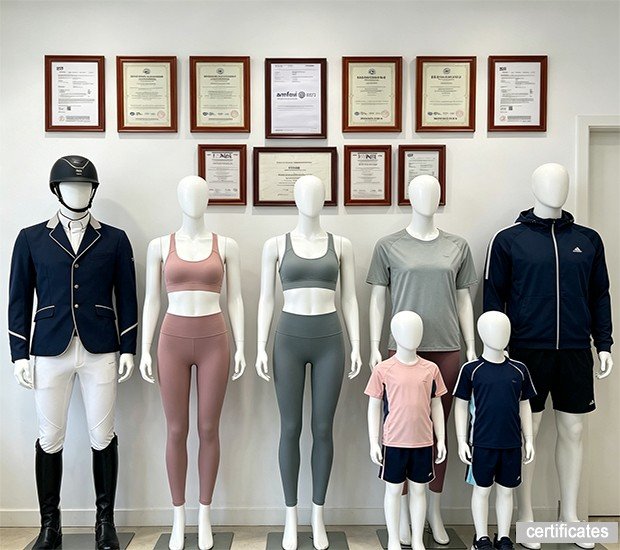
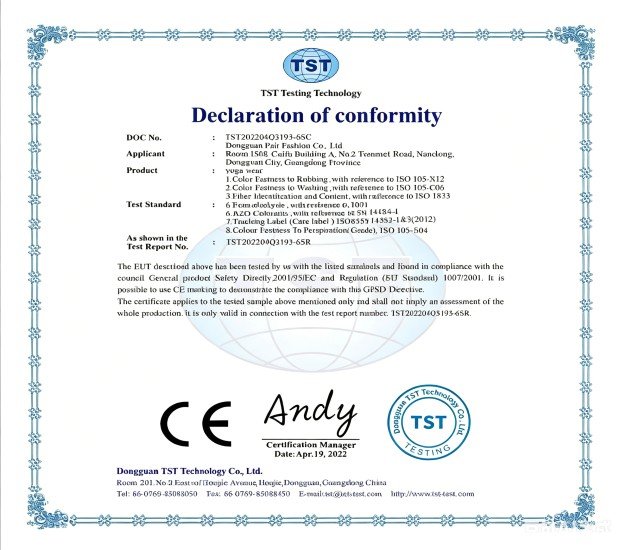
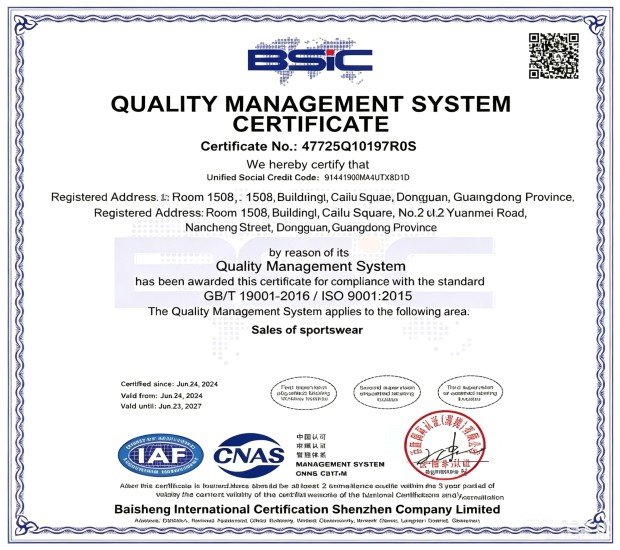
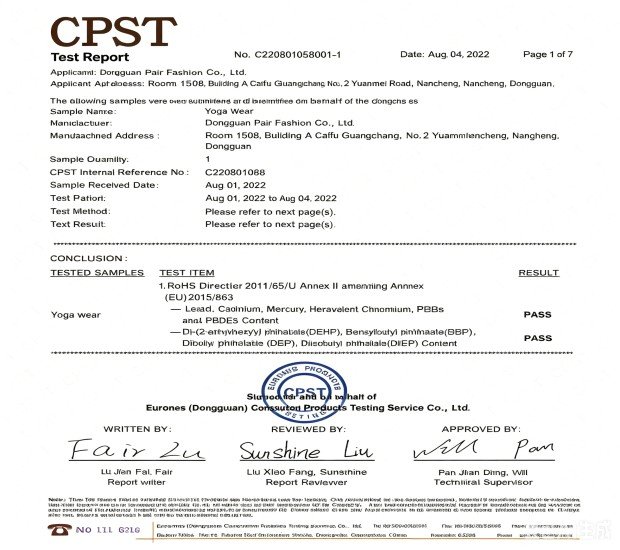
How Can Buyers Verify an Equestrian Manufacturer Before Placing an Order?
Buyers should verify an equestrian manufacturer through product-relevant evidence, sample execution, material knowledge, production controls and commercial consistency rather than relying on website claims alone. A useful verification process connects every important supplier claim to something the buyer can check: relevant products, factory information, approved specifications, test reports, sample performance, quality records or repeat-production procedures. The objective is not to eliminate every sourcing risk, but to identify important weaknesses before the bulk order begins.
Supplier verification becomes more difficult when several factories make similar claims.
Almost every supplier can say:
“High quality.”
“Professional manufacturer.”
“Fast delivery.”
“OEM/ODM available.”
“Strict quality control.”
These statements are useful introductions, but they are not enough to make a purchasing decision.
The buyer needs to move from Claim → Evidence.
If a manufacturer says it specializes in riding breeches, ask for evidence related to riding breeches. If it claims stable bulk quality, examine how approved specifications are transferred into production. If it promotes fast sampling, determine what that timeline includes and whether revisions are controlled.
This approach makes comparisons between equestrian companies more objective without pretending that supplier selection can be reduced to one score.
What Factory Evidence Should Buyers Request?
Start with evidence that is relevant to the product being sourced.
A buyer developing riding tights does not learn much from photographs of a factory producing cotton T-shirts. Likewise, a supplier may have impressive machinery without demonstrating that it routinely works with high-stretch fabrics, silicone grip or technical riding construction.
Useful evidence can include:
- Business and factory information
- Production-floor photographs or video
- Relevant production lines
- Pattern and sample room capability
- Similar equestrian products
- Fabric and trim records
- In-line inspection procedures
- Final inspection records
- Testing information
- Production capacity information
- Certification documents where relevant
- Examples of repeat production
Factory size should be interpreted carefully.
A larger factory can usually provide more production capacity, but a bigger factory size does not mean the supplier must have better product specialization or stricter quality control.
A smaller but more specialized manufacturer may understand technical riding products better than a large general garment factory. However, if the buyer’s order quantity grows very fast, a small specialized supplier may also face some limitations in production capacity.
The evidence should therefore answer two separate questions:
Can they make it correctly?
and
Can they make enough of it reliably?
Both matter.
How Can Buyers Verify Relevant Equestrian Production Experience?
Ask for evidence that matches the product architecture, not merely the product name.
If you are sourcing full-seat breeches, useful evidence may include experience with:
High-stretch fabric + Riding fit + Full-seat grip + Technical pockets + Boot-compatible lower legs
If you are sourcing a winter riding jacket, the relevant combination changes:
Technical shell + Insulation + Riding movement + Zippers + Weather protection + Functional pockets
This matters because two garments can belong to the same equestrian category while requiring very different manufacturing skills.
A supplier that has produced thousands of basic riding tights may still need additional development work for a structured competition jacket.
Buyers should also ask how often the relevant category is produced.
There is a difference between:
“We made something similar three years ago.”
and
“This is one of our regular production categories.”
When comparing equestrian companies, recurring category experience can reduce the number of problems that have to be discovered during your own order.
Which Certifications Matter and What Do They Not Prove?
Certifications can provide useful evidence about management systems, social compliance, material claims or specific product requirements.
Depending on the project, buyers may encounter standards or certifications related to:
- Quality management
- Social compliance
- Recycled materials
- Chemical requirements
- Product-specific conformity
- Customer-specific testing
For example, Pair Fashion lists ISO9001, BSCI, GRS, CE and ROHS among its company certifications and compliance documentation.
However, a certificate should be interpreted according to what it actually covers.
An ISO9001 quality-management certification can support confidence that a documented quality system exists. It does not prove that every pair of riding breeches leaving the factory will automatically fit correctly.
A recycled-material certification does not prove that the garment pattern is suitable for riding.
A social-compliance audit does not prove that silicone grip has good adhesion.
This leads to a useful purchasing principle:
Certification supports a claim. It does not replace product verification.
Buyers should check the certificate scope, validity and relevance instead of counting logos on a supplier page.
How Should Buyers Evaluate Fabric and Functional Test Reports?
Fabric is one of the most common areas where a technically acceptable sample can become a disappointing bulk product.
Two fabrics with the same stated composition can behave differently.
For example:
75% nylon / 25% elastane
does not tell the buyer everything about:
- Fabric weight
- Knitting structure
- Stretch direction
- Recovery
- Hand feel
- Opacity
- Pilling resistance
- Colorfastness
- Moisture behavior
- Dimensional stability
This is why experienced buyers approve more than a fiber-content label.
For technical projects, relevant testing may include fabric weight, colorfastness, dimensional stability, pilling, stretch and recovery, abrasion or other performance properties required by the product and target market.
The level of testing should match the risk.
A basic training top does not necessarily require the same verification program as a premium technical product with specific performance claims.
The goal is not to order every available laboratory test.
It is to identify which material failure would create the greatest commercial problem and verify accordingly.
What Should Buyers Check During Sample Development?
Sample development is one of the best opportunities to evaluate a supplier because it reveals more than the garment itself.
Pay attention to how the manufacturer handles uncertainty.
Does the supplier ask useful questions?
Does it identify conflicts in the Tech Pack?
Does it explain when a requested construction may not work with the selected fabric?
Does it record revisions?
Does the second sample actually correct the issues identified in the first?
These behaviors provide information about future production.
A useful sample review should cover four areas:
| Review Area | What to Check |
|---|---|
| Fit | Waist, hip, rise, thigh, knee, calf, sleeve or body proportions |
| Function | Movement, grip, pockets, saddle contact, boot compatibility |
| Construction | Seams, reinforcement, stitching, zippers, hems and trims |
| Appearance | Color, logo, grip artwork, finishing and overall balance |
For riding garments, the fit should be checked during actual riding movements, not only when the rider is standing.
A pair of breeches may look very good when the rider is standing, but some fit problems may still appear when the rider bends the knees, sits in the saddle or wears tall riding boots.
The sample should therefore answer a practical question:
Does the product work in the situation for which it was designed?
How Do You Verify QC Before Bulk Production?
Quality control should connect the approved product to the actual production order.
A useful production-control sequence can look like this:
Approved Sample → PP Sample → Locked Specifications → Incoming Material Check → In-Line Inspection → Final Inspection → Packing Records
At Pair Fashion, the documented quality structure includes IQC for incoming materials, IPQC during production and FQC for finished products, supported by a 13-person QC team.
The terminology used by different equestrian companies may vary, but the underlying logic should remain similar.
The buyer defines the requirement.
The factory checks against the requirement.
If something fails, the factory records or communicates the problem.
A correction is made.
The corrected product is checked again.
In simple form:
Requirement → Check → Record → Correction → Recheck
A sophisticated software platform is useful only if people actually use the information correctly. A disciplined paper-based or spreadsheet system can be more effective than an expensive digital system that is ignored on the production floor.
Buyers should focus on whether the control loop closes.
Can a Good Sample Prove That Bulk Production Will Be Reliable?
No.
A good sample proves that the supplier has successfully made one or a few acceptable garments under sample-room conditions.
Bulk production introduces additional variables:
- Larger fabric lots
- Multiple sewing operators
- Production-line speed
- Size grading
- Color consistency
- Cutting accuracy
- Grip application volume
- Trim consistency
- Packing accuracy
This is why sample approval and bulk repeatability should be treated as separate supplier capabilities.
Imagine that the approved sample uses a fabric roll with excellent recovery. The bulk fabric arrives from a different production lot with slightly different stretch.
The pattern has not changed.
The garment can still fit differently.
Or the approved silicone grip was applied carefully to one sample, but bulk production introduces temperature or curing inconsistencies.
Again, the artwork has not changed.
The performance can.
A stronger manufacturer controls the transition from sample-room success to production-line repeatability.
That transition deserves as much attention as the original sample.
What Production Records Should Support Repeat Orders?
Repeat orders should become easier, not more uncertain.
Useful retained information may include:
- Approved pattern version
- Graded measurements
- Approved sample reference
- Fabric supplier and article number
- Approved color reference
- Grip artwork and placement
- Trim specifications
- Logo files and positions
- Stitching requirements
- Packaging details
- Previous inspection records
- Approved changes from earlier orders
This information becomes especially valuable six or twelve months later when the buyer wants to reorder the same product.
Without controlled records, the supplier may effectively rebuild the style from memory.
That creates unnecessary variation.
Strong equestrian companies treat repeatability as part of product development rather than an administrative afterthought.
For brands building long-term private label collections, working with a private label equestrian clothing supplier that can retain approved product references helps protect fit, construction and branding across future orders.
What Are the Hidden Risks When Comparing Equestrian Companies?
The biggest risks when comparing equestrian companies often come from information that looks convincing but does not prove what the buyer assumes it proves. A famous brand does not prove private label capability, a large catalog does not prove manufacturing depth, certifications do not guarantee product execution, and an excellent sample does not guarantee bulk consistency. Buyers should identify what evidence sits behind each claim and which unresolved weakness could create the greatest commercial loss.
Supplier selection becomes dangerous when one attractive factor controls the entire decision.
A buyer sees an extremely low MOQ and ignores weak technical experience.
Another sees impressive factory photographs and overlooks poor sample communication.
Another receives an excellent sample and assumes the bulk order will automatically match it.
The problem is rarely that the attractive factor is false.
The problem is that it is only one part of the decision.
Why Can a Famous Equestrian Brand Still Be the Wrong Benchmark for Sourcing?
Successful consumer brands are valuable references for understanding product direction, retail price, styling and rider expectations.
They are not automatically manufacturing benchmarks.
A premium riding brand may have excellent products because it has spent years developing specifications and managing a specialized supplier network. Looking at the finished garment tells you very little about whether another company can reproduce that development process for your brand.
There is also a commercial distinction.
A company can be one of the best-known equestrian companies in the consumer market while offering no OEM or private label service at all.
For sourcing, buyers need to separate:
Brand Strength ≠ Manufacturing Service
Study brands to understand the market.
Study manufacturers to understand production capability.
The two analyses can inform each other, but they should not be confused.
Why Does a Large Product Catalog Not Prove Manufacturing Specialization?
A supplier website may show:
Breeches. Jackets. Saddle pads. Horse boots. Polo shirts. Gloves. Bags. Blankets. Accessories.
That breadth can be useful.
But it creates an important question:
Which products does this company actually manufacture regularly?
Some suppliers operate broad manufacturing systems. Others combine internal production with outsourced categories. Both models can work, but the buyer should know which model is being used.
For a critical product, ask:
- Where is it produced?
- How frequently is it produced?
- Which process is internal?
- Which process is subcontracted?
- Who controls the subcontractor?
- Who performs final inspection?
A broad catalog is evidence of commercial range.
It is not automatically evidence of technical depth.
What Does a Certification Prove — and What Does It Not Prove?
One of the easiest sourcing mistakes is using certificates as a shortcut for capability.
A certification may demonstrate that a system, facility, process or material meets a defined standard.
It does not answer every product question.
A factory can hold strong compliance credentials and still misunderstand the fit of a riding breech.
Another supplier may produce an excellent sample but lack the compliance documentation required by a large retailer.
These are different risks.
A useful evaluation therefore has separate categories:
Compliance Evidence
and
Product Execution Evidence
Both may matter.
Neither should be used as a substitute for the other.
Why Can a Perfect Sample Still Fail in Bulk Production?
Because sampling and bulk production operate under different conditions.
A sample room works slowly.
One skilled sample maker may spend considerable time adjusting a garment. Materials may be selected from a small quantity. The product receives unusually high attention because everyone knows it will be sent to the buyer.
Bulk production is different.
Hundreds of garments move through cutting, sewing, grip application, finishing, inspection and packing.
Variation becomes the enemy.
For example, assume an approved breech waistband measures 72 cm.
If production tolerance is not controlled, finished garments might begin appearing at 70 cm, 73 cm, 75 cm or beyond.
Each individual difference may look small.
Across several sizes and hundreds of pieces, the result can become inconsistent customer fit and higher returns.
The important question is therefore not:
“Can you make my sample?”
It is:
“How will you reproduce my approved sample across the whole order?”
That question separates sample capability from manufacturing capability.
How Can an Attractive MOQ Hide Material or Color Minimums?
A website may advertise:
MOQ: 50 pcs
That number can be completely genuine and still fail to describe the buyer’s project.
The 50-piece offer may depend on:
- Available fabric
- Existing colors
- Standard trims
- Existing pattern
- Simple branding
Change the requirement to custom-dyed fabric and the mill may require 300 pieces.
Add exclusive silicone artwork and there may be a setup charge.
Request a custom zipper and the zipper supplier may have its own minimum.
Split 100 garments across five colors and production efficiency may change again.
This is why buyers comparing equestrian companies should request an MOQ structure, not merely an MOQ number.
A useful quotation explains:
Garment MOQ → Color MOQ → Material MOQ → Custom Component MOQ
Once the structure is visible, buyers can decide where compromise makes commercial sense.
Why Can the Cheapest Quotation Create a Higher Total Sourcing Cost?
The unit price is only one part of sourcing cost.
Assume two suppliers quote a riding tight:
Supplier A: $15.80
Supplier B: $17.10
For 1,000 pieces, Supplier A appears to save $1,300.
But suppose Supplier A has inconsistent sizing and 8% of the order becomes difficult to sell.
That is 80 garments.
If those units generate refunds, discounts, replacement shipping or lost customer trust, the apparent $1,300 saving can disappear quickly.
There are also less visible costs:
- Extra sample rounds
- Repeated courier fees
- Delayed product launches
- Internal staff time
- Rework
- Airfreight caused by production delay
- Overstock created by a high material MOQ
- Customer complaints
- Lower repeat-purchase rates
A useful supplier comparison therefore considers:
Unit Cost + Development Cost + Inventory Exposure + Quality Risk + Delay Risk + Reorder Risk
Not every risk can be converted into an exact dollar value.
But ignoring them does not make them disappear.
What Happens When Your Brand Outgrows a Small Supplier?
A supplier that is perfect for the first order may not remain perfect forever.
This is not necessarily a failure by either company.
A startup may initially need:
100 pieces + intensive development support + flexible decisions
Three years later, the same brand may need:
10,000 pieces + multiple delivery windows + testing + structured QC + replenishment planning
Those are different manufacturing requirements.
Buyers should therefore ask about scalability earlier than they think they need it.
Questions can include:
- What is the realistic monthly capacity for our product?
- How many lines can handle this construction?
- What happens during peak season?
- Can you manage several styles simultaneously?
- How are repeat orders scheduled?
- Can approved materials be reserved or forecast?
- How are urgent replenishment orders handled?
The objective is not to demand that a small supplier behave like a large industrial factory.
It is to understand where the supplier’s comfortable operating range ends.
How Should Buyers Think About Supplier Weaknesses?
Every supplier has weaknesses.
The goal of due diligence is not to find an equestrian company with zero weaknesses. That company probably does not exist.
The goal is to identify whether the weakness matters to your order.
A supplier may have:
Excellent technical capability + Higher MOQ
That may be acceptable for an established retailer.
Another may offer:
Low MOQ + Strong development support + Limited large-volume capacity
That may be ideal for a startup.
Another may have:
Large capacity + Competitive price + Less flexibility for small revisions
That may work extremely well for a mature program with locked specifications.
This is why supplier weaknesses should be evaluated against order risk, not in isolation.
A practical way to think about the decision is:
| Supplier Weakness | Low-Risk Situation | High-Risk Situation |
|---|---|---|
| Higher MOQ | Proven bestseller | Untested startup product |
| Limited design support | Complete Tech Pack | Early-stage concept |
| Smaller capacity | 200-piece launch | 10,000-piece seasonal program |
| Longer sample time | Stable repeat style | Urgent launch |
| Narrow product range | Breeches specialist needed | Multi-category consolidation required |
| Higher unit price | Premium differentiated product | Highly price-sensitive basic program |
The best equestrian companies are therefore not those that appear strongest in every possible category.
They are the companies whose strengths match the requirements that matter most, whose weaknesses are acceptable for the specific order, and whose production model can support the buyer’s next realistic stage of growth.
That is a much stronger basis for partnership than choosing a supplier because one number on a quotation looked better.
1. Product Development
Regular monthly product development ensures consistent updates to your brand line.
2. Fabric Sourcing
Regular monthly product development ensures consistent updates to your brand line.
3. Sample Making
Regular monthly product development ensures consistent updates to your brand line.
4. Bulk Production
Regular monthly product development ensures consistent updates to your brand line.
5. Packaging & Delivery
Regular monthly product development ensures consistent updates to your brand line.
Frequently Asked Questions: What Do Business-to-Business Buyers Ask About Equestrian Companies?
1. What Are the Best Equestrian Companies for Private Label Apparel?
The best equestrian companies for private label apparel are usually manufacturers that combine relevant riding-wear experience with custom development, manageable MOQ conditions, reliable sample execution and the ability to reproduce approved specifications in bulk. The right supplier depends on whether you need breeches, riding tights, competition tops, jackets or a broader collection, as well as your order size and development stage.
A startup developing its first riding tight may need more pattern, fabric and sampling support. An established brand with complete Tech Packs may care more about bulk repeatability, capacity and delivery reliability.
Private label capability should also mean more than placing a logo on an existing garment.
Depending on the project, customization may include patterns, measurements, fabrics, colors, grip artwork, pockets, trims, labels, logos and packaging.
Before choosing a supplier, determine which of these elements can actually be customized and what MOQ or setup cost applies to each one.
The best private label manufacturer is therefore not necessarily the supplier offering the largest catalog. It is the one whose development and production system fits the product your brand is trying to build.
2. Which Equestrian Companies Manufacture Custom Riding Clothes in China?
China has specialist equestrian manufacturers as well as broader functional-apparel factories producing custom riding breeches, tights, tops, show shirts, jackets and related products. Buyers should shortlist equestrian companies according to their actual product specialization and verify whether the supplier provides OEM, ODM or private label development rather than assuming that every company displaying riding apparel accepts custom manufacturing.
Major apparel manufacturing regions such as Dongguan and other parts of Guangdong, as well as Fujian, provide access to established garment and material supply chains.
For custom projects, buyers should look beyond location and ask what the supplier actually controls:
Pattern development
Fabric sourcing
Sample making
Size grading
Silicone grip
Printing or embroidery
Custom trims
Bulk production
Quality inspection
Packaging
A company does not need to perform every specialist process inside one building. What matters is whether it can control those processes against the approved product specification.
For brands looking specifically for riding-apparel development rather than a general supplier directory, working with a custom equestrian apparel manufacturer can provide a clearer route from product concept to production-ready specifications.
3. What Is the Difference Between an Equestrian Brand and an Equestrian Manufacturer?
An equestrian brand primarily develops, markets and sells products under its own name, while an equestrian manufacturer produces products for brands, retailers or other business customers. Some companies may combine several roles, but buyers looking for OEM, ODM or private label production should verify that the company actually provides manufacturing services before treating a well-known equestrian brand as a potential supplier.
The distinction matters because consumer visibility and manufacturing capability measure different things.
A famous riding brand may provide useful information about:
Market trends
Product positioning
Retail pricing
Rider preferences
Popular features
A manufacturer should instead be evaluated through:
Relevant production experience
Pattern and sample capability
Material knowledge
Customization
MOQ
Quality control
Capacity
Repeat-order performance
For sourcing purposes:
Study brands to understand the market.
Study manufacturers to understand production.
Both are valuable, but they answer different questions.
4. How Much Does Custom Equestrian Clothing Cost?
Custom equestrian clothing does not have one standard price because cost changes with fabric, construction, order quantity, grip, branding, trims, packaging and testing requirements. Buyers should compare quotations only after shortlisted manufacturers are pricing the same specification. A lower unit price can be misleading when one quotation uses stock materials while another includes custom fabric, exclusive grip, branded trims or retail packaging.
For example, a basic riding tight using an available fabric and standard branding will normally have a different cost structure from premium full-seat breeches requiring:
Higher-grade technical fabric
Custom Pantone dyeing
New pattern development
Exclusive silicone artwork
Branded zippers or trims
Custom labels
Retail packaging
Performance testing
Order quantity also affects unit economics.
Development, cutting setup, printing and other fixed costs are distributed across fewer garments in a small run, so a 100-piece order may cost more per piece than a 1,000-piece order.
However, lower unit cost does not automatically mean lower business cost.
Buyers should also consider inventory commitment, freight, testing, development fees and the financial risk of unsold stock.
The useful question is not only:
“What is the unit price?”
It is:
“What total commercial commitment is required to launch this specification?”
5. What Is the MOQ for Custom Equestrian Apparel?
MOQ for custom equestrian apparel varies according to the manufacturer, fabric, color, product complexity and customization level. Some manufacturers can support trial quantities around 100 pieces for suitable programs, while custom dyeing, exclusive fabrics or specialized trims may require several hundred pieces. Buyers should always separate garment MOQ from fabric, color and component minimums.
A supplier might offer:
100 pieces using available fabric colors
but require:
300 pieces for custom-dyed fabric.
Another might accept 100 pieces per style but require at least 50 pieces per color.
A third may accept a low garment quantity while the selected zipper, silicone artwork or branded trim carries a separate supplier minimum.
This is why the most useful MOQ discussion has four parts:
Garment MOQ → Color MOQ → Fabric MOQ → Trim/Component MOQ
For new brands, this structure can also reveal where specifications can be adjusted without damaging the core product.
Using an available premium fabric color for the first order, for example, may allow a brand to test demand before committing to a custom dye lot.
Low MOQ is valuable when it reduces unnecessary inventory risk. It becomes less valuable when achieving it requires removing the product features that make the collection commercially distinctive.
6. How Long Does a Custom Equestrian Sample Take?
A custom equestrian sample can take from several days to a few weeks depending on pattern development, fabric availability, grip, trims, branding and the number of revisions required. Simple projects using available materials can move faster, while new patterns, custom-dyed fabrics or specialized components require more preparation. Buyers should evaluate sample accuracy and revision control alongside speed rather than choosing a manufacturer only because it promises the shortest lead time.
Sample development can involve:
Requirement Review → Pattern → Fabric → Cutting → Sewing → Grip/Branding → Internal Check → Buyer Evaluation → Revision
A supplier may complete a simple sample quickly because the fabric and pattern already exist.
Another project may require more time because the manufacturer is creating a new pattern and sourcing a specific material.
These timelines should not be compared without understanding what work is included.
Pair Fashion can support accelerated sample development for suitable projects, with the fastest first samples beginning around three days, while more complex custom products require additional development time.
The more important objective is to reach an approved production reference, not simply to receive the first sample as quickly as possible.
7. Do Chinese Equestrian Manufacturers Accept Tech Packs and Custom Designs?
Yes, many Chinese equestrian manufacturers accept Tech Packs, sketches, reference garments, photographs and other product-development inputs, although the level of technical support varies between suppliers. A complete Tech Pack usually makes development more controlled, but brands without one can still work with manufacturers that provide pattern, sample and specification-development support.
A detailed Tech Pack may include:
Technical drawings
Measurement charts
Size grading
Fabric specification
Construction details
Stitching
Color references
Grip artwork
Logo positions
Labels
Trims
Packaging
When this information is complete, the manufacturer has a clearer reference for costing and sampling.
When it is incomplete, the supplier’s development capability becomes more important.
For example, Pair Fashion can begin development from ideas, reference images, physical samples or Tech Packs, then clarify pattern, material and construction requirements during the sampling process.
The buyer should still approve the final details before bulk production.
Development support should help turn incomplete information into a controlled specification; it should not replace buyer approval.
8. How Do I Verify an Equestrian Factory Before Paying a Deposit?
Before paying a deposit, verify the supplier’s business identity, relevant product experience, manufacturing role, quotation scope, sample result, payment details and agreed production terms. For higher-value orders, buyers may also request a factory video, audit information, inspection records, certificates or third-party verification. The depth of due diligence should increase as the financial and product risk increases.
A practical pre-deposit check can cover:
Company Identity — Does the legal business information match the contracting and payment details?
Product Evidence — Has the supplier demonstrated experience relevant to your product?
Manufacturing Role — Do you understand where and how the order will be produced?
Approved Sample — Is the product sufficiently developed for production?
Locked Specification — Are materials, measurements, colors, grip, branding and packaging clear?
Quotation — Does the price include everything you expect?
MOQ and Quantity Breakdown — Are style, color and component minimums understood?
Lead Time — When does production timing begin, and what approvals are required first?
Quality Standard — How will bulk production be checked against approval?
Payment Terms — Are the beneficiary and contractual terms consistent with the verified supplier?
Do not make the verification process unnecessarily complicated for a low-risk sample order.
At the same time, do not use the same level of verification for a $200 sample and a $50,000 bulk order.
Due diligence should be proportional to exposure.
Which Equestrian Company Should You Choose?
The right choice among equestrian companies is the supplier whose product experience, development capability, commercial conditions, production controls and growth capacity best match your actual order. Buyers should not choose solely by brand recognition, factory size, MOQ, sample appearance or unit price. A stronger decision comes from combining relevant evidence with a controlled sample, aligned quotation, bulk-quality plan and realistic assessment of the supplier’s weaknesses as well as its strengths.
There is no universal number-one manufacturer.
That conclusion may sound less convenient than a simple ranking, but it is much more useful for a buyer spending real money.
A startup developing its first 100-piece riding collection may need low inventory exposure, pattern support and responsive sampling.
A growing DTC brand may need stable repeat orders, material continuity and the ability to develop related styles.
An established retailer may care more about capacity, bulk repeatability, delivery performance and formal quality records.
A premium technical brand may place the greatest weight on fabric performance, fit, construction and technical product evidence.
These buyers can review exactly the same ten equestrian companies and reasonably reach different conclusions.
That is not a weakness in the comparison.
It is how supplier selection works.
A Final Buyer Checklist
Before choosing a manufacturer, confirm that you can answer these questions:
What type of company is it?
Does it regularly make my product category?
What evidence supports that capability?
Who controls product development and bulk production?
Does the sample prove the important fit and functional requirements?
Are all shortlisted suppliers quoting the same specification?
What creates the MOQ?
What is included in the price?
How will the approved sample be transferred into bulk production?
How are quality problems identified and corrected?
Can the supplier reproduce the product in a repeat order?
Can its capacity support my realistic growth?
Which supplier weaknesses could create the greatest risk for this order?
If several of these answers remain unclear, the supplier comparison is probably not finished.
From First Order to Long-Term Manufacturing Partnership
The first purchase order should not be treated as the end of supplier selection.
It is another source of evidence.
The first bulk order shows whether the manufacturer can translate:
Approved Sample → Locked Specification → Bulk Materials → Production → Inspection → Finished Product
The repeat order tests something different:
Can they make it again?
That question is especially important for brands.
A bestselling pair of breeches loses commercial value if the second production run has a different waistband, different fabric hand feel or noticeably different grip.
Patterns, specifications, material references, approval records and quality information help protect continuity.
Over time, a strong supplier relationship should reduce uncertainty rather than create new uncertainty with every order.
The manufacturer learns the brand’s fit, quality and presentation requirements. The buyer learns how to provide clearer forecasts, approvals and development inputs. Product development becomes faster because previous decisions do not need to be rediscovered.
This is where partnership potential becomes commercially meaningful.
It is not about how friendly the sales conversation feels.
It is about whether both businesses can repeat successful products, solve problems efficiently and support more complex orders as the brand grows.
For brands developing custom breeches, riding tights, tops, jackets and complete riding collections, Pair Fashion provides OEM, ODM and private label equestrian apparel development in Dongguan, China. We can start the development from your product idea, reference pictur
Buyers can learn more about working with an experienced equestrian clothing manufacturer for custom development and scalable private label production.
The Bottom Line
The strongest equestrian companies are not necessarily the companies with the lowest price, smallest MOQ, fastest sample or largest factory.
Those numbers matter, but only in context.
A useful sourcing decision connects five things:
Product Fit → Evidence → Commercial Fit → Production Repeatability → Growth Potential
If a supplier is strong in the areas that matter most to your product, can demonstrate those strengths through evidence, offers commercial terms your business can realistically support and has a credible system for reproducing the approved standard, it deserves serious consideration.
If one of those foundations is missing, an attractive quotation should not hide the risk.
The goal is not to find a manufacturer with no weaknesses.
It is to choose one whose strengths match your most important requirements, whose weaknesses are acceptable for your order, and whose manufacturing model can support the next realistic stage of your brand.
- Yoga Pant
- Sports Bras
- Tank Tops
- Gym Shorts
- Men & Kids Sportswear
- Riding Tops
- Breeches
- Competition Wear
- Jackets
- Man & Kids Equestrian
- Joggers
- Sweatshirt & Hoodies
- Sweaters
- Coat & Jacket
- Men & Kids Loungewear
Other OEM Apparel
- Tennis Clothing
- Jumpsuit
- Dress & Skirts
- Plus Size Activewear
- Maternity Activewear