OEM/ODM Sportswear Manufacturer | 3-Day Sampling | Low MOQ | 50K Monthly Capacity | ISO9001 & BSCI Certified

Find the Right Plus Size Wholesale Activewear Manufacturer for Confident Brand Growth
Compare each Plus Size Wholesale Activewear Manufacturer with confidence through supplier verification, sample evaluation, commercial terms, MOQ flexibility and production capability. Build a stronger shortlist, reduce sourcing uncertainty and choose a manufacturing partner that supports reliable orders and sustainable brand growth.
Which Top 10 Plus Size Wholesale Activewear Manufacturer Choices Should Buyers Compare?
A useful shortlist should compare each Plus Size Wholesale Activewear Manufacturer under the same purchasing framework: location, supplier type, extended-size focus, published MOQ, sampling information, production model and evidence that still needs verification. Published numbers are useful for initial screening, but they should never be treated as confirmed order terms until the supplier reviews your actual product, fabric, colors, size range, customization and quantity.
Choosing a Plus Size Wholesale Activewear Manufacturer from a Top 10 list is different from buying a finished product from a catalogue. The company with the lowest published MOQ may not offer the lowest practical commitment once colors, fabrics and size distribution are confirmed. The company with the largest factory may not have the strongest extended-size experience. Likewise, a supplier advertising 5XL or 6XL has not automatically demonstrated that its grading works for your target customer.
For this reason, the manufacturers below should be treated as candidates for further qualification, not as an automatic ranking from strongest to weakest.
Quick Comparison of Plus Size Activewear Manufacturing Options
| Manufacturer | Location | Published Focus | Published MOQ | Sample Information | Manufacturing Model | What Buyers Should Verify |
|---|---|---|---|---|---|---|
| Pair Fashion | Dongguan, China | Plus size and functional activewear | Regular programs generally from 100 pcs; specific niche programs may vary | Fastest 3 days; normally around 7 days | OEM / ODM / Private Label | MOQ by project, size distribution, fabric minimums |
| MENWILD | Dongguan, China | Big & tall activewear, 2XL–6XL | From 100 pcs | 7–10 business days stated for wholesale plus-size activewear | OEM / ODM / Private Label | Women’s category relevance where required |
| YOUMEGA | Xiamen, China | Yoga, leggings, bras and activewear sets | 100 sets stock + logo; 300–500 pcs full custom | About 7 days stock; 10–15 days custom | OEM / ODM / Private Label | Extended-size blocks and full-custom fit evidence |
| Chenjia | China | Yoga, gym and studio activewear | 100 pcs/style/color | Standard 20 working days; priority route 10 working days subject to review | Private Label / Custom | Plus-size grading and size-set evidence |
| FITCLO | China | Yoga, gym and athleisure | From 100 pcs | Around 7 days stated | Private Label / Custom | Extended-size specialization |
| Shanlinyang Apparel | Xiamen, China | Women’s activewear and curve apparel | Confirm current project conditions | Confirm current project conditions | Private Label / Custom | MOQ, current lead time and technical plus-size evidence |
| ActiveWearFactory | Quanzhou, China | Performance activewear | Confirm for project | Confirm for project | OEM / ODM / Private Label | Extended-size specialization and current commercial terms |
| Maqi Apparel | China | Activewear and sustainable programs | Confirm for project | Confirm for project | OEM / Private Label | Extended-size grading and current commercial terms |
| Yueyi Active | China | Broad activewear and sportswear | Confirm for project | Confirm for project | OEM / ODM | Plus-size specialization and size-set process |
| Renrui Textile | Suzhou, China | Private label performance apparel | Confirm for project | Confirm for project | OEM / Private Label | Extended-size blocks and current order terms |
Published information can change. Always obtain a written quotation based on the same RFQ before comparing commercial terms.
1. Pair Fashion — Dongguan, China
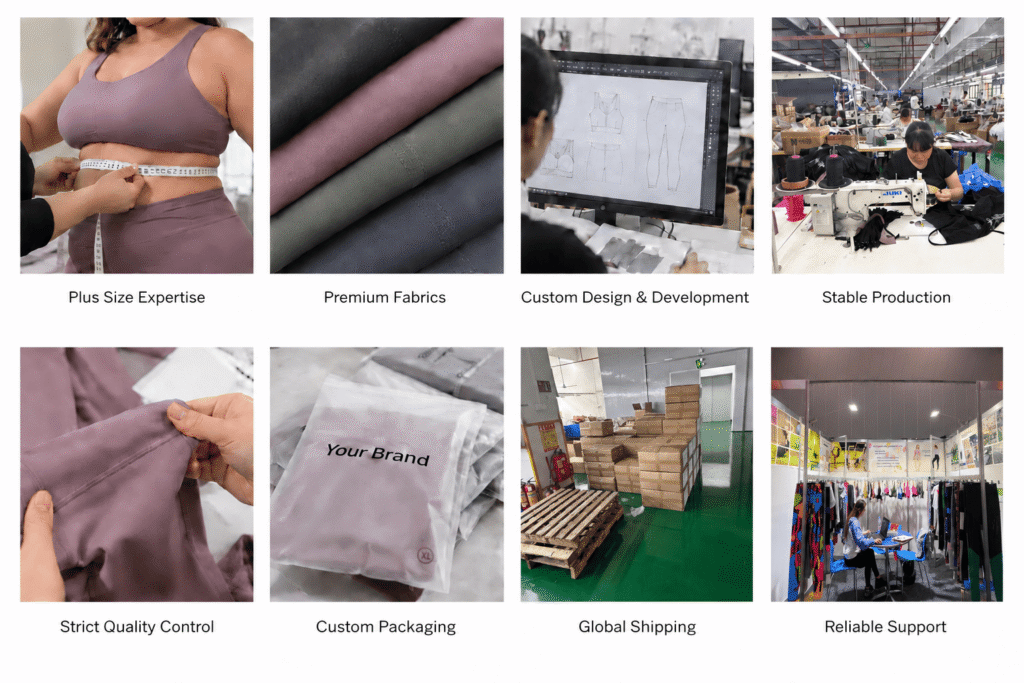
Pair Fashion was established in 2016 in Dongguan, Guangdong and focuses on functional sportswear OEM, ODM and private label production. For a buyer comparing a Plus Size Wholesale Activewear Manufacturer, the relevant evidence includes an 11-person pattern and sample development team, 13 QC staff and seven standardized production lines. Stable production capacity is approximately 50,000 pieces per month, while peak capacity can reach approximately 65,000 pieces.
The company develops plus size leggings, sports bras, tops, shorts and coordinated activewear alongside other functional apparel categories. Pattern development can begin from a Tech Pack, physical sample, sketch or reference, while size grading and specialized fit development are available for extended-size programs.
Buyer profile
Established: 2016
Location: Dongguan, Guangdong, China
Employees: 135
Pattern and sample team: 11
QC team: 13
Production lines: 7
Stable monthly capacity: Approximately 50,000 pcs
Sample timing: Fastest 3 days; normally around 7 days
Bulk timing: Fastest 15 working days; standard production approximately 20–25 working days
Core products: Plus size activewear, yoga and fitness apparel, equestrian apparel, maternity activewear, modest sportswear and selected leisure sportswear
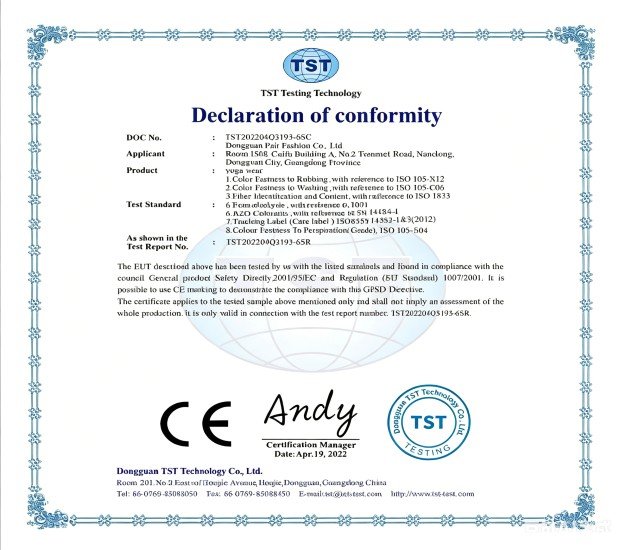
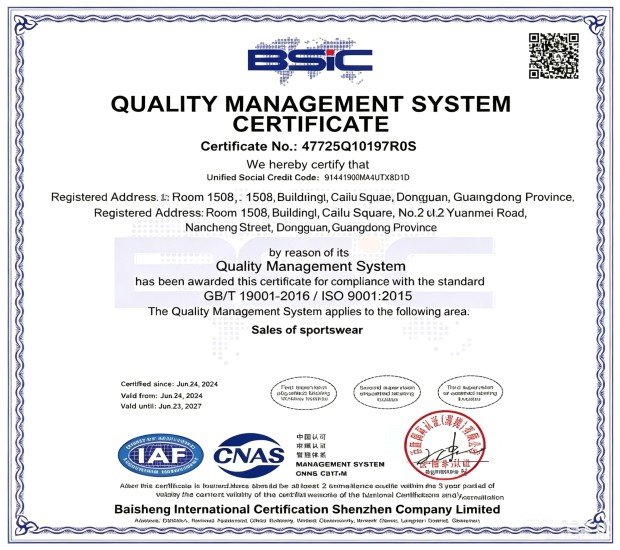
Certifications listed: ISO9001, BSCI, GRS, CE and ROHS
Production model: OEM / ODM / Private Label
Pair Fashion can be relevant when a brand wants a Plus Size Wholesale Activewear Manufacturer that can work from early product information through pattern and sample development. Buyers with complete Tech Packs can also use the manufacturer for specification-led projects.
Core advantage: Extended-size development sits within the same manufacturing structure as sampling, bulk production and quality control, making it possible for buyers to evaluate one production system rather than coordinating unrelated development and production suppliers.
Possible limitation: Buyers seeking only ready-stock products or extremely small quantities may find a wholesale marketplace or stock supplier more appropriate. Complex projects below normal production minimums require individual confirmation.
Brands that have finished the supplier-comparison stage and want to examine the production route in more detail can review Pair Fashion’s Plus Size Wholesale Activewear Manufacturer service for custom fit, extended sizing and brand production.
2. MENWILD — Dongguan, China
MENWILD presents a different specialization. Founded in 1998 in Humen, Dongguan, it focuses heavily on big & tall menswear and states that its extended-size activewear covers 2XL–6XL. Its published information lists more than 200 employees, monthly capacity above 80,000 pieces and an MOQ starting from 100 pieces.
For a buyer evaluating a Plus Size Wholesale Activewear Manufacturer, MENWILD is particularly relevant when the target customer is male and the collection requires big & tall proportions rather than simply additional standard sizes.
Buyer profile
Founded: 1998
Location: Humen, Dongguan, China
Published size focus: 2XL–6XL
Published MOQ: From 100 pcs
Published sample timing: 7–10 business days for its wholesale plus-size activewear program
Employees: 200+ stated
Monthly capacity: 80,000+ pcs stated
Core products: Performance tops, training shorts, joggers, hoodies and extended-size menswear
Production model: OEM / ODM / Private Label
Core advantage: MENWILD publicly positions extended-size grading as a central capability rather than a secondary size extension.
Possible limitation: Big & tall menswear expertise should not automatically be treated as proof of equivalent women’s plus-size sports bra or legging expertise. Buyers developing women’s products should request category-specific samples and grading evidence.
3. YOUMEGA — Xiamen, China
YOUMEGA illustrates why buyers should ask what the word MOQ actually refers to. The company publishes two different commercial routes: stock products with custom branding from approximately 100 sets, and full custom OEM/ODM programs generally from 300–500 pieces per style and color.
That distinction is useful when comparing a Plus Size Wholesale Activewear Manufacturer because stock private labeling and proprietary product development are commercially different projects.
Buyer profile
Location: Xiamen, China
Founded: 2017
Published MOQ: 100 sets for stock + logo; 300–500 pcs/style/color for full custom
Sample timing: Around 7 days for stock; 10–15 days for custom development
Core products: Leggings, sports bras, yoga wear and activewear sets
Production model: OEM / ODM / Private Label
QC: AQL 2.5 stated
Standards/certification references: OEKO-TEX Standard 100, BSCI, REACH, CPSIA and GRS-related sourcing are listed on its website
Core advantage: Different entry routes allow buyers to distinguish between market-testing programs and full custom development.
Possible limitation: Buyers requiring proprietary extended-size blocks should request evidence of plus-size grading and fitting rather than assuming that a low-MOQ stock program demonstrates the same technical capability.
4. Chenjia — China
Chenjia focuses on private label yoga, gym and studio apparel. Its current website states an MOQ of 100 pieces per style per colour, with sizes allowed to be mixed within that MOQ. It lists standard sampling at around 20 working days, a priority route at around 10 working days when capacity and materials allow, and bulk planning at approximately 30–45 days after approvals are complete.
For brands comparing a Plus Size Wholesale Activewear Manufacturer, Chenjia provides a useful lesson: an MOQ becomes meaningful only when the buyer understands whether it applies to the entire order, each style, each color or another production variable.
Buyer profile
Location: China
Published MOQ: 100 pcs/style/color
Size mixing: Allowed within the stated MOQ
Sample timing: Standard 20 working days; priority 10 working days subject to review
Bulk planning: Approximately 30–45 days after approval
Core products: Yoga, gym, studio activewear, leggings, sports bras and sets
Production model: Private Label / Custom
Core advantage: Commercial conditions are presented with useful detail instead of relying only on the phrase “low MOQ.”
Possible limitation: The public positioning is broader activewear manufacturing. A plus-size project therefore requires separate verification of extended-size blocks, grading and fitting experience.
5. FITCLO — China
FITCLO states that it was established in 2010 and operates a 16,000-square-meter production plant with more than 500 staff members and over 20 production lines. Its current website advertises an MOQ from 100 pieces and sampling in approximately seven days.
When comparing a Plus Size Wholesale Activewear Manufacturer, this scale may be relevant for buyers planning larger collections or future volume growth. However, production scale and extended-size specialization are two separate questions.
Buyer profile
Established: 2010
Country: China
Published MOQ: From 100 pcs
Sample timing: Approximately 7 days
Factory area: 16,000 m² stated
Employees: 500+ stated
Production lines: 20+ stated
Core products: Yoga wear, gym wear and athleisure
Production model: Private Label / Custom Activewear
Core advantage: Significant published manufacturing infrastructure and a clear activewear focus.
Possible limitation: A large factory does not automatically prove specialist plus-size fit capability. Buyers should request extended-size measurement charts, graded samples and relevant production examples.
6. Shanlinyang Apparel — Xiamen, China
Shanlinyang positions itself around women’s apparel, including activewear and curve categories. This makes it worth investigating when a buyer needs women’s extended-size products rather than a manufacturer whose primary experience is big & tall menswear.
When evaluating Shanlinyang as a Plus Size Wholesale Activewear Manufacturer, buyers should request its current MOQ, sample lead time, available extended-size range and evidence of grading for the exact category being developed.
What to verify
Current manufacturing location
Current MOQ by style and color
Sample and bulk lead time
Available extended-size range
Existing curve blocks
Legging and sports-bra grading experience
Current certifications
Private label options
Core advantage: Women’s apparel and curve positioning can make the supplier relevant to brands building female-focused collections.
Possible limitation: Marketing a curve range is not the same as proving technical activewear fit. Buyers should test measurements, movement and fabric performance through physical samples.
7. ActiveWearFactory — Quanzhou, China
ActiveWearFactory positions itself as an OEM, ODM and private label activewear producer. For buyers considering it as a Plus Size Wholesale Activewear Manufacturer, the key question is whether its general performance-apparel experience is supported by relevant extended-size production evidence.
A supplier does not need to manufacture only plus sizes to be suitable. However, buyers should distinguish between a manufacturer that can make a larger size and one that has repeatedly produced extended-size activewear under controlled measurements.
What to verify
Current MOQ
Current sample timing
Size range
Existing extended-size blocks
Size-set sampling
Fabric sourcing conditions
Production capacity
QC procedure
Current certifications
Core advantage: Broad custom activewear manufacturing can support brands developing multiple performance categories.
Possible limitation: Plus-size specialization should be demonstrated with project-relevant evidence rather than inferred from general activewear experience.
8. Maqi Apparel — China
Maqi Apparel markets OEM and private label activewear manufacturing and also promotes sustainable material options. It may therefore enter the shortlist when a brand wants to investigate performance apparel together with recycled or other sustainability-related fabric requirements.
A buyer comparing Maqi with another Plus Size Wholesale Activewear Manufacturer should keep two technical questions separate: Can the supplier source the required material, and can it execute the required extended-size fit?
Success in one does not prove the other.
What to verify
Current MOQ
Sample timing
Bulk lead time
Plus-size grading evidence
Size-set procedure
Fabric certification scope
Certification validity
Testing requirements
Reorder conditions
Core advantage: Activewear production combined with sustainability-oriented material options may be useful for brands with defined material requirements.
Possible limitation: Sustainability claims should not replace verification of extended-size fit capability.
9. Yueyi Active — China
Yueyi Active operates across broad activewear and sportswear categories and publicly presents itself as an OEM/ODM manufacturing option.
For a larger buyer, production capacity can be important. For a plus-size buyer, however, the more important question is whether that capacity can reproduce the required measurements, fit and workmanship across the complete extended-size range.
When considering Yueyi as a Plus Size Wholesale Activewear Manufacturer, buyers should therefore evaluate production scale and plus-size evidence separately.
What to verify
Current MOQ
Sample and bulk timing
Extended-size range
Pattern-grading experience
Size-set sample procedure
Current capacity
Audit status
Material certification
QC documentation
Reorder planning
Core advantage: Broader sportswear manufacturing can be relevant to buyers developing multiple categories or planning higher future volumes.
Possible limitation: Broad category capability is not the same as specialized plus-size capability.
10. Renrui Textile — Suzhou, China
Renrui Textile positions itself around private label performance apparel and provides another sourcing option for brands comparing Chinese activewear manufacturers.
For buyers assessing Renrui as a Plus Size Wholesale Activewear Manufacturer, published commercial information should be confirmed against the actual RFQ. Extended sizing can affect fabric consumption, marker efficiency, size ratios and sometimes material minimums, so standard activewear conditions should not automatically be applied to a plus-size program.
What to verify
Current MOQ per colorway
Sample lead time
Bulk lead time
Payment structure
Incoterms
Extended-size blocks
Size-set sampling
Current certifications
Fabric minimums
Reorder conditions
Core advantage: Private label performance-apparel positioning can make the supplier relevant for brands seeking a structured B2B production route.
Possible limitation: Buyers should obtain project-specific evidence of extended-size pattern and production experience before final selection.
How Should Buyers Use This Manufacturer List to Build a Shortlist?
The purpose of a manufacturer list is not to replace supplier qualification. It is to reduce a large sourcing market into a smaller group worth investigating.
Suppose one Plus Size Wholesale Activewear Manufacturer publishes a 100-piece MOQ, another advertises sizes through 5XL, and a third promises a seven-day sample. Those statements answer three different questions. They do not tell you which supplier can manufacture your product under your commercial conditions.
Before comparing quotations, send shortlisted suppliers substantially the same RFQ. At minimum, specify:
Product type and construction
Target size range
Measurement chart or reference fit
Fabric composition and target weight
Colors and approximate quantity per color
Logo technique
Main label, care label and size label
Packaging requirements
Quantity per style
Required sample type
Testing or certification requirements
Target delivery window
Required Incoterm
A Plus Size Wholesale Activewear Manufacturer quoting 100 pieces per style cannot be directly compared with another supplier quoting 100 pieces per color. Likewise, a quotation based on available fabric cannot be fairly compared with one based on custom-dyed fabric.
The same rule applies to extended sizing. A Plus Size Wholesale Activewear Manufacturer that lists 5XL should still be asked how the size range was developed, which measurements change between sizes, whether a size-set sample is available and whether similar products have already been produced.
The shortlist becomes useful only after these differences are normalized.
At that point, the question changes from:
“Which manufacturer looks best?”
to:
“Which manufacturers have provided enough evidence to justify the next stage of evaluation?”
That is a much safer basis for deciding where to spend money on samples, development and the first production order.
For buyers who have already completed supplier screening and are ready to evaluate the manufacturing side of a specific project, Pair Fashion’s custom plus size activewear manufacturing service provides further information about extended sizing, sampling and scalable brand production.

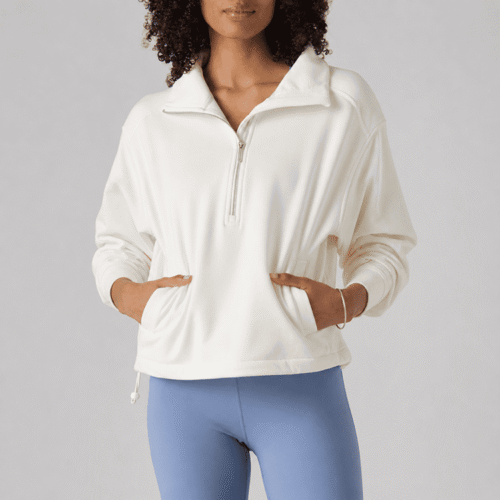
Custom Women’s Half Zip Oversized Sweatshirt Athleisure Pullover OEM ODM
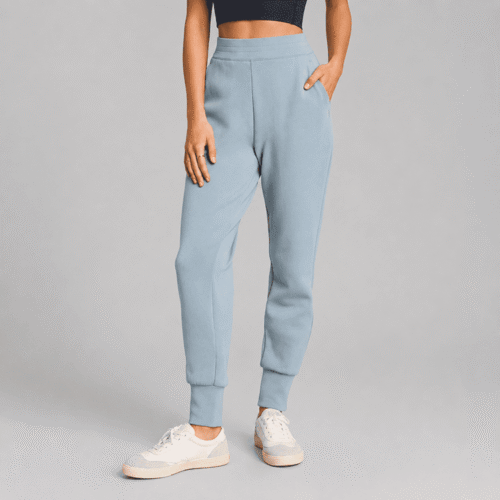
Custom Women’s High-Waist Jogger Pants OEM ODM Athleisure Sweatpants
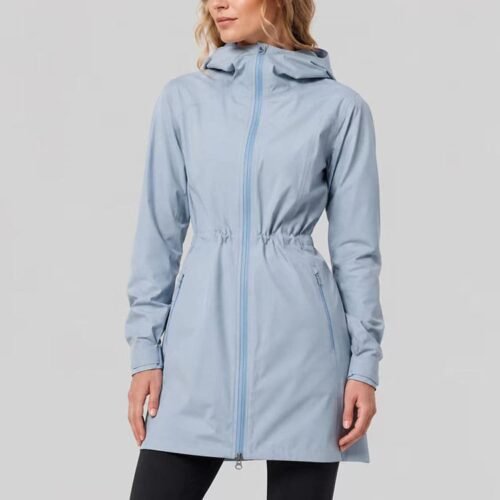
Custom Women’s Hooded Longline Windbreaker Jacket Waterproof Outerwear OEM ODM
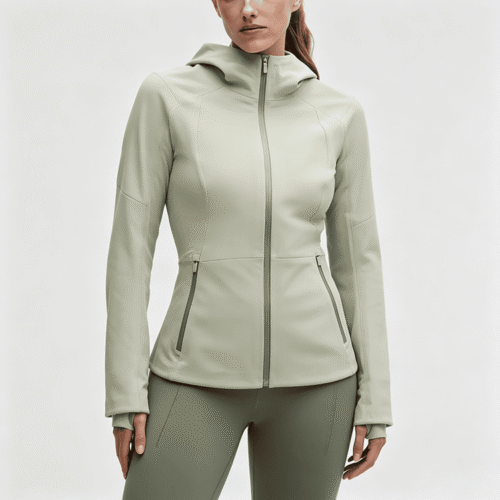
Custom Women’s Hooded Performance Jacket Full Zip Athleisure Outerwear OEM ODM
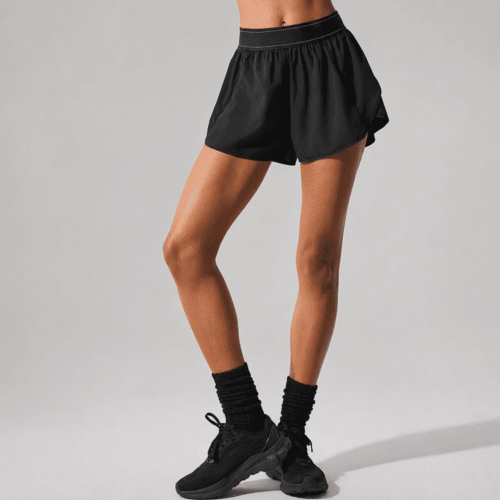
Custom Women’s Lightweight Running Shorts OEM ODM Workout Shorts
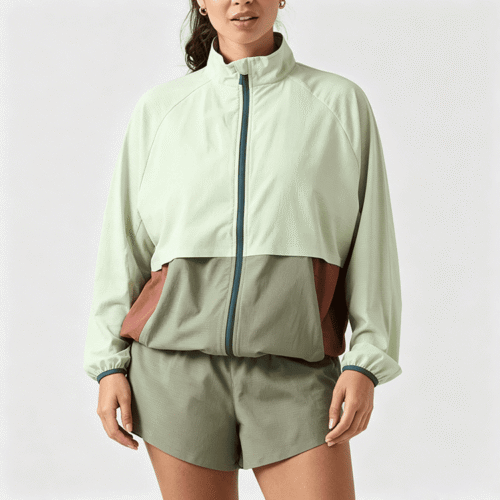
Custom Women’s Lightweight Windbreaker Jacket Full Zip Training Outerwear OEM ODM
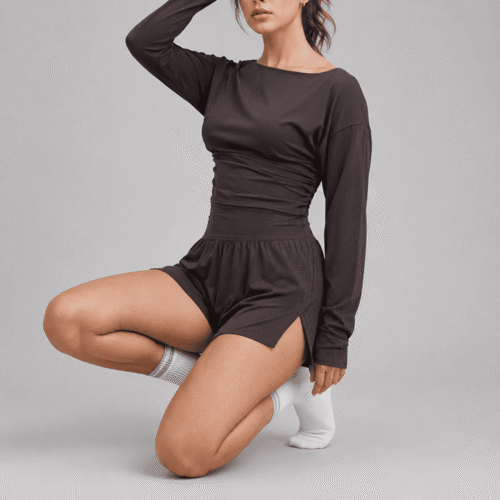
Custom Women’s Long Sleeve Lounge Romper OEM ODM Loungewear
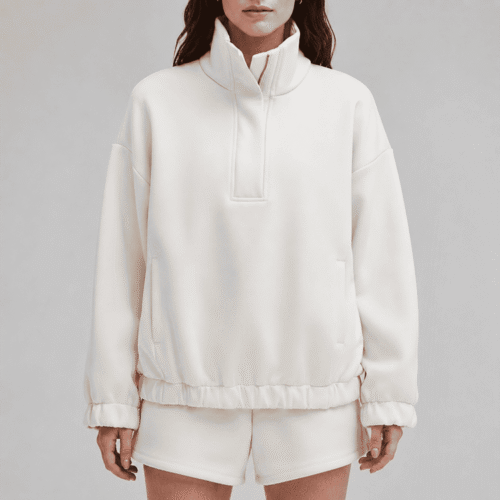
Custom Women’s Oversized Half Zip Sweatshirt Fleece Pullover OEM ODM
Manufacturer vs Trading Company vs Marketplace: Who Are You Actually Buying From?
Before choosing a Plus Size Wholesale Activewear Manufacturer, buyers should identify whether the supplier actually manages manufacturing, operates mainly as a trading company, works as a sourcing intermediary, or sells through a wholesale marketplace. These business models can all be useful, but they provide different levels of production visibility, product development support, MOQ flexibility, ready-stock access and supply-chain control. The right choice depends on what the buyer needs to purchase.
The word manufacturer can be surprisingly imprecise in apparel sourcing. A company may own sewing lines, manage production through partner facilities, coordinate several subcontractors, or simply source finished garments from other producers. All four models can appear under similar search terms.
That does not mean an intermediary is automatically a poor supplier, or that direct production is automatically better. It means buyers should understand who is responsible for the work that matters to their order.
When comparing a Plus Size Wholesale Activewear Manufacturer, the practical questions are therefore more useful than the company label alone:
Who develops or controls the pattern?
Who purchases the fabric?
Where are samples made?
Who cuts and sews the bulk garments?
Who performs in-line and final inspection?
Who controls subcontracted processes?
Who handles a production problem?
Can the buyer obtain evidence from the actual production site?
The answers reveal much more than the word “factory” on a homepage.
What Is a Direct Activewear Manufacturer?
A direct Plus Size Wholesale Activewear Manufacturer normally has direct responsibility for important production functions such as pattern development, sampling, cutting, sewing, production management or quality control. Some processes may still be outsourced because modern apparel production rarely requires every operation to remain under one roof.
Printing, embroidery, garment washing, specialized bonding or particular fabric treatments, for example, may be handled by specialist partners. The more important question is whether the supplier has a controlled process for managing those partners.
This distinction matters in plus-size activewear because a production problem may come from several places.
A waistband measurement problem may originate in the pattern. Poor recovery may relate to the fabric specification. A twisting seam may result from cutting or sewing. Logo cracking may involve an external printing process. If several companies are involved, buyers need to know who owns corrective action.
Working directly with an experienced activewear manufacturer can be particularly useful when the buyer has a proprietary Tech Pack, specific measurement tolerances, a defined extended-size range, custom fabric requirements, repeated seasonal orders, strict inspection requirements or a need for traceable production changes.
However, direct manufacturing does not remove the need for verification.
A company calling itself a Plus Size Wholesale Activewear Manufacturer should still be able to explain which operations are completed internally, which are outsourced and how outsourced processes are controlled.
What Is a Trading Company or Sourcing Company?
A trading company generally connects buyers with one or more manufacturing resources rather than relying entirely on its own production facility. A sourcing company may go further by helping with supplier selection, development coordination, inspection, logistics or communication.
For some buyers, that structure can be useful.
A brand developing leggings, jackets, seamless products and accessories may discover that one manufacturing facility is not equally strong in every category. A capable sourcing company can coordinate different specialists while giving the buyer one commercial contact.
The trade-off is an additional layer between the buyer and production.
When a trading company appears in a search for a Plus Size Wholesale Activewear Manufacturer, buyers should clarify:
Which facility will manufacture the actual order?
Can that facility be identified before payment?
Does the quotation include the intermediary’s margin?
Who approves production changes?
Can factory records and QC evidence be obtained?
Will the same facility handle the reorder?
What happens if the production facility changes?
Price alone does not answer these questions.
A trading company may quote competitively because it has strong purchasing relationships. A direct manufacturer may also offer competitive pricing because there is no intermediary margin. Either assumption can be wrong without project-specific evidence.
The more useful comparison is commercial transparency and control.
How Is a Wholesale Marketplace Different From a Manufacturer?
A wholesale marketplace primarily helps buyers discover and purchase products from multiple sellers. Its value usually comes from selection, convenience and access to existing products, rather than direct control over how one particular garment is manufactured.
That can be useful for:
Testing a product category quickly
Buying ready-stock products
Purchasing several unrelated categories
Comparing many existing designs
Avoiding development work for an early market test
But a marketplace should not automatically be evaluated as though it were a Plus Size Wholesale Activewear Manufacturer.
Suppose a buyer wants 150 existing leggings with a simple logo. A marketplace or stock supplier may offer a practical route.
Now suppose the buyer wants a proprietary legging with a specific waistband height, graded extended-size measurements, a selected fabric weight, custom Pantone colors, private labels and repeat production six months later.
That is a different sourcing problem.
The buyer now needs to know who controls the pattern, who locks the material, who retains the approved specifications and who is responsible for reproducing the product.
Is a Consumer Plus Size Activewear Brand the Same as a Manufacturing Supplier?
No. A consumer brand can be an excellent source of market and product benchmarking, but it should not automatically be treated as a manufacturing option.
This distinction matters because searches for “best plus size activewear companies” and “plus size activewear manufacturers” can produce overlapping results.
A consumer brand may demonstrate:
Interesting size architecture
Strong product-market positioning
Popular silhouettes
Successful merchandising
Useful retail price benchmarks
But that does not mean the company accepts OEM or private label orders.
A buyer looking for a Plus Size Wholesale Activewear Manufacturer should therefore distinguish between companies worth studying and companies available for contract manufacturing.
The first group can help answer:
What products are already working in the market?
The second group must answer:
Can you manufacture our product to our specifications and commercial requirements?
Those are different research tasks.
Which Supplier Type Fits OEM, ODM, Private Label or Ready-to-Ship Purchasing?
Different sourcing models solve different problems. Buyers should start with the required purchasing outcome instead of assuming that one supplier type is universally better.
| Supplier Type | Production Relationship | Custom Development | Ready Stock | Production Visibility | Common Purchasing Use |
|---|---|---|---|---|---|
| Direct Manufacturer | Direct or substantially controlled | Usually strong when capability exists | Sometimes limited | Usually higher | Custom OEM, repeat production, technical products |
| Trading Company | Coordinates external production | Depends on supplier network | Often available | Medium | Multi-category sourcing, consolidated purchasing |
| Sourcing Company | Finds and manages suppliers | Can be strong through specialist network | Depends on network | Medium to high when transparent | Complex sourcing programs involving several suppliers |
| Wholesale Marketplace | Multiple independent sellers | Usually limited | Strong | Usually lower | Ready-stock testing and broad product discovery |
| Consumer Brand | Produces for its own market | Usually not offered to external buyers | Retail inventory | Not relevant to B2B production | Product and market benchmarking |
For a brand with a finished Tech Pack and tightly controlled specifications, a direct Plus Size Wholesale Activewear Manufacturer may provide a clearer route because fewer commercial layers sit between the specification and production.
For a buyer sourcing many unrelated products, however, a trading or sourcing company may reduce coordination work. For a startup testing demand with an existing design, ready-stock wholesale may create less development cost.
The question is not:
“Which business model is best?”
A better question is:
“Which business model gives this order the right balance of development capability, production visibility, commercial flexibility and purchasing efficiency?”
How Can You Tell Whether Production Is Really Controlled?
A polished website is not production evidence.
Neither is a collection of factory photographs without context.
Before treating a supplier as a Plus Size Wholesale Activewear Manufacturer, ask for evidence that can be connected to the actual order.
Useful evidence can include:
1. Production-site information
Ask where the order will be sampled, cut, sewn, inspected and packed.
2. Current production evidence
Recent workshop footage or order-specific production updates can be more informative than generic promotional photographs.
3. Pattern and sample responsibility
Confirm who creates and updates patterns and who records approved revisions.
4. Quality-control responsibility
Identify who performs incoming inspection, in-line inspection and final inspection.
5. Subcontracting disclosure
Ask which processes are external and how the supplier controls them.
6. Reorder traceability
Confirm whether patterns, measurements, material information, color standards and approved samples are retained for future orders.
A genuine Plus Size Wholesale Activewear Manufacturer does not necessarily need to perform every specialized process internally. What matters is whether responsibilities are clear and the manufacturing system is controlled.
For example, outsourcing embroidery to a specialist facility is not inherently a problem. Losing control of thread color, placement, dimensions or approval standards is the problem.
The same principle applies to fabric dyeing, printing and other specialized processes.
Does Buying Direct Always Mean a Lower Price?
Not necessarily.
“Direct factory price” is one of the most common phrases in apparel sourcing, but it should not be treated as a complete commercial argument.
A direct Plus Size Wholesale Activewear Manufacturer may remove an intermediary margin, but its MOQ may be higher. A trading company may add a margin but obtain better material pricing because it consolidates orders across multiple customers. A marketplace may offer a higher unit price but allow the buyer to purchase only a small amount of ready stock.
Consider a simplified example:
| Supply Route | Unit Price | Initial Quantity | Initial Product Spend |
|---|---|---|---|
| Direct Manufacturer | $9.20 | 500 pcs | $4,600 |
| Trading / Stock Route | $10.60 | 150 pcs | $1,590 |
The direct route has the lower unit price.
The second route requires much less initial inventory.
For a product with established sales, the first structure could be commercially attractive. For an untested style, the second may create a more manageable initial commitment even though each garment costs more.
This is why buyers should distinguish unit economics from inventory economics.
What Questions Should You Ask Before Classifying a Supplier?
A buyer does not need to conduct a full audit just to understand the supplier’s business model.
Start with direct questions:
Do you own or directly operate the facility producing my order?
Which production processes are completed in-house?
Which processes are subcontracted?
Where will my sample be made?
Will bulk production use the same manufacturing facility?
Who controls the patterns and approved specifications?
Can I review production and QC evidence before shipment?
Who is responsible if subcontracted work fails inspection?
Will the same production route be available for reorders?
A Plus Size Wholesale Activewear Manufacturer that answers these questions clearly gives the buyer a stronger basis for verification than a supplier relying mainly on general claims such as “professional factory,” “best quality” or “20 years of experience.”
The answers should then be checked against the requirements of the project.
Supplier Type Identification Checklist
Before moving a supplier into the sample stage, buyers can record the following information:
| Verification Point | Confirmed | Needs Evidence |
|---|---|---|
| Legal business identity | □ | □ |
| Actual production location | □ | □ |
| Sample-making location | □ | □ |
| Pattern responsibility | □ | □ |
| Fabric purchasing responsibility | □ | □ |
| Cutting location | □ | □ |
| Sewing location | □ | □ |
| Printing / embroidery location | □ | □ |
| In-line QC responsibility | □ | □ |
| Final inspection responsibility | □ | □ |
| Subcontracted processes disclosed | □ | □ |
| Bulk production facility confirmed | □ | □ |
| Reorder records retained | □ | □ |
The purpose of this checklist is not to eliminate every supplier that uses external resources. Apparel supply chains frequently depend on specialized partners.
The purpose is to remove ambiguity.
When a Plus Size Wholesale Activewear Manufacturer can explain exactly how an order moves from pattern and material sourcing to production and inspection, the buyer can evaluate the real supply chain instead of relying on a company label.
This becomes especially important when two suppliers quote similar prices but operate very differently.
One may control pattern development, cutting, sewing and QC directly while outsourcing only printing. Another may coordinate nearly the entire order through external factories. Either model may work, but the buyer should know which model is being purchased before comparing price, samples and order terms.

How Do You Verify a China Plus Size Wholesale Activewear Manufacturer Before Paying for Samples?
Before paying for samples, buyers should verify a Plus Size Wholesale Activewear Manufacturer through business identity, production evidence, relevant product history, extended-size records and project-specific commercial confirmation. A certificate, factory video or “sizes up to 5XL” statement can support a supplier profile, but none proves suitability alone. Strong verification connects the supplier’s claims to the exact product, size range, fabric, quantity and quality requirements the buyer plans to order.
Supplier verification does not need to begin with an expensive third-party audit.
For an initial shortlist, the objective is simpler: determine whether the company appears to be a credible production candidate and whether there is enough relevant evidence to justify spending money on development and samples.
A Plus Size Wholesale Activewear Manufacturer should therefore be evaluated in layers. Start with basic company identity, then examine production capability, followed by plus-size evidence and finally project-specific conditions.
This prevents buyers from spending too much time verifying a manufacturer that cannot meet a mandatory requirement in the first place.
Is the Supplier a Manufacturer, Trading Company or Agent?
The first step is to understand who will actually manufacture the order.
Ask for the legal company name, business registration information, production address and the relationship between the company receiving payment and the facility producing the garments.
The names do not always need to be identical. Apparel supply chains can involve related companies, export entities and specialized subcontractors.
The important issue is transparency.
Before treating a company as a Plus Size Wholesale Activewear Manufacturer, buyers should be able to answer:
What is the legal company name?
Where is the production facility?
Who receives payment?
Who makes the samples?
Who owns or controls the patterns?
Where will cutting take place?
Where will sewing take place?
Which processes are subcontracted?
Who performs final inspection?
Will the same facility handle the bulk order?
A supplier should be able to explain these relationships clearly.
An unclear company structure is not automatic proof of a problem, but unexplained differences between the quotation, bank account, company name and production site deserve further investigation before payment.
What Business and Production Evidence Should Buyers Request?
A professional website is useful for discovery, but it is not enough to verify production capability.
Buyers evaluating a Plus Size Wholesale Activewear Manufacturer should ask for evidence connected to current operations.
Useful evidence may include:
Business evidence
Business registration
Legal company name
Registered address
Production address
Export entity information where relevant
Production evidence
Current workshop photographs or video
Cutting area
Sewing lines
Pattern or sample room
QC area
Packing area
Current production examples
Production equipment relevant to the product
Order-management evidence
Sample approval records
Measurement inspection records
In-line inspection forms
Final inspection records
Material or trim approval records
Production tracking documents
A factory tour can provide additional confidence, but buyers should not assume that visiting a large building answers every technical question.
The objective is to connect the people, processes and records to the product being sourced, while buyers conducting deeper supply-chain checks can also refer to the OECD Due Diligence Guidance for Responsible Supply Chains in the Garment and Footwear Sector for a broader garment-specific due diligence framework.
For example, seeing 100 sewing machines says something about capacity. It says much less about whether the supplier can correctly grade a plus-size sports bra or control the recovery of a high-stretch legging fabric.
How Do You Verify Real Plus Size Manufacturing Experience?
This is where supplier verification becomes more specific.
A company can be an experienced activewear producer without having deep extended-size experience.
When a Plus Size Wholesale Activewear Manufacturer claims it can produce sizes from XL to 5XL, 6XL or beyond, ask for evidence behind the size range.
Useful evidence can include:
Existing extended-size measurement charts
Previous size ranges produced
Graded pattern examples
Size-set samples
Measurement inspection records
Previous plus-size production examples
Fit comments from relevant development projects
Photographs of actual extended-size samples or production
Product-specific grading rules
The objective is not to collect documents for the sake of having documents.
The objective is to answer a practical question:
Has this supplier previously controlled the type of size changes that my product requires?
For plus size activewear manufacturing, leggings may require closer examination of waist, hip, rise, thigh and inseam relationships, especially when buyers are verifying whether a supplier has real extended-size development experience.
For buyers developing extended-size custom sports bras, bust, underbust, strap length, armhole and support structure may require more attention when comparing supplier grading and fit evidence.
For training tops, bust, waist, hip, bicep, armhole and garment length may become important.
A Plus Size Wholesale Activewear Manufacturer does not need to use exactly the same grading rules for every brand. In fact, that could be a warning sign because different target customers and product categories may require different specifications.
What matters is whether the manufacturer can explain and execute the buyer’s required measurements.
Why Is “Sizes Up to 5XL” Not Enough Evidence?
A size label is not a fit system.
Two garments marked 3XL can have very different body assumptions, finished measurements and intended fits.
This is why buyers should avoid using the largest published size as the main measure of plus-size capability.
Suppose Supplier A advertises sizes through 6XL.
Supplier B publicly advertises only to 4XL but can provide a detailed measurement chart, graded patterns, size-set samples and previous production records for a similar product.
The label “6XL” alone does not provide enough evidence to conclude that Supplier A has stronger extended-size capability.
A Plus Size Wholesale Activewear Manufacturer should be evaluated through the relationship between:
Body target → Pattern → Garment measurement → Fabric behavior → Physical sample
This is particularly important in activewear because stretch can hide fit problems during a casual fitting.
A garment may technically fit onto the body while still creating poor waistband stability, excessive compression, inadequate coverage or restricted movement.
The buyer therefore needs measurable evidence, not only a size label.
Straight Grading vs Plus Size Pattern Evidence: What Should Buyers Ask?
Buyers do not need to become professional pattern makers, but they should understand the risk of assuming that every measurement can simply increase by the same amount.
Ask the shortlisted Plus Size Wholesale Activewear Manufacturer questions such as:
Do you use an existing extended-size block?
Which base size will be used for this project?
How will the target customer’s measurements be incorporated?
Can you provide a graded measurement chart before bulk production?
Which measurements require different grading rules?
Can we review more than one size before production?
How are garment tolerances controlled?
How are approved measurement revisions recorded?
The purpose is not to force the manufacturer to reveal proprietary patternmaking methods.
It is to determine whether the supplier treats extended sizing as a controlled specification rather than an automatic enlargement command.
This distinction becomes more important as the size range becomes wider.
Should Buyers Request a Size-Set Sample?
For a wide extended-size range, checking only one sample size may leave significant uncertainty.
Imagine a collection running from XL to 5XL.
The development sample in 2XL fits well.
That does not automatically prove that XL and 5XL will behave correctly.
A buyer working with a Plus Size Wholesale Activewear Manufacturer can therefore discuss whether selected sizes or a full size set should be reviewed before bulk production.
The appropriate approach depends on:
Number of sizes
Product complexity
Fabric stretch
Fit sensitivity
Order value
Previous production history
Buyer risk tolerance
Not every order requires a sample in every size.
However, the wider and more technically sensitive the range becomes, the weaker the assumption that one middle size represents the entire collection.
For a first order, reviewing strategic sizes can provide useful evidence before committing to bulk production.
Which Certifications Actually Matter to Your Order?
Certificates can support supplier verification, but buyers should understand what each certificate actually covers and how it relates to the sourcing requirement; the OECD guidance on sustainability certifications in garment and footwear due diligence provides additional context for evaluating certification as one part of broader supplier due diligence.
A Plus Size Wholesale Activewear Manufacturer may present business social-compliance audits, quality-management certifications, recycled-material standards or product-related test reports.
These documents answer different questions.
For example:
ISO 9001 relates to quality-management systems. It does not certify that one particular pair of leggings fits correctly.
BSCI-related audit evidence concerns social-compliance assessment. It does not prove fabric performance.
GRS is relevant to certified recycled content and chain-of-custody requirements under the applicable certification system. It should not be interpreted as a general product-quality certificate.
Material test reports may provide information about composition, colorfastness, stretch, harmful substances or other tested characteristics, depending on the report.
The correct verification question is therefore not:
“Do you have certificates?”
It is:
“Which document supports the requirement that matters to this order?”
How Should Buyers Check Certification Evidence?
When certification is commercially important, ask the Plus Size Wholesale Activewear Manufacturer for enough information to verify relevance, and use resources such as IAF CertSearch where applicable to check accredited certification information rather than relying only on a certificate image supplied by the manufacturer.
Check:
Certificate holder: Does it match the supplier or relevant facility?
Certificate number: Can it be verified through the appropriate scheme?
Validity: Is it current?
Scope: What facility, material, process or activity does it cover?
Product relevance: Does it actually apply to the requirement in your order?
Supply-chain relevance: Does a material claim require certified upstream suppliers?
Target-market relevance: Does your destination market require additional testing or documentation?
A certificate can be genuine and still be irrelevant to the purchasing requirement.
For example, a valid quality-management certificate does not replace a fabric test. A recycled-material certificate does not prove garment measurements. A social-compliance audit does not prove colorfastness.
Verification should match evidence to risk.
What Are the Red Flags Before You Pay for a Sample?
One warning sign rarely proves that a supplier is unsuitable. Several unresolved inconsistencies are more meaningful.
A buyer evaluating a Plus Size Wholesale Activewear Manufacturer should investigate further when the supplier:
Cannot clearly identify where production will take place
Uses inconsistent company names without explanation
Avoids showing current production evidence
Claims to manufacture nearly every garment category with equal specialization
Promises every request without checking specifications
Quotes before understanding fabric, size range or construction
Refuses to provide a measurement chart
Cannot explain whether MOQ is per style or per color
Gives certification claims but cannot provide relevant documents
Pushes for immediate bulk payment before basic specifications are confirmed
Changes key commercial conditions repeatedly
Cannot explain who is responsible for defects or corrective action
Extremely fast answers can also deserve attention.
If a complex custom product is quoted immediately from a photograph without questions about material, measurements, construction, quantity or branding, the quotation may contain assumptions that have not been communicated to the buyer.
A serious quotation should become more accurate as specifications become clearer.
Published Claims vs Confirmed Project Conditions
One of the most useful habits in supplier verification is keeping these two categories separate.
Consider the following:
| Published Claim | What the Buyer Still Needs to Confirm |
|---|---|
| MOQ from 100 pcs | Per style, color, fabric or total order? |
| Sizes up to 5XL | What measurements and grading system are used? |
| 7-day sample | From payment, fabric arrival or specification approval? |
| OEM / ODM available | Which development services are included? |
| Recycled fabrics available | Which materials have valid certification? |
| Fast production | When does the production lead time start? |
| Quality inspection | What is inspected, when and against which standard? |
| Custom packaging | MOQ, setup fee and lead time? |
This distinction prevents marketing information from becoming an accidental purchase specification.
If a Plus Size Wholesale Activewear Manufacturer publishes “MOQ from 100 pieces,” record that as published information.
After the supplier reviews your Tech Pack and confirms:
100 pieces per style, two colors allowed, mixed sizes, available fabric, standard packaging
you now have a project-specific condition.
Those two pieces of information should not be treated as equivalent.
Should You Verify Everything Before Ordering a Sample?
No.
Verification should be proportional to the stage and financial risk.
Spending thousands of dollars on a full audit before buying a relatively inexpensive first sample may not always make commercial sense.
A more practical sequence is:
Stage 1 — Basic Screening
Confirm business identity, product relevance, approximate MOQ and basic manufacturing capability.
Stage 2 — Pre-Sample Verification
Check relevant production evidence, extended-size experience, sample terms and mandatory requirements.
Stage 3 — Sample Evaluation
Assess physical execution, measurements, communication and revision response.
Stage 4 — Pre-Bulk Verification
Confirm final specifications, production conditions, QC responsibilities, payment terms and inspection requirements.
Stage 5 — Higher-Risk Due Diligence
For larger orders, strategic suppliers or compliance-sensitive programs, consider deeper audits, third-party inspection or additional testing.
This staged approach helps the buyer spend verification resources where they create the most value.
Supplier Verification Checklist Before Sampling
Before paying a sample fee to a Plus Size Wholesale Activewear Manufacturer, buyers can use the following checklist:
| Verification Item | Confirmed | Needs Follow-Up |
|---|---|---|
| Legal company identity confirmed | □ | □ |
| Production location identified | □ | □ |
| Supplier type understood | □ | □ |
| Relevant activewear production evidence reviewed | □ | □ |
| Extended-size production evidence reviewed | □ | □ |
| Target size range discussed | □ | □ |
| MOQ basis confirmed | □ | □ |
| Sample type confirmed | □ | □ |
| Sample fee confirmed | □ | □ |
| Sample timeline confirmed | □ | □ |
| Required fabric capability discussed | □ | □ |
| Mandatory certifications checked | □ | □ |
| Customization requirements discussed | □ | □ |
| Communication contact identified | □ | □ |
| Bulk conditions broadly feasible | □ | □ |
The checklist should not become a competition about who can provide more documents.
A supplier with 50 documents does not mean it is automatically more suitable than another supplier with only 15 documents.
The main purpose is to collect the evidence needed for the actual risks of the order.
If certified recycled fabric is a mandatory requirement, buyers should pay more attention to material traceability. If the product has more complicated extended-size fitting requirements, grading evidence and physical size samples should receive more attention. If the order quantity is large, production capacity, QC and production repeatability should become more important.
A Plus Size Wholesale Activewear Manufacturer should therefore be verified against the project rather than against a generic definition of a “good factory.”
When Is a Supplier Ready to Move Into the Sample Stage?
A supplier does not need to answer every possible question before sampling.
It needs to pass the requirements that matter before the buyer spends more money.
A reasonable pre-sample decision can be based on four questions:
1. Is the company credible enough to continue?
Business identity and production relationships are reasonably clear.
2. Is there relevant capability?
The supplier can provide evidence related to activewear and the required extended-size program.
3. Are the basic commercial conditions workable?
MOQ, approximate pricing structure, sample terms and timeline are within a realistic range.
4. Are mandatory requirements possible?
Required materials, certifications, product features or market conditions can be supported.
If the answer to a genuinely mandatory requirement is no, an attractive quotation should not keep the supplier in the final comparison.
A Plus Size Wholesale Activewear Manufacturer can communicate well, provide a low sample price and show an impressive workshop, but those strengths cannot compensate for an inability to meet a requirement that the product must have.
This is why supplier verification should happen before scoring suppliers against softer preferences.
Mandatory requirements create the gate.
Samples then provide evidence of execution.
Commercial comparison comes after the suppliers remaining on the shortlist are actually comparable.
For brands that have completed supplier verification and are moving into a specific development project, Pair Fashion’s extended-size activewear development service explains the manufacturing-side process for custom fit, sampling and brand production.
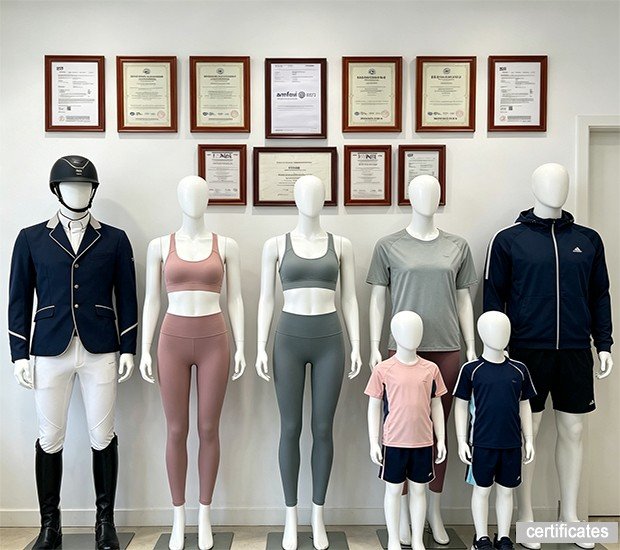
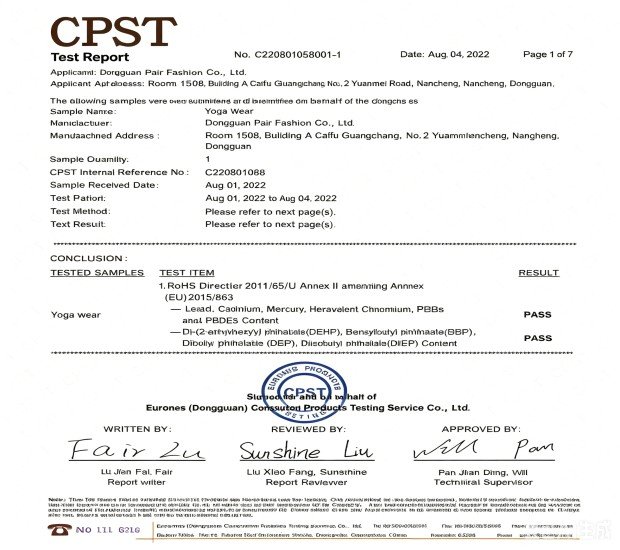
Trusted Manufacturing Standards For Global Sportswear Brands
We operate under internationally recognized quality, sustainability, and ethical manufacturing standards. Our certifications help ensure consistent product quality, responsible sourcing, and reliable production for global sportswear brands.
- 20+ Countries Served
- 6000+ Styles Developed
- 50,000 PCS Monthly Capacity
- 3-Day Sample Development
Why Do Buyers Choose China for Plus Size Activewear Manufacturing?
Buyers often consider China when a Plus Size Wholesale Activewear Manufacturer needs to coordinate garment production with fabric sourcing, trims, labels, packaging, sampling and export logistics through an established apparel supply chain. The commercial advantage is not simply a lower factory price. China becomes more relevant when several parts of the sourcing program need to work together, while the final decision should still depend on product complexity, quantity, lead time, landed cost and supply-chain risk.
China has spent decades developing a large textile and apparel manufacturing ecosystem. For activewear buyers, this matters because one finished garment may depend on far more than a sewing line.
A pair of plus size performance leggings can involve stretch fabric, dyeing, elastic, thread, heat-transfer labels, logo application, packaging, pattern grading, cutting, sewing, inspection and international shipping. When these resources can be coordinated within a mature regional supply chain, development and production may become easier to manage.
However, choosing a Plus Size Wholesale Activewear Manufacturer only because it is located in China is not enough.
A buyer still needs to ask whether that particular manufacturer understands the product, size range, material, order quantity and quality requirements of the project.
Why Does China Matter Beyond Factory Price?
The phrase “China factory price” can make sourcing sound simpler than it really is.
Garment cost is only one part of the purchasing decision.
A Plus Size Wholesale Activewear Manufacturer may need to coordinate several resources before one finished product can be shipped:
Performance fabric sourcing
Custom dyeing
Elastic and support materials
Labels and care labels
Heat-transfer or printed branding
Zippers, cords and other trims
Custom packaging
Pattern and sample resources
Cutting and sewing
Specialized printing or embroidery
Inspection
Export documentation
International logistics
The advantage of an established apparel supply chain is therefore coordination density.
A manufacturer does not necessarily need to produce every component itself. In fact, specialized suppliers can sometimes perform a particular process better than a garment manufacturer trying to keep everything in-house.
What matters is whether those resources can be sourced, approved and controlled without creating unnecessary delays or inconsistency.
For a brand launching several activewear styles, this can become more important than saving a few cents on sewing.
China Manufacturer vs US Manufacturer: What Should Buyers Actually Compare?
A China vs US comparison should not begin with the assumption that one country is always cheaper, faster or better.
A local manufacturer may reduce international freight and make face-to-face communication easier. A Chinese manufacturer may have broader access to performance fabrics, trims and specialized apparel processes.
But these advantages depend on the actual project.
When comparing a US supplier with a Chinese Plus Size Wholesale Activewear Manufacturer, use the same commercial assumptions.
| Comparison Point | Questions to Ask |
|---|---|
| Product Cost | Is the quotation based on the same construction and specifications? |
| Fabric | Is the same composition, weight and performance level included? |
| MOQ | Is it per style, per color, per fabric or total order? |
| Size Range | Does the quote include the complete extended-size range? |
| Sampling | What sample type and number of revisions are included? |
| Customization | Are logos, labels, trims and packaging included? |
| Lead Time | When does the production clock officially start? |
| Freight | What is the estimated international or domestic shipping cost? |
| Duties | Are import duties included or excluded? |
| Incoterm | Is the quote EXW, FOB, CIF or DDP? |
| Testing | Are required material or product tests included? |
| Inventory | How much money must be committed to the first order? |
Without this normalization, comparing two unit prices can create a false conclusion.
A $9 quotation and an $11 quotation are not meaningfully comparable if one includes custom packaging and delivery while the other stops at the factory door.
Unit Price vs Landed Cost vs Inventory Commitment: What Is the Difference?
A buyer evaluating a Plus Size Wholesale Activewear Manufacturer should separate three different numbers:
Unit price is the cost assigned to each garment under the quoted production conditions.
Landed cost is the amount required to bring the product to the intended destination after relevant logistics and import-related expenses are considered.
Inventory commitment is the amount of stock and capital the buyer must commit before knowing how quickly the product will sell.
These numbers can point in different directions.
Consider a simplified first-order comparison:
| Commercial Condition | Supplier A | Supplier B |
|---|---|---|
| Unit Price | $9.00 | $10.40 |
| Minimum Quantity | 500 pcs | 150 pcs |
| Product Spend | $4,500 | $1,560 |
| Freight / Import Costs | To be added | To be added |
| Inventory Exposure | Higher | Lower |
Supplier A has the lower unit price.
Supplier B requires much less initial inventory.
For an established style selling thousands of units, Supplier A’s structure could be commercially attractive. For a new brand testing an uncertain product, Supplier B may create a more manageable inventory commitment even though its unit price is $1.40 higher.
This is why procurement decisions should distinguish unit economics from inventory economics.
The lowest price per garment does not automatically create the lowest-risk first order.
Why Can Plus Size Products Change the Cost Comparison?
Extended sizing introduces additional variables that should be considered when comparing quotations.
A Plus Size Wholesale Activewear Manufacturer may use more fabric for larger sizes, but material consumption is only one part of the calculation.
The actual commercial impact can also depend on:
Size distribution
Fabric width
Marker efficiency
Garment construction
Compression requirements
Reinforcement
Lining or double-layer areas
Elastic width
Packaging dimensions
Order quantity by size
Suppose a buyer orders 500 leggings from XL to 5XL.
An equal size distribution would mean 100 pieces per size. But real demand may be concentrated in 2XL and 3XL. Another brand may need a much broader distribution at the upper end of the range.
These two orders can have the same total quantity while creating different material and production conditions.
That is why buyers should give every shortlisted Plus Size Wholesale Activewear Manufacturer the same size breakdown when requesting final quotations.
Otherwise, one supplier may be pricing an equal size split while another is pricing the buyer’s actual size ratio.
The resulting prices are not directly comparable.
When Does a China Manufacturer Make Commercial Sense?
China manufacturing can make practical sense when a project requires several sourcing and production functions to work together.
A China-based Plus Size Wholesale Activewear Manufacturer may be particularly relevant when the buyer needs:
Multiple activewear styles developed under one program
Performance fabrics that are difficult to source locally
Custom colors or material treatments
Several logo or trim options
Extended-size production across multiple styles
Private labels and custom packaging
Repeat production after initial market validation
International export support
This does not mean every project should be moved overseas.
The strongest case usually appears when product complexity and supply-chain requirements justify the additional coordination involved in international sourcing.
For example, a brand developing leggings, sports bras and training tops may need several fabrics, elastics, labels and logo applications. If local production still requires many of those components to be imported, the apparent geographic advantage of producing locally can become smaller.
A buyer should compare the entire sourcing structure rather than the sewing location alone.
When Might Local Manufacturing Be More Practical?
Local production may be commercially sensible when proximity solves an important problem.
A brand may prefer local production when it needs:
Very small quantities
Extremely frequent design changes
Rapid physical meetings
Very short domestic replenishment routes
A strong local-made marketing position
Production that depends on locally available materials
A first test too small for overseas manufacturing economics
A Chinese Plus Size Wholesale Activewear Manufacturer may offer a lower production cost at a certain volume, but international freight, duties, longer transportation time and higher coordination requirements still need to be considered.
For example, a brand testing 30 pieces of one simple style may find that local production or ready stock is more practical even if the unit cost is higher.
The same brand ordering 2,000 pieces across several styles six months later may reach a different conclusion.
Country selection should therefore be revisited when the order structure changes.
Does a Lower China Quote Always Mean a Lower Final Cost?
No.
A quotation from a Plus Size Wholesale Activewear Manufacturer should be read together with its Incoterm.
Consider three common structures:
EXW — Ex Works
The buyer takes responsibility from the manufacturer’s premises and normally needs to manage pickup, export arrangements, international freight, import clearance and onward delivery.
FOB — Free on Board
The supplier generally manages the goods through export handling and delivery to the agreed port under the defined FOB terms, while the buyer manages the main international freight and subsequent import process.
DDP — Delivered Duty Paid
The seller takes substantially more responsibility for transporting the goods to the agreed destination and handling the applicable import obligations under the DDP arrangement.
A quotation of:
$8.80 EXW
cannot be directly compared with:
$10.20 DDP
by looking only at the two unit prices.
The buyer needs to determine what happens between the quoted point and the final receiving location.
This is especially important for smaller brands that may not have an established freight forwarder or import process.
How Should Buyers Compare Landed Cost?
A useful comparison should bring every shortlisted Plus Size Wholesale Activewear Manufacturer to the same commercial destination.
The calculation may include:
**Garment cost
labels and packaging
testing
inland transportation
export charges
international freight
insurance where applicable
import duty
customs or brokerage costs
final delivery**
Not every cost applies in exactly the same way to every Incoterm or destination, so buyers should avoid treating this as a fixed universal formula.
The principle is more important:
Compare suppliers at the same commercial endpoint.
If Supplier A is quoted at the factory gate and Supplier B is quoted delivered to your warehouse, their headline prices answer different questions.
How Can Buyers Compare Lead Time More Fairly?
Lead time is another number that can look precise while hiding different assumptions.
A Plus Size Wholesale Activewear Manufacturer may state a 20-day bulk lead time, but buyers should ask:
Twenty days from what event?
Possible starting points include:
Deposit received
Fabric available
Fabric approval
Lab dip approval
Pre-production sample approval
Final Tech Pack confirmation
All trims received
Production slot confirmation
These differences can add weeks to the actual calendar.
Suppose Supplier A quotes:
20-day production
but the fabric requires 18 days before production can begin.
Supplier B quotes:
30-day production
using material already available.
The shorter published production time does not automatically mean the earlier shipment.
When comparing a Plus Size Wholesale Activewear Manufacturer, buyers should therefore request a simple milestone timeline:
Specification Confirmation → Material Readiness → Sample Approval → Production Start → Final Inspection → Shipment
This creates a much more useful comparison than the phrase “fast lead time.”
Should Buyers Choose China Mainly for Cost?
Cost matters, but relying on cost alone can create poor sourcing decisions.
The strongest reason to consider a Plus Size Wholesale Activewear Manufacturer in China is usually the combination of manufacturing capability, material access, customization resources, commercial structure and scalable production.
A lower unit price is valuable only when the garment meets the required specifications.
A fast lead time is valuable only when the product is approved and repeatable.
A low MOQ is valuable only when it applies to the styles, colors and materials the buyer actually wants.
And a large factory is valuable only when its production system fits the requirements of the order.
For this reason, country selection should happen before supplier selection, but it should not replace supplier selection.
China can provide a deep sourcing environment. The buyer still needs to identify which Plus Size Wholesale Activewear Manufacturer within that environment can provide the evidence, commercial conditions and production structure required for the actual project.
The next purchasing decision should therefore be based on verification rather than geography alone.
How Should Buyers Compare Samples From Different Manufacturers?
Buyers should compare samples from each Plus Size Wholesale Activewear Manufacturer under substantially the same conditions. Give shortlisted suppliers the same Tech Pack, measurement chart, target fabric requirements, size, branding details and evaluation criteria whenever possible. Then assess measurement accuracy, fit, fabric performance, construction, workmanship and communication separately. A visually impressive sample is useful evidence, but it does not by itself prove that the manufacturer can reproduce the same result consistently in bulk production.
Sampling becomes much more useful when it is treated as a controlled supplier comparison, not simply as an opportunity to collect several garments.
Imagine three shortlisted manufacturers.
Supplier A receives a complete Tech Pack and measurement chart.
Supplier B receives three reference photographs.
Supplier C receives only a short message describing the product.
The resulting samples may look different, but those differences do not tell the buyer very much about comparative manufacturing capability. Each supplier was solving a different problem.
When evaluating a Plus Size Wholesale Activewear Manufacturer, the buyer should therefore control as many important variables as reasonably possible before comparing the results.
What Type of Sample Should You Request?
Not every sample answers the same question.
One supplier may call its first garment a prototype sample, another may use the term development sample, and another may move directly to a fit sample. Document names can vary between manufacturers.
Instead of focusing only on terminology, ask what the sample is intended to confirm.
Prototype or development sample
Usually helps determine whether the initial concept, construction and product direction can be made as intended.
Fit sample
Focuses more heavily on measurements, proportions, wearing fit and revisions.
Size-set sample
Checks selected or multiple sizes to determine whether the approved grading works across the intended size range.
Pre-production sample
Represents the specifications expected for bulk production after important details have been approved.
When comparing a Plus Size Wholesale Activewear Manufacturer, buyers should make sure they are comparing samples serving approximately the same purpose.
A first development sample from Supplier A should not automatically be judged against a fully revised pre-production sample from Supplier B.
The second garment has already had more opportunities for correction.
Why Should Every Manufacturer Receive the Same Tech Pack?
A fair supplier comparison begins with comparable input.
If you already have a complete Tech Pack, send substantially the same version to every shortlisted manufacturer.
It may include:
Technical drawings
Construction details
Measurement chart
Size range
Measurement tolerances
Fabric specification
Target fabric weight
Color information
Stitching requirements
Logo dimensions and placement
Labels
Trims
Packaging requirements
If no Tech Pack exists, create a standardized development brief so each Plus Size Wholesale Activewear Manufacturer receives the same basic product requirements.
The purpose is not to eliminate every difference between suppliers.
Different manufacturers may recommend different fabrics, construction methods or technical solutions. Those differences can be valuable.
The important point is that their recommendations should begin from the same purchasing problem.
Otherwise, buyers may mistakenly reward the manufacturer that received the clearest instructions rather than the manufacturer that executed the project most effectively.
Should Buyers Send a Physical Reference Sample?
A physical garment can be useful when the buyer wants to communicate a specific silhouette, construction method, fabric feeling or fit direction that is difficult to describe with photographs.
However, a reference garment should not replace written specifications.
If a buyer sends a reference sample to one Plus Size Wholesale Activewear Manufacturer but gives another only photographs, the comparison again becomes less controlled.
Where possible, give shortlisted suppliers access to equivalent reference information.
Buyers should also clearly identify what should and should not be copied.
For example:
Use the waistband height as a fit reference, but do not copy the pocket construction.
Or:
Use the overall silhouette as a reference, but follow our own measurement chart and fabric specification.
This prevents a reference garment from becoming an ambiguous instruction.
What Should a Plus Size Activewear Sample Scorecard Include?
A sample scorecard helps separate objective requirements from personal impressions.
Without one, buyers may overvalue the first thing they notice.
A beautiful logo can distract from inaccurate measurements. Soft fabric can make poor recovery less obvious during a short fitting. Clean packaging can create a positive impression even when construction does not match the specification.
When comparing samples from each Plus Size Wholesale Activewear Manufacturer, evaluate categories separately.
| Sample Criterion | Supplier A | Supplier B | Supplier C |
|---|---|---|---|
| Measurement Accuracy | /10 | /10 | /10 |
| Extended-Size Fit | /10 | /10 | /10 |
| Fabric Match | /10 | /10 | /10 |
| Stretch & Recovery | /10 | /10 | /10 |
| Coverage / Opacity | /10 | /10 | /10 |
| Construction Accuracy | /10 | /10 | /10 |
| Stitching & Workmanship | /10 | /10 | /10 |
| Logo Execution | /10 | /10 | /10 |
| Revision Response | /10 | /10 | /10 |
| Specification Understanding | /10 | /10 | /10 |
A numerical score can make comparison easier, but it should not become the only decision rule.
Suppose Supplier A scores 87/100.
That looks strong.
But the project requires a specific certified material and Supplier A cannot provide it.
The total score becomes commercially misleading.
Excellent communication and sewing cannot compensate for an inability to meet a mandatory material requirement.
For this reason, buyers should separate:
Mandatory requirements — Pass / Fail
from
Comparative preferences — Weighted score
Use the mandatory gate first.
Score only the suppliers that remain commercially viable.
How Should Buyers Evaluate Plus Size Fit Without Turning the Comparison Into Personal Preference?
Fit evaluation should return to the agreed product specification.
A Plus Size Wholesale Activewear Manufacturer should not be rewarded simply because one person says, “This feels comfortable.”
Comfort matters, but it needs context.
Ask:
Does the garment meet the approved measurements?
Does the waistband remain in the intended position?
Is compression appropriate for the product?
Does the fabric become excessively transparent when stretched?
Does the garment restrict intended movement?
Are seams positioned correctly?
Does the rise work in standing and movement?
Does the sports bra provide the intended coverage?
Do armholes or straps create unwanted pressure?
Does garment length remain appropriate in the tested size?
For a wider extended-size range, the buyer may also need to test more than one size.
A good 2XL sample does not automatically prove that 5XL is correct.
This is particularly important when the garment uses high-stretch material. Stretch can allow a garment to physically fit a body even when the underlying proportions are not ideal.
Being able to put the garment on is not the same as confirming fit.
How Should Performance Be Tested During Sample Comparison?
Static appearance tells only part of the story.
If the garment is intended for yoga, training, running or other movement, sample evaluation should include relevant movement.
For leggings, this may include:
Squatting
Sitting
Walking
Hip flexion
Knee bending
Waistband movement
For sports bras:
Arm raising
Forward reaching
Light jumping where appropriate
Strap movement
Underband stability
For tops:
Reaching overhead
Forward bending
Torso rotation
Arm movement
When comparing a Plus Size Wholesale Activewear Manufacturer, use substantially the same movement checks for each sample.
This makes observations more meaningful.
If Supplier A is tested only while standing and Supplier B is tested during a full movement session, the evaluation conditions are not comparable.
How Should Buyers Check Measurements?
Measure samples against the same specification sheet.
Do not rely only on the size label.
If the target chest width is 58 cm with an agreed tolerance, record the actual result. Repeat this for the critical points of measurement.
For plus-size leggings, these may include:
Waist / Hip / Front Rise / Back Rise / Thigh / Inseam / Leg Opening
For sports bras:
Bust / Underbust / Body Length / Strap Length / Armhole
For training tops:
Chest / Waist / Hip / Shoulder / Bicep / Sleeve / Body Length
A Plus Size Wholesale Activewear Manufacturer may use slightly different measurement methods from another supplier, so the buyer should also confirm how each point of measurement is taken.
A 1 cm disagreement about where a measurement begins can create apparent differences that are actually measurement-method differences.
How Long Should Sampling Take?
There is no single correct sample lead time for every activewear project.
A simple style using available fabric and standard trims may move quickly.
A product requiring custom-dyed material, unusual trims, specialized printing or several fitting revisions can take longer.
When comparing a Plus Size Wholesale Activewear Manufacturer, ask what is included in the quoted sample time.
For example:
Supplier A: 7-day sample
Supplier B: 12-day sample
Supplier A initially looks faster.
But suppose Supplier A’s seven days begin after all custom fabric arrives, while Supplier B’s twelve days include material sourcing from available stock.
The headline numbers now describe different timelines.
Ask each supplier to identify:
Specification Approval → Material Ready → Pattern → Cutting → Sewing → Internal Check → Sample Dispatch
You do not need an hour-by-hour production schedule.
You need enough information to understand where the clock starts and what can stop it.
Sample Price vs Development Value: What Are You Actually Paying For?
Sample prices are often disproportionately high compared with bulk unit prices.
That is not automatically a warning sign.
One sample cannot benefit from the same efficiencies as hundreds of garments. The supplier may need to source a small amount of material, create or modify a pattern, cut one garment, set up a logo process and allocate skilled sample-room labor.
When comparing sample quotations from a Plus Size Wholesale Activewear Manufacturer, ask what the fee includes.
Possible components include:
Pattern creation
Pattern modification
Fabric sourcing
Sample fabric
Trims
Individual cutting
Sewing
Logo setup
Printing or embroidery
Measurement checking
Revision work
Courier charges
Consider two quotations:
Supplier A — Sample: $80
Supplier B — Sample: $150
The $80 sample is not automatically better value.
Supplier B may include pattern development, a custom logo setup and one revision, while Supplier A may charge those items separately.
Normalize the scope before comparing the price.
Should Buyers Ask for Free Samples?
Free samples can make sense when the supplier already has a suitable showroom garment or when an existing product is being evaluated.
For custom development, however, buyers should not assume that professional development work has no cost.
A Plus Size Wholesale Activewear Manufacturer may need skilled pattern makers, sample machinists and sourcing staff to create a garment that does not yet exist.
The better commercial question is:
What development work is included in the sample fee, and will any part of the fee be credited against a future bulk order?
Different suppliers use different policies.
The policy itself matters less than understanding it before payment.
How Should Revision Performance Be Compared?
The first sample is not the only evidence.
How the supplier handles problems can reveal more about a future working relationship.
Suppose all three manufacturers produce a first sample with the same waistband issue.
Supplier A changes the waistband but does not update the measurement record.
Supplier B asks for clarification, updates the specification and identifies how the revision affects related measurements.
Supplier C says the issue will be corrected in bulk without producing evidence.
These responses are not equivalent.
When evaluating a Plus Size Wholesale Activewear Manufacturer, record:
How quickly the issue is understood
Whether the supplier asks relevant questions
Whether revisions are documented
Whether related measurements are considered
Whether the revised sample matches the requested change
Whether old and new specifications are clearly distinguished
A development mistake is not always the strongest warning sign.
Repeating the same mistake after clear correction can be more informative.
Does a Good Sample Prove Bulk Production Capability?
No.
This is one of the most important distinctions in apparel sourcing.
A sample room may produce one excellent garment using a senior sample machinist. Bulk production may later involve different operators, cutting batches, material lots and production pressures.
One good sample proves that one good garment can be made.
It does not prove that 500 or 5,000 garments can be reproduced within agreed tolerances.
Before moving a Plus Size Wholesale Activewear Manufacturer from sample approval to bulk production, buyers should therefore examine a second set of questions:
How are approved specifications transferred to production?
Is a pre-production sample used?
How are measurements communicated to the production line?
How is fabric lot consistency controlled?
What in-line inspections are performed?
How are measurement deviations recorded?
What happens when production falls outside tolerance?
What final inspection method is used?
These questions do not invalidate a good sample.
They determine whether the good sample can become a repeatable production standard.
How Should Buyers Make the Final Sample Comparison?
Once the physical samples have been evaluated, bring the evidence together without reducing everything to one number too quickly.
Use three layers:
Layer 1 — Mandatory Requirements
Pass or fail:
Required material available
Required size range possible
Mandatory certification possible
Required construction possible
Commercial MOQ feasible
Layer 2 — Sample Execution
Compare:
Measurements
Fit
Fabric
Construction
Workmanship
Branding
Movement performance
Layer 3 — Development Performance
Compare:
Communication
Technical understanding
Revision accuracy
Documentation
Problem solving
Response consistency
This prevents a visually attractive sample from hiding a commercially important weakness.
The final sample comparison should answer:
Which suppliers have demonstrated enough product and development evidence to remain in the commercial comparison?
It should not yet answer:
Which supplier gets the entire order?
Price, MOQ, payment terms, production conditions and inventory exposure still need to be normalized.
For buyers who have completed comparative sampling and are ready to move from supplier evaluation into a defined product program, Pair Fashion’s plus size activewear production service provides further information on custom development, approved samples and scalable manufacturing.

How Do You Compare MOQ, Price and Order Terms on the Same Commercial Basis?
Buyers should compare each Plus Size Wholesale Activewear Manufacturer only after normalizing the quotation. Confirm whether MOQ applies per style, color, fabric or total order, then align fabric specifications, size range, size distribution, colors, branding, labels, packaging, testing and Incoterms. A lower unit price is not automatically the better commercial offer if it requires more inventory, excludes important costs or uses different product assumptions from competing quotations.
Price comparison becomes unreliable when suppliers are quoting different products without the buyer realizing it.
Supplier A may quote available black fabric with a standard label.
Supplier B may quote custom-dyed fabric, printed branding and individual packaging.
Supplier C may include sizes XL–5XL while another quotation assumes only XL–3XL.
All three quotations can be legitimate, but they cannot be compared fairly until the assumptions are aligned.
When evaluating a Plus Size Wholesale Activewear Manufacturer, buyers should therefore separate three questions:
What exactly is being manufactured?
How much must be purchased?
What exactly is included in the quoted price?
Only after these questions are answered does the headline unit price become commercially useful.
What Does MOQ Actually Mean?
MOQ means minimum order quantity, but the number alone is incomplete.
A supplier saying “MOQ 100 pieces” could mean:
100 pieces per style
100 pieces per color
100 pieces per fabric
100 pieces per size
100 pieces total with mixed colors and sizes
100 pieces only when using available material
These structures create very different inventory commitments.
Suppose a Plus Size Wholesale Activewear Manufacturer offers an MOQ of 100 pieces per color.
The buyer wants:
3 styles × 3 colors × 100 pieces
The actual minimum becomes:
900 pieces
Another supplier may require 200 pieces per style but allow two colors and mixed sizes.
For the same three-style collection:
3 styles × 200 pieces = 600 pieces
The second supplier has a higher published MOQ number but may require less total inventory.
This is why buyers should never compare MOQ as a standalone number.
MOQ per Style vs MOQ per Color: Why Does It Matter?
Consider two quotations.
| Commercial Condition | Supplier A | Supplier B |
|---|---|---|
| Published MOQ | 100 pcs | 200 pcs |
| MOQ Basis | Per color | Per style |
| Styles | 2 | 2 |
| Colors per Style | 3 | 3 |
| Minimum Total Quantity | 600 pcs | 400 pcs |
Supplier A appears more flexible when the buyer looks only at “100 pcs vs 200 pcs.”
The opposite becomes true after the MOQ basis is understood.
When requesting a quotation from a Plus Size Wholesale Activewear Manufacturer, ask the supplier to write the MOQ in a complete sentence.
For example:
MOQ: 100 pieces per style per color, mixed sizes allowed.
Or:
MOQ: 200 pieces per style, up to two colors, mixed sizes allowed subject to available fabric.
That one sentence can prevent a significant misunderstanding later.
How Does Fabric Affect MOQ?
Garment MOQ and fabric MOQ are related but not always identical.
A manufacturer may be willing to sew 100 garments while the fabric mill requires a much larger quantity for custom dyeing or custom production.
Suppose a buyer wants a proprietary color.
The garment Plus Size Wholesale Activewear Manufacturer accepts 100 pieces, but the fabric supplier requires 300 kilograms for custom dyeing.
The project now has a material minimum that may be more commercially important than the sewing MOQ.
Possible solutions can include:
Using an available stock color
Selecting an available fabric
Sharing material across several styles
Increasing the garment quantity
Paying a small-lot surcharge where available
Holding excess material for a future reorder
Not every supplier or fabric mill offers all of these options.
The buyer should therefore ask:
Is this MOQ controlled by garment production, fabric production, color dyeing, trims or another component?
That question helps identify where the real minimum originates.
How Should Plus Size Distribution Be Included in the MOQ Discussion?
A total order quantity does not explain how units are distributed across sizes.
Suppose the order is 300 pieces from XL to 5XL.
An equal distribution would be:
| Size | Quantity |
|---|---|
| XL | 60 |
| 2XL | 60 |
| 3XL | 60 |
| 4XL | 60 |
| 5XL | 60 |
| Total | 300 |
But actual demand may be:
| Size | Quantity |
|---|---|
| XL | 35 |
| 2XL | 70 |
| 3XL | 90 |
| 4XL | 65 |
| 5XL | 40 |
| Total | 300 |
A buyer should confirm whether the Plus Size Wholesale Activewear Manufacturer allows sizes to be mixed freely within the style or color MOQ.
This becomes especially important when upper sizes represent a smaller percentage of expected sales.
A rigid minimum per size can create excess inventory even when the total MOQ appears reasonable.
Buyers should therefore send the expected size ratio with the RFQ rather than asking only:
“What is your MOQ?”
Low MOQ vs Low Unit Price: Which One Matters More?
Neither is automatically more important.
The answer depends on the purchasing stage.
Consider:
| Condition | Supplier A | Supplier B |
|---|---|---|
| Unit Price | $8.60 | $10.00 |
| Minimum Quantity | 500 pcs | 150 pcs |
| Initial Product Spend | $4,300 | $1,500 |
| Cost Difference per Piece | — | +$1.40 |
Supplier A has the lower unit price.
Supplier B requires far less initial inventory.
For an established product selling thousands of units, Supplier A’s structure could be commercially attractive.
For a new brand testing an uncertain market, Supplier B may create a more manageable inventory commitment even though its unit price is $1.40 higher.
This is why a buyer comparing a Plus Size Wholesale Activewear Manufacturer should distinguish unit economics from inventory economics.
The commercial question is not simply:
How cheaply can I buy one garment?
It is also:
How much cash and inventory must I commit before I know how the product will sell?
What Is Commercial Normalization?
Commercial normalization means adjusting supplier quotations so they describe substantially the same purchasing requirement.
Without normalization, a spreadsheet can create the appearance of precision while comparing different products.
Before comparing one Plus Size Wholesale Activewear Manufacturer with another, align at least the following variables:
| Variable | Normalized Requirement Example |
|---|---|
| Product | High-rise performance legging |
| Fabric Composition | 75% nylon / 25% elastane |
| Fabric Weight | Target 230 GSM |
| Size Range | XL–5XL |
| Size Distribution | Buyer-specified ratio |
| Colors | Black + 2 custom colors |
| Quantity | 600 pcs total |
| Logo | Heat-transfer logo |
| Main Label | Custom woven label |
| Care Label | Custom printed label |
| Packaging | Individual recycled polybag |
| Testing | Specified required tests |
| Delivery Basis | FOB nominated port |
| Payment Basis | Compared separately |
| Target Shipment | Same required window |
After normalization, price differences become more informative.
Before normalization, they may simply reflect different assumptions.
What Costs Are Commonly Missing From the Headline Unit Price?
The garment quotation may not include every cost required to bring the product to market.
Ask each Plus Size Wholesale Activewear Manufacturer whether the quotation includes or excludes:
Pattern or development charges
Sample fees
Sample courier
Fabric surcharge
Custom dyeing
Lab dips
Logo setup
Screen or mold charges
Embroidery setup
Main labels
Care labels
Size labels
Hangtags
Custom packaging
Cartons
Testing
Inspection
Inland transportation
Export charges
International freight
Import duty
Customs clearance
Final delivery
Not every project will contain all of these costs.
The objective is not to make the quotation unnecessarily complicated.
The objective is to prevent a low headline price from becoming a much higher final cost after production begins.
How Should Buyers Compare Sample and Setup Charges?
Development charges should be separated from bulk unit prices.
Suppose Supplier A charges:
Sample: $70
Logo setup: $50
Courier: $40
Supplier B charges:
Sample: $145 including logo setup
Courier: $35
The sample price alone suggests that Supplier A is cheaper.
Total initial development cost tells a different story:
Supplier A: $160
Supplier B: $180
The difference is now only $20.
If Supplier B also includes one revision while Supplier A charges separately, the comparison changes again.
When comparing a Plus Size Wholesale Activewear Manufacturer, record sample charges, setup fees and refund or credit policies separately.
A supplier may refund a sample fee after a bulk order reaches an agreed quantity. Another may treat development charges as non-refundable.
Neither policy is automatically better.
What matters is that buyers understand the conditions before payment.
Why Should Buyers Compare EXW, FOB and DDP Separately?
An EXW quotation should not be placed next to a DDP quotation and treated as though both prices stop at the same point.
They do not.
EXW places substantial transportation responsibility on the buyer from the seller’s premises.
FOB generally moves the commercial comparison further through the export process to the agreed port under the defined terms.
DDP places substantially more delivery and import responsibility on the seller under the agreed destination conditions.
If one Plus Size Wholesale Activewear Manufacturer quotes:
$8.90 EXW
and another quotes:
$10.30 DDP
the $8.90 supplier is not automatically $1.40 cheaper.
The buyer still needs to calculate the costs required to move the EXW goods to the same final destination.
For a meaningful comparison, either request the same Incoterm from all suppliers or calculate each quotation to the same commercial endpoint.
What Does Landed Cost Look Like in Practice?
A simplified landed-cost model may look like:
**Product Cost
Branding and Packaging
Testing or Inspection
Origin-Side Logistics
International Freight
Insurance Where Applicable
Import Duty
Customs/Brokerage Costs
Destination Delivery**
The exact structure depends on the Incoterm, destination and logistics arrangement.
The important point is consistency.
If the buyer asks one Plus Size Wholesale Activewear Manufacturer for FOB pricing and another for DDP pricing, the resulting spreadsheet should identify that difference rather than hiding it inside one “Unit Price” column.
A practical comparison sheet can include:
| Cost Category | Supplier A | Supplier B | Supplier C |
|---|---|---|---|
| Garment Cost | $ | $ | $ |
| Branding | $ | $ | $ |
| Packaging | $ | $ | $ |
| Testing | $ | $ | $ |
| Inspection | $ | $ | $ |
| Origin Charges | $ | $ | $ |
| Freight | $ | $ | $ |
| Duty / Import Cost | $ | $ | $ |
| Destination Delivery | $ | $ | $ |
| Estimated Landed Cost | $ | $ | $ |
This can give buyers a much clearer purchasing view than only comparing factory quotations.
How Should Payment Terms Be Compared?
Payment terms can directly affect the buyer’s cash flow and purchasing risk.
A common payment arrangement in the apparel industry may require a deposit before production, with the remaining balance paid before shipment. However, buyers should not assume that every supplier will use the same payment structure.
Ask the Plus Size Wholesale Activewear Manufacturer to confirm:
Deposit percentage
When the deposit becomes due
When the balance becomes due
Whether final inspection happens before balance payment
Accepted payment methods
Currency
Bank charges
Conditions for repeat orders
Whether larger orders can use different negotiated terms
For example:
Supplier A: 30% deposit / 70% before shipment
Supplier B: 50% deposit / 50% before shipment
If both quotations are otherwise identical, Supplier A requires less initial cash.
However, payment terms should not be evaluated independently from supplier reliability.
A favorable payment structure does not compensate for weak production evidence.
How Do Incoterms and Payment Terms Affect Cash Flow Together?
Two suppliers can offer the same unit price but create different cash requirements at different points in the order.
Suppose the order value is $20,000.
Supplier A requires a 30% deposit:
Initial payment = $6,000
Supplier B requires a 50% deposit:
Initial payment = $10,000
Now suppose Supplier A quotes FOB while Supplier B quotes DDP.
Supplier A may require additional freight and import payments later. Supplier B may incorporate more of those costs into the commercial arrangement.
A buyer comparing a Plus Size Wholesale Activewear Manufacturer should therefore map when money leaves the business, not only how much the garment costs.
This becomes particularly important for growing brands managing several purchase orders at the same time.
What Should a Normalized RFQ Look Like?
A good RFQ makes it easier for manufacturers to quote the same project.
It does not need to be unnecessarily long, but it should remove major assumptions.
A useful RFQ can include:
Product
Product name
Reference image or technical drawing
Construction requirements
Material
Composition
Target GSM
Required performance
Available or custom color
Sizing
Size range
Measurement chart
Expected size ratio
Customization
Logo
Labels
Hangtags
Packaging
Commercial Requirements
Quantity per style
Quantity per color
Target MOQ structure
Required Incoterm
Destination
Target shipment date
Compliance
Required certification
Required testing
Inspection requirements
Sending the same RFQ to each Plus Size Wholesale Activewear Manufacturer does not guarantee identical quotations, because suppliers may use different material sources, production systems and cost structures.
It does ensure that the differences are more likely to represent real supplier differences rather than different assumptions.
How Should Buyers Compare the Final Commercial Offers?
Do not reduce the comparison to one numerical score too quickly.
First remove suppliers that fail a genuinely mandatory requirement.
For example, if a project requires a specific material certification and one supplier cannot provide it, an attractive quotation should not keep that supplier in the final comparison if the certification is genuinely mandatory.
The same applies when the buyer can commercially commit to only 200 pieces per color and the manufacturer’s minimum is 1,000 pieces per color.
After mandatory requirements are satisfied, compare:
Normalized unit price
Total initial order value
MOQ flexibility
Size-mixing conditions
Development charges
Packaging costs
Estimated landed cost
Payment terms
Lead time
Inventory exposure
Reorder conditions
At this stage, the lowest-priced Plus Size Wholesale Activewear Manufacturer may still be the right commercial choice.
But now the buyer knows why it is cheaper.
Alternatively, a supplier with a slightly higher unit price may reduce inventory exposure, include more services, offer a more suitable MOQ or provide better payment conditions.
The goal is not to make price unimportant.
The goal is to make price comparable.
Commercial Comparison Checklist
Before selecting finalists, confirm that every remaining supplier has been compared under substantially the same conditions:
| Commercial Requirement | Confirmed |
|---|---|
| Same product specification | □ |
| Same fabric specification | □ |
| Same target GSM | □ |
| Same size range | □ |
| Same size distribution | □ |
| Same colors | □ |
| Same quantity | □ |
| Same logo requirements | □ |
| Same labels | □ |
| Same packaging | □ |
| Same testing requirements | □ |
| MOQ basis confirmed | □ |
| Sample/setup charges recorded | □ |
| Same Incoterm or normalized landed cost | □ |
| Payment terms recorded | □ |
| Lead-time starting point confirmed | □ |
| Reorder conditions discussed | □ |
A commercial comparison becomes reliable only when the important assumptions are visible.
If one Plus Size Wholesale Activewear Manufacturer appears substantially cheaper after normalization, the buyer can investigate the real reason: different overhead, material source, production efficiency, margin structure or another commercial factor.
If the price advantage disappears after missing costs are added, the original headline quotation was never the complete comparison.
For buyers, this is the purpose of commercial normalization:
not to force every manufacturer to operate in the same way, but to make the differences visible before the purchase order is placed.
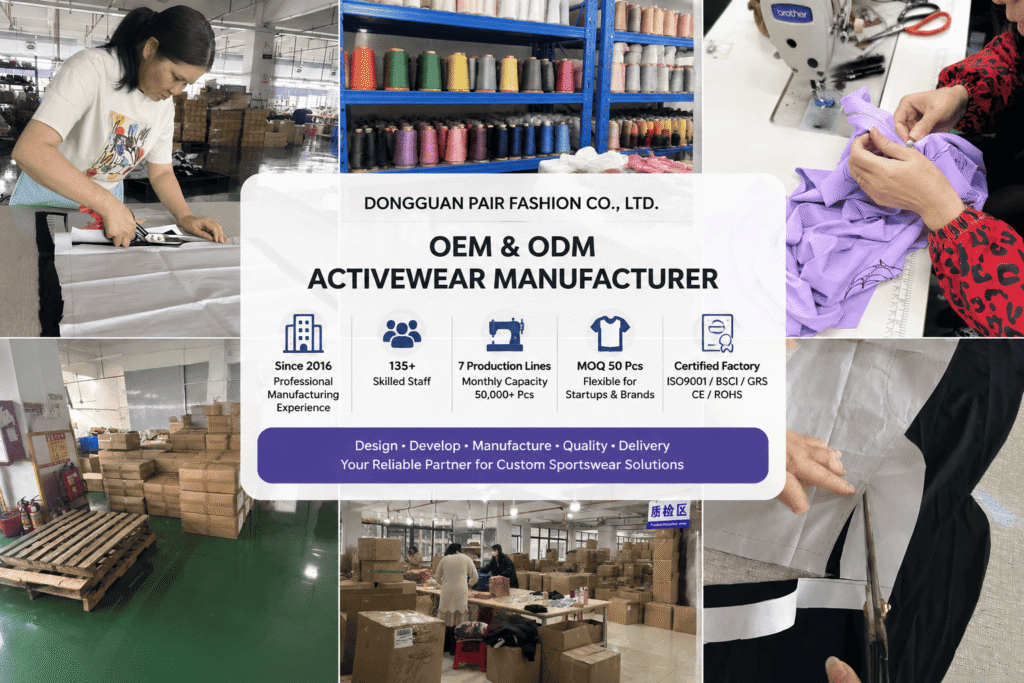
Which Manufacturer Fits Your Order Type and Purchasing Stage?
The right Plus Size Wholesale Activewear Manufacturer depends on the buyer’s purchasing stage, product maturity, order volume and internal development capability. A startup testing its first collection may prioritize manageable inventory and development support, while a mature brand with approved specifications may prioritize repeatability, capacity and supply continuity. Instead of searching for one manufacturer that is “best” for every buyer, match supplier capabilities and commercial conditions to the risks of the actual order.
A common sourcing mistake is comparing manufacturers without first defining what the buyer actually needs from the supplier.
Two companies can request quotations for almost identical leggings and still require very different manufacturing relationships.
One may be a startup with reference images, limited technical knowledge and an uncertain sales forecast. The other may be an established brand with a complete Tech Pack, approved fabric, tested measurements and predictable monthly replenishment.
The same Plus Size Wholesale Activewear Manufacturer may be suitable for one project but commercially inefficient for the other.
The starting question should therefore be:
What does this order need the supplier to solve?
What Should a Startup Look for?
A startup usually faces more uncertainty than an established buyer.
The brand may still be testing:
Product-market fit
Target retail price
Preferred silhouettes
Size demand
Color demand
Customer response
Reorder potential
This changes the sourcing priority.
A startup evaluating a Plus Size Wholesale Activewear Manufacturer may place greater importance on:
Manageable first-order quantity
Mixed-size flexibility
Clear sample costs
Development communication
Available fabric options
Simple branding choices
Transparent pricing
Realistic lead times
Ability to scale after validation
For example, Manufacturer A may quote $8.80 per legging with a minimum of 500 pieces per color.
Manufacturer B may quote $10.20 but allow a much smaller first commitment.
If the brand has no reliable sales history, Manufacturer B may create less inventory exposure even though its unit price is higher.
The startup should not automatically optimize for the lowest unit cost.
It should optimize for how much it needs to risk in order to learn whether the product works.
Should a Startup Always Choose the Lowest MOQ?
No.
A low MOQ can reduce inventory risk, but it can also come with trade-offs.
A Plus Size Wholesale Activewear Manufacturer offering a very small quantity may require the buyer to use:
Available fabrics
Existing colors
Standard trims
Limited packaging
Existing product blocks
Simpler logo methods
That may be completely acceptable for an early market test.
But if the brand requires custom-dyed fabric, proprietary construction, several colors and specialized trims, a very low MOQ may no longer be commercially realistic.
The better question is:
What customization is possible at this MOQ?
This helps the startup distinguish between low-MOQ market testing and full custom product development.
They are not always the same manufacturing offer.
What Should a Growing DTC Brand Prioritize?
A growing direct-to-consumer brand usually has more evidence than a startup.
It may already know:
Which products sell
Which sizes move fastest
Which colors repeat
Typical return reasons
Customer fit feedback
Approximate reorder frequency
At this stage, choosing a Plus Size Wholesale Activewear Manufacturer becomes less about proving that one garment can be made and more about determining whether successful products can be supplied repeatedly.
The buyer may place greater weight on:
Production consistency
Reorder capability
Material continuity
Color consistency
Capacity planning
Inspection records
Specification control
Size-ratio flexibility
Reliable production scheduling
Suppose a brand’s 2XL and 3XL leggings consistently sell faster than XL and 5XL.
A supplier that allows practical size ratios may create better inventory economics than one requiring an equal quantity in every size.
Similarly, a manufacturer with a slightly higher unit price but stronger replenishment support may become commercially useful when stockouts cost the brand more than a small production-price difference.
Why Does Reorder Capability Become More Important as a Brand Grows?
The first order proves that a product can enter the market.
The reorder tests whether the supply chain can support the business.
For a growing brand, the value of a Plus Size Wholesale Activewear Manufacturer increasingly depends on repeatability.
The buyer should ask:
Are approved patterns retained?
Are final measurement specifications retained?
Is the approved fabric recorded?
Are color standards retained?
Are label and packaging specifications archived?
Can previous QC findings be retrieved?
Can the same material be sourced again?
What changes if the original material is unavailable?
What is the normal reorder lead time?
Does reorder MOQ differ from first-order MOQ?
A first order and a reorder should not be treated as completely unrelated projects.
The more accurately approved specifications can be retrieved, the easier it becomes to identify and control unnecessary variation.
What Should a Wholesaler or Distributor Prioritize?
Wholesalers and distributors can face a different commercial problem.
Instead of testing only one hero product, they may need:
Broader SKU coverage
Multiple colors
Mixed size ratios
Reliable delivery windows
Commercial packaging
Consistent replenishment
Predictable cost structures
A wholesaler evaluating a Plus Size Wholesale Activewear Manufacturer may therefore accept a higher total MOQ if the supplier can support a broader commercial program efficiently.
For example, a distributor may be comfortable ordering 3,000 pieces overall but still require flexibility across:
6 styles × 3 colors × 5 sizes
The total volume looks large.
The quantity per individual SKU can still be relatively small.
This is why distributors should examine MOQ architecture, not only total purchasing volume.
A supplier may have enough production capacity for 3,000 garments but still impose material or color minimums that make the assortment commercially difficult.
What Should Mature Brands With Complete Tech Packs Prioritize?
A mature brand often requires less product interpretation from the supplier.
It may already have:
Approved Tech Packs
Measurement charts
Grading rules
Fabric specifications
Color standards
Construction requirements
Packaging specifications
Inspection criteria
For this buyer, a Plus Size Wholesale Activewear Manufacturer should be evaluated heavily on execution against locked specifications.
The purchasing team may prioritize:
Specification accuracy
Material traceability
PP sample control
Production capacity
In-line inspection
Final inspection
Tolerance control
On-time delivery
Corrective-action response
Repeatability between orders
A mature buyer may also have less tolerance for undocumented substitutions.
If an approved fabric becomes unavailable, the supplier should not simply replace it with a visually similar material.
The change should be communicated, evaluated and approved according to the buyer’s process.
For these projects, reliable execution can be more valuable than extensive design assistance.
OEM vs ODM vs Private Label: Which Model Fits the Buyer?
These terms are frequently used together, but the purchasing requirements can be different.
OEM generally becomes more relevant when the buyer owns or provides substantial product specifications and needs a manufacturer to execute them.
ODM can be useful when the buyer needs more supplier involvement in product development or wants to adapt existing development resources.
Private label often involves applying the buyer’s branding to products developed through a supplier’s existing or adapted product structure.
Actual service definitions can vary between companies, so buyers should confirm exactly what is included.
A Plus Size Wholesale Activewear Manufacturer advertising OEM, ODM and private label should be asked practical questions instead of being evaluated by the acronyms alone.
For example:
Who creates the pattern?
Who owns the final Tech Pack?
Can an existing style be modified?
Which changes affect MOQ?
Are custom fabrics possible?
Are existing fabrics available for lower quantities?
Are labels and packaging included?
Can the approved specifications be used for future reorders?
These answers reveal the actual manufacturing model.
When Does OEM Make More Sense?
OEM can make practical sense when the brand already knows what it wants to manufacture.
The buyer may have:
A complete Tech Pack
Defined measurements
Target materials
Approved construction
Established branding
Previous production history
In this situation, the role of the Plus Size Wholesale Activewear Manufacturer is less about creating the product concept and more about executing the buyer’s requirements consistently.
For mature products, buyers may care more about:
Accuracy → Repeatability → Capacity → Delivery
than broad design support.
However, even a detailed Tech Pack does not remove the need for supplier feedback.
A manufacturer may identify a construction issue, material limitation or production risk that deserves discussion before bulk production.
OEM should therefore be treated as specification-led manufacturing, not one-way communication.
When Does ODM Make More Sense?
ODM can be useful when the buyer has a clear market direction but does not yet have every technical detail finalized.
For example, a brand may know that it wants:
A high-rise plus-size training legging
Medium-to-firm support
Side pockets
A matte surface
Several extended sizes
Private branding
but may still need support converting those requirements into a manufacturable product.
When considering an ODM-oriented Plus Size Wholesale Activewear Manufacturer, buyers should confirm how much development work the supplier actually provides.
One supplier may offer pattern development and material recommendations.
Another may simply allow modifications to an existing style.
Both can describe themselves as ODM.
The term itself does not tell the buyer how much product development is included.
When Does Private Label Make More Sense?
Private label can be practical when the priority is market validation rather than maximum product originality.
For example, a new brand may want to test whether its audience will buy plus-size activewear before investing heavily in proprietary product development.
An existing product structure with custom branding may allow the buyer to enter the market with fewer development variables.
A private-label Plus Size Wholesale Activewear Manufacturer may therefore be relevant when the buyer prioritizes:
Faster market entry
Lower development complexity
Existing materials
Proven construction
Branding customization
Smaller initial product changes
The trade-off is differentiation.
If several brands can purchase substantially the same base product, the buyer may need to create differentiation through branding, merchandising, customer experience or later proprietary development.
Can a Brand Change Manufacturing Models as It Grows?
Yes.
The sourcing model used for the first 100–300 pieces does not need to remain the sourcing model used at 5,000 pieces.
A brand may move through stages such as:
Ready Stock → Private Label → ODM → Custom OEM
or use several models at the same time.
For example:
Core leggings use custom OEM
New experimental tops begin as ODM
Accessories use private label
Urgent stock gaps use ready-stock purchasing
The right Plus Size Wholesale Activewear Manufacturer relationship can therefore change as product certainty and purchasing volume increase.
Buyers should periodically reassess whether the commercial structure still matches the business.
A supplier that was ideal for a 150-piece market test may not be the most efficient structure at 10,000 pieces per season.
The reverse can also be true: a high-capacity manufacturer designed around large production programs may be inefficient for early testing.
Which Supplier Structure Fits Each Purchasing Stage?
A practical framework looks like this:
| Buyer Stage | Main Purchasing Risk | Supplier Capability to Prioritize | Commercial Priority |
|---|---|---|---|
| Early Startup | Unsold inventory | Flexible entry route and clear development conditions | Manageable commitment |
| Market Validation | Uncertain product demand | Sampling and practical small-order structure | Learning at controlled cost |
| Growing DTC Brand | Stockouts and inconsistency | Repeatability and replenishment | Reliable reorders |
| Wholesaler / Distributor | SKU complexity | Assortment and production coordination | MOQ architecture |
| Mature Brand | Specification deviation | Process control and repeatability | Accurate execution |
| High-Volume Program | Capacity and continuity | Capacity planning and supply stability | Scalable production |
This framework does not identify one universal winner.
Instead, it helps the buyer ask whether the supplier’s strengths solve the risks that matter at the current purchasing stage.
How Should Buyers Build a Stage-Based Shortlist?
Start by writing down the three or four commercial problems the supplier must solve.
A startup might write:
1. Keep the first inventory commitment manageable.
2. Support an extended-size range.
3. Allow mixed sizes.
4. Provide enough development support to reach an acceptable sample.
A mature brand might write:
1. Follow the approved Tech Pack.
2. Maintain material and color consistency.
3. Produce 8,000 pieces within the required window.
4. Support repeatable replenishment.
These two buyers should not necessarily assign the same weight to the same Plus Size Wholesale Activewear Manufacturer.
The startup may value flexibility more heavily.
The mature brand may value capacity and repeatability more heavily.
That does not make either buyer’s evaluation wrong.
It means the evaluation reflects the actual order.
Why Should Buyers Avoid Searching for a Universal “Best Manufacturer”?
The word best becomes less useful when purchasing conditions are different.
Suppose Manufacturer A has:
Lower MOQ
Higher unit price
Strong development support
Moderate capacity
Manufacturer B has:
Higher MOQ
Lower unit price
Limited development support
Large production capacity
For a new brand testing its first 200 units, Manufacturer A may fit the commercial structure.
For an established brand ordering 20,000 units from a locked Tech Pack, Manufacturer B may fit a completely different purchasing structure.
The comparison does not require declaring one company universally superior.
A Plus Size Wholesale Activewear Manufacturer should be judged against the requirements and risks of the actual program.
Buyer–Supplier Fit Checklist
Before reducing the shortlist further, buyers can ask:
| Question | Yes / No |
|---|---|
| Does the supplier’s normal MOQ fit our current purchasing volume? | □ |
| Can sizes be distributed according to expected demand? | □ |
| Does the supplier support our required manufacturing model? | □ |
| Is the development structure appropriate for our internal technical capability? | □ |
| Can the supplier support our required product categories? | □ |
| Are sample and development costs commercially reasonable for this stage? | □ |
| Can production capacity support expected growth? | □ |
| Can approved specifications be retained for reorders? | □ |
| Are the payment structure and cash requirements manageable? | □ |
| Does the supplier provide evidence relevant to our main project risks? | □ |
At this stage, buyers should have moved beyond a long list of companies found through search.
They should now have a smaller group of suppliers that meet the commercial structure of the actual order.
The final question is no longer whether a company looks like a professional Plus Size Wholesale Activewear Manufacturer.
It is:
Does this supplier’s manufacturing model, MOQ structure, development capability, capacity and order terms match the purchasing stage we are in now?
That question creates a much stronger foundation for the final shortlist.
1. Product Development
Regular monthly product development ensures consistent updates to your brand line.
2. Fabric Sourcing
Regular monthly product development ensures consistent updates to your brand line.
3. Sample Making
Regular monthly product development ensures consistent updates to your brand line.
4. Bulk Production
Regular monthly product development ensures consistent updates to your brand line.
5. Packaging & Delivery
Regular monthly product development ensures consistent updates to your brand line.
How Do You Choose a China Plus Size Activewear Manufacturer After Building a Shortlist?
After building a shortlist, buyers should choose a Plus Size Wholesale Activewear Manufacturer step by step instead of depending only on one overall score. First, confirm all mandatory requirements. Then normalize the quotations, compare samples under the same conditions, check production evidence and evaluate the commercial differences. If a supplier cannot meet a truly non-negotiable requirement, it should be removed before using the weighted scoring system. After this, the remaining suppliers can be compared based on the actual risks and priorities of the order.
At this stage, most obviously unsuitable suppliers should already be gone.
The remaining manufacturers should have passed basic business verification, demonstrated relevant product capability, provided comparable quotations and completed enough sample work to show how they respond to the project.
The challenge is now different.
The buyer is no longer asking:
“Can I find a Plus Size Wholesale Activewear Manufacturer?”
The question becomes:
“Which remaining supplier fits this specific order, and what evidence supports that decision?”
A practical decision chain is:
Search → Verify → Normalize → Sample → Eliminate → Compare → First Order
Each stage removes a different type of uncertainty.
Step 1: Search Broadly, but Do Not Decide From Search Results
Search results, manufacturer directories, referrals, exhibitions and sourcing platforms are useful for discovering suppliers.
They are not final purchasing evidence.
A company may rank highly online because it has strong marketing. Another may have less visible marketing but stronger production capability for a particular product.
When identifying a Plus Size Wholesale Activewear Manufacturer, use the discovery stage to build a longlist rather than make the final decision.
At this point, collect basic information such as:
Location
Supplier type
Product categories
Published size range
Published MOQ
Manufacturing model
Sampling information
Basic certification claims
Contact information
Do not spend too much time scoring suppliers at this stage.
The information is still largely published claims.
Step 2: Verify Before You Compare
The next stage converts marketing claims into evidence.
Confirm business identity, production relationships, relevant activewear experience and extended-size capability.
If a Plus Size Wholesale Activewear Manufacturer says it produces through 5XL, ask for evidence related to measurement charts, grading, size-set samples or previous extended-size production.
If it advertises a certification that is mandatory for the project, verify whether the certification is current and relevant.
If it claims direct manufacturing, understand which processes are actually controlled internally and which are subcontracted.
The purpose is not to prove that the supplier is perfect.
It is to determine whether there is enough credible evidence to continue spending time and money on the evaluation.
Step 3: Give the Finalists the Same RFQ
For a meaningful comparison, the final two or three suppliers should receive substantially the same core product requirements.
If Supplier A receives a detailed Tech Pack, Supplier B receives three reference photos and Supplier C receives only a short message, the resulting quotations and samples cannot tell you much about comparative manufacturing capability.
A normalized RFQ should define:
Product
Construction
Fabric
Target GSM
Size range
Size distribution
Colors
Logo
Labels
Packaging
Quantity
Testing requirements
Delivery basis
Target timing
Every Plus Size Wholesale Activewear Manufacturer may still respond differently.
That is useful.
The important point is that the differences now come from the supplier’s manufacturing approach and commercial structure rather than from different instructions.
Step 4: Create a Mandatory Requirement Gate
Before assigning scores, identify the requirements that the project cannot proceed without.
These are not preferences.
They are gates.
For example:
| Requirement | Mandatory? | Supplier A | Supplier B | Supplier C |
|---|---|---|---|---|
| XL–5XL Size Range | Yes | Pass | Pass | Pass |
| Required Material | Yes | Pass | Fail | Pass |
| MOQ ≤ 300 pcs/color | Yes | Pass | Pass | Pass |
| Required Certification | Yes | Pass | Fail | Pass |
| Target Shipment Window | Yes | Pass | Pass | Pass |
| Custom Packaging | No | Pass | Pass | Pass |
Supplier B may communicate extremely well.
It may provide the lowest quotation.
It may produce an attractive sample.
But if the required material and certification are genuinely mandatory, those strengths do not solve the problem.
A Plus Size Wholesale Activewear Manufacturer should therefore pass the mandatory gate before receiving a meaningful comparative score.
This prevents a high total score from hiding a critical commercial failure.
Why Can an 87/100 Supplier Still Be the Wrong Fit?
Consider a simplified scorecard.
Supplier A receives:
87/100
That looks strong.
But suppose the project requires a specific material that Supplier A cannot provide.
The total score becomes commercially misleading.
Excellent communication and sewing cannot compensate for an inability to meet a mandatory material requirement.
The same logic applies if the buyer can commercially commit to only 200 pieces per color while the manufacturer requires 1,000 pieces per color.
A Plus Size Wholesale Activewear Manufacturer can be capable, professional and reliable while still being unsuitable for a particular order.
This distinction is important.
Supplier quality and project fit are related, but they are not the same question.
Step 5: Normalize the Commercial Conditions
After mandatory requirements are checked, compare the remaining suppliers under the same commercial assumptions.
For example:
Supplier A
$9.10 per piece
500 pcs minimum
EXW
Packaging extra
Supplier B
$10.20 per piece
200 pcs minimum
FOB
Standard packaging included
Supplier C
$11.00 per piece
150 pcs minimum
DDP
Packaging included
The lowest headline price does not answer the purchasing question.
Before choosing a Plus Size Wholesale Activewear Manufacturer, calculate or estimate:
Total initial order value
Quantity commitment
Packaging costs
Development charges
Testing
Inspection
Logistics
Import-related costs
Payment timing
Inventory exposure
Only then does the price comparison become commercially meaningful.
Step 6: Compare Samples Under the Same Scorecard
The remaining suppliers should be evaluated using substantially the same sample criteria.
A useful scorecard may include:
| Sample Category | Weight |
|---|---|
| Measurement Accuracy | 20% |
| Fit & Movement | 20% |
| Fabric Match & Performance | 15% |
| Construction | 15% |
| Workmanship | 10% |
| Branding Execution | 5% |
| Revision Accuracy | 10% |
| Technical Communication | 5% |
These weights are only an example.
A buyer should change them according to the product.
A compression legging may place more weight on fit, fabric and recovery.
A fashion-led activewear top may place more weight on appearance and construction.
A Plus Size Wholesale Activewear Manufacturer should therefore be scored against the actual risk profile of the product rather than a universal template.
Step 7: Separate Evidence From Impressions
Supplier evaluation often contains both objective evidence and subjective impressions.
Both can matter, but they should not be confused.
Evidence might include:
Actual sample measurements
Verified MOQ
Written lead time
Test reports
Production records
Inspection documents
Verified certifications
Quoted payment terms
Impressions might include:
“Communication feels professional”
“The team seems experienced”
“The sample looks premium”
“The sales representative responds quickly”
A buyer evaluating a Plus Size Wholesale Activewear Manufacturer should record both, but objective evidence should carry more weight when the requirement can be measured.
For example:
“The supplier seems very quality-focused.”
is weaker evidence than:
“The supplier provided measurement inspection records and explained how deviations outside tolerance are handled.”
Good communication is valuable.
It should support manufacturing evidence rather than replace it.
Step 8: Evaluate Production Capability Separately From the Sample
A good sample remains important, but the final shortlist should also consider whether the supplier can reproduce it.
Ask:
What production line will handle the order?
Is capacity available in the required window?
How are approved specifications transferred to production?
Is a PP sample required?
How are fabric and trims approved?
What in-line inspection is performed?
What final inspection is performed?
How are non-conforming products handled?
Are production records retained for reorders?
A Plus Size Wholesale Activewear Manufacturer that produces one excellent sample but cannot explain how specifications move into bulk production leaves an important gap in the evaluation.
Sample quality shows development capability.
Production evidence helps evaluate repeatability.
Both matter.
Step 9: Use Weighted Scoring Only After Mandatory Elimination
Once unsuitable suppliers have been removed, a weighted score can help organize the remaining trade-offs.
For example:
| Evaluation Category | Weight |
|---|---|
| Product & Plus Size Capability | 25% |
| Sample Performance | 20% |
| Commercial Terms | 15% |
| Production & QC Evidence | 15% |
| MOQ & Inventory Fit | 10% |
| Lead Time | 5% |
| Communication | 5% |
| Reorder Support | 5% |
| Total | 100% |
The weights should reflect the order.
A startup may increase the weighting for MOQ and inventory fit.
A mature brand may increase production control and repeatability.
A wholesaler may increase capacity and delivery reliability.
The score helps organize information. It should not replace purchasing judgment.
If a Plus Size Wholesale Activewear Manufacturer scores highly because it performs well across many minor categories but remains weak in one critical area, the buyer should investigate that weakness rather than blindly accept the total.
Step 10: Look at the Trade-Offs Behind the Score
Suppose two finalists remain:
| Factor | Supplier A | Supplier B |
|---|---|---|
| Sample | Very Strong | Strong |
| Unit Price | Lower | Higher |
| MOQ | Higher | Lower |
| Lead Time | Similar | Similar |
| QC Evidence | Strong | Strong |
| Size Flexibility | Moderate | Strong |
| Initial Inventory | Higher | Lower |
| Capacity | Higher | Moderate |
There is no need to make the comparison become a conclusion that one supplier is better for every buyer.
Supplier A may be more suitable for a stable product with large order quantities.
Supplier B may be more suitable for a growing brand that still needs more flexibility in inventory.
When choosing a Plus Size Wholesale Activewear Manufacturer, the buyer should document the reason behind the decision.
For example:
Supplier B was selected for the first order because its MOQ and size-mixing conditions reduce initial inventory exposure while still meeting the mandatory product requirements.
That statement is more useful internally than:
Supplier B scored 89 and Supplier A scored 86.
The first explains the purchasing logic.
Step 11: Consider a Controlled First Order
Passing the evaluation process does not eliminate every production risk.
For a new supplier relationship, the first bulk order can be treated as another stage of evidence.
Where commercially practical, buyers may avoid immediately placing the largest possible order.
A controlled first order can help evaluate:
Bulk consistency
Production communication
Measurement control
Packaging accuracy
Inspection response
Shipment timing
Documentation
Corrective-action handling
This does not mean every first order should be artificially small.
The order still needs to meet the manufacturer’s commercial minimum and the buyer’s business requirements.
The principle is to avoid increasing exposure faster than the available evidence justifies.
A new Plus Size Wholesale Activewear Manufacturer relationship becomes more valuable when successful sample performance is followed by successful bulk production and then a consistent reorder.
Step 12: Record Why a Supplier Was Eliminated
A supplier database becomes more useful when buyers record why companies were removed.
Possible reasons include:
MOQ too high
Required material unavailable
Mandatory certification unavailable
Sample outside tolerance
Poor revision response
Unacceptable lead time
Insufficient extended-size evidence
Commercial terms unsuitable
Capacity unavailable
Communication breakdown
This information can matter later.
A supplier eliminated because its MOQ is too high today may become relevant when the brand grows.
A supplier eliminated because it cannot provide a mandatory material may remain unsuitable for the same product.
A Plus Size Wholesale Activewear Manufacturer should therefore be classified by the reason for elimination rather than simply marked “bad supplier.”
This makes future sourcing faster and more accurate.
What Should the Final Supplier Decision Record Include?
Before issuing the purchase order, create a short internal decision record.
It can include:
Supplier selected:
Manufacturer name
Product:
Style or collection
Mandatory requirements:
All passed
Sample result:
Approved / approved with defined conditions
Commercial basis:
Normalized quotation and agreed Incoterm
MOQ:
Confirmed by style, color and size structure
Main reason for selection:
Two or three evidence-based reasons
Known trade-offs:
Any accepted limitations
First-order risk controls:
PP sample, inspection, testing or other agreed controls
This record does not need to become a complicated procurement report.
Its purpose is to make the decision traceable.
Six months later, the buyer should still be able to understand why this supplier was selected.
A Practical Final Selection Framework
The full supplier-selection process can be reduced to seven stages:
1. Search
Build a broad supplier list.
2. Verify
Confirm business identity, production relationships and relevant capability.
3. Normalize
Give finalists comparable RFQs and commercial assumptions.
4. Sample
Compare physical execution under the same evaluation framework.
5. Eliminate
Remove suppliers that fail mandatory requirements.
6. Compare
Evaluate the remaining commercial and operational trade-offs.
7. First Order
Use bulk production as the next stage of supplier evidence.
The strongest sourcing process does not depend on finding a perfect Plus Size Wholesale Activewear Manufacturer.
It depends on reducing uncertainty in the correct order.
Verify before trusting claims.
Normalize before comparing prices.
Eliminate mandatory failures before scoring preferences.
Compare samples before committing to production.
Confirm production controls before scaling volume.
By the time a buyer reaches the final two or three manufacturers, the decision should be supported by much more than a website, quotation or salesperson’s promise.
It should be supported by business evidence, product evidence, sample evidence, commercial evidence and production evidence connected to the requirements of the actual order.
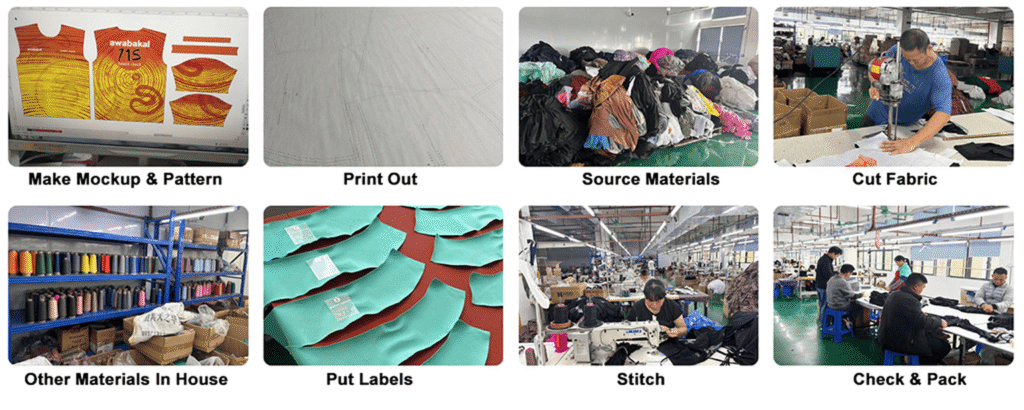
What Should Buyers Confirm Before Placing the First Bulk Order?
Before placing the first bulk order with a Plus Size Wholesale Activewear Manufacturer, buyers should confirm the approved sample, locked specifications, final fabric and color, size chart, tolerances, trims, branding, packaging, MOQ, price, payment terms, Incoterm and production timeline in writing. The purchase order should reflect these agreed conditions, while inspection responsibilities and corrective-action procedures should be understood before production begins rather than negotiated after a problem appears.
Supplier selection is not complete when the buyer chooses a manufacturer.
There is still an important transition between:
“We want to work with this supplier.”
and
“The supplier has everything required to begin bulk production.”
Many avoidable disputes begin in this gap.
The sample may have been approved, but the final fabric code is missing. The quotation may show the correct price, but the packaging requirement was discussed only in a message. The size chart may be correct, but tolerances were never confirmed.
Before authorizing a Plus Size Wholesale Activewear Manufacturer to begin the first bulk order, buyers should convert important development decisions into a controlled production reference.
Is the Approved Sample Clearly Identified?
“Sample approved” should refer to a specific garment or documented version.
During development, a buyer may receive several samples:
Sample 1 → Fit revision → Sample 2 → Logo revision → PP sample
If the buyer says only:
“The sample is approved.”
the manufacturer needs to know which sample and which revision now represent the production requirement.
For a first order with a Plus Size Wholesale Activewear Manufacturer, record:
Style number
Sample version
Approval date
Approved size
Approved measurements
Approved fabric
Approved color
Approved construction
Approved logo
Approved trims
Approved labels
Approved packaging where applicable
Any remaining written comments
The physical sample and the written specifications should support each other.
If they conflict, resolve the conflict before bulk production.
What Does “Locked Specifications” Mean?
Locked specifications are the product requirements that have reached final approval for production.
They may include:
Product
Style number
Construction
Stitching
Pocket details
Waistband structure
Support features
Material
Fabric composition
Fabric code
Target weight
Approved color
Elastic
Mesh or lining
Other functional materials
Sizing
Size range
Measurement chart
Grade
Tolerances
Size distribution
Branding
Logo method
Logo dimensions
Placement
Main label
Care label
Size label
Hangtag
Packaging
Polybag
Size sticker
Barcode
Folding method
Carton requirements
A Plus Size Wholesale Activewear Manufacturer should not have to guess which development comments remain active after the product is approved.
If Sample 1 says “waist +2 cm” and Sample 2 later changes it to “waist +1 cm,” the final production document should contain the approved measurement rather than forcing the production team to reconstruct the development history.
Bulk production should work from the final approved specification, not from a chain of old messages.
Why Should Fabric Be Locked Before Production?
Two fabrics can look similar in a photograph while behaving differently during wear and production.
Before the first bulk order, confirm the approved:
Supplier or material reference
Composition
Fabric construction
Target GSM where relevant
Color
Stretch direction
Surface appearance
Finishing
Performance requirements
Certification requirements where applicable
If the Plus Size Wholesale Activewear Manufacturer needs to replace an approved material because of availability, MOQ or another production issue, the substitute should not be treated as automatically equivalent.
The buyer should understand what changed and decide whether additional approval is required.
This is particularly important for activewear because a material change can affect more than appearance.
Stretch, recovery, compression, opacity, hand feel and garment measurements can all change.
How Should Buyers Lock the Size Specification?
The final size chart should identify the points of measurement and approved tolerances.
Do not rely only on:
XL / 2XL / 3XL / 4XL / 5XL
Those are size names, not production measurements.
For leggings, the final specification may include:
Waist
Hip
Front rise
Back rise
Thigh
Inseam
Leg opening
For tops:
Chest
Waist
Hip
Shoulder
Armhole
Bicep
Sleeve length
Body length
For sports bras:
Bust
Underbust
Body length
Strap length
Armhole
Relevant support measurements
A Plus Size Wholesale Activewear Manufacturer should also know which measurement method the buyer expects.
If the buyer measures the waistband relaxed while the supplier measures it stretched flat, both teams can report different numbers for the same garment.
Measurement method therefore needs to be understood together with the measurement value.
Should Buyers Approve a PP Sample Before Bulk Production?
A pre-production sample, often called a PP sample, can provide an important checkpoint before bulk manufacturing.
Its role is different from an early development sample.
Development samples help solve the product.
The PP sample should represent the product after important production specifications have been finalized.
Before approving a PP sample from a Plus Size Wholesale Activewear Manufacturer, buyers can check:
Final fabric
Final color
Final measurements
Final construction
Final stitching
Final logo
Final labels
Final trims
Final packaging details where practical
The appropriate PP process can vary according to product complexity and order structure.
What matters is that production has a clear approved reference before large quantities are made.
What Should Be Written Into the Purchase Order?
The purchase order should not simply say:
1,000 leggings — $9 each.
A useful PO connects commercial terms to the approved product.
Depending on the order, it may include:
Buyer and supplier information
PO number
Style number
Product description
Quantity
Quantity by color
Quantity by size
Unit price
Total order value
Agreed Incoterm
Payment terms
Required shipment date
Packaging requirements
Referenced approved specifications
Inspection requirements
Other agreed commercial conditions
When ordering from a Plus Size Wholesale Activewear Manufacturer, size distribution deserves particular attention.
If the buyer needs:
XL: 100
2XL: 200
3XL: 300
4XL: 250
5XL: 150
that distribution should not remain only in an informal message if it affects the production order.
Important purchasing conditions should appear in controlled order documents.
When Does the Production Lead Time Actually Start?
“25-day lead time” is incomplete unless both parties know when Day 1 begins.
Possible starting conditions include:
Deposit received
PP sample approved
Final Tech Pack approved
Fabric confirmed
Lab dip approved
Labels confirmed
All trims ready
Production slot confirmed
Before placing the order, ask the Plus Size Wholesale Activewear Manufacturer to identify the conditions required before the production clock starts.
A simple milestone schedule may look like:
Deposit → Material Approval → PP Approval → Bulk Production → Final Inspection → Shipment
If custom fabric is required, material preparation may happen before the sewing lead time begins.
If labels are delayed, the garments may be sewn but not ready for final packing.
This is why buyers should distinguish:
Material Lead Time
from
Bulk Production Lead Time
and
Transportation Time.
How Should Buyers Confirm Payment Terms?
Payment conditions should be written and understood before production begins.
Confirm:
Deposit percentage
Balance percentage
Payment milestones
Currency
Accepted payment method
Bank details
Bank charges where relevant
Whether inspection occurs before final payment
Conditions for future reorders
Suppose a Plus Size Wholesale Activewear Manufacturer uses:
30% deposit / 70% balance before shipment
The buyer should still confirm what must happen before the balance becomes due.
Does the buyer receive a final inspection report?
Can a third-party inspection be arranged?
What happens if the inspection identifies a major issue?
The commercial agreement should address important expectations before money becomes due, rather than relying on assumptions after production is complete.
What Inspection Stages Should Be Understood Before Production?
Quality control should not begin only when cartons are ready to ship.
Depending on the order and supplier system, control can include:
Incoming Inspection
Checking relevant incoming fabrics, trims and components.
In-Line Inspection
Checking production while garments are being made.
Final Inspection
Checking completed goods against agreed requirements before shipment.
A buyer working with a Plus Size Wholesale Activewear Manufacturer should understand who performs each inspection and what happens when a problem is found.
Questions can include:
Which measurements are checked?
How frequently are measurements checked?
Are workmanship defects recorded?
Are colors and logos checked against approved references?
Is quantity checked?
Is packaging checked?
Can the buyer appoint a third-party inspector?
What inspection standard will be used if one has been agreed?
The objective is not to create unnecessary inspection paperwork.
It is to make acceptance criteria visible before production is completed.
What Should Happen When Production Falls Outside Specification?
Problems should have a response path.
Suppose an in-line inspection finds that the hip measurement is consistently outside the agreed tolerance.
The worst response is to continue production and discuss the problem after all garments are finished.
A more controlled process is:
Identify → Isolate → Investigate → Correct → Recheck → Continue
When working with a Plus Size Wholesale Activewear Manufacturer, buyers should understand who has authority to stop or correct production when a significant issue is found.
Corrective action may depend on the problem.
Possible responses include:
Pattern adjustment
Sewing correction
Rework
Replacement
Additional inspection
Sorting
Production hold
Buyer approval of a documented deviation
Not every deviation requires the same solution.
The important point is that deviations are identified and managed, rather than silently accepted.
Why Should Buyers Avoid Last-Minute Specification Changes?
Changes become more expensive and risky as the order moves closer to production.
Changing a logo during early sampling may be straightforward.
Changing the same logo after 1,000 transfers have been produced can create waste, additional cost and delay.
Changing the size chart after bulk cutting has started can be much more serious.
Before authorizing a Plus Size Wholesale Activewear Manufacturer to begin production, buyers should therefore separate:
Required corrections before production
from
ideas for the next order.
Not every improvement needs to be introduced immediately.
If an approved product is commercially acceptable, repeatedly changing minor preferences can destabilize the production reference and create unnecessary delays.
Lock the current order.
Record future improvements separately.
How Should Buyers Handle Approved Changes?
If an important change is made after initial approval, update the controlled specification.
Do not rely only on a message saying:
“Please use the new waistband.”
A change record can identify:
What changed
Previous specification
New specification
Date
Affected styles
Affected sizes
Whether price changes
Whether lead time changes
Whether a new sample is required
Buyer approval
A Plus Size Wholesale Activewear Manufacturer may manage many customers and styles at the same time.
Clear revision control reduces the risk that an old specification is accidentally used.
The principle is simple:
The latest approved requirement should be easy to identify.
What Should Buyers Confirm About Packaging?
Packaging can appear less important than fit or fabric, but errors can still create commercial problems.
Before bulk production is completed, confirm:
Folding method
Individual bag requirements
Bag dimensions where relevant
Size stickers
Barcode
Hangtags
Carton quantity
Carton markings
Assortment requirements
Retail or warehouse requirements
If the buyer supplies barcode data, check it carefully before mass printing.
If a Plus Size Wholesale Activewear Manufacturer is shipping directly to a fulfillment center, retailer or distributor, packaging and carton requirements may need to meet the receiving party’s standards.
A correctly manufactured garment can still create delays if cartons, labels or barcodes are wrong.
What Should Buyers Confirm About Reorders Before the First Order Is Finished?
Reorder planning can begin before the first order ships.
Ask what information will be retained after production:
Final pattern
Approved measurement chart
Fabric reference
Color reference
Trim specifications
Logo files
Label specifications
Packaging details
QC records
Production comments
The objective is commercial repeatability.
If the first order succeeds, the buyer should not need to rebuild the entire product from memory.
A Plus Size Wholesale Activewear Manufacturer that maintains clear production records can make future comparison easier because the buyer can distinguish an intentional change from an accidental variation.
However, buyers should still reconfirm material availability, price, MOQ and lead time before every reorder.
Market conditions and material availability can change.
Final Pre-Order Checklist
Before releasing the first bulk order, use a final written check.
| Requirement | Confirmed |
|---|---|
| Final supplier selected | □ |
| Approved sample identified | □ |
| PP sample approved where required | □ |
| Final Tech Pack / specification locked | □ |
| Fabric confirmed | □ |
| Color confirmed | □ |
| Size range confirmed | □ |
| Measurement chart confirmed | □ |
| Tolerances confirmed | □ |
| Size distribution confirmed | □ |
| Logo confirmed | □ |
| Labels confirmed | □ |
| Trims confirmed | □ |
| Packaging confirmed | □ |
| MOQ confirmed | □ |
| Unit price confirmed | □ |
| Total order value confirmed | □ |
| Sample / setup charges resolved | □ |
| Payment terms confirmed | □ |
| Incoterm confirmed | □ |
| Production lead-time starting point confirmed | □ |
| Required shipment timing confirmed | □ |
| Inspection responsibilities confirmed | □ |
| Corrective-action process understood | □ |
| Reorder records to be retained | □ |
A checklist does not guarantee that nothing will ever go wrong.
It reduces the number of problems caused by unclear expectations.
From Supplier Search to the First Bulk Order
Choosing a Plus Size Wholesale Activewear Manufacturer should not depend on one impressive factory video, one attractive sample, one low quotation or one high supplier score.
A stronger purchasing process connects several types of evidence:
Supplier Evidence
Who are you buying from?
Product Evidence
Can the supplier make the required product and size range?
Sample Evidence
Can it execute the specification physically?
Commercial Evidence
Are MOQ, price, payment and inventory conditions workable?
Production Evidence
Can the approved result be repeated at bulk scale?
The complete purchasing sequence is:
Search → Verify → Normalize → Sample → Eliminate → Compare → Approve → First Order → Inspect → Reorder
Each stage answers a different question.
A buyer does not need a manufacturer that appears strongest in every possible category.
The buyer needs a Plus Size Wholesale Activewear Manufacturer whose verified capability, commercial structure and production system fit the requirements of the actual order.
For the first bulk order, that means turning every important decision made during supplier selection and sampling into a clear production reference.
Approved sample.
Locked specifications.
Confirmed commercial terms.
Defined inspection requirements.
Traceable production records.
Once those conditions are in place, the purchase order becomes more than permission to manufacture.
It becomes the commercial connection between what the buyer approved and what the supplier is expected to deliver.