OEM/ODM Sportswear Manufacturer | 3-Day Sampling | Low MOQ | 50K Monthly Capacity | ISO9001 & BSCI Certified

Top 10 Women's Sports Bra Wholesale Manufacturer Options | MOQ & Costs
Compare 10 Women’s Sports Bra Wholesale Manufacturer options in China by MOQ, order costs, product specialization and supplier suitability. Learn how to verify quotations and reduce inventory risks before choosing the right wholesale sourcing partner.
Top 10 Women's Sports Bra Wholesale Manufacturer Options: Comparing MOQ, Order Costs and Inventory Risks
A sports bra costing $8 per piece can become a more expensive purchasing decision than one costing $11. The difference often comes down to minimum order quantities, size distribution and the amount of money tied up in unsold stock.
Imagine two manufacturers quoting the same sports bra specifications. Supplier A offers $8 per piece but requires 500 units. Supplier B quotes $11 per piece with a 100-unit minimum. The first order requires $4,000 in product expenditure, while the second requires $1,100. Supplier A offers a lower unit cost, but Supplier B leaves more working capital available for marketing, product testing and future replenishment.
For an activewear brand, choosing a Women’s Sports Bra Wholesale Manufacturer is not simply about finding an attractive quotation. It is about selecting a supplier whose manufacturing capabilities, minimum order conditions and commercial structure match the brand’s actual purchasing needs.
Some manufacturers are better suited to small trial collections. Others may offer stronger economies of scale for established products with predictable demand. A supplier that works well for one brand may be unsuitable for another.
The following comparison examines ten China-based manufacturing and sourcing options, the differences buyers should investigate and the financial risks that deserve attention before committing to wholesale production.
The best Women’s Sports Bra Wholesale Manufacturer is not necessarily the supplier offering the lowest unit price or the smallest advertised MOQ. Buyers should compare manufacturers using consistent product specifications, confirmed order minimums, total purchasing costs, sample evidence and delivery requirements. Small brands often benefit from lower initial inventory commitments, while established businesses may achieve better economics through larger production runs. The right decision depends on product complexity, expected sales volume, available working capital and the manufacturer’s ability to deliver repeatable quality.
Top 10 Women’s Sports Bra Wholesale Manufacturer Options in China: Which Suppliers Should Buyers Shortlist?
A useful Women’s Sports Bra Wholesale Manufacturer shortlist should compare suppliers by product specialization, minimum order conditions, production capabilities and suitability for different buyers. No manufacturer is automatically the best choice for every sports bra program. Some companies publish relatively clear starting MOQs, while others quote according to fabric, construction and order size. Buyers should treat published figures as preliminary information and confirm the actual purchasing conditions before comparing prices or approving samples.
Quick Comparison Table: Manufacturer, Product Focus, MOQ and Buyer Suitability
| Manufacturer | Location | MOQ Information | Main Product Focus | Potential Buyer Fit |
|---|---|---|---|---|
| Pair Fashion | Dongguan, Guangdong | Generally from 100 pcs, subject to requirements | Custom sports bras and specialized activewear | Startups, growing brands and targeted collections |
| Bloomto | Dongguan, Guangdong | Selected sports bras from 100 pcs | Sports bras, yoga wear and private label activewear | Small and growing activewear brands |
| INGOR Sportswear | Guangzhou, Guangdong | General bulk MOQ around 300 pcs; product conditions vary | Performance sports bras and activewear | Growing and established brands |
| HUCAI Sportswear | China; production location requires confirmation | Quotation required | OEM/ODM sportswear | Buyers evaluating additional manufacturing options |
| Modaknits | China; assigned facility requires confirmation | Published starting quantities vary by product | Sports bras and multi-category apparel | Brands sourcing multiple garment categories |
| BERUNWEAR | China; facility requires confirmation | Quotation required | Custom sportswear and wholesale apparel | Multi-category sportswear buyers |
| UGA Wear | China; facility requires confirmation | Selected programs advertised around 100 pcs | Sports bras and fitness clothing | Smaller private label programs |
| Eationwear | China; facility requires confirmation | Project-dependent | Yoga wear and functional activewear | Growing brands and repeat-order buyers |
| AOLAFREE | China; facility requires confirmation | Selected products advertised from 150 pcs | Sports bras and gym wear | Small and mid-sized brands |
| Appareify | China; production arrangements require confirmation | Quotation required | Multi-category custom apparel | Buyers comparing broader sourcing services |
MOQ figures are indicative and may differ by design, fabric, color and customization. A published starting quantity should not be treated as a confirmed minimum for every product.
1. Pair Fashion — Custom Sports Bra Manufacturing for Growing Activewear Brands
Company: Dongguan Pair Fashion Co., Ltd.
Location: Dongguan, Guangdong, China
Established: 2016
Pair Fashion manufactures OEM, ODM and private label activewear for international brands, retailers and wholesale buyers. Its product range includes sports bras, leggings, fitness tops, maternity activewear, plus-size sportswear and equestrian apparel.
For buyers comparing suppliers, Pair Fashion’s main consideration is the relationship between product development capability and initial order flexibility.
Key purchasing information
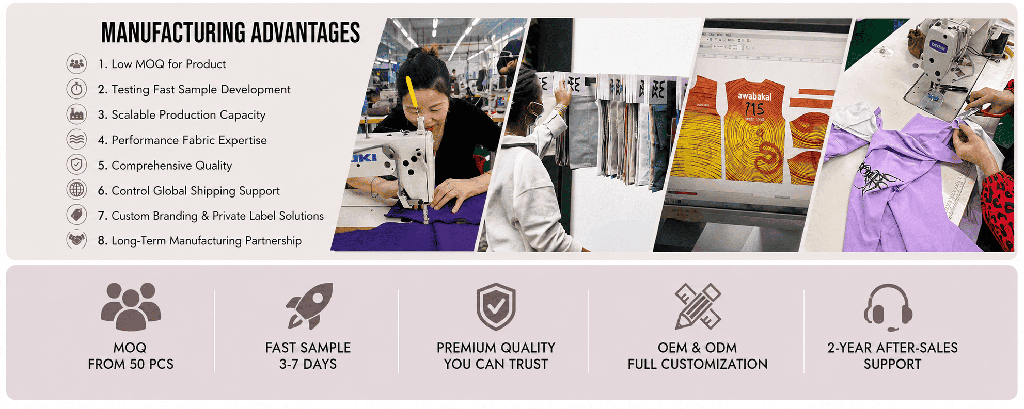
MOQ: Standard starting quantity of approximately 100 pieces, depending on product requirements.
Sampling: Approximately 3–7 days for suitable projects.
Bulk production: Typically 20–25 working days, subject to confirmed scheduling.
Production resources: Seven production lines and approximately 50,000 garments of monthly capacity across product categories.
Development and inspection: An 11-person pattern and sampling team and a 13-person QC team.
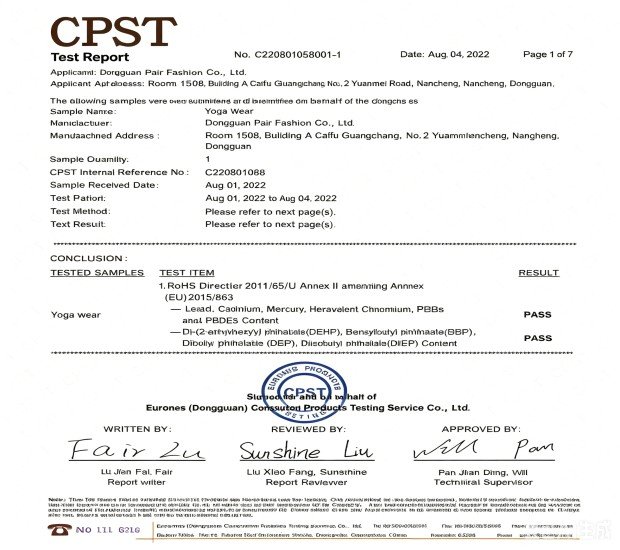
Reported credentials: ISO 9001, BSCI and GRS-related documentation; buyers should verify the applicable scope and validity.
Where this supplier may fit
Pair Fashion may be suitable for brands introducing differentiated sports bra products, testing focused collections or planning to expand into related activewear categories.
Its relatively manageable starting MOQ can be useful when a buyer wants to limit the financial commitment of a first order.
Important purchasing considerations
The 100-piece starting quantity does not automatically apply to every custom fabric, color or construction. A buyer planning several sports bra styles should confirm whether the minimum applies separately to each style and color.
Brands purchasing large quantities of basic, standardized products should also compare total quotations rather than assume that a flexible-order manufacturer will offer the lowest unit price.
Potentially suitable for: Startups, growing activewear brands, specialty sportswear businesses and private label buyers.
Potentially less suitable for: Buyers seeking only the lowest commodity price without product-specific development requirements.
For brands considering Pair Fashion as a Women’s Sports Bra Wholesale Manufacturer, its custom wholesale sports bra manufacturing capabilities provide additional information about the production services available for specific projects.
2. Bloomto — OEM/ODM Sports Bra and Private Label Activewear Sourcing
Company: Bloomto
Location: Dongguan, Guangdong, China
Established: 2015, according to its published company information.
Bloomto supplies custom sports bras, yoga clothing and other activewear products. Its public product catalog includes multiple sports bra styles with starting quantities advertised at approximately 100 pieces.
Key purchasing information
MOQ: Selected sports bra products from 100 pieces.
Sampling: The company advertises sample development from approximately seven days.
Bulk production: Confirm according to the selected product and current order schedule.
Core products: Sports bras, yoga leggings, fitness tops and coordinated activewear.
Manufacturing model: OEM, ODM and private label services.
Certifications: Request current documentation for the relevant factory and materials.
Where this supplier may fit
Bloomto may appeal to brands seeking sports bra styles with relatively accessible starting quantities and a broad activewear catalog.
Buyers who want to compare several existing constructions before developing a new collection may find this product range useful.
Important purchasing considerations
An advertised 100-piece MOQ may apply to a particular design or color arrangement rather than the entire collection.
A buyer ordering three styles in four colors should request the minimum for each combination before calculating the initial inventory investment.
Potentially suitable for: New and growing activewear brands, yoga-focused retailers and private label businesses.
Potentially less suitable for: Buyers requiring many custom colors at very small quantities without additional material commitments.
3. INGOR Sportswear — Performance Activewear and Larger Production Programs
Company: Guangzhou INGOR Sportswear Co., Ltd.
Location: Guangzhou, Guangdong, China
Established: 2009
INGOR Sportswear manufactures fitness apparel, yoga wear and sports bras for international buyers. Its published information emphasizes OEM/ODM manufacturing, performance fabrics and substantial production resources.
Key purchasing information
MOQ: The company’s main website describes a general bulk MOQ of approximately 300 pieces. Individual product pages may show different conditions.
Sampling: Selected sports bra product pages indicate approximately seven working days.
Bulk production: The company advertises bulk delivery within approximately 30 days for suitable orders.
Core products: Sports bras, leggings, gym wear and other performance activewear.
Reported credentials: BSCI, GRS, OEKO-TEX and ISO-related credentials, subject to verification.
Where this supplier may fit
INGOR may be suitable for brands with established product specifications, regular order volumes or an interest in recycled performance materials.
Larger production resources can be commercially useful when a buyer expects repeat orders or several activewear product categories.
Important purchasing considerations
The company’s published MOQ information varies between its general manufacturing pages and some individual product listings.
Buyers should obtain a current written quotation rather than selecting the lowest number found online.
A large advertised production capacity also does not guarantee immediate availability for every order.
Potentially suitable for: Growing and established activewear brands, wholesalers and recurring production programs.
Potentially less suitable for: Buyers who need a guaranteed very small minimum across multiple custom designs without prior confirmation.
4. HUCAI Sportswear — An Additional OEM/ODM Sourcing Option
Company: HUCAI Sportswear
Location: China; the registered company and relevant production facility should be verified.
HUCAI Sportswear is a potential sourcing option for buyers researching Chinese sportswear manufacturing.
Before including this supplier in a final purchasing shortlist, buyers should establish whether the company can provide direct manufacturing services for the required sports bra construction.
Key purchasing information
Established: Not independently confirmed.
MOQ: A current project quotation is required.
Sampling and lead time: Written confirmation required.
Core products: Confirm the current sports bra and activewear manufacturing range.
Certifications: Verify the certificate holder, production site and applicable product scope.
Where this supplier may fit
HUCAI may be worth evaluating when a buyer is comparing additional OEM/ODM candidates and has sufficient time to request technical evidence and samples.
Important purchasing considerations
A supplier without readily confirmed commercial information should not automatically be rejected, but it should not receive the same verification score as a manufacturer that has supplied current supporting documents.
Potentially suitable for: Buyers conducting a wider supplier search.
Potentially less suitable for: Procurement programs that require prequalified manufacturers with fully documented facilities before initial contact.
5. Modaknits — Sports Bras and Multi-Category Apparel Manufacturing
Company: Modaknits
Location: China; confirm the production facility assigned to the order.
Modaknits offers sports bra manufacturing alongside other apparel categories. Its published information discusses different sports bra constructions and broader garment manufacturing capabilities.
Key purchasing information
MOQ: Published starting quantities vary according to product and order conditions.
Sampling: Confirm the actual development schedule.
Bulk lead time: Project-specific quotation required.
Core products: Sports bras, fitness clothing and other apparel.
Certifications: Verify documentation for the relevant manufacturing facility.
Where this supplier may fit
Modaknits may appeal to buyers sourcing sports bras alongside several other garment categories.
A multi-category sourcing arrangement can simplify communication when the buyer wants to coordinate multiple product groups.
Important purchasing considerations
General apparel manufacturing experience is not automatically equivalent to specialized sports bra expertise.
Buyers should request evidence involving similar underband construction, stretch fabrics, support requirements and size grading.
Potentially suitable for: Multi-category clothing brands and buyers comparing different production methods.
Potentially less suitable for: Projects requiring specialist sports bra manufacturing evidence before supplier approval.
6. BERUNWEAR — Custom Sportswear and Wholesale Apparel Programs
Company: BERUNWEAR
Location: China; confirm the legal contracting entity and actual production site.
BERUNWEAR is a candidate for buyers researching wholesale sportswear and custom apparel sourcing.
When comparing this type of supplier, the key question is not simply how many products appear in the catalog. Buyers need to know which products are manufactured directly and how production quality is controlled.
Key purchasing information
Established: Not independently confirmed.
MOQ: Confirm for each sports bra design and fabric.
Lead time: Request a project-specific schedule.
Core products: Sportswear and custom apparel; current sports bra capabilities require confirmation.
Certifications: Request valid facility and material documentation.
Where this supplier may fit
BERUNWEAR may be relevant to buyers sourcing several sportswear categories through a coordinated purchasing arrangement.
Important purchasing considerations
If manufacturing is distributed across partner facilities, buyers should clarify responsibility for sample approval, fabric purchasing, inspection and corrective actions.
Potentially suitable for: Sportswear wholesalers and multi-category brands.
Potentially less suitable for: Buyers who require a directly verified sports bra production facility before considering a supplier.
7. UGA Wear — Sports Bra and Fitness Clothing Wholesale
Company: UGA Wear
Location: China; verify the production facility.
UGA Wear offers sports bras and other fitness clothing for wholesale and private label customers.
Its published purchasing information includes small-order options for selected sports bra programs.
Key purchasing information
MOQ: Selected programs advertise starting quantities around 100 pieces.
Sampling: Published information indicates approximately 5–7 days for certain initial samples.
Bulk lead time: Confirm according to the product and current schedule.
Core products: Sports bras, fitness tops, leggings and workout clothing.
Certifications: Current supporting documents should be requested.
Where this supplier may fit
UGA Wear may be worth comparing when a brand wants to test a focused sports bra range without committing immediately to a large production volume.
Important purchasing considerations
The time required to produce the first sample is not necessarily the total sample approval period.
Revisions, fabric changes and additional size testing can extend the development schedule.
Potentially suitable for: Smaller activewear brands and private label retailers.
Potentially less suitable for: Buyers with complex technical requirements that have not yet been evaluated through samples.
8. Eationwear — Functional Activewear and Repeat-Order Sourcing
Company: Eationwear
Location: China; confirm the relevant production site.
Eationwear promotes OEM sportswear manufacturing and a broad activewear product range.
Its published company information emphasizes production resources, custom activewear development and international wholesale supply.
Key purchasing information
MOQ: Project-dependent; written confirmation required.
Sampling: The company advertises approximately 7–10 days for certain projects.
Bulk production: Published information describes approximately 25-day production for suitable orders.
Core products: Sports bras, yoga wear and functional activewear.
Reported credentials: BSCI, GRS, ISO 9001 and OEKO-TEX-related claims; verify current applicability.
Where this supplier may fit
Eationwear may be suitable for buyers planning recurring production or a wider activewear collection.
Important purchasing considerations
Published production capacity and standard lead times should not be interpreted as guaranteed availability.
A buyer with a fixed retail launch date should request a schedule covering material readiness, sample approval, production and dispatch.
Potentially suitable for: Growing brands and established wholesale programs.
Potentially less suitable for: Buyers requiring an unconditional low MOQ before specifications are confirmed.
9. AOLAFREE — Custom Sports Bras and Gym Wear
Company: AOLAFREE
Location: China; verify the relevant manufacturing facility.
AOLAFREE offers sports bras, yoga clothing and other activewear styles. Its published product information includes different minimum quantities for selected designs.
Key purchasing information
MOQ: Selected products advertise approximately 150 pieces per style, while other products may require 200 or 300 pieces.
Sampling: Approximately 7–15 days in published guidance.
Bulk production: Approximately 25–35 days for certain orders.
Core products: Sports bras, gym wear and yoga apparel.
Certifications: Verify documents applicable to the selected materials and facility.
Where this supplier may fit
AOLAFREE may be useful for buyers comparing existing sports bra designs and evaluating moderate starting quantities.
Important purchasing considerations
A published MOQ for one product should not be applied to every design.
Buyers should confirm whether quantities can be mixed across sizes and colors, and whether listed prices include the required branding and packaging.
Potentially suitable for: Small and mid-sized activewear brands.
Potentially less suitable for: Buyers expecting one fixed MOQ or price across all sports bra constructions.
10. Appareify — Multi-Category Custom Apparel Sourcing
Company: Appareify
Location: China; verify the contracting entity and assigned production facilities.
Appareify is a sourcing option for buyers considering custom apparel across multiple categories.
For sports bra procurement, the important issue is whether the supplier can demonstrate suitable production arrangements and technical capability for the intended garment.
Key purchasing information
Established: Not independently confirmed for the relevant manufacturing entity.
MOQ: Project-specific quotation required.
Sampling and bulk lead time: Confirm according to the actual order.
Core products: Custom apparel across multiple categories.
Certifications: Request documentation for the facility and materials involved.
Where this supplier may fit
Appareify may be relevant to brands comparing broader clothing sourcing services rather than sports bra production alone.
Important purchasing considerations
Buyers should identify the facility responsible for their sports bra order and clarify who manages approved specifications, inspection records and production corrections.
Potentially suitable for: Brands sourcing several apparel categories.
Potentially less suitable for: Buyers requiring a specialist sports bra factory with independently verified production capabilities from the beginning.
How Should Buyers Verify the Top 10 Manufacturers Before Requesting Quotations?
A published supplier list is useful for discovery, but it cannot replace purchasing evidence.
A Women’s Sports Bra Wholesale Manufacturer should be evaluated against the requirements of the actual order. The most important details include the manufacturer’s legal identity, production role, product experience, minimum order conditions and ability to meet confirmed specifications.
Buyers should distinguish between information published on a website and conditions confirmed in a quotation. A company may advertise a 100-piece starting MOQ, while a custom-dyed fabric or specialized construction requires a higher quantity. Both statements can be valid under different purchasing conditions.
Before reducing the shortlist to two or three suppliers, request the following information:
Company identity: Registered business name and production location.
Manufacturing role: Direct factory, trading company or coordinated sourcing service.
MOQ structure: Minimum per style, color, fabric and size assortment.
Price conditions: Currency, quotation validity, packaging and Incoterms.
Sample evidence: Relevant garment samples, measurements and test results.
Production timing: Material availability, approval requirements and bulk lead time.
Quality evidence: Inspection procedures, applicable certifications and corrective-action responsibilities.
Reorder conditions: Repeat-order minimums, fabric continuity and specification control.
One supplier may provide a lower price but require a larger minimum order. Another may charge more per piece but allow a manageable first purchase. A third may offer strong production resources but require longer preparation for specialized materials.
These differences should be compared under the same product specifications.
For example, a buyer requesting a medium-support sports bra in nylon-spandex fabric should provide the same fabric requirements, measurement chart, size range, branding details and estimated quantities to every shortlisted supplier. Otherwise, the quotations may represent different products rather than different manufacturing costs.
The purpose of supplier comparison is not to identify the company with the most impressive marketing claims. It is to find the manufacturer whose verified capabilities and purchasing conditions provide the best fit for the order.
A disciplined comparison makes it easier to eliminate unsuitable suppliers early, request meaningful samples and avoid unnecessary inventory commitments.

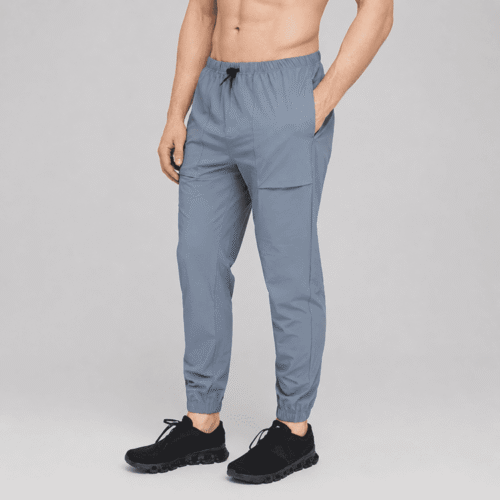
Custom Men’s Cargo Jogger Pants Performance Activewear OEM ODM
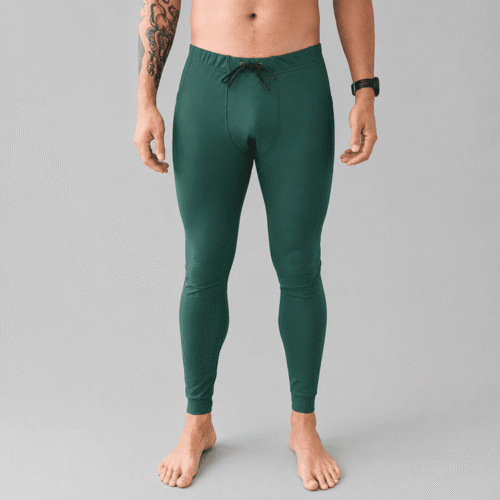
Custom Men’s Compression Yoga Pants OEM ODM Training Leggings
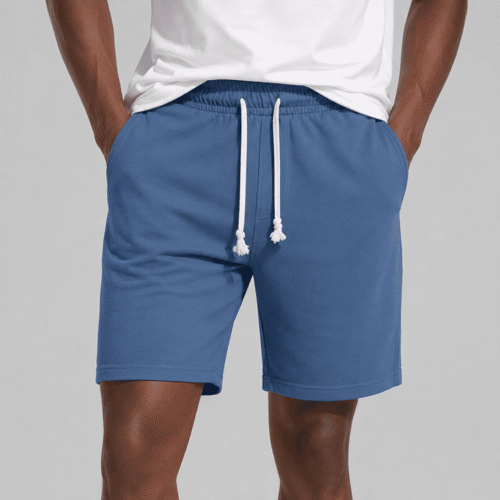
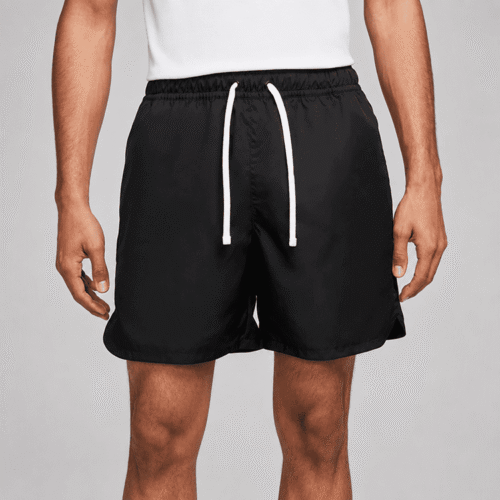
Custom Men’s Drawstring Lounge Shorts OEM ODM Casual Sweat Shorts
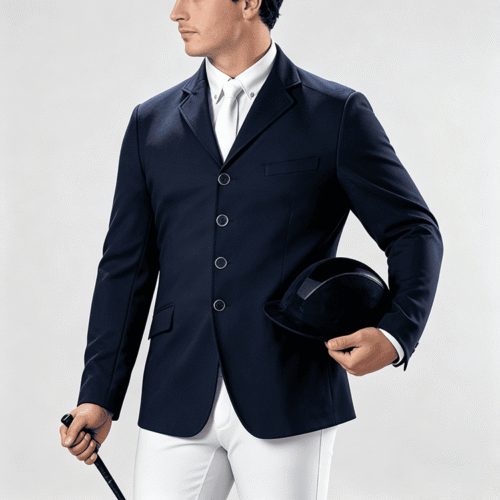
Custom Men’s Equestrian Show Jacket Competition Riding Coat OEM ODM
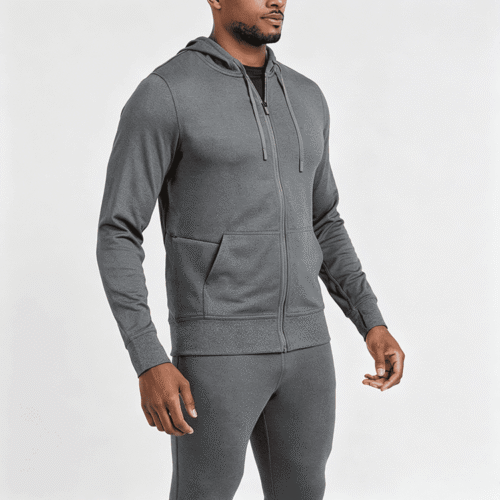
Custom Men’s Full Zip Hoodie Fleece Sweatshirt OEM ODM
Custom Men’s Gym Shorts OEM ODM Lightweight Workout Shorts
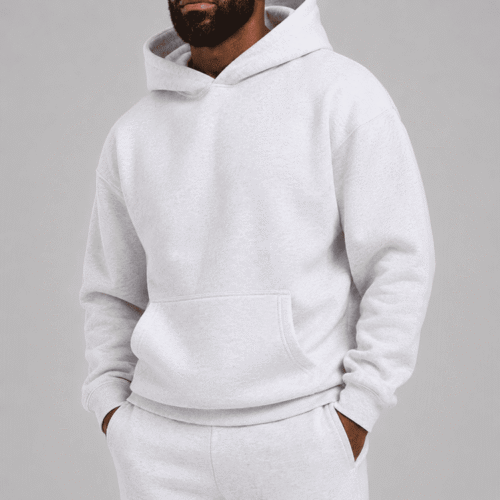
Custom Men’s Heavyweight Pullover Hoodie Fleece Sweatshirt OEM ODM
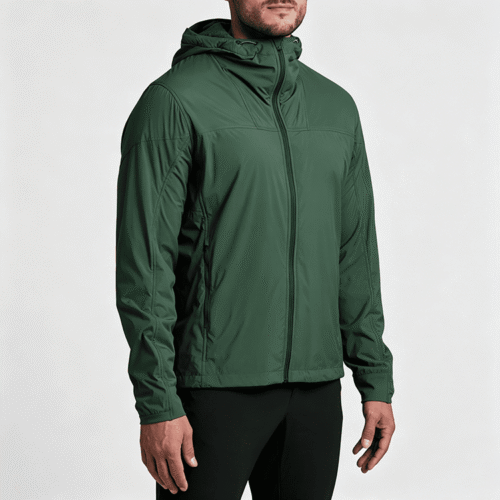
Custom Men’s Hooded Windbreaker Jacket Lightweight Training Outerwear OEM ODM
Why Choose Sports Bra Manufacturers in China? China vs Local and Nearshore Sourcing
China remains an important sourcing destination for sports bra brands because its apparel supply chain connects fabric development, elastic trims, pattern making, garment manufacturing and export services. This can make it easier to coordinate products with different support levels, fabrics and branding requirements. However, China is not automatically the cheapest or fastest option. Buyers should compare minimum orders, landed costs, development requirements, shipping time and supply-chain risks before deciding where to manufacture.
Choosing a Women’s Sports Bra Wholesale Manufacturer in China can offer advantages beyond the quoted garment price. A sports bra is a relatively small product, but its manufacturing requirements can be demanding. The performance of the finished garment depends on several components working together, including fabric stretch, elastic recovery, underband construction, strap stability and sewing accuracy.
When these materials and production services can be coordinated efficiently, brands may find it easier to develop and replenish consistent products. However, the advantage depends on the supplier’s actual experience and the availability of suitable materials.
A Chinese manufacturer with reliable fabric sourcing and technical sports bra experience may be more suitable than a cheaper supplier with limited product knowledge. Similarly, a local manufacturer may be the better option when the buyer needs very small quantities, frequent design changes or exceptionally short delivery distances.
The purchasing decision should therefore be based on the total requirements of the order rather than the manufacturer’s country alone.
What Makes China’s Sports Bra Manufacturing Supply Chain Competitive?
China’s main advantage is the availability of connected manufacturing resources.
Sports bra production requires more than fabric cutting and garment sewing. Depending on the design, manufacturers may need performance fabrics, elastic bands, removable padding, molded cups, mesh panels, adjustable straps, heat-transfer labels and specialized stitching.
These components can affect both manufacturing costs and the time required to complete an order.
For example, consider two medium-support sports bras that look almost identical in product photographs.
The first uses a standard nylon-spandex fabric, conventional elastic straps and removable padding. The second requires a specially developed fabric, wider underband elastic, reinforced construction and a custom color.
Although their appearance may be similar, the second design could require additional material sourcing, testing and minimum purchases.
A Women’s Sports Bra Wholesale Manufacturer with access to suitable material suppliers may be able to coordinate these requirements more efficiently. Nevertheless, buyers should confirm whether the proposed materials are regularly stocked or must be produced specifically for their order.
The most useful supply-chain advantages include:
Fabric availability: Access to different stretch fabrics, fabric weights and performance finishes.
Component sourcing: Options for underband elastic, straps, padding, labels and packaging.
Technical development: Pattern making, grading and construction adjustments for different support levels.
Production coordination: The ability to connect approved materials with bulk manufacturing requirements.
Replenishment planning: Opportunities to maintain material specifications for future orders.
These advantages are valuable only when the supplier can demonstrate that the relevant resources are available for the actual project.
A broad fabric catalog does not guarantee immediate material availability. Likewise, access to multiple sewing lines does not guarantee that the manufacturer has experience producing high-support sports bras.
Buyers should ask specific questions about material sourcing, technical capability and repeat-order consistency rather than relying on general statements about manufacturing capacity.
How Has China’s Activewear Manufacturing Industry Developed?
China’s activewear manufacturing industry has developed from large-scale garment production into a supply chain that also supports specialized performance clothing, technical fabrics and customized brand collections.
Historically, international apparel buyers often evaluated Chinese suppliers primarily through production capacity and labor costs.
Today, sportswear sourcing involves a wider set of requirements. Brands may need fabric performance testing, more precise fit development, recycled material documentation, specialized garment construction and consistent production across several collections.
This change is particularly relevant to sports bras.
Unlike a basic T-shirt, a sports bra must provide an appropriate balance between compression, support, comfort and movement. Small differences in underband tension, strap placement or fabric recovery can significantly affect the wearer’s experience.
A manufacturer producing general clothing successfully may not have the same experience with these requirements.
For this reason, buyers should not assume that a company with a long manufacturing history is automatically the strongest sports bra supplier.
Relevant product experience is often more useful than company age alone.
A younger specialist with strong sports bra development records may be more suitable for a technical collection than an older manufacturer focused mainly on casual garments.
Similarly, a large factory may be attractive for stable, high-volume programs, while a smaller specialist may offer a more suitable commercial structure for a limited product launch.
The important question is how the supplier’s current capabilities match the product being purchased.
China vs Local vs Nearshore Manufacturers: Which Offers Better Total Sourcing Conditions?
The best manufacturing location depends on order volume, product complexity, delivery requirements and the buyer’s ability to manage inventory.
A brand based in the United States might compare suppliers in China, domestic manufacturers and nearshore production locations such as Mexico or parts of Central America.
Each option has potential advantages and limitations.
| Purchasing Factor | China | Local Manufacturing | Nearshore Manufacturing |
|---|---|---|---|
| Fabric and component sourcing | Broad supply-chain options | Depends on domestic availability | Depends on local and imported materials |
| Minimum order quantities | Vary by supplier and product | May suit smaller runs with selected suppliers | Vary by factory and material sourcing |
| Unit manufacturing cost | Potentially competitive at suitable volumes | Often affected by higher domestic operating costs | Depends on labor, materials and production structure |
| Product development | Broad range of technical and standard options | Easier in-person collaboration for nearby buyers | Regional communication and development advantages |
| International transportation | Longer distance for US and European buyers | Domestic transportation | Often shorter distance to the target market |
| Import duties and customs | Depend on destination, classification and trade rules | No import process for domestically produced goods | Depend on origin, trade agreements and eligibility |
| Reorder flexibility | Depends on material availability and production scheduling | Potentially faster for nearby production | Potentially shorter replenishment routes |
| Main purchasing risk | Transit time, import costs and larger inventory commitments | Higher unit costs or limited local material options | Material dependencies and variable factory capabilities |
These are general sourcing considerations, not guaranteed conditions for every manufacturer or country.
A common mistake is comparing a Chinese supplier’s FOB quotation directly with a domestic manufacturer’s delivered price.
These quotations do not cover the same costs.
The Chinese quotation may exclude international freight, import duties, customs clearance and domestic delivery. The domestic quotation may already include transportation to the buyer’s warehouse.
For a meaningful comparison, buyers should calculate the cost of receiving usable products at the same destination.
Total landed cost is more useful than factory price alone.
Delivery time should also be evaluated carefully.
A local manufacturer is not necessarily faster if it must import the required fabric. A Chinese supplier is not necessarily slower if the materials are available and the production schedule is confirmed.
The actual timeline depends on material readiness, sample approval, production capacity, transportation and customs processing.
For a Women’s Sports Bra Wholesale Manufacturer comparison, buyers should request the same delivery destination and order specifications from every supplier. This helps separate real commercial differences from quotation differences caused by inconsistent assumptions.
Which Types of Wholesale Orders Are Better Suited to Chinese Manufacturers?
Chinese manufacturing may be particularly relevant when a brand needs several parts of the sourcing process to work together.
However, the suitability of China depends on the type of order.
1. Brands developing coordinated activewear collections
A brand launching sports bras alongside custom yoga leggings, shorts or fitness tops may benefit from suppliers that can coordinate fabrics, colors and production requirements across multiple categories.
This can simplify collection planning, although the buyer must still confirm whether minimum orders apply separately to each product.
2. Buyers requiring specialized performance materials
Some sports bra projects depend on particular fabric structures, stretch recovery, compression levels or finishing requirements.
Chinese supply-chain resources may provide useful sourcing options, but buyers should request relevant fabric specifications and test evidence rather than selecting materials only from photographs.
3. Growing brands with predictable repeat demand
When a sports bra style already has stable sales, a larger production order may reduce the unit manufacturing cost.
The advantage becomes more meaningful when the brand can forecast demand, maintain consistent specifications and manage replenishment schedules.
4. Buyers developing multiple sizes or product variations
A collection covering different support levels or extended sizes may require additional pattern development and grading.
A suitable manufacturer should be able to demonstrate experience with the required size range and garment construction.
However, more variations can also increase sampling costs and inventory commitments. Buyers should confirm the commercial conditions before expanding the collection.
5. Brands planning long-term supplier relationships
Repeat production can become more efficient when approved specifications, material references and inspection requirements are maintained consistently.
A supplier’s ability to manage these records may be more valuable over time than a small difference in the first quotation.
For buyers comparing a Women’s Sports Bra Wholesale Manufacturer, the most attractive option is often the one that balances technical capability with manageable purchasing conditions.
A low price is useful, but it should not compensate for a supplier’s inability to meet essential product requirements.
When Should Buyers Consider Manufacturing Outside China?
China is not always the most suitable manufacturing location.
A buyer may reasonably choose domestic or nearshore production when proximity, order flexibility or delivery speed is more important than potential unit cost savings.
Consider a new sportswear brand planning a very small product test.
If the brand needs only 30 sports bras in two colors, a local small-batch producer may offer a more practical purchasing arrangement than an overseas manufacturer requiring a larger minimum order.
Even if the local unit price is higher, the brand may avoid committing money to unnecessary inventory.
Another example is a retailer responding to an unexpected increase in demand.
If the retailer needs additional stock within a short period, a nearby manufacturer with available materials and production capacity may be more suitable than a supplier requiring international transportation.
There are also situations where the buyer needs frequent in-person development meetings, local production claims or a specific regional sourcing arrangement.
Manufacturing outside China may make more sense when:
The order quantity is below the overseas manufacturer’s practical MOQ.
The brand requires frequent, small replenishment orders.
Short transportation distances are commercially important.
The required materials and production resources are available locally.
The buyer needs regular in-person development or inspection.
Import costs or trade requirements reduce the financial advantage of overseas sourcing.
These factors should be evaluated using actual quotations and confirmed production conditions.
For example, a Chinese supplier may offer a lower unit price but require 500 pieces per color. A local manufacturer may quote a higher price but accept 100 pieces across several colors.
If the brand has not yet established reliable sales demand, the second arrangement could create a more manageable inventory commitment.
On the other hand, if the product sells consistently and the buyer needs several thousand pieces, the larger overseas order may provide better overall economics.
Neither option is automatically correct.
The best sourcing location is the one that meets the product requirements while keeping total costs, delivery commitments and inventory exposure within the buyer’s acceptable limits.
A well-chosen Women’s Sports Bra Wholesale Manufacturer should support the brand’s purchasing strategy, not force the brand to build its purchasing strategy around the supplier’s minimum order conditions.
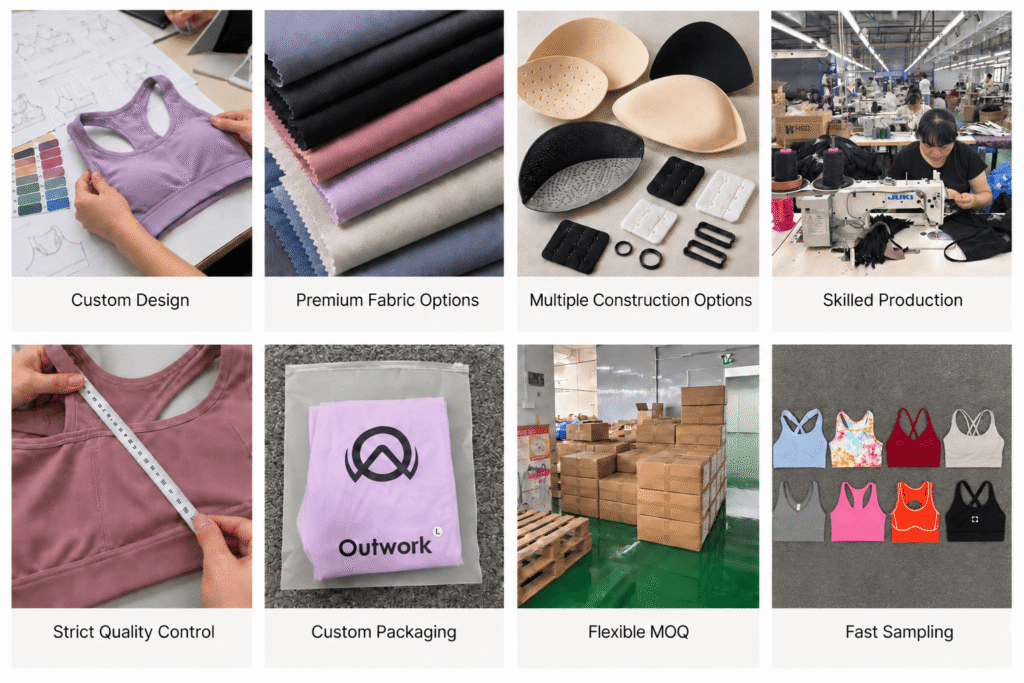
How Do Sports Bra Manufacturer MOQs Compare, and Which Minimum Order Conditions Matter Most?
Sports bra minimum order quantities should be compared by style, color, fabric and size assortment rather than by the advertised MOQ alone. A supplier offering 100 pieces per style and color may require a larger total order than one allowing 300 pieces across several colors. Buyers should confirm material minimums, mixed-size rules, customization charges and reorder conditions before comparing quotations. The most suitable MOQ is the one that supports the required product specifications without creating unnecessary inventory or cash commitments.
A low MOQ can look attractive on a manufacturer’s website. However, the actual purchasing conditions may be very different from what a buyer initially expects.
For example, a Women’s Sports Bra Wholesale Manufacturer may advertise a starting MOQ of 100 pieces. A brand planning two styles in three colors might assume that 100 pieces is enough to test the entire collection.
If the minimum applies separately to every style and color, the actual requirement becomes 600 pieces.
This is why buyers should ask for the complete MOQ structure before discussing the unit price.
What Does MOQ Mean per Style, Color, Size and SKU?
MOQ stands for Minimum Order Quantity, the smallest quantity a supplier agrees to manufacture or sell under specified conditions.
In sports bra manufacturing, MOQ can apply at several levels.
| MOQ Type | Meaning | Example |
|---|---|---|
| Per order | Minimum quantity for the entire purchase | 300 pieces across approved styles |
| Per style | Minimum quantity for each design | 100 pieces of each sports bra style |
| Per color | Minimum quantity for each color | 100 black and 100 navy pieces |
| Per style and color | Minimum quantity for every design-color combination | 100 pieces of each style in each color |
| Per fabric | Minimum quantity linked to a particular material | 500 pieces using a custom-dyed fabric |
| Per SKU | Minimum quantity for each individual sellable variation | Separate quantities for black/S, black/M and black/L |
A SKU, or Stock Keeping Unit, identifies a particular product variation.
For example, one medium-support sports bra available in black and navy across five sizes creates ten SKUs.
However, ten SKUs do not necessarily mean ten separate manufacturing minimums.
Many manufacturers allow buyers to distribute sizes within an approved style-and-color quantity. Others may apply restrictions to particular sizes or require a minimum cutting quantity.
Consider the following hypothetical order:
| Product | Colors | Sizes | MOQ Rule | Total Quantity |
|---|---|---|---|---|
| Medium-support sports bra | 3 | 5 | 100 pcs per style/color | 300 pcs |
| High-support sports bra | 2 | 5 | 100 pcs per style/color | 200 pcs |
| Total | 5 combinations | 25 SKUs | 500 pcs |
The brand is purchasing only two designs, but the color choices create five separate production combinations.
If the buyer expected a 100-piece total order, this difference could substantially change the launch budget.
Before accepting an MOQ, ask whether it applies per order, style, color, fabric or SKU.
The answer should appear in the written quotation, not only in an informal conversation.
How Can Buyers Compare Published MOQ Claims With Confirmed Quotations?
Published MOQs are useful for identifying potential suppliers, but they are not always directly comparable.
One manufacturer may advertise 100 pieces for an existing design using available fabric. Another may require 300 pieces for a fully customized product.
The lower published quantity does not necessarily indicate greater manufacturing flexibility.
The two offers may represent different production conditions.
Buyers should separate three stages of MOQ information:
1. Advertised MOQ
The starting quantity shown on a supplier’s website or product catalog.
This helps buyers decide whether the company is worth contacting.
2. Project-specific MOQ
The minimum quantity quoted after the manufacturer reviews the actual design, fabric, colors, sizes and branding requirements.
This is more useful for purchasing decisions.
3. Confirmed production MOQ
The quantity accepted in the final commercial agreement after materials, specifications and production conditions have been approved.
This should be the basis for purchase orders and inventory planning.
A Women’s Sports Bra Wholesale Manufacturer may be able to offer a lower quantity when the buyer selects a standard fabric and existing color. The same manufacturer may require a larger order when the project involves custom dyeing, unusual elastic components or specialized construction.
Buyers should not assume that the difference represents inconsistent pricing or an unreliable supplier.
Instead, ask what specific requirement caused the minimum to change.
A manufacturer that explains its material and production constraints clearly may be easier to work with than one that promises a very low MOQ without explaining the conditions.
Low MOQ vs High MOQ: Which Creates a Better Purchasing Commitment?
A low MOQ reduces the quantity a buyer must purchase, but it does not automatically create the lowest total cost.
A higher MOQ may support a lower unit price because some production costs are distributed across more garments.
These costs can include production preparation, cutting, machine setup, quality inspections and packaging arrangements.
However, the lower unit price becomes valuable only if the brand can sell the additional inventory.
Consider three hypothetical quotations for the same approved sports bra specification:
| Supplier Option | MOQ | Unit Price | Initial Product Cost | Main Purchasing Consideration |
|---|---|---|---|---|
| A | 100 pcs | $12.00 | $1,200 | Lower initial inventory commitment |
| B | 300 pcs | $9.50 | $2,850 | Moderate inventory and lower unit cost |
| C | 500 pcs | $8.50 | $4,250 | Lowest unit cost but highest initial commitment |
These figures are illustrative purchasing examples, not actual quotations from the manufacturers listed above. Freight, duties, sampling, testing and other costs are excluded.
Supplier C offers a unit price that is $3.50 lower than Supplier A.
However, choosing Supplier C requires an additional $3,050 in initial product expenditure.
For a brand with limited working capital, that money may be needed for customer acquisition, product photography, fulfillment or developing the next collection.
For an established retailer with reliable demand, the 500-piece option may be commercially attractive.
The important distinction is between unit cost efficiency and inventory investment.
A brand should not purchase more products simply because the unit price becomes lower.
It should purchase more when expected demand, cash flow and replenishment requirements justify the additional commitment.
How Do Fabric Minimums, Custom Colors and Packaging Change the Actual Order Quantity?
The garment MOQ is not always the only minimum quantity affecting an order.
Sports bras often use several materials, including main fabric, lining, underband elastic, straps, padding and labels.
Some materials may be readily available. Others may require a separate production run.
For example, a brand may request a custom color in a particular nylon-spandex fabric.
The garment manufacturer might be willing to sew 100 sports bras, but the fabric supplier could require a larger minimum for custom dyeing.
The buyer may then face several choices:
Increase the garment order to use the required fabric quantity.
Select an available stock color.
Pay an additional charge for a smaller material run, if available.
Purchase and reserve excess fabric for future orders, subject to agreement.
Change the material specification to one with more practical sourcing conditions.
None of these options is automatically the best choice.
The decision depends on how important the custom material is to the brand and whether the additional cost or inventory commitment is commercially justified.
Packaging can create similar problems.
A buyer may order 100 sports bras but request specially printed packaging that has a separate minimum of 1,000 units.
The supplier may offer to store unused packaging, charge a small-run premium or recommend an alternative packaging method.
Buyers should confirm material and packaging minimums separately from garment MOQ.
A quotation that states only the garment quantity may not reveal the full purchasing commitment.
Do Manufacturers Allow Mixed Sizes, Colors or Styles Within One MOQ?
Size mixing can make a low MOQ more practical, especially for brands testing a new product.
However, buyers should distinguish mixed sizes from mixed colors and mixed styles.
These are different commercial arrangements.
A supplier may allow five sizes within a 100-piece order of one style and color.
That does not mean the buyer can divide the same 100 pieces across five colors or several different designs.
Consider a sports bra offered in XS, S, M, L and XL.
A brand might allocate a 100-piece order as follows:
| Size | Quantity | Share of Order |
|---|---|---|
| XS | 10 | 10% |
| S | 20 | 20% |
| M | 30 | 30% |
| L | 25 | 25% |
| XL | 15 | 15% |
| Total | 100 | 100% |
This distribution is an example, not a recommended size curve for every market.
The correct allocation should reflect the brand’s target customers, historical sales and product fit.
For an established business, previous sales data may provide a reasonable starting point.
For a new brand, size planning is more uncertain. The buyer may need to combine market research, fit testing and a conservative initial assortment.
A Women’s Sports Bra Wholesale Manufacturer should be able to explain its size-mixing rules and identify any restrictions before the buyer confirms the purchase order.
This is especially important for extended-size collections, where grading requirements and fabric consumption may differ across the size range. Brands developing inclusive sportswear can also review plus size activewear manufacturing options to better understand the product development requirements involved.
What Is the Real Inventory Commitment at 100, 300 and 500 Pieces?
The number of garments ordered is only one part of the inventory commitment.
Buyers should also consider how many product variations must be sold and how long the inventory is expected to remain in stock.
Suppose a brand expects to sell approximately 50 sports bras per month.
Under a simplified model, different order quantities represent the following inventory coverage:
| Initial Quantity | Expected Monthly Sales | Estimated Inventory Coverage |
|---|---|---|
| 100 pcs | 50 pcs | 2 months |
| 300 pcs | 50 pcs | 6 months |
| 500 pcs | 50 pcs | 10 months |
This simplified example assumes constant demand, no stockouts, no returns and no differences between sizes or colors. Actual inventory performance will vary.
A 500-piece order might appear efficient because of its lower unit price.
However, ten months of inventory could be excessive for a new style whose demand has not been established.
During that period, the brand may need to discount slow-selling colors, introduce a new collection or respond to changing customer preferences.
Inventory risk also increases when the order is spread across many SKUs.
A brand may sell out of medium sizes while still holding substantial stock in less popular sizes.
The total inventory figure could appear healthy even when the remaining assortment is difficult to sell.
For this reason, buyers should estimate inventory coverage at both the collection level and the SKU level.
A manageable MOQ is one that matches expected sales, not simply the lowest quantity a manufacturer advertises.
Which MOQ Terms Should Buyers Confirm Before Paying a Deposit?
MOQ conditions should be clearly documented before the buyer pays a production deposit.
A verbal statement such as “100 pieces is acceptable” may leave several important questions unanswered.
The final quotation or purchase agreement should identify:
Minimum per style: Whether different sports bra constructions have separate minimums.
Minimum per color: Whether each color requires its own production quantity.
Size assortment: Which sizes can be mixed and whether minimums apply to individual sizes.
Material conditions: Whether custom fabrics or colors require additional quantities.
Packaging requirements: Any separate minimums for branded packaging or accessories.
Price breaks: The unit prices available at different order quantities.
Overproduction tolerance: Whether the final delivered quantity may vary from the ordered quantity.
Reorder conditions: Whether repeat orders have the same MOQ as the first production run.
Unused material arrangements: Who owns and stores any excess fabric or packaging.
Payment obligations: When deposits, balances and additional material charges become payable.
The reorder MOQ deserves particular attention.
A supplier may accept a small first order using available materials but require a higher minimum when those materials are no longer in stock.
A brand expecting frequent replenishment should clarify this possibility before approving its first production run.
Buyers should also ask whether the manufacturer can maintain the approved fabric, color and construction specifications across repeat orders.
A low first-order MOQ has limited long-term value if the supplier cannot support commercially practical replenishment.
The right MOQ decision balances unit price, initial inventory, product variation, expected demand and future reorder flexibility.
Before choosing a Women’s Sports Bra Wholesale Manufacturer, buyers should compare these conditions in writing and calculate the total purchasing commitment under the same product specifications.
The manufacturer offering the smallest advertised minimum is not always the one offering the most suitable commercial arrangement.
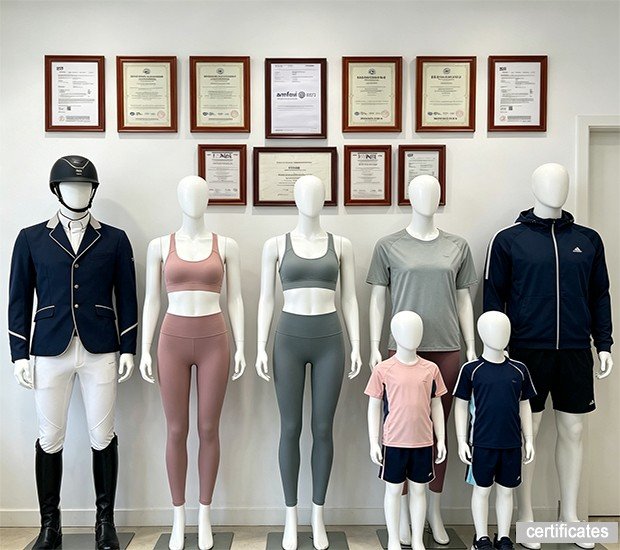
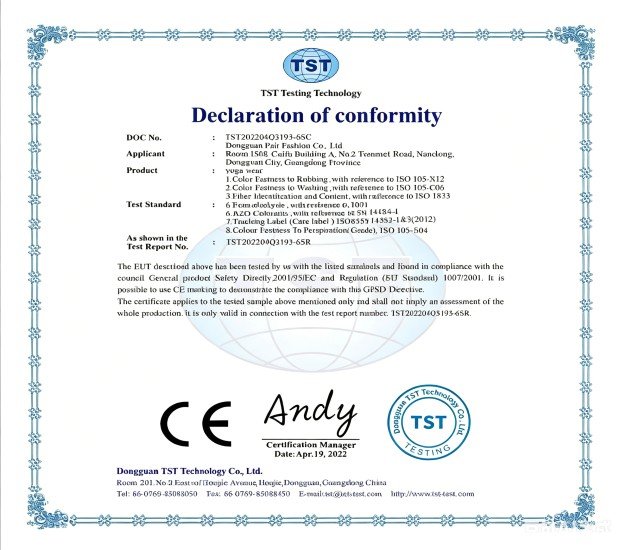
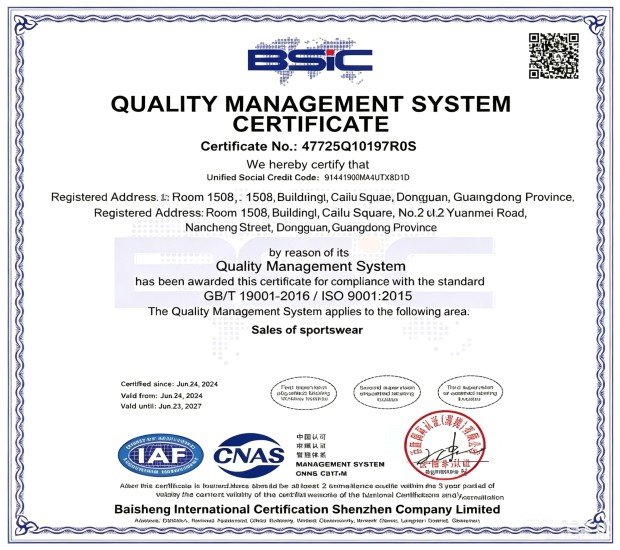
Trusted Manufacturing Standards For Global Sportswear Brands
We operate under internationally recognized quality, sustainability, and ethical manufacturing standards. Our certifications help ensure consistent product quality, responsible sourcing, and reliable production for global sportswear brands.
- 20+ Countries Served
- 6000+ Styles Developed
- 50,000 PCS Monthly Capacity
- 3-Day Sample Development
How Can Buyers Compare Inventory Risks Before Choosing a Women's Sports Bra Wholesale Manufacturer?
Buyers should compare sports bra inventory risks by evaluating minimum order quantities, upfront purchasing costs, expected sell-through, size distribution and replenishment flexibility. A lower unit price does not necessarily create a better purchasing decision if it requires substantially more inventory than the brand can sell. The most suitable supplier is one whose order conditions support realistic demand forecasts, manageable cash commitments and practical repeat purchasing. Inventory risk should be evaluated before selecting a manufacturer, not after the products arrive.
Inventory is one of the largest financial commitments in a wholesale sports bra program.
A brand may negotiate an attractive unit price but still experience financial pressure if the order contains too many products, unpopular colors or sizes that do not match customer demand.
This is particularly important for new brands introducing unfamiliar sports bra styles.
Without reliable sales history, demand estimates are uncertain. A product that performs well in photographs or receives positive feedback during development may not achieve the expected sales volume after launch.
Choosing a Women’s Sports Bra Wholesale Manufacturer therefore requires more than comparing product costs. Buyers should consider how much inventory each supplier requires them to purchase, how quickly that inventory may sell and how easily successful products can be reordered.
Why Does the Lowest Unit Price Not Always Mean the Lowest Purchasing Risk?
A lower unit price reduces the cost of each garment, but a larger MOQ can increase the total amount of money committed to inventory.
Consider two hypothetical suppliers quoting the same approved sports bra specification.
Supplier A offers a price of $8.00 per piece with a minimum order of 500 pieces.
Supplier B offers $11.00 per piece with a minimum order of 100 pieces.
| Purchasing Factor | Supplier A | Supplier B |
|---|---|---|
| Minimum order quantity | 500 pcs | 100 pcs |
| Unit garment price | $8.00 | $11.00 |
| Initial product expenditure | $4,000 | $1,100 |
| Additional product expenditure compared with B | $2,900 | — |
| Initial inventory commitment | Higher | Lower |
The figures are illustrative and exclude freight, duties, testing, packaging and other costs.
Supplier A offers a $3.00 saving per garment.
However, choosing Supplier A requires the brand to purchase 400 additional units and commit another $2,900 before any sales occur.
For a business with established demand, this may be acceptable.
For a new brand testing a product, the additional inventory could remain unsold for months.
The brand may eventually need to discount slow-moving products, pay for additional storage or delay other product launches because too much cash is tied up in stock.
Supplier B’s higher unit price may therefore create a more manageable purchasing arrangement.
A lower manufacturing price becomes a financial advantage only when the additional inventory can be sold at an acceptable margin within a reasonable period.
How Do MOQ, SKU Count and Size Distribution Affect Unsold Inventory?
Inventory risk increases when an order is divided across many product variations.
A sports bra collection may include different support levels, colors and sizes.
Each combination creates a separate SKU with its own sales performance.
For example, a brand launches two sports bra styles in four colors and five sizes.
The collection contains:
2 styles × 4 colors × 5 sizes = 40 SKUs
If the manufacturer requires 100 pieces per style and color, the brand must purchase at least 800 garments.
An 800-piece order may seem manageable when considered as one quantity.
However, the brand must generate enough demand across 40 different product variations.
Some combinations may sell quickly while others remain in stock.
Suppose black and navy sports bras account for most customer purchases, while two seasonal colors attract limited demand.
The brand may run out of popular colors before selling the remaining inventory.
The same problem can occur with size distribution.
A brand might sell medium and large sizes quickly but hold excess stock in sizes that have lower demand among its customers.
This creates imbalanced inventory.
The total number of remaining garments does not fully describe the problem because some units may be difficult to sell without discounts.
Buyers should therefore evaluate inventory at three levels:
Collection level: Total inventory across all products.
Style and color level: Inventory performance for each design and color combination.
SKU level: Inventory and demand for each individual size and variation.
A Women’s Sports Bra Wholesale Manufacturer that allows practical size mixing may help buyers create an assortment closer to expected demand.
However, buyers should confirm whether size mixing is available within each color, whether special sizes have separate minimums and whether the same conditions apply to repeat orders.
What Is the Difference Between Unit Cost Savings and Inventory Investment?
Unit cost savings and inventory investment measure different aspects of a purchasing decision.
Unit cost savings describe how much less the buyer pays for each garment.
Inventory investment describes how much money the buyer must commit to purchasing stock.
A supplier may offer substantial unit savings while requiring a much larger initial investment.
Consider a sports bra brand expecting to sell approximately 200 units during its first three months.
The brand receives two quotations:
| Purchasing Factor | Supplier A | Supplier B |
|---|---|---|
| MOQ | 500 pcs | 200 pcs |
| Unit price | $8.00 | $10.50 |
| Initial product cost | $4,000 | $2,100 |
| Forecast three-month sales | 200 pcs | 200 pcs |
| Potential unsold stock after three months | 300 pcs | 0 pcs |
| Purchase cost of remaining stock | $2,400 | $0 |
This example assumes the forecast is achieved exactly, all units are sellable and no replenishment occurs. Remaining stock is not automatically a financial loss.
Supplier A has a $2.50 lower unit price.
However, the buyer commits $1,900 more at the beginning and may still hold 300 units after the forecast period.
The remaining stock has a purchase cost of $2,400.
This does not mean the inventory has lost all its value. The garments may sell later.
Nevertheless, the money remains committed until those sales occur.
Supplier B requires less initial capital and allows the buyer to observe actual customer demand before making a larger purchasing decision.
This distinction is especially important for startups and growing brands with limited working capital.
For established businesses with reliable sales data, purchasing larger quantities may improve margins without creating excessive inventory risk.
How Can Buyers Estimate Sell-Through Rate, Break-Even Volume and Cash Exposure?
Inventory decisions become more reliable when buyers use measurable financial indicators.
Three useful measures are sell-through rate, break-even volume and cash exposure.
1. Sell-Through Rate
Sell-through rate measures the proportion of available inventory sold during a defined period.
Sell-Through Rate = Units Sold ÷ Units Available for Sale × 100%
Suppose a brand receives 400 sports bras and sells 240 within three months.
240 ÷ 400 × 100% = 60% sell-through
The brand has sold 60% of its available inventory and has 160 units remaining.
A 60% sell-through rate is not automatically good or bad.
Its commercial meaning depends on the product lifecycle, expected selling period, seasonality and replenishment strategy.
A core black sports bra intended for year-round sales may be evaluated differently from a limited seasonal color.
2. Break-Even Volume
Break-even volume estimates how many units must be sold to cover the relevant fixed costs and contribution-based expenses of the project.
A simplified formula is:
Break-Even Units = Fixed Project Costs ÷ Contribution Margin per Unit
Contribution margin per unit is calculated as:
Selling Price − Variable Cost per Unit
For example, assume:
Selling price: $30.00 per sports bra.
Variable cost per sold unit: $14.00, including the relevant landed product cost and variable selling expenses.
Fixed project costs: $2,400, excluding costs already counted in the variable cost.
The contribution margin is:
$30.00 − $14.00 = $16.00
The simplified break-even volume is:
$2,400 ÷ $16.00 = 150 units
The brand needs to sell approximately 150 units to cover the specified fixed project costs under these assumptions.
This calculation is not the same as recovering the entire cash payment for purchased inventory. Unsold garments remain an asset unless their value is impaired, while the purchasing cash has already been committed.
Buyers should therefore consider break-even performance and cash requirements separately.
3. Cash Exposure
Cash exposure measures how much money the buyer must commit before receiving sufficient sales proceeds.
It may include:
Production deposits.
Balance payments.
Freight and import charges.
Sampling and testing expenses.
Warehousing and launch preparation.
Other payments due before meaningful sales revenue arrives.
A manufacturer may require a 30% deposit and a 70% balance before shipment.
Another may offer different payment terms.
Even if the total purchase costs are similar, the timing of these payments can affect working capital.
Buyers should map when each payment is due and compare it with the expected timing of customer sales.
A profitable product can still create cash-flow pressure if too much money is committed before the inventory is sold.
How Should First Orders and Repeat Orders Be Evaluated Differently?
A first order and a repeat order serve different commercial purposes.
The first order often tests product-market fit.
The brand may still be learning which sizes, colors, support levels and price points customers prefer.
A repeat order can be based on actual sales evidence.
For this reason, the same MOQ strategy may not be suitable for both stages.
| Purchasing Factor | First Order | Repeat Order |
|---|---|---|
| Main objective | Test demand and product acceptance | Replenish proven products |
| Demand confidence | Usually lower | Potentially higher |
| Preferred assortment | Focused styles and colors | Based on actual sales |
| MOQ priority | Limit initial inventory exposure | Balance unit cost and replenishment |
| Size distribution | Initial forecast and fit testing | Historical SKU-level sales |
| Main risk | Buying too much unproven stock | Stockouts, delays or excessive replenishment |
For a first order, a brand may choose one or two sports bra designs with a limited color range.
This reduces the number of separate SKUs and makes customer demand easier to evaluate.
After launch, the brand can identify which products sell consistently.
A repeat order may then justify a higher quantity for successful styles while reducing or eliminating weak-performing variations.
For example, a brand might initially purchase 100 black, 100 navy and 100 pink sports bras.
After several months, black and navy may account for most sales.
The next order could allocate more inventory to those colors rather than repeating the original assortment.
A suitable supplier should support this type of purchasing adjustment where commercially feasible.
Buyers should confirm whether the manufacturer can maintain the approved fabric, fit, color and construction specifications for future orders.
Replenishment flexibility is valuable only when the repeat products remain consistent with the approved originals.
When Does a Higher MOQ Become Commercially Justifiable?
A higher MOQ becomes more attractive when the buyer has sufficient demand evidence and the savings justify the additional inventory commitment.
This may occur when a sports bra style has stable sales, predictable replenishment needs and a low risk of becoming obsolete.
However, the decision should be based on actual numbers.
Consider a brand that consistently sells 250 units of a core sports bra every month.
A 500-piece order represents approximately two months of expected demand before considering existing stock, lead time and safety inventory.
If the brand has sufficient cash and the product specifications are stable, purchasing 500 pieces may be commercially reasonable.
Now consider a new product expected to sell only 30 units per month.
The same 500-piece order represents more than 16 months of forecast demand.
Even with a lower unit price, the larger purchase may create excessive inventory exposure.
A higher MOQ is more defensible when:
Historical sales support the expected order volume.
Demand is reasonably stable across sizes and colors.
The product is unlikely to become obsolete quickly.
The unit savings are meaningful after all additional costs.
Working capital remains sufficient for other business needs.
The manufacturer can deliver consistent repeat production.
The buyer has a realistic plan for selling the full quantity.
A Women’s Sports Bra Wholesale Manufacturer offering attractive high-volume pricing may be suitable for an established product but less suitable for an untested collection.
The correct decision depends on the relationship between demand confidence and the financial commitment required.
Inventory Risk Case Study: Comparing Two Suppliers With Different Prices and Minimum Orders
Consider a new activewear brand preparing to launch a medium-support sports bra.
The brand expects to sell 180 units during the first three months.
It receives two hypothetical quotations for the same approved product specifications.
Supplier A
MOQ: 500 pieces.
Unit garment price: $8.00.
Initial product cost: $4,000.
Supplier B
MOQ: 200 pieces.
Unit garment price: $10.50.
Initial product cost: $2,100.
Assume the brand sells 180 units during the first three months.
| Financial Measure | Supplier A | Supplier B |
|---|---|---|
| Initial quantity | 500 pcs | 200 pcs |
| Initial product expenditure | $4,000 | $2,100 |
| Units sold | 180 pcs | 180 pcs |
| Sell-through rate | 36% | 90% |
| Remaining inventory | 320 pcs | 20 pcs |
| Purchase cost of remaining inventory | $2,560 | $210 |
| Initial cash commitment difference | $1,900 more | $1,900 less |
The comparison excludes logistics, taxes, marketing, returns and other costs. Remaining inventory is valued at its original garment purchase cost for illustration.
Supplier A provides the lower unit price.
If the brand eventually sells all 500 garments at the expected selling price, that lower cost may improve the overall product margin.
However, after the first three months, the brand still holds 320 units.
Supplier B leaves only 20 units unsold and requires substantially less initial capital.
The brand may use the remaining funds to evaluate customer feedback, improve the product or develop a second collection.
Neither supplier is automatically better.
If the brand already has confirmed wholesale orders covering most of the 500 pieces, Supplier A may offer a more attractive commercial arrangement.
If the brand is testing uncertain demand, Supplier B may reduce the financial risk of the launch.
The important difference is not simply the $2.50 unit price gap.
It is the amount of inventory the brand must purchase before knowing how customers will respond.
Inventory risk should be compared using the full purchasing commitment, expected sell-through, SKU-level demand and cash-flow requirements.
Before choosing a Women’s Sports Bra Wholesale Manufacturer, buyers should determine whether the supplier’s minimum order conditions match the brand’s sales evidence and financial capacity.
A strong supplier relationship should support sustainable purchasing decisions, not encourage larger orders that the buyer cannot reasonably justify.

How Much Does a Wholesale Sports Bra Order Really Cost? Factory Price vs Total Landed Cost
The real cost of a wholesale sports bra order includes more than the manufacturer’s unit price. Buyers should consider fabric specifications, garment construction, sampling, packaging, quality testing, international freight, import duties, customs clearance and domestic delivery. A lower factory quotation can become more expensive once these costs are included. To compare suppliers fairly, request quotations based on the same product specifications, quantities and shipping conditions, then calculate the total cost of receiving sellable garments at the intended destination.
When comparing a Women’s Sports Bra Wholesale Manufacturer, the lowest quoted price often attracts attention first. However, a $7.50 sports bra and a $9.00 sports bra may represent different products, purchasing conditions or delivery responsibilities.
One quotation may include branded labels, individual packaging and export documentation. Another may cover only garment production, leaving the buyer to pay separately for packaging, inspection and transportation.
The difference becomes even more important when suppliers quote different minimum quantities.
A manufacturer offering a low unit price at 1,000 pieces is not directly comparable with another offering a higher price at 100 pieces.
Before deciding which supplier is cheaper, buyers need to understand exactly what each quotation includes.
What Cost Factors Make Sports Bra Manufacturer Quotations Different?
Sports bra manufacturing costs are influenced by the materials, construction requirements, order quantity and production conditions.
Two sports bras may look similar in photographs but have significantly different manufacturing costs.
For example, a basic low-support sports bra may use a standard stretch fabric, simple elastic straps and removable padding.
A high-support sports bra may require stronger underband construction, additional lining, reinforced stitching, adjustable straps and more demanding fit testing.
These differences affect material consumption, sewing time, production complexity and inspection requirements.
The main cost factors include:
Fabric type: Polyester-spandex, nylon-spandex, recycled materials and specialized performance fabrics have different sourcing costs.
Fabric weight and construction: Heavier or more complex fabrics may require additional material investment.
Support level: Higher-support designs may involve additional panels, reinforcement and specialized construction.
Padding and cups: Removable pads, fixed padding and molded cups have different production requirements.
Straps and underband: Adjustable straps, wide elastic bands and reinforced construction can increase costs.
Seam construction: Flatlock stitching, bonding and other specialized methods may require different equipment or processing.
Size range: Extended sizes may involve additional development, grading and material consumption.
Branding and packaging: Custom labels, heat transfers, hangtags and printed packaging can create separate costs.
Order quantity: Larger production runs may distribute preparation and setup costs across more garments.
A lower quotation is not necessarily evidence of lower quality. A supplier may have better material purchasing conditions, more efficient production or a design that is easier to manufacture.
However, buyers should not assume that two quotations represent equivalent products unless the specifications are comparable.
How Do Product Specifications and Order Quantities Affect Price Comparability?
A fair price comparison starts with a consistent product specification.
Suppose three manufacturers receive different information about the same sports bra project.
Supplier A receives a complete technical package with measurements, fabric composition, garment construction and packaging requirements.
Supplier B receives only product photographs.
Supplier C receives a short description stating that the buyer wants a medium-support sports bra.
The resulting quotations cannot provide a reliable comparison.
Supplier A may calculate the cost of a precisely defined garment. Suppliers B and C may estimate prices using different fabrics, construction methods and assumptions.
The buyer could mistakenly select the lowest quotation without realizing that it represents a different product.
For a meaningful comparison, each manufacturer should receive substantially the same information.
| Specification | Information to Provide |
|---|---|
| Product type | Medium-support sports bra |
| Fabric | Target composition, weight, stretch and recovery requirements |
| Construction | Underband, straps, lining, padding and seam requirements |
| Sizes | Required size range and measurement chart |
| Colors | Number of colors and color references |
| Branding | Logo method, labels and hangtags |
| Packaging | Individual packaging and carton requirements |
| Order quantity | Requested quantities at different price levels |
| Delivery terms | Required Incoterm and destination |
| Quality requirements | Relevant testing and inspection expectations |
Buyers should also request price breaks at comparable quantities.
For example, asking every supplier to quote 100, 300 and 500 pieces provides more useful information than comparing one manufacturer’s 100-piece price against another manufacturer’s 1,000-piece price.
The goal is to understand how each supplier’s commercial structure changes as the order grows.
A Women’s Sports Bra Wholesale Manufacturer should be able to explain which specifications affect the quotation and which price differences result from quantity rather than product quality.
OEM vs ODM vs Private Label: How Do Commercial Costs Differ?
OEM, ODM and private label manufacturing can involve different development costs and purchasing commitments.
However, these terms are not used identically by every supplier. Buyers should confirm what services are included in the quotation.
| Sourcing Model | Typical Buyer Situation | Main Cost Considerations |
|---|---|---|
| OEM | Buyer provides detailed product specifications | Pattern work, samples, materials, construction and production |
| ODM | Supplier contributes design or development resources | Development charges, design revisions, materials and production |
| Private Label | Buyer applies branding to an existing or adapted product | Logo application, labels, packaging and product minimums |
OEM purchasing
OEM may be appropriate when the brand already has an approved design, measurement chart and detailed construction requirements.
The buyer should confirm whether the manufacturer needs to create new patterns or samples before production.
ODM purchasing
ODM may involve more development work from the supplier.
Depending on the project, this could include product design assistance, material recommendations, pattern development or construction adjustments.
Buyers should clarify ownership of patterns, approved specifications and any development charges.
Private label purchasing
Private label programs may offer a more straightforward starting point when the brand selects an existing design and adds its own branding.
However, changing the fabric, fit or construction can turn a simple private label project into a more complex development order.
The commercial difference is not determined by the label alone.
A private label sports bra with custom-dyed fabric and specialized packaging may require a larger investment than a straightforward OEM order using available materials.
Buyers should compare the actual work, materials and purchasing conditions rather than assuming that one manufacturing model is always cheaper.
What Is the Difference Between EXW, FOB and DDP Pricing?
International purchasing terms determine which party is responsible for particular transportation costs, risks and customs obligations.
Three terms commonly discussed in apparel sourcing are EXW, FOB and DDP.
| Term | General Meaning | Important Buyer Consideration |
|---|---|---|
| EXW — Ex Works | Seller makes goods available at the named location | Buyer generally takes responsibility for collection, export arrangements and onward transportation |
| FOB — Free on Board | Seller delivers goods on board the vessel at the named port | Buyer generally handles main freight, import clearance and destination delivery |
| DDP — Delivered Duty Paid | Seller delivers goods to the named destination with import duties and taxes handled as agreed | Confirm the destination, import responsibilities, taxes and unloading arrangements |
These descriptions are simplified. Buyers should review the ICC Incoterms® 2020 rules and confirm the named place or port before accepting a quotation. FOB is intended for sea and inland waterway transport, while other terms may be more appropriate for air or multimodal shipments.
A common comparison mistake is treating EXW, FOB and DDP quotations as if they include the same services.
They do not.
For example, a supplier may quote $8.00 per piece EXW while another quotes $9.20 per piece FOB.
The difference does not necessarily mean that the second supplier has a higher manufacturing cost.
The FOB price includes certain delivery and export responsibilities that are not generally included under EXW.
DDP quotations can simplify budgeting, but buyers should still verify the exact delivery destination, customs treatment and responsibilities stated in the contract.
A fair supplier comparison should use the same delivery basis whenever possible.
If that is not practical, buyers should calculate the additional costs required to bring every quotation to the same destination.
Which Sampling, Packaging, Testing, Shipping and Import Costs Are Often Overlooked?
A quotation may look complete while leaving out several expenses that affect the final purchasing budget.
These costs are especially important for smaller orders because fixed charges are distributed across fewer garments.
Commonly overlooked expenses include:
Sample development: Prototype samples, fit revisions and additional size samples.
Material testing: Fabric composition, colorfastness, stretch recovery or other required tests.
Custom components: Special elastic, padding, labels, hangtags and packaging.
Inspection: Independent pre-shipment inspection or additional quality checks.
International freight: Air, sea or other transportation costs.
Import charges: Applicable duties, taxes, customs brokerage and clearance fees.
Domestic transportation: Delivery from the arrival point to the warehouse or fulfillment center.
Banking and currency costs: Transfer fees and exchange-rate differences.
Defects and shortages: Costs associated with unusable garments, missing quantities or corrective action.
Storage and fulfillment preparation: Warehousing, labeling or handling costs after arrival.
Not every order will incur every expense.
For example, a buyer may not need a separate laboratory test for every repeat order if valid test evidence is already available and the applicable requirements are satisfied.
Similarly, some quotations may already include packaging or transportation.
The important point is to identify which costs are included, which are excluded and which depend on later decisions.
A supplier offering a slightly higher garment price but including necessary packaging and inspection services may be more competitive than one with a lower headline price and several additional charges.
How Do Buyers Calculate Total Landed Cost and Cost per Sellable Unit?
Total landed cost is the combined cost of purchasing and receiving goods at the intended destination.
A practical calculation is:
Total Landed Cost = Product Cost + Freight + Insurance + Applicable Import Duties and Taxes + Customs and Handling + Other Included Sourcing Expenses
Buyers should apply this calculation consistently and avoid counting the same expense twice.
For example, if a DDP quotation already includes applicable import duties and delivery, those amounts should not be added again.
For profitability analysis, buyers may also include allocated sampling, testing and other project costs.
The cost per sellable unit can then be calculated as:
Cost per Sellable Unit = Total Relevant Order Cost ÷ Number of Sellable Units Received
This second calculation matters because the quantity ordered may not always equal the quantity available for sale.
Consider a hypothetical order of 500 sports bras:
| Cost Item | Amount |
|---|---|
| Garment production: 500 × $8.50 | $4,250 |
| Packaging and labels | $150 |
| Allocated sampling and testing | $200 |
| International freight and insurance | $450 |
| Import duties and customs charges | $550 |
| Domestic delivery | $150 |
| Total Relevant Order Cost | $5,750 |
If all 500 garments are sellable:
$5,750 ÷ 500 = $11.50 per sellable unit
The original factory price was $8.50, but the fully allocated cost is $11.50 per garment.
Now suppose that only 490 garments are accepted as sellable and the buyer receives no credit or replacement for the remaining ten.
$5,750 ÷ 490 = approximately $11.73 per sellable unit
This example illustrates why the lowest factory price does not always produce the lowest effective purchasing cost.
The figures are hypothetical and should not be treated as actual freight rates, duty rates or supplier quotations.
Which Supplier Offers the Better Deal? A Standardized Three-Quotation Example
A buyer comparing three manufacturers should use the same product specification, delivery destination and cost categories.
Consider a brand purchasing 300 medium-support sports bras.
All three suppliers are assumed to quote the same approved garment specifications and a total quantity of 300 pieces.
| Cost Item | Supplier A | Supplier B | Supplier C |
|---|---|---|---|
| Unit garment price | $8.20 | $8.80 | $9.30 |
| Garment cost for 300 pcs | $2,460 | $2,640 | $2,790 |
| Packaging and labels | $180 | $90 | Included |
| Allocated sampling and testing | $180 | $120 | $100 |
| Freight and insurance | $420 | $350 | $300 |
| Duties, customs and destination delivery | $400 | $350 | $300 |
| Total Relevant Order Cost | $3,640 | $3,550 | $3,490 |
| Cost per Sellable Unit | $12.13 | $11.83 | $11.63 |
All figures are hypothetical. The example assumes 300 sellable garments from each supplier and comparable delivery responsibilities.
Supplier A has the lowest garment price at $8.20.
However, Supplier C has the lowest total cost per sellable unit at approximately $11.63.
The difference comes from packaging, sampling and transportation-related expenses.
This does not automatically make Supplier C the best manufacturer.
The buyer must still consider sample performance, production reliability, payment conditions and the risk of delays or defects.
For example, if Supplier C requires a larger deposit or has a substantially longer confirmed lead time, the commercial advantage may become less attractive.
Similarly, a supplier with stronger quality evidence may justify a modest cost difference when the product is technically demanding.
The best quotation is not simply the cheapest garment price. It is the most competitive verified offer for the same product, quantity, quality requirements and delivery conditions.
Before selecting a Women’s Sports Bra Wholesale Manufacturer, buyers should request a standardized quotation that separates manufacturing costs from logistics and other project expenses.
This makes it easier to identify real price differences, negotiate specific cost items and choose a supplier without overlooking the financial consequences of the order.
1. Product Development
Regular monthly product development ensures consistent updates to your brand line.
2. Fabric Sourcing
Regular monthly product development ensures consistent updates to your brand line.
3. Sample Making
Regular monthly product development ensures consistent updates to your brand line.
4. Bulk Production
Regular monthly product development ensures consistent updates to your brand line.
5. Packaging & Delivery
Regular monthly product development ensures consistent updates to your brand line.
What Evidence Should Buyers Check Before Trusting a Sports Bra Manufacturer's MOQ, Price and Production Claims?
Buyers should verify a sports bra manufacturer’s business identity, production arrangements, quotation conditions, sample performance and quality documentation before committing to a wholesale order. Published MOQ figures, certifications and production capacities are useful starting points, but they do not automatically prove that a supplier can meet a particular project’s requirements. Reliable supplier evaluation connects commercial promises with supporting records, approved product specifications and clearly assigned production responsibilities.
Choosing a Women’s Sports Bra Wholesale Manufacturer requires more than reviewing product photographs, company profiles and advertised prices.
A supplier may publish an attractive minimum order quantity but apply different conditions to custom fabrics or colors. Another may advertise substantial production capacity without confirming whether the relevant equipment and production lines are available for the buyer’s order.
These differences do not automatically indicate unreliable suppliers. Manufacturing conditions can legitimately vary between products and production periods.
The important question is whether the manufacturer can explain its claims and provide evidence relevant to the actual purchasing project.
A practical verification process should focus on documents, samples and production arrangements that can be checked before the buyer makes a significant financial commitment.
How Do Buyers Verify a Chinese Manufacturer’s Business Identity and Production Role?
Business verification should establish who the buyer is contracting with and which company is responsible for manufacturing the garments.
The first step is to request the supplier’s registered legal name, business registration information and operating address.
For Chinese suppliers, buyers can compare the information provided with public enterprise registration records through China’s National Enterprise Credit Information Publicity System to check the supplier’s registered business identity and relevant company information.
A company may use an English trading name that differs from its registered Chinese legal name. This is not necessarily a problem, but the relationship between the names should be clear.
Useful verification information includes:
Registered company name and business registration details.
Registered business address and current operating location.
Name of the contracting and invoicing entity.
Production facility responsible for the order.
Bank account beneficiary and its relationship to the contracting company.
Main product categories and relevant manufacturing experience.
Responsibility for sampling, production, inspection and delivery.
Buyers should pay particular attention when the company receiving payment is different from the company signing the contract.
There may be legitimate reasons for this arrangement, including the use of an authorized export or group company.
However, the buyer should obtain a clear explanation and supporting documents before transferring funds.
A factory photograph alone does not establish that the supplier owns or operates the facility.
Likewise, a business registration document does not prove that the company has the technical capability to manufacture a particular sports bra.
Business identity verification confirms who the supplier is. Production verification establishes what the supplier can actually deliver.
Both are necessary for a meaningful sourcing decision.
Manufacturer vs Trading Company: Which Business Model Fits Different Orders?
Direct manufacturers and trading companies can both participate in legitimate apparel supply chains.
The most suitable business model depends on the buyer’s requirements.
A direct manufacturer generally operates or directly manages the production facility responsible for the garments.
A trading company may coordinate sourcing, product development, manufacturing and export services through one or more production partners.
Neither business model is automatically superior.
| Evaluation Factor | Direct Manufacturer | Trading Company or Sourcing Provider |
|---|---|---|
| Production relationship | Direct responsibility for manufacturing operations | Coordinates production through partner facilities |
| Product specialization | Depends on the factory’s technical experience | May access different specialists |
| Communication | Potentially closer to production personnel | May provide centralized commercial coordination |
| Product range | May focus on selected categories | May offer broader sourcing options |
| Quality control | Managed through the manufacturer’s own system | Requires clear oversight of partner production |
| Main verification priority | Facility capability and production controls | Production transparency and responsibility allocation |
A direct manufacturer may be attractive when the buyer requires detailed control over sports bra construction, technical measurements and repeated production.
However, a direct factory does not automatically offer better quality or lower prices.
A trading company may be useful when the brand sources several different product categories and needs one organization to coordinate multiple production arrangements.
The important issue is transparency.
Buyers should know which facility manufactures their products, who approves the samples and who is responsible if bulk production does not meet the agreed specifications.
A Women’s Sports Bra Wholesale Manufacturer should be evaluated according to its actual manufacturing role and accountability, rather than the label it uses in marketing materials.
What Should Buyers Check in Sample Reports, Size Measurements and Fabric Test Results?
Samples provide evidence of a manufacturer’s ability to translate product specifications into a physical garment.
However, one attractive sample does not prove that the supplier can consistently manufacture a full production order.
Buyers should compare samples against the same technical requirements used to request quotations.
For sports bras, the evaluation should cover both appearance and functional performance.
Important sample evaluation areas include:
| Evaluation Area | What Buyers Should Check |
|---|---|
| Fabric | Composition, weight, stretch, recovery and hand feel |
| Underband | Measurement, tension, stability and comfort |
| Straps | Width, placement, adjustability and movement stability |
| Padding | Shape, position, removability and appearance |
| Seams | Stitch consistency, comfort and resistance to stretching |
| Fit | Coverage, compression and movement performance |
| Size grading | Measurement consistency across the required size range |
| Washing | Dimensional changes, color performance and garment appearance |
A buyer developing a medium-support sports bra should test the garment during relevant movements rather than evaluating it only on a mannequin or in a static photograph.
Fit testing may include walking, stretching, raising the arms and other movements appropriate to the intended activity.
For higher-support designs, more demanding movement assessments may be necessary. Buyers who need to understand how support levels, fabrics and fit requirements influence product development can explore custom sports bra development and manufacturing before finalizing their technical specifications.
Testing requirements should reflect the product’s intended use and any claims the brand plans to make.
Fabric testing also requires careful interpretation.
A test report for one fabric does not automatically establish the performance of every fabric supplied by the same manufacturer.
Buyers should confirm the tested material reference, test method, result, date and relationship to the proposed production fabric.
The same principle applies to garment measurements.
A measurement chart is useful only when the sample is checked against it and any approved deviations are documented.
Which Certification Claims Require Independent Verification?
Certifications can support supplier evaluation, but buyers should understand what each certificate actually covers.
Different certifications relate to different subjects.
For example:
ISO 9001 concerns quality management systems.
BSCI-related audit documentation concerns social compliance assessment within the applicable audit framework.
GRS concerns recycled material claims and related chain-of-custody requirements within its certification scope.
OEKO-TEX STANDARD 100 concerns testing for harmful substances in covered textile products or components.
These credentials are not interchangeable.
A quality management certificate does not prove that a particular fabric contains recycled material.
A recycled-material certification does not automatically prove that every garment produced by the company qualifies for a recycled-content claim.
Buyers should also distinguish between a manufacturer’s facility certification and documentation covering a specific material or transaction.
A useful certification verification process includes:
Confirm the certificate holder’s legal name.
Check the issuing organization and certificate number.
Review the validity period and applicable scope.
Identify the covered facility, product or material.
Verify certificates through the relevant issuing or verification system where available. For recycled-material claims under Textile Exchange standards, buyers can use Textile Exchange certificate authentication to check the appropriate scope or transaction certificate records.
Confirm whether additional transaction-level documentation is required for the intended claim.
For example, a brand purchasing sports bras made with recycled polyester may need evidence connecting the certified material to the actual supply chain and order.
A supplier’s general statement that it works with recycled fabrics is not enough to establish that a particular finished garment qualifies for a specific certified claim.
Similarly, a certificate issued to a fabric supplier should not be presented as though it certifies the garment manufacturer.
The value of certification depends on its relevance, validity and connection to the actual product being purchased.
How Can Buyers Check Sample-to-Bulk Consistency Without Relying on Marketing Claims?
Sample-to-bulk consistency is a major concern in wholesale sports bra purchasing.
A manufacturer may produce an acceptable development sample but encounter differences during bulk production because of fabric substitutions, cutting variation, elastic tension or sewing adjustments.
Buyers should establish a clear production reference before approving the order.
An approved sample should be supported by documented specifications, including:
Final fabric composition and material reference.
Approved color and color standard.
Measurement chart and tolerances.
Underband and strap specifications.
Padding and lining requirements.
Stitching and construction details.
Branding and packaging requirements.
Relevant quality and testing criteria.
The approved pre-production sample should reflect the materials and construction intended for bulk production.
If the manufacturer proposes a material substitution or construction change, the buyer should review and approve the change before it is implemented.
Production consistency should be checked at several stages.
Incoming material inspection can identify differences in fabric, elastic or other components before production begins.
In-line inspection can identify construction or measurement problems while garments are being manufactured.
Final inspection can evaluate finished garments against the agreed acceptance criteria.
However, inspection alone cannot guarantee that every unit is free from defects.
The buyer and supplier should agree on inspection methods, sampling plans, defect classifications and corrective-action responsibilities.
A Women’s Sports Bra Wholesale Manufacturer with documented production controls may offer greater purchasing confidence than one relying mainly on product photographs and general quality promises.
For brands assessing whether a supplier’s production arrangements match their requirements, reviewing the manufacturer’s sports bra manufacturing and quality-control services can help identify which project-specific records and procedures should be requested.
What Evidence Supports a Manufacturer’s Lead Time and Reorder Commitments?
Published production lead times are usually estimates based on certain assumptions.
The actual schedule may depend on fabric availability, sample approval, order quantity, production capacity and shipping arrangements.
A supplier advertising a 20-day bulk production period may be referring only to the manufacturing stage after all materials and specifications have been confirmed.
The buyer should not assume that the same period includes product development, material sourcing, international transportation and customs clearance.
A useful production schedule should identify:
| Stage | Evidence or Confirmation Required |
|---|---|
| Material sourcing | Availability, purchase status and expected arrival |
| Sample approval | Approved specifications and outstanding revisions |
| Production scheduling | Planned production start and completion dates |
| Bulk manufacturing | Quantity, production arrangement and progress milestones |
| Inspection | Inspection timing and release requirements |
| Shipment | Agreed dispatch conditions and shipping documents |
| Reorders | Material continuity, revised MOQ and available production capacity |
Buyers should distinguish between a supplier’s standard lead time and the confirmed schedule for the actual order.
For example, a manufacturer may normally complete production within 25 working days.
However, if the selected fabric requires additional preparation, the total order schedule may be longer.
This does not automatically indicate poor reliability.
The more important question is whether the supplier identifies the dependency early and communicates a realistic timeline.
Repeat orders also require verification.
A manufacturer may have produced a successful first order but no longer have the same fabric available.
The brand should confirm whether the approved material can be reordered and whether any changes will affect color, hand feel, performance or MOQ.
A reliable replenishment plan depends on material continuity as well as sewing capacity.
Which Warning Signs Should Eliminate a Supplier Before Contract Signing?
Not every uncertainty should lead to immediate supplier rejection.
Some information may require additional discussion or supporting documents.
However, certain problems create risks that cannot be resolved through an attractive quotation alone.
Serious warning signs include:
The supplier cannot clearly identify the legal company receiving payment.
The production facility or manufacturing role is deliberately misrepresented.
Certificate information is altered, expired or presented outside its applicable scope.
The supplier refuses to confirm essential product specifications in writing.
Material substitutions are proposed without buyer approval.
The supplier cannot explain significant differences between the sample and quotation.
Payment instructions change unexpectedly without satisfactory verification.
The supplier promises an unrealistic schedule while refusing to explain material or production dependencies.
The contract does not clearly assign responsibility for defects, shortages or major specification changes.
Buyers should distinguish between missing information and contradictory evidence.
A supplier that has not yet provided a document may simply need time to retrieve it.
A supplier that provides inconsistent legal information or knowingly misrepresents certification status presents a different level of risk.
For example, if a project requires a particular certified material and the supplier cannot provide the necessary evidence, a lower quotation should not override that mandatory requirement.
Likewise, if the brand requires a defined size range and the manufacturer cannot demonstrate suitable grading capability, the supplier may be unsuitable regardless of its overall production capacity.
A structured evaluation should eliminate manufacturers that fail essential requirements before comparing the remaining suppliers on price.
Supplier verification is most effective when it focuses on the risks of the actual order rather than collecting documents without a clear purpose.
Before selecting a Women’s Sports Bra Wholesale Manufacturer, buyers should confirm that the supplier can meet mandatory product requirements, explain its commercial conditions and provide credible evidence of production responsibility.
The objective is not to find a company with the longest list of certifications or the largest advertised capacity. It is to choose a supplier whose documented capabilities match the technical, commercial and delivery requirements of the project.
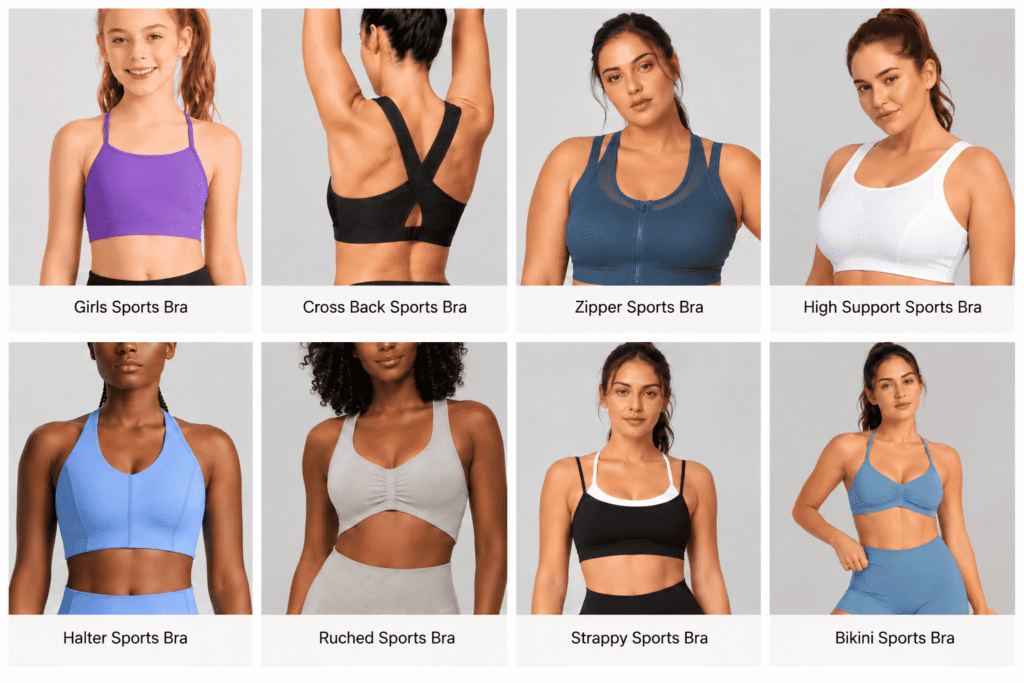
How Do You Choose the Best Women's Sports Bra Wholesale Manufacturer in China Using a Supplier Scorecard?
The best Women’s Sports Bra Wholesale Manufacturer should be selected through a structured evaluation of mandatory requirements, comparable quotations, sample performance, total purchasing costs and production reliability. Buyers should first eliminate suppliers that cannot meet essential product or compliance conditions. The remaining manufacturers can then be compared using a weighted scorecard that reflects the brand’s order volume, commercial priorities and sourcing risks. A strong overall score should never override a critical requirement that the supplier cannot satisfy.
A supplier comparison becomes more useful when purchasing decisions are based on consistent evidence rather than general impressions.
One manufacturer may offer the lowest unit price but require a larger minimum order. Another may have stronger technical samples but a longer confirmed production schedule. A third may offer attractive payment conditions but limited experience with the required sports bra construction.
These differences cannot be evaluated fairly when each supplier receives different specifications or when buyers rely on website claims instead of project-specific information.
A structured scorecard helps buyers identify the trade-offs behind each option.
However, the scorecard should support commercial judgment rather than replace it. The quality of the final decision depends on the evidence used to assign the scores.
What Information Should Every Manufacturer Receive in the Same RFQ?
An RFQ, or Request for Quotation, should provide enough information for manufacturers to price substantially the same product.
Without consistent specifications, quotations may reflect different materials, construction methods or purchasing assumptions.
For example, one supplier may quote a sports bra using standard polyester-spandex fabric, while another assumes a more expensive nylon-spandex material with different performance requirements.
The resulting price difference may reflect the product specification rather than the supplier’s manufacturing efficiency.
A useful sports bra RFQ should include the following information:
| RFQ Item | Information Required | Why It Matters |
|---|---|---|
| Product description | Sports bra type and intended activity | Defines the basic product requirement |
| Technical specifications | Measurements, construction and support requirements | Reduces differences in manufacturing assumptions |
| Fabric requirements | Composition, weight, stretch and recovery | Supports material comparability |
| Size range | Required sizes and measurement chart | Clarifies grading and material consumption |
| Colors | Number of colors and color references | Identifies color-related minimums |
| Branding | Logo method, labels and hangtags | Clarifies customization costs |
| Packaging | Individual packaging and carton requirements | Prevents omitted charges |
| Order quantities | Requested quantities at several price levels | Supports MOQ and price-break comparisons |
| Testing | Required material or product evidence | Identifies testing responsibilities |
| Delivery | Destination and requested Incoterm | Supports landed-cost calculations |
| Timeline | Required approval and delivery milestones | Helps assess scheduling feasibility |
| Payment | Requested payment structure | Clarifies cash commitments |
Buyers should also ask each manufacturer to identify assumptions or exclusions in its quotation.
For example, a supplier may quote based on available fabric colors rather than custom dyeing.
Another may exclude sample development charges or third-party inspection costs.
These differences should be disclosed before the quotations are compared.
A complete RFQ does not guarantee identical supplier responses, but it makes the differences easier to identify and evaluate.
How Do You Normalize Quotations Before Comparing Suppliers?
Quotation normalization means adjusting supplier offers to a consistent basis so that buyers can compare equivalent purchasing conditions.
The process begins by identifying differences in product specifications, order quantities and included services.
Suppose three manufacturers quote the same medium-support sports bra.
Supplier A offers a low EXW price but excludes packaging.
Supplier B provides an FOB quotation including labels and standard packaging.
Supplier C offers a higher unit price with additional services and delivery arrangements.
The prices cannot be compared directly.
Buyers should first identify the common requirements and then calculate the total cost of meeting those requirements under each offer.
A practical normalization process includes five steps.
Step 1: Confirm product equivalence
Check that the proposed fabric, construction, sizes, branding and packaging match the approved requirements.
A quotation using a different material should not be treated as equivalent unless the buyer accepts the substitution.
Step 2: Align order quantities
Compare prices at the same quantity where possible.
If a manufacturer cannot accept the requested quantity, record the difference as a commercial constraint.
Step 3: Align delivery responsibilities
Convert quotations to a comparable destination-cost basis.
Include the necessary freight, customs and delivery expenses without counting costs already included in the quoted Incoterm.
Step 4: Identify additional charges
Record sampling, testing, packaging, tooling and other relevant expenses.
Separate one-time development costs from recurring production costs.
Step 5: Confirm commercial conditions
Review payment schedules, quotation validity, lead times and reorder minimums.
Two suppliers with similar total costs may create different cash-flow or delivery risks.
After normalization, buyers can compare the remaining differences more accurately.
The objective is not to make every quotation look identical. It is to identify which differences reflect real supplier advantages and which result from inconsistent quotation assumptions.
Which Factors Should Be Included in a Weighted Supplier Scorecard?
A weighted supplier scorecard assigns different levels of importance to the factors that influence the purchasing decision.
For sports bra sourcing, the most relevant criteria often include product capability, sample performance, MOQ flexibility, total landed cost, quality evidence, delivery reliability and communication.
The weight assigned to each factor should reflect the risks of the actual order.
For example, a startup testing an unfamiliar sports bra design may place greater importance on low initial inventory commitment.
An established retailer replenishing a proven product may place more importance on unit economics and consistent delivery.
A technical sports bra project may require stronger weighting for construction capability and sample performance.
The following scorecard illustrates one possible approach for a growing activewear brand.
| Evaluation Factor | Suggested Weight | Main Evidence |
|---|---|---|
| Product and technical capability | 20% | Relevant samples and construction experience |
| Sample quality and fit | 20% | Measurements, fit testing and material performance |
| MOQ and order flexibility | 15% | Confirmed minimums and size-mixing rules |
| Total landed cost | 15% | Normalized quotation |
| Quality and compliance evidence | 15% | Inspection records and applicable documentation |
| Delivery and reorder reliability | 10% | Confirmed schedule and replenishment conditions |
| Communication and issue resolution | 5% | Accuracy, responsiveness and corrective-action process |
| Total | 100% |
These weights are illustrative.
A buyer should not automatically use them for every project.
The scoring method should be established before reviewing the final supplier quotations. Otherwise, buyers may unintentionally adjust the weights to favor a preferred company.
How Should Buyers Score MOQ Flexibility, Total Cost, Quality Evidence and Delivery Reliability?
A practical scorecard can use a five-point rating system.
| Score | General Interpretation |
|---|---|
| 1 | Does not adequately meet the evaluated requirement |
| 2 | Meets the requirement only with significant limitations |
| 3 | Meets the basic requirement |
| 4 | Meets the requirement with supporting evidence and manageable risks |
| 5 | Strong fit supported by relevant, verifiable evidence |
Each score should be linked to an explanation or supporting document.
For example, a supplier should not receive a high quality score simply because its website lists several certifications.
The buyer should consider whether the documentation is valid and relevant to the product and production facility.
Similarly, a low MOQ should not automatically receive the highest flexibility score if the supplier restricts colors, sizes or future reorders.
The weighted score can be calculated as:
Weighted Score = Σ (Criterion Score ÷ 5 × Criterion Weight)
Using the scorecard above, consider three hypothetical manufacturers.
| Evaluation Factor | Weight | Supplier A | Supplier B | Supplier C |
|---|---|---|---|---|
| Product and technical capability | 20% | 4 | 5 | 3 |
| Sample quality and fit | 20% | 4 | 5 | 3 |
| MOQ and order flexibility | 15% | 2 | 4 | 5 |
| Total landed cost | 15% | 5 | 3 | 4 |
| Quality and compliance evidence | 15% | 4 | 5 | 3 |
| Delivery and reorder reliability | 10% | 4 | 4 | 3 |
| Communication and issue resolution | 5% | 3 | 4 | 4 |
| Weighted Score | 100% | 75/100 | 88/100 | 69/100 |
These are hypothetical evaluation scores, not assessments of the manufacturers listed earlier in this article.
Supplier B receives the highest overall score.
Its stronger technical capability, sample performance and quality evidence outweigh its less competitive landed cost.
Supplier A performs well on cost but has weaker MOQ flexibility.
Supplier C offers attractive order flexibility but receives lower scores for technical capability and quality evidence.
However, the scorecard does not automatically establish that Supplier B is the correct choice.
The buyer must still confirm that Supplier B satisfies every mandatory requirement.
A weighted score is useful for comparing qualified suppliers, not for excusing critical failures.
Which Mandatory Requirements Should Override a High Supplier Score?
Some purchasing requirements should be treated as mandatory rather than negotiable scoring factors.
These requirements depend on the product, market and buyer’s commercial obligations.
For example, a brand may require a particular certified material, a defined size range or a specific garment construction.
If a manufacturer cannot meet one of these requirements, an attractive overall score should not keep the supplier in the final selection.
Examples of mandatory requirements include:
The ability to manufacture the specified sports bra construction.
Compliance with applicable legal and product requirements.
Required material or certification evidence.
The complete approved size range.
Essential fabric performance or testing criteria.
A commercially acceptable minimum order quantity.
A delivery schedule compatible with a non-negotiable launch deadline.
Clear legal contracting and payment arrangements.
Consider a supplier that receives 90 out of 100 points.
The supplier communicates well, offers competitive pricing and has strong production resources.
However, the project requires a specific certified material that the supplier cannot provide.
The 90-point score becomes misleading because the supplier cannot satisfy a mandatory condition.
The same applies when a buyer can commit to only 200 pieces per color but the manufacturer requires 1,000 pieces per color.
A high score for production capacity or communication cannot remove that inventory constraint.
Mandatory requirements should be checked before weighted scoring begins.
Only suppliers that pass the essential conditions should enter the final comparison.
This approach reduces the risk of choosing a manufacturer whose overall presentation is attractive but whose capabilities do not match the actual order.
How Should Startups, Growing Brands and Established Buyers Weight Their Priorities?
Different stages of brand development create different purchasing risks.
A startup launching its first sports bra collection may have limited sales evidence and working capital.
A growing brand may already know which products sell well but still need flexibility to introduce new styles.
An established buyer may prioritize predictable replenishment, consistent quality and total purchasing efficiency.
The following table illustrates how sourcing priorities can change.
| Purchasing Priority | Startup Brand | Growing Brand | Established Buyer |
|---|---|---|---|
| Low initial MOQ | Very important | Important | Depends on product |
| Unit manufacturing cost | Important | Very important | Very important |
| Sample and fit accuracy | Very important | Very important | Very important |
| Inventory flexibility | Very important | Very important | Important |
| Repeat-order consistency | Important | Very important | Very important |
| Production capacity | Depends on forecast | Important | Very important |
| Delivery reliability | Important | Very important | Very important |
| Cash-flow management | Very important | Very important | Important |
A startup may reasonably choose a supplier with a higher unit price if the smaller MOQ substantially reduces the risk of unsold inventory.
A growing brand may accept a moderate MOQ in exchange for stronger quality consistency and more competitive repeat-order pricing.
An established retailer may benefit from larger production runs if demand is predictable and the manufacturer can meet confirmed delivery requirements.
These priorities should not be interpreted as universal rules.
A startup developing a highly technical sports bra may need to prioritize product capability over MOQ flexibility.
An established buyer launching an unfamiliar category may still prefer a conservative test order.
The correct weights depend on the project, not simply the size of the company.
What Is the Final Supplier Selection Checklist Before Placing a Wholesale Order?
Before placing a wholesale sports bra order, buyers should review the final supplier decision against a consistent checklist.
Product and technical requirements
Are the fabric, construction and support requirements confirmed?
Has the approved sample been evaluated against the measurement chart?
Are size grading and fit requirements documented?
Are any material substitutions clearly identified and approved?
Commercial conditions
Is the MOQ confirmed by style, color and size arrangement?
Does the quotation include all required branding and packaging?
Have the delivery terms and destination costs been normalized?
Are the payment schedule and additional charges documented?
Are repeat-order minimums and price conditions understood?
Quality and production evidence
Is the manufacturer’s legal identity verified?
Is the responsible production facility identified?
Are relevant certifications and test reports valid and applicable?
Are inspection requirements and acceptance criteria agreed?
Is responsibility for defects and corrective action documented?
Delivery and inventory planning
Is the production schedule based on confirmed material availability?
Does the order quantity match realistic sales expectations?
Has the buyer considered size-level and color-level inventory risks?
Are shipping and import responsibilities clear?
Is there a practical plan for replenishing successful products?
A final purchasing decision should consider all four areas together.
The lowest quotation may be attractive, but it should not compensate for unacceptable product quality or excessive inventory exposure.
Likewise, a supplier with excellent technical capability may be commercially unsuitable if its minimum order conditions exceed the buyer’s financial capacity.
For buyers comparing a Women’s Sports Bra Wholesale Manufacturer, the strongest decision is usually supported by verified product evidence, normalized costs and a purchasing quantity that matches realistic demand.
Once the shortlist has been reduced to qualified suppliers, brands can examine the selected manufacturer’s custom sports bra production options to confirm whether its services and commercial terms meet the requirements of the intended collection.
The best supplier is not the company with the highest marketing claims, the largest advertised capacity or the lowest initial price. It is the manufacturer whose verified capabilities, commercial conditions and production reliability provide the most suitable balance for the buyer’s actual order.
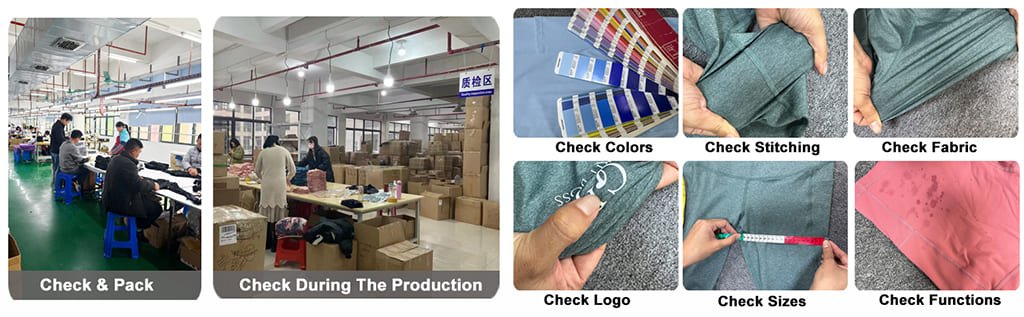
Frequently Asked Questions About Women's Sports Bra Wholesale Manufacturer Comparisons
Choosing a sports bra manufacturer involves comparing more than published prices and minimum order quantities. Buyers should evaluate whether a supplier can meet the required product specifications, support the planned order quantity, provide credible production evidence and maintain acceptable quality across repeat orders. The following questions address common sourcing decisions for brands comparing Chinese sports bra manufacturers, particularly when balancing initial investment, customization requirements, delivery reliability and inventory exposure.
1. Who Are the Best Sports Bra Manufacturers in China for Small Wholesale Orders?
The best sports bra manufacturers for small wholesale orders are those offering commercially manageable minimum quantities, suitable product experience and clear customization conditions. Buyers should not select suppliers solely because they advertise a low MOQ. A minimum of 100 pieces may apply to each style and color rather than the entire order. Small brands should compare confirmed order quantities, fabric availability, size-mixing rules, sampling costs and repeat-order conditions. The most suitable manufacturer is one that can meet the required product specifications without forcing the buyer to purchase excessive inventory.
2. Is a Low-MOQ Manufacturer Always the Best Choice for a Startup?
A low-MOQ manufacturer is not always the best choice for a startup because order quantity is only one part of the purchasing decision. Smaller orders can reduce initial inventory exposure, but they may also involve higher unit prices or limitations on fabrics, colors and customization. Startups should compare total purchasing costs, sample quality, payment conditions and the ability to reorder successful products. A slightly higher MOQ may be reasonable when the brand has confirmed demand, but untested collections generally benefit from controlling the number of styles, colors and SKUs.
3. Are Published Sports Bra Wholesale Prices Reliable for Budget Planning?
Published sports bra wholesale prices should be treated as preliminary references rather than confirmed project quotations. Actual prices depend on fabric specifications, support construction, padding, straps, branding, order quantity, packaging and delivery responsibilities. Buyers should provide the same technical requirements to shortlisted suppliers and request written quotations showing included and excluded costs. A fair comparison should consider the total cost of receiving sellable garments, not only the advertised unit price. Sampling, testing, freight, import charges and destination delivery may significantly affect the final purchasing budget.
4. Do Manufacturers Allow Mixed Sizes and Colors Within One Minimum Order?
Some sports bra manufacturers allow mixed sizes within a minimum order, but this does not automatically mean that buyers can mix colors or styles under the same quantity. A supplier may accept five sizes within 100 pieces of one design and color while requiring separate minimums for additional colors. Buyers should request written confirmation of the MOQ per style, color and size arrangement. They should also check whether extended sizes have different conditions and whether the same flexibility applies to repeat orders. These details directly affect inventory planning.
5. What Type of Supplier Is Better for OEM vs Private Label Purchasing?
OEM is generally more suitable when a brand has defined product specifications, while private label purchasing may be practical when the buyer wants to brand an existing or adapted design. ODM may be appropriate when the supplier contributes additional product development resources. However, these terms are not used consistently by every manufacturer. Buyers should compare actual services, pattern development responsibilities, sample charges, customization limits and ownership of approved specifications. The best sourcing model depends on product originality, technical complexity, budget and the amount of development work required.
6. How Long Should Buyers Allow for Supplier Verification and Sample Evaluation?
Buyers should allow enough time to verify the supplier, confirm specifications, evaluate samples and resolve technical questions before approving bulk production. There is no universal schedule because the process depends on product complexity, fabric availability, sample revisions and testing requirements. A straightforward existing design may require less development than a new high-support sports bra with specialized construction. Buyers should request separate timelines for verification, sampling, material sourcing, bulk production and shipping. Production lead time should not be confused with the total time required to receive the finished order.
7. Which Documents Should Buyers Request Before Paying a Production Deposit?
Before paying a production deposit, buyers should obtain a confirmed quotation, agreed product specifications, approved sample reference, purchase order or contract, payment terms and a documented production schedule. They should also verify the supplier’s legal identity, payment beneficiary and relevant quality or certification evidence. The agreement should identify quantities, colors, sizes, materials, packaging, delivery responsibilities and procedures for handling defects or unauthorized changes. Additional testing or transaction-level documentation may be necessary when the order depends on specific material or compliance claims.
8. When Should Buyers Choose a Higher-Priced Manufacturer?
Buyers should consider a higher-priced manufacturer when the additional cost provides meaningful advantages in product capability, verified quality, inventory flexibility or delivery reliability. For example, a supplier with a higher unit price may allow a smaller first order, reducing the amount of cash committed to unproven inventory. Another may provide stronger evidence of fit accuracy or consistent production for technically demanding sports bras. The decision should be based on comparable quotations and measurable purchasing risks. A higher price is justified only when its benefits are relevant to the actual order.