OEM/ODM Sportswear Manufacturer | 3-Day Sampling | Low MOQ | 50K Monthly Capacity | ISO9001 & BSCI Certified

Top 10 100 Cotton Clothing Plus Size Manufacturer Choices: Buyer Comparison Guide
Compare Top 10 100 Cotton Clothing Plus Size Manufacturer choices by cotton evidence, extended sizing, MOQ, samples, pricing and production requirements to build a more reliable supplier shortlist.
Top 10 100 Cotton Clothing Plus Size Manufacturer Choices: How Buyers Compare Fabric Purity, Extended Fit and Production Requirements
Choosing a 100 Cotton Clothing Plus Size Manufacturer becomes more difficult when several suppliers appear capable of making the same product. One may offer a lower MOQ, another may advertise sizes up to 5XL or 6XL, and another may provide a surprisingly low unit price. These numbers are useful, but they do not prove that the suppliers are quoting or producing the same garment.
The differences often sit behind the quotation. Two fabrics can both be described as 100% cotton while differing in construction, GSM, finishing and expected wash performance. Two manufacturers can both advertise extended sizing while using very different approaches to measurement charts, grading and size verification. Even a lower MOQ may become less attractive if it applies only to stock colors or requires a different fabric specification.
A reliable 100 Cotton Clothing Plus Size Manufacturer comparison should start with common purchasing requirements rather than price alone. Buyers should compare cotton specifications, extended-size evidence, relevant manufacturing capability, MOQ structure, sample conditions, lead time, quality-control evidence and repeat-order support. Giving shortlisted suppliers substantially the same RFQ makes quotations and samples easier to compare and reduces the risk of selecting a supplier on assumptions that later change.
For B2B buyers, the real purchasing decision is therefore not simply which manufacturer has the widest size range or the lowest published price. It is which supplier can support the actual fabric, fit, quantity, customization and production requirements of the order with evidence that can be checked before bulk production.
What Should Buyers Compare Before Shortlisting a 100 Cotton Clothing Plus Size Manufacturer?
Before adding a 100 Cotton Clothing Plus Size Manufacturer to a serious shortlist, buyers should compare five areas: fabric evidence, extended-size evidence, relevant manufacturing experience, commercial terms and repeat-order capability. The comparison becomes more reliable when every supplier receives substantially the same core requirements. Otherwise, different prices, MOQs and sample promises may reflect different product assumptions rather than meaningful differences in manufacturing value.
When comparing suppliers, buyers should first separate what the supplier says from what the supplier can actually prove. “100% cotton,” “sizes up to 6XL,” “low MOQ,” “fast sample” and “strict QC” all sound good, but each claim should have enough supporting information before buyers can make a fair comparison with other suppliers.
The objective is not to force every manufacturer into an identical production model. It is to understand what is actually included behind each claim and quotation.
Is “100% Cotton” Enough Information to Compare Two Suppliers?
No. For supplier screening, 100% cotton is an important material description, but it is not a complete basis for comparing quotations.
Suppose three manufacturers receive an inquiry for the same plus-size cotton T-shirt:
- Supplier A quotes a lighter stock cotton jersey.
- Supplier B quotes a heavier custom-dyed cotton jersey.
- Supplier C quotes “100% cotton” without identifying the fabric weight.
All three quotations may technically refer to cotton garments, but their unit prices are not yet commercially comparable.
Before treating one quotation as cheaper, buyers should confirm several basic variables:
- Fiber composition
- Fabric construction
- GSM or agreed weight range
- Stock color vs custom dye
- Relevant finishing
- Expected wash or dimensional requirements
- Intended garment type
This is particularly important in plus-size products because fabric consumption can increase across extended sizes. A difference in fabric weight or construction can therefore affect not only hand feel and garment appearance but also the commercial structure of the order.
Buyers who have not yet established these product specifications may need to complete the development stage with a custom 100% cotton plus size clothing manufacturer before sending the same finalized requirements to multiple suppliers for comparison.
Which Extended-Size Evidence Matters More Than a 5XL or 6XL Label?
A published size range is useful for initial screening, but the largest size shown on a website does not by itself demonstrate extended-size manufacturing capability.
For supplier comparison, buyers can request evidence that answers practical questions:
- What size range has the manufacturer produced in relevant products?
- Can it work from the buyer’s existing size chart and grade rules?
- Can it show relevant plus-size samples or product experience?
- Is a fit sample available for the required development stage?
- Can a size set be produced when the order requires broader size verification?
- What measurement tolerances will apply to bulk production?
- How will approved sizing information be referenced during repeat orders?
The distinction matters because two suppliers can both advertise XL–5XL while offering very different levels of evidence behind that claim.
A brand already selling plus-size clothing may arrive with established measurement charts and tolerances. A brand entering extended sizing for the first time may require more development support. Neither situation automatically makes one manufacturer better than another; it changes which supplier capabilities deserve more weight in the shortlist.
What Production and Commercial Information Should Be Compared?
A useful supplier shortlist combines technical evidence with commercial reality.
A manufacturer may demonstrate relevant product experience but require an MOQ that does not fit a market test. Another may accept a smaller order but have limited evidence for the required extended-size range. A third may offer attractive pricing but base the quotation on different packaging, fabric or color assumptions.
A first-round comparison can therefore use five categories:
| Comparison Area | What Buyers Should Verify | Why It Matters |
|---|---|---|
| Fabric Evidence | Composition, construction, GSM, finish and color basis | Helps identify whether suppliers are quoting comparable materials |
| Extended-Size Evidence | Size range, size chart compatibility, grading evidence, samples and tolerances | Shows what supports the supplier’s plus-size claims |
| Manufacturing Evidence | Relevant products, production scope, QC information and factory evidence | Helps connect general capability claims to the actual order |
| Commercial Terms | MOQ, color MOQ, sample fee, unit price, lead time and payment conditions | Shows whether the supplier fits the buyer’s purchasing model |
| Repeat-Order Capability | Approved specifications, material references, QC records and replenishment process | Becomes important when a successful style needs to be reproduced |
The weighting should follow the order rather than a generic manufacturer score.
For a startup testing one cotton top, MOQ, sampling clarity and communication may carry more commercial importance. For an established brand transferring a proven extended-size program, specification accuracy, production consistency and replenishment control may deserve more attention.
This is why supplier selection works better as a fit-to-order decision than as a simple search for the biggest factory, longest history or lowest price.
How Should Buyers Normalize RFQ Requirements Before Comparing Suppliers?
The most useful quotations usually come from suppliers that have been asked substantially the same commercial question.
If one 100 Cotton Clothing Plus Size Manufacturer receives a complete Tech Pack and another receives only reference photos, their quotations should not be treated as equivalent. One supplier may be pricing a defined product while the other is estimating what the buyer probably wants.
Before requesting final comparative quotations, buyers should align the main RFQ inputs where possible:
- Product type and construction requirements
- Tech Pack, drawing or reference information
- Target cotton specification
- Target GSM or acceptable range
- Required size range
- Measurement chart and grade rules, if available
- Total quantity and size breakdown
- Number of colors
- Stock or custom color requirements
- Print or embroidery requirements
- Main label, care label and size label
- Hangtags and packaging
- Sample requirements
- Target production timing
- Destination market
- Project-specific testing or inspection requirements
A supplier can still propose an alternative. In fact, a technically or commercially useful alternative may reveal valuable manufacturing experience. The important point is to identify the alternative clearly instead of comparing it as though it were the original specification.
The same principle applies to MOQ. A statement such as “MOQ 100 pieces” is incomplete until the buyer knows whether that means 100 pieces per style, per color, per fabric or for the entire order. Custom-dyed fabric, specialized finishing, labels and packaging may each introduce separate minimums.
A more dependable sourcing sequence is:
Common RFQ → Comparable Quotations → Supplier Shortlist → Comparable Samples → Production Verification
This process helps reduce an initial list of manufacturers before buyers invest heavily in sampling. It also creates a cleaner foundation for comparing the Top 10 100 Cotton Clothing Plus Size Manufacturer choices by published capability, commercial fit and evidence relevant to the actual order.
Top 10 100 Cotton Clothing Plus Size Manufacturer Choices in China
The most useful Top 10 100 Cotton Clothing Plus Size Manufacturer shortlist is not simply a ranking of the largest factories. Buyers should compare suppliers by relevant product specialization, cotton capability, extended-size evidence, MOQ structure, sample conditions, OEM/ODM support and production fit. Published information is useful for creating an initial shortlist, but fabric specifications, pricing, capacity and order conditions should still be confirmed against the actual RFQ.
China has thousands of apparel suppliers, but a broad product catalog does not automatically make a manufacturer relevant to a 100% cotton plus-size project. Some suppliers specialize in big-and-tall menswear, some are stronger in women’s extended sizing, and others offer broader OEM/ODM production across activewear, casualwear or private-label collections.
The following manufacturers therefore serve as comparison candidates rather than interchangeable suppliers. Published figures can change according to fabric, color, construction, size range, customization and order quantity. Buyers should verify current commercial conditions directly before using them for a purchasing decision.
1. Pair Fashion — Custom Plus Size Development for Growing Apparel Brands
Location: Dongguan, Guangdong, China
Established: 2016
Company Size: 135 employees
Pattern & Sample Team: 11 people
QC Team: 13 people
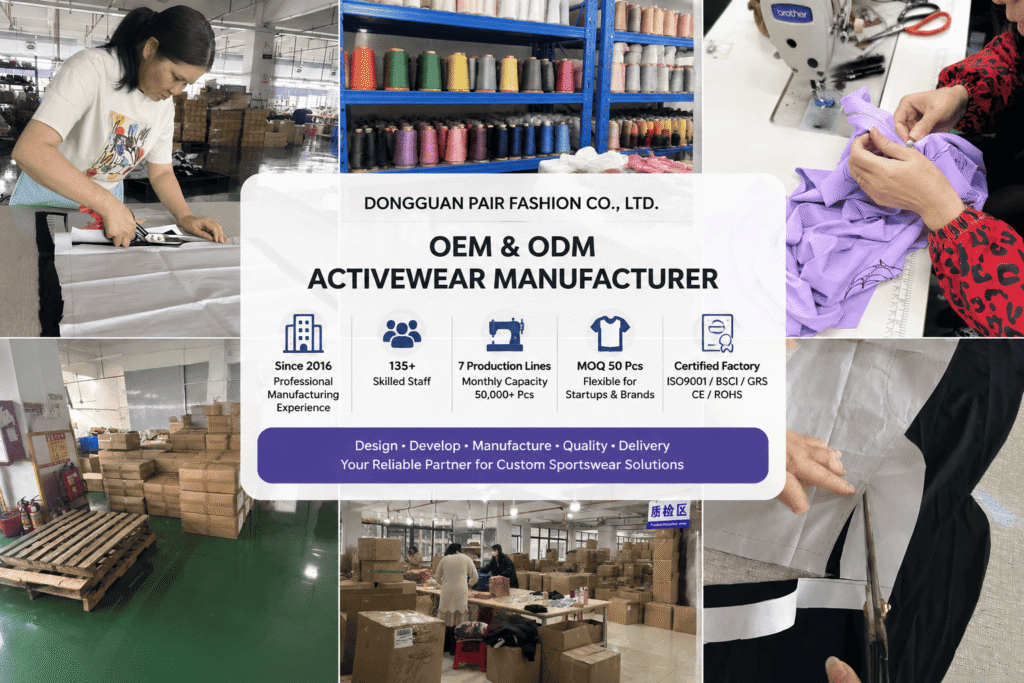
Production Lines: 7
Published Production Capacity: Approximately 50,000 pieces per month under stable production conditions
Sample Lead Time: As fast as 3 days; normally around 7 days
Bulk Lead Time: As fast as 15 working days; standard projects normally around 20–25 working days
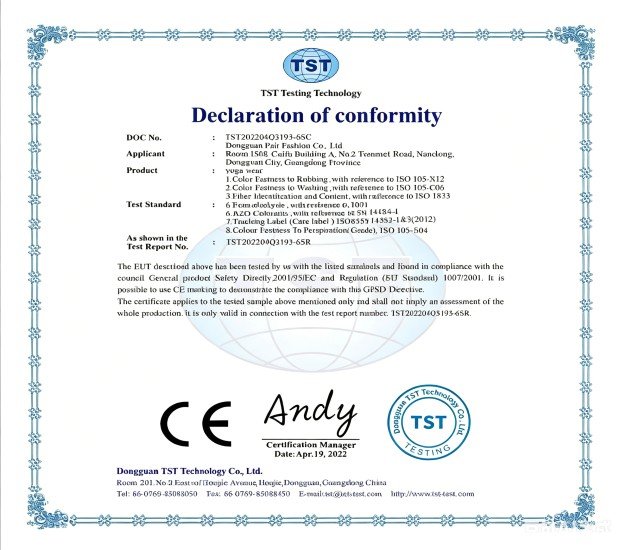
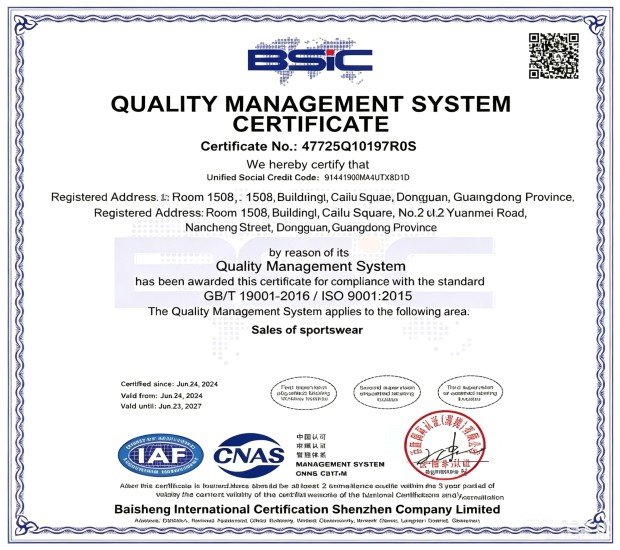
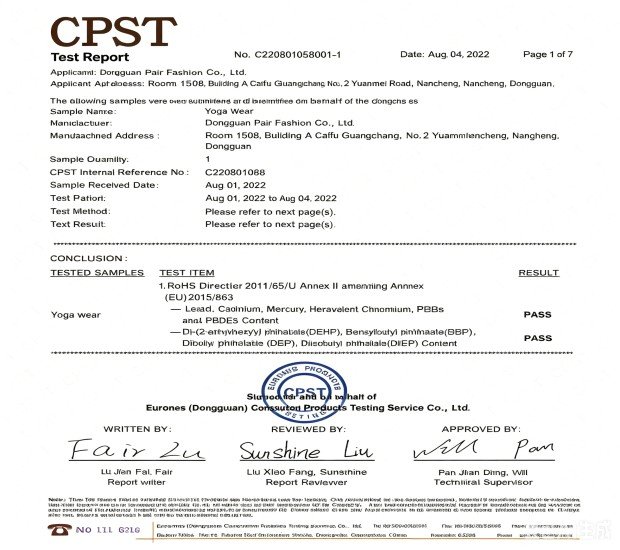
Certifications: ISO9001, BSCI, GRS, CE and ROHS
Core Products: Plus-size activewear, yoga and fitness apparel, equestrian clothing, maternity activewear, Muslim sportswear, sports bras, leggings, tops, sweatshirts and other functional apparel
Services: OEM, ODM and private label
Pair Fashion is based in Dongguan and works with brands requiring more than ready-made wholesale products. Its published manufacturing structure includes dedicated pattern and sample development, QC personnel and seven production lines, with separate capabilities for functional sportswear and equestrian apparel.
For plus-size projects, its relevance is strongest when the buyer needs custom product development rather than only purchasing an existing blank or stock garment. Development can start from a Tech Pack, physical sample, sketch, reference images or product concept, while the available pattern services include full-size grading and specific support for plus-size fits.
The company also works across special-fit categories including plus size, maternity and modest sportswear. That experience can be useful for buyers whose projects involve fit requirements outside conventional standard-size apparel.
MOQ: Pair Fashion’s published internal production data distinguishes between different project structures rather than presenting one universal minimum. Regular styles are generally structured from around 100 pieces, while selected special categories can support different minimums. Actual MOQ should be confirmed according to fabric, color, size range, customization and SKU structure.
Suitable for: Brands developing custom extended-size collections, growing DTC brands, buyers requiring OEM/ODM support, brands needing sampling and pattern development, and customers planning repeat production after initial market testing.
May be less suitable for: Buyers looking only for immediate ready-stock wholesale inventory or extremely small retail-like quantities without product development.
Key strength: The combination of an 11-person pattern/sample team, 13-person QC team and support for special-fit categories gives buyers several relevant capabilities under one manufacturing structure.
What to verify: For a 100% cotton project, confirm the required cotton construction, GSM, finishing, color minimums and wash requirements against the specific style before comparing its quotation with another 100 Cotton Clothing Plus Size Manufacturer.
2. NewWay — Extended Sizing With Clearly Published Commercial Conditions
Location: Zhejiang, China
Manufacturing History: Published company information states manufacturing since 1994
Published Size Range: XL–6XL, with custom ranges available
MOQ: 100 pieces per style using stock fabric; custom fabric requirements can be significantly higher
Sample Lead Time: Approximately 14 days
Bulk Lead Time: Approximately 30 days after sample approval and deposit
Core Products: Dresses, knitwear, occasion wear, sportswear and extended-size apparel
Certifications: BSCI and GRS are publicly stated
Services: Full-package manufacturing and client-supplied grading support
NewWay stands out because its public plus-size information gives buyers relatively specific commercial reference points. It states an XL–6XL standard range and explains that custom grade rules can be matched to the target demographic.
More importantly for sourcing comparison, it distinguishes stock-fabric MOQ from custom-fabric MOQ. Its published plus-size information lists 100 pieces per style for stock-fabric production while custom fabric or specialty material programs may require substantially higher quantities.
That distinction is commercially important. A buyer comparing NewWay’s 100-piece figure with another manufacturer’s 500-piece quotation should first check whether both suppliers are quoting the same material route.
NewWay also publicly describes fit sampling in a target plus size and notes that higher fabric consumption affects plus-size pricing.
Suitable for: Buyers wanting a clearly structured extended-size program, brands with established grading requirements, and customers comparing stock-fabric and custom-fabric production models.
May be less suitable for: A very small custom-fabric launch where the mill minimum is higher than the brand can commercially absorb.
Key strength: Public information provides unusually clear reference points for size range, stock-fabric MOQ, custom-material considerations, sample timing and bulk timing.
What to verify: Confirm whether the proposed cotton fabric is stock or custom, the actual GSM and construction, color minimums and whether the published lead time applies to the required product.
3. MENWILD — Big & Tall Menswear Specialist
Location: Humen, Dongguan, Guangdong, China
Established: 1998
Published Experience: More than 28 years
Published Size Range: 2XL–6XL
MOQ: From approximately 100 pieces per style and color
Published Capacity: More than 80,000 pieces per month
Team: More than 200 employees according to published company information
Core Products: Big-and-tall T-shirts, polos, shirts, jackets, jeans, casualwear and activewear
Services: OEM, ODM and private label
Sample Capability: Publicly promotes fast sampling; project-specific timing should be confirmed
MENWILD occupies a more specialized position than a general plus-size supplier. Its public material focuses strongly on men’s big-and-tall apparel, particularly 2XL–6XL pattern grading and proportion adjustments for larger and taller male customers.
This specialization matters when building a shortlist. A women’s plus-size fashion brand and a men’s big-and-tall brand may both search for a 100 Cotton Clothing Plus Size Manufacturer, but the fit requirements are not interchangeable.
MENWILD publicly states that its big-and-tall approach addresses areas such as longer rises, sleeves and torsos rather than simply scaling standard menswear patterns. It also promotes in-house cut-and-sew and knitting capability together with decoration and private-label services.
Suitable for: Men’s big-and-tall brands, retailers expanding into extended men’s sizes, and buyers developing cotton T-shirts, polos, casualwear or related menswear.
May be less suitable for: Buyers whose main project is women’s plus-size fashion and who need a supplier portfolio specifically centered on women’s extended-fit development.
Key strength: A clearly defined big-and-tall menswear specialization makes its positioning easier to evaluate than that of a manufacturer claiming to serve every apparel category.
What to verify: Confirm the exact cotton fabric specification, sampling time, current MOQ by color, applicable certifications and whether the factory has produced a closely comparable product in the required size range.
4. Essty Garment — Low-MOQ Women’s Plus Size Production
Location: Guangzhou, Guangdong, China
Published Manufacturing History: Since 2014
MOQ: Approximately 100 pieces per style/color, with mixed sizes stated as available
Sample Lead Time: Approximately 5–7 days according to published information
Published Production Lead Time: Approximately 10–15 days for its promoted plus-size programs
Core Products: Women’s plus-size dresses and fashion apparel, including products positioned for African markets
Private Label: Available
Custom Packaging: Available
Essty Garment is a useful comparison for buyers whose plus-size project is closer to women’s fashion and boutique retail than technical activewear or big-and-tall menswear.
Its public information emphasizes curve-oriented patterning, mixed sizes within a production run and a 100-piece per-style/color MOQ. It also publishes comparatively short sample and production timelines.
Those numbers are attractive on paper, but they should be treated as project-specific published conditions rather than universal promises. A straightforward fashion dress using available material and a custom-dyed heavyweight cotton product do not create the same sourcing requirements.
Suitable for: Boutique brands, women’s plus-size fashion sellers and buyers wanting relatively small initial runs with mixed extended sizes.
May be less suitable for: Highly technical garments or projects requiring specialized performance construction outside its publicly emphasized fashion categories.
Key strength: Accessible MOQ structure and a clearly defined women’s plus-size fashion focus.
What to verify: Buyers developing 100% cotton products should confirm whether the required cotton construction is regularly sourced, whether the quoted MOQ applies to custom colors and whether the stated lead time remains realistic after fabric development and sample approval.
5. Wings2Fashion — Flexible Small-Batch Plus Size Customization
Published China-Facing Plus Size Service: Available
MOQ: Public information states approximately 50 pieces per style with mixed sizes
Core Products: Plus-size fashion, winter apparel, jackets, layered garments and custom clothing
Customization: Fabric selection, print, embroidery, private label and packaging
Production Capability: Public information describes knitting, stitching, washing/softening and finishing equipment
Sample and Lead Time: Confirm directly for the actual project
Wings2Fashion is notable for publishing a relatively low minimum quantity and allowing mixed sizes within a style. For a brand testing demand, this type of commercial structure can reduce the inventory commitment required for the first production run.
Its plus-size information also discusses heavier winter fabrics, lined garments and ease allowances for layering, giving it a somewhat different product emphasis from manufacturers centered mainly on T-shirts or activewear.
However, low MOQ should never be evaluated separately from the fabric specification. A 50-piece order using available material is commercially different from 50 pieces requiring a new custom-dyed 100% cotton fabric.
Suitable for: Smaller brands, boutique programs and buyers prioritizing lower initial quantity and customization.
May be less suitable for: Projects where a buyer requires extensive publicly documented factory data, certification details or a highly specialized technical category that is not clearly represented in the supplier’s published portfolio.
Key strength: Flexible small-batch positioning combined with private-label customization.
What to verify: Legal manufacturing entity, production location for the actual order, certifications where required, cotton sourcing route, sample timing and whether the stated MOQ applies to the requested fabric and color.
6. Dongguan Humen Hucai Garment — Sportswear-Oriented OEM/ODM Manufacturing
Location: Dongguan, Guangdong, China
Established: Public marketplace information states 1998
Core Products: Sportswear, yoga pants, sports bras and T-shirts
Services: OEM/ODM
Sample Service: Publicly listed as available
Published MOQ Examples: Around 200 pieces for several sportswear listings; actual project MOQ varies
Plus Size Products: Public listings include plus-size sportswear and casual products
Hucai is more relevant to buyers whose extended-size project sits between sportswear, yoga apparel, T-shirts and casual clothing. Public manufacturing profiles identify it as a manufacturer/factory and trading company with OEM/ODM capability.
Unlike a specialist whose entire positioning is built around plus size, Hucai presents a broader sportswear manufacturing portfolio. That can be useful when a brand wants standard and extended sizes across the same wider collection, but buyers should verify how much of its pattern and production experience is specifically related to plus-size garments.
Suitable for: Sportswear brands, yoga and fitness programs, and buyers looking for a broader OEM/ODM sportswear supplier that can include extended sizes.
May be less suitable for: Buyers who require a manufacturer dedicated primarily to plus-size fashion or who want extensive publicly documented extended-size grading methodology before making contact.
Key strength: Established sportswear-oriented OEM/ODM capability with public plus-size product evidence.
What to verify: Relevant plus-size references, target size range, cotton-fabric capability, grading method, current MOQ, sample lead time and applicable certifications.
7. Guangzhou Yuedong Clothing — Higher-Capacity Sports and Casual Apparel Production
Location: Guangzhou, Guangdong, China
Published Experience: Company information describes approximately 30 years of industry experience
Factory Size: Public profile states more than 10,000 square meters
Employees: More than 300 according to public company information
Published Monthly Output: Approximately 30,000–120,000 sets
Core Products: T-shirts, hoodies, shorts, tracksuits, children’s clothing and sportswear
Services: OEM/ODM and custom production
Sample Service: Available according to public marketplace information
100% Cotton Evidence: Public listings include 100% cotton oversized and plus-size T-shirts
Yuedong is a different type of comparison candidate because its public profile emphasizes larger production infrastructure and broad sports/casual apparel capacity rather than narrow plus-size specialization.
Public product listings include heavyweight 100% cotton T-shirts, oversized styles and plus-size products. This makes it relevant for buyers sourcing cotton casualwear, especially when production scale may become important after a product proves demand.
The trade-off is that broad capacity should not be confused with specialized extended-size expertise. Buyers should still ask for evidence connected to the actual plus-size product rather than assuming that a larger workforce or higher output automatically produces a better fit.
Suitable for: Growing or established brands sourcing T-shirts, sportswear and casualwear with potential for larger repeat orders.
May be less suitable for: Brands whose main purchasing risk is highly specialized women’s plus-size fit and who need deep evidence of dedicated extended-size development before sampling.
Key strength: Published production scale combined with OEM/ODM capability and visible 100% cotton product examples.
What to verify: Exact plus-size grading experience, cotton GSM and finish, sample timing, MOQ for the requested custom specification and certifications relevant to the destination market.
8. Guangzhou Qiyang Clothing — Fabric-to-Garment Shirt Manufacturing
Location: Guangzhou, Guangdong, China
Core Products: Shirts, T-shirts, uniforms, trousers, dresses and fabrics
Services: OEM/ODM
Sample Service: Publicly listed as available
Manufacturing Scope: Public information describes fabric production, pattern development, cutting, sewing and final inspection
Plus Size Evidence: Public listings include plus-size men’s shirts and cotton long-sleeve apparel
Published MOQ Examples: Several shirt listings show approximately 499–599 pieces; project conditions should be confirmed directly
Qiyang offers an interesting comparison for buyers sourcing cotton shirts or woven products, because its public profile describes involvement from fabric production through garment manufacturing.
That vertical scope can matter when fabric consistency is a major purchasing concern. At the same time, its publicly visible MOQs for some shirt products are higher than the low-MOQ offers promoted by several other suppliers in this list.
This does not make one commercial model better than the other. A higher MOQ can be workable for an established shirt program while being unrealistic for a startup testing its first extended-size collection.
Suitable for: Buyers sourcing cotton shirts, woven apparel or programs where fabric-to-garment coordination is valuable.
May be less suitable for: Small startups that need very low initial quantities or brands primarily developing specialized plus-size activewear.
Key strength: Publicly described integration of fabric and garment manufacturing.
What to verify: Whether the required 100% cotton fabric can be produced at the target GSM and finish, current MOQ, extended-size grade capability, sample timing and order-specific QC requirements.
9. Mingteng Clothing Factory — Broad Private Label and Custom Apparel Range
Location: Guangdong, China
Company Type: Publicly listed as a manufacturer/factory
Core Products: Custom clothing, blank clothing, T-shirts, children’s apparel, women’s fashion, menswear, sportswear, streetwear, yoga clothing and golf apparel
Services: OEM/ODM, custom label and private label
Sample Service: Publicly listed as available
Published MOQ Examples: Some activewear listings show minimums around 10 sets; these listing-level quantities should not be assumed for custom 100% cotton development
Mingteng represents the broad custom-manufacturing model. Instead of concentrating its public positioning on one extended-size category, it covers numerous apparel types and private-label services.
That breadth may appeal to a buyer trying to consolidate multiple product categories with one supplier. It also creates a different verification requirement: a broad catalog tells buyers what a manufacturer may be able to produce, but not necessarily which category represents its deepest expertise.
For a 100 Cotton Clothing Plus Size Manufacturer comparison, buyers should therefore move beyond marketplace listings and request examples closely related to the intended fabric, garment construction and extended-size range.
Suitable for: Private-label buyers with multiple casualwear or sportswear categories and customers interested in broad customization.
May be less suitable for: Buyers who want a narrowly specialized plus-size manufacturer with extensive published fit methodology.
Key strength: Wide product scope and private-label customization.
What to verify: Factory location for the order, relevant 100% cotton plus-size examples, actual project MOQ, pattern/grading capability, certifications, sample timing and production capacity.
10. Nanchang Finery Clothing — General Custom Apparel With 100% Cotton Product Evidence
Location: Jiangxi, China
Core Products: Custom T-shirts, hoodies, vests, pants, children’s clothing, suits, tracksuits, sportswear and gym clothing
Services: OEM/ODM
Sample Service: Publicly listed as available
100% Cotton Evidence: Public listings include custom 100% cotton plus-size men’s street and casual T-shirts
Published MOQ Example: A 100% cotton plus-size men’s T-shirt listing shows approximately 100 pieces
Company Establishment and Certifications: Confirm directly
Nanchang Finery Clothing is relevant as a general custom-apparel option with visible marketplace evidence for 100% cotton plus-size T-shirts.
Its broad product range makes it potentially useful for straightforward cotton casualwear programs. However, marketplace product availability should not be treated as proof of deep extended-size specialization. Buyers considering it for a larger size range should request specific grading, sample and measurement evidence.
This is particularly important when moving from oversized styling into true extended sizing. An oversized standard-size T-shirt and a systematically graded plus-size collection solve different fit requirements, even when both use heavyweight 100% cotton fabric.
Suitable for: Buyers sourcing cotton T-shirts, casualwear, hoodies or broader custom-apparel programs.
May be less suitable for: Projects requiring highly documented plus-size specialization, complex women’s extended sizing or detailed public certification information before initial supplier contact.
Key strength: Direct public product evidence connecting custom manufacturing with 100% cotton plus-size casualwear.
What to verify: Extended-size grading experience, exact factory credentials, certifications, fabric source, GSM, shrinkage expectations, sample lead time, bulk lead time and current MOQ.
Quick Comparison of the 10 Manufacturing Choices
| Manufacturer | Main Positioning | Published Plus Size Evidence | Published MOQ Reference | Sample / Lead-Time Reference | Buyer Profile to Investigate |
|---|---|---|---|---|---|
| Pair Fashion | Custom OEM/ODM and special-fit apparel | Plus-size development and full-size grading | Project-dependent; regular programs generally around 100 pcs | Sample as fast as 3 days; standard bulk 20–25 working days | Custom and growing brands |
| NewWay | Full-package extended-size manufacturing | XL–6XL | 100 pcs stock fabric; higher for custom fabric | 14-day sample / 30-day bulk published | Structured extended-size programs |
| MENWILD | Men’s big & tall specialist | 2XL–6XL | From 100 pcs per style/color | Confirm by project | Men’s big & tall brands |
| Essty Garment | Women’s plus-size fashion | Curve-oriented plus-size production | 100 pcs per style/color | 5–7-day sample / 10–15-day production published | Boutiques and women’s fashion |
| Wings2Fashion | Flexible plus-size customization | Mixed-size plus-size programs | 50 pcs per style published | Confirm directly | Smaller test orders |
| Hucai Garment | Sportswear OEM/ODM | Plus-size sportswear listings | Around 200 pcs on several listings | Sample available | Sports and yoga brands |
| Yuedong Clothing | Higher-capacity sports/casual manufacturing | Plus-size and 100% cotton listings | Product-dependent | Sample available | Growing and larger-volume buyers |
| Qiyang Clothing | Fabric-to-garment shirts | Plus-size cotton shirt listings | Around 499–599 pcs on selected listings | Sample available | Shirt and woven programs |
| Mingteng Clothing | Broad private-label apparel | Plus-size/custom product listings | Listing-level MOQ varies | Sample available | Multi-category private label |
| Nanchang Finery | General custom apparel | 100% cotton plus-size T-shirt listings | Around 100 pcs on selected listing | Sample available | Cotton casualwear buyers |
The table is most useful as a shortlisting tool, not a final supplier scorecard. Published MOQ and lead-time figures can change when the buyer changes fabric, GSM, color, size range, decoration, packaging or total quantity.
More importantly, the manufacturers are not identical businesses. MENWILD’s big-and-tall menswear specialization solves a different sourcing problem from Essty’s women’s fashion positioning. Qiyang’s fabric-to-shirt structure serves a different buyer from a small brand prioritizing a 50-piece test order. Pair Fashion’s combination of special-fit development, sampling and multi-category OEM/ODM support may be more relevant when a buyer needs to develop a custom collection rather than select an existing product.
A serious shortlist should therefore reduce these ten names according to the actual order risk. Buyers can first remove manufacturers whose product specialization, MOQ or size capability does not fit the project. The remaining suppliers can then receive comparable RFQs before price, samples and production evidence are evaluated in greater detail.

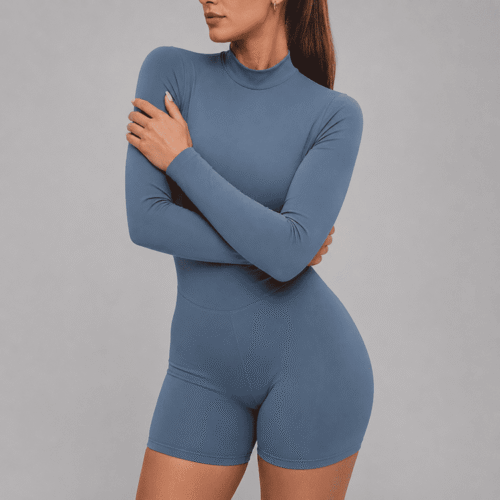
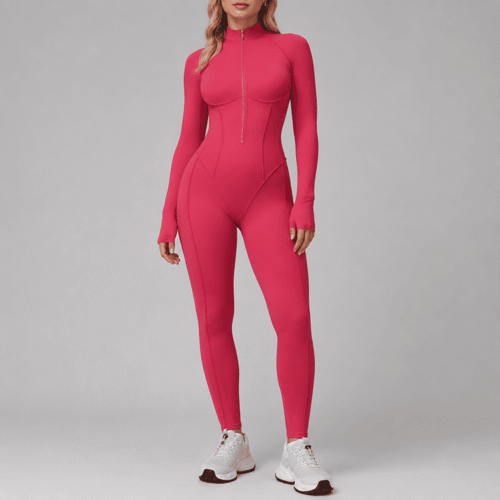
Custom Women’s Long Sleeve Yoga Jumpsuit OEM ODM Mock Neck Activewear Romper
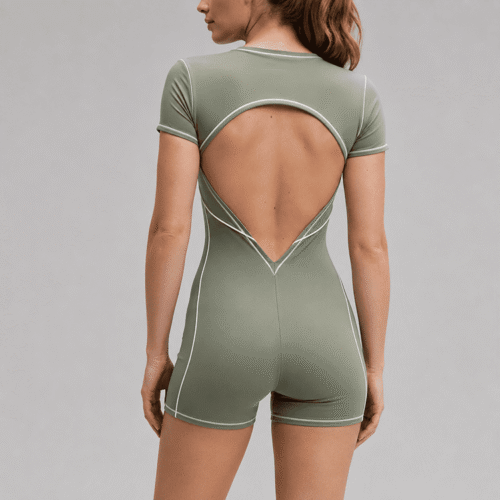
Custom Women’s Open Back Yoga Jumpsuit OEM ODM Activewear Romper
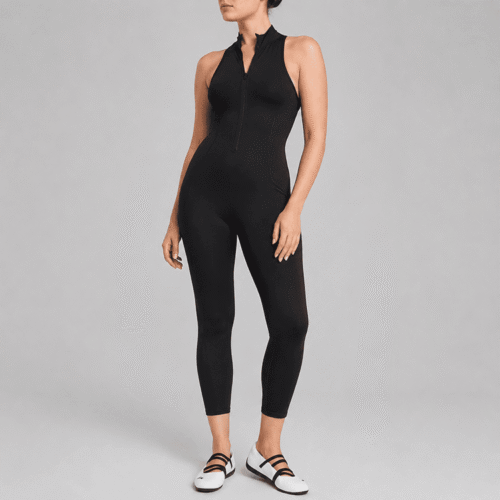
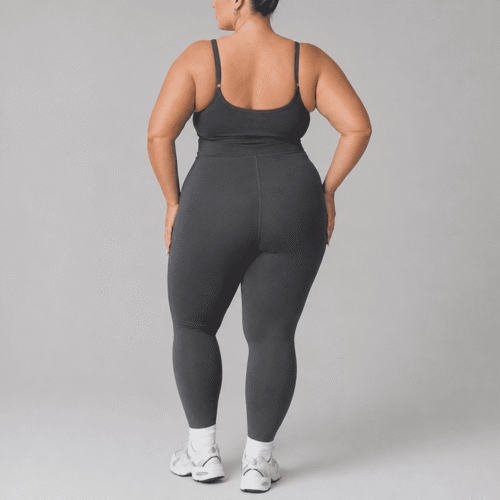
Custom Women’s Sleeveless Zip Front Yoga Jumpsuit OEM ODM Sculpting Activewear
Custom Women’s Spaghetti Strap Yoga Jumpsuit OEM ODM Sculpting Activewear
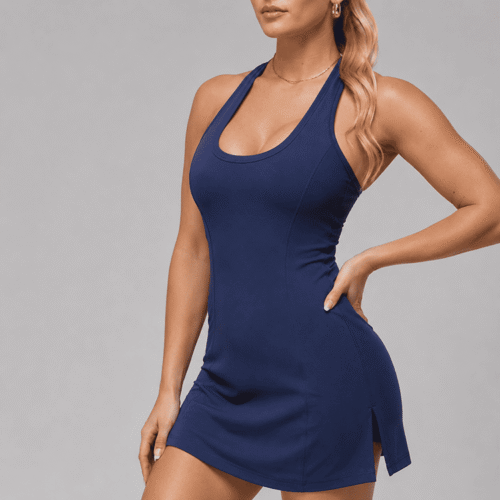
Custom Women’s Tennis Activewear Dress OEM ODM Fitness Sports Dress
Custom Women’s Zip Front Long Sleeve Yoga Jumpsuit OEM ODM Sculpting Activewear
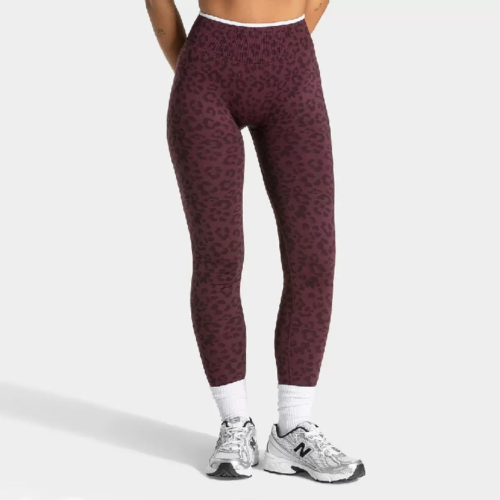
Custom Yoga Leggings – High Waist Seamless Workout Pants OEM/ODM
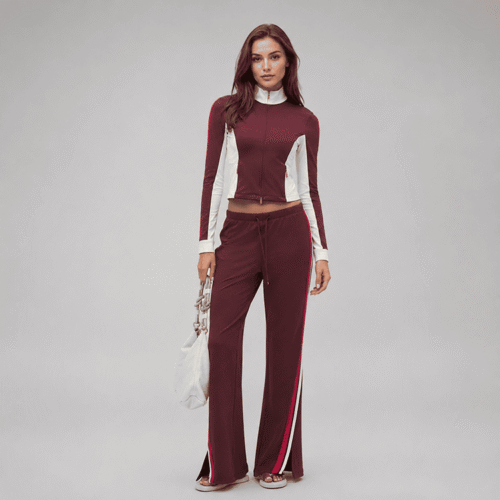
OEM Women’s Activewear Set Custom Zip-Up Jacket & Wide Leg Workout Pants
How Can Buyers Compare Fabric Purity, Extended Fit and Supplier Evidence?
Buyers should compare supplier claims by converting them into evidence that can be checked. For cotton, this means looking beyond a “100% cotton” description to construction, GSM, finishing and relevant material documentation. For extended sizing, buyers should look beyond the largest size label to size charts, grading information, samples and measurement tolerances. The stronger supplier is not the one making the most claims, but the one providing clearer evidence for the actual order.
A supplier website can make almost every manufacturer look capable. Terms such as premium cotton, inclusive sizing, strict QC, low MOQ and fast sampling are useful starting points, but they are not standardized manufacturing specifications.
For a buyer comparing several factories, the practical task is to turn each marketing claim into a question that can be answered with evidence.
A simple rule works well:
Claim → Specification → Evidence → Comparison
This keeps the evaluation focused on the order rather than the wording used in a supplier’s marketing materials.
What Evidence Supports a “100% Cotton” Specification?
A 100 Cotton Clothing Plus Size Manufacturer should be able to clarify what material is being proposed for the quotation. The buyer does not need to assume that every supplier uses the same cotton fabric simply because the fiber-content description is identical.
A more useful comparison separates fiber content from fabric specification.
For example:
| Supplier Claim | What Buyers Should Ask | Useful Evidence |
|---|---|---|
| 100% Cotton | What is the stated fiber composition? | Fabric specification or relevant material information |
| Heavyweight Cotton | What is the GSM or agreed weight range? | Swatch and GSM information |
| Soft Cotton | What construction and finish create the hand feel? | Physical swatch or approved fabric reference |
| Custom Color | Is the color stock, custom dyed or subject to a material minimum? | Lab dip, color standard and MOQ information |
| Low Shrinkage | Under what wash method and tolerance? | Relevant wash-test information or agreed requirement |
| Premium Cotton | What measurable specification supports “premium”? | Construction, weight, finish and material evidence |
The word premium should be checked carefully because it sounds attractive in the market, but its technical meaning is not very clear.
A buyer may prefer one fabric because of its hand feel, surface appearance, weight or finishing. However, these points should be clearly confirmed instead of simply thinking that “premium cotton” has the same meaning from every supplier.
The same applies to fabric purity.
For products intended to be sold as 100% cotton, buyers should make sure the proposed fiber-content information supports the intended labeling and market requirements. For products sold into the United States, buyers can also review the FTC guidance on labeling and advertising cotton products when checking whether a 100% cotton claim is appropriate. This becomes especially relevant when the garment includes rib, decoration, elastic components, trims or other textile elements that may not have the same composition as the main body fabric.
For supplier selection, the objective is not to turn every sourcing manager into a textile laboratory technician. It is to make sure that Supplier A’s “100% cotton” and Supplier B’s “100% cotton” refer to sufficiently defined materials before their prices are placed side by side.
180 GSM vs 220 GSM Cotton: Are Two Quotations Really Comparable?
Not necessarily.
Imagine that two factories quote the same relaxed plus-size cotton T-shirt.
Supplier A
- 100% cotton jersey
- 180 GSM
- Available stock color
- Standard finish
- Existing fabric source
Supplier B
- 100% cotton jersey
- 220 GSM
- Custom Pantone color
- Additional finishing
- Fabric produced against the order
If Supplier A quotes a lower unit price, the immediate conclusion might be that it is the more competitive factory.
That conclusion would be premature.
Supplier B is working with a heavier material, potentially higher fabric consumption and a different color-development requirement. The difference in quotation may reflect the specification rather than manufacturing efficiency.
The comparison becomes even more important across extended sizes because material consumption can change as the size distribution moves upward. An order concentrated in XL–2XL does not necessarily have the same average fabric consumption as one concentrated in 4XL–6XL.
This is why buyers should normalize at least the fabric construction, target GSM, color basis and size breakdown before using price as a major supplier-selection factor.
A quotation that is 8% lower is not automatically a saving if the supplier has quietly reduced fabric weight or changed another important specification.
What Evidence Shows Real Extended-Size Capability?
Extended sizing should be evaluated through relevant evidence, not only a size-range statement. Buyers working with women’s extended sizing can also use recognized references such as the ASTM body measurement tables for plus women as an external benchmark when appropriate, while still developing or applying the measurement system required by their own target market and customer profile.
A supplier advertising XS–6XL may indeed have strong plus-size capability. But the label range alone does not explain how the larger sizes were established or whether the manufacturer has produced comparable garments before.
Useful evidence can include:
- A size chart covering the required extended sizes
- Relevant plus-size product examples
- Ability to follow buyer-provided grade rules
- Fit samples in a relevant target size
- Size-set samples when commercially justified
- Defined bulk measurement tolerances
- Measurement records from production
- Evidence of repeat orders in comparable size ranges
The buyer should also distinguish between oversized styling and true extended sizing.
An oversized T-shirt may use intentionally loose proportions within a conventional size structure. A plus-size collection normally requires deliberate measurement decisions across bust, waist, hip, upper arm, shoulder, length and other relevant points.
Both products can be large. They do not represent the same pattern-development evidence.
For supplier comparison, this distinction prevents a catalog of oversized streetwear from being treated automatically as proof of comprehensive plus-size capability.
Fit Sample vs Size Set Sample: Which Evidence Does a Buyer Need?
A fit sample and a size set answer different purchasing questions.
A fit sample helps the buyer evaluate whether the intended fit, measurements, construction and overall garment direction are acceptable in the selected development size.
A size set checks how the approved sizing logic translates across additional sizes.
From a supplier-selection perspective, buyers do not necessarily need a complete size set from every factory in the first round. That can create unnecessary sample cost and slow the shortlist process.
A more efficient sequence is:
Initial Supplier Screening → Comparable Fit Samples → Shortlist Reduction → Size-Set Verification Where Required
The level of verification should follow the risk of the order.
A simple relaxed cotton top covering XL–3XL may justify a different sample strategy from a fitted product covering XL–6XL with multiple critical measurement points.
Buyers transferring an established program may already have locked grade rules and therefore need to verify execution accuracy. A new brand without established extended-size specifications may need more development input before supplier comparisons become meaningful.
This difference should be recognized early because the two projects require different types of manufacturer support.
Which Claims Should Buyers Verify Instead of Accepting at Face Value?
Several common supplier claims become much more useful when buyers translate them into measurable questions.
“We Use Premium Cotton”
Ask:
- What is the composition?
- What is the construction?
- What is the GSM?
- What finish is applied?
- Can a fabric swatch be provided?
“We Specialize in Plus Size”
Ask:
- Which extended sizes have you produced?
- Which product categories?
- Can you work with our grade rules?
- Can you show relevant sample or production evidence?
- What measurement tolerances do you normally control?
“Our MOQ Is 100 Pieces”
Ask:
- Per order?
- Per style?
- Per color?
- Per fabric?
- Can sizes be mixed?
- Does custom dyeing create another minimum?
“We Can Make Samples Quickly”
Ask:
- How long after specifications and fabric are confirmed?
- Does the timing include custom fabric?
- Does it include print or embroidery setup?
- How are revisions handled?
“We Have Strict QC”
Ask:
- What is inspected?
- At which production stages?
- Which measurements are checked?
- What happens when a result is outside the agreed tolerance?
- Can relevant inspection records be provided?
These questions do not assume that the manufacturer’s claims are false. They make the claims comparable.
A supplier that says “low MOQ” may have a commercially attractive offer. A supplier that clearly explains what the MOQ applies to and what conditions can change it provides the buyer with more useful information.
How Should Buyers Build a Claim-to-Evidence Comparison?
Once several suppliers remain on the shortlist, buyers can record their claims in a simple evidence matrix.
| Supplier Claim | Supplier A | Supplier B | Supplier C | What Still Needs Verification? |
|---|---|---|---|---|
| 100% Cotton | Specification provided | Swatch only | Website claim | Composition and final bulk material |
| Target GSM | Confirmed | Confirmed | Not stated | Supplier C |
| Extended Sizes | XL–5XL | XL–6XL | Up to 5XL | Actual grading evidence |
| Fit Sample | Available | Available | Confirm directly | Sample size and timing |
| Size Set | Available after approval | Available | Not stated | Cost and timing |
| MOQ | Per style | Per style/color | Published as total MOQ | Fabric and color minimums |
| QC | Checkpoints defined | General QC statement | Inspection service listed | Actual inspection scope |
This matrix helps buyers identify information gaps before paying for samples or deposits.
A manufacturer does not need to publish every detail on its website to remain a serious candidate. Many legitimate factories provide project-specific information only after reviewing an RFQ. The important issue is whether the missing information can be clarified when it becomes relevant.
The opposite is also true. A highly detailed website does not replace sample verification, commercial confirmation or production evidence.
The strongest shortlist therefore contains manufacturers whose claims can progressively be converted into clear specifications, physical samples, commercial terms and production evidence.
For buyers who are still defining the product rather than comparing finished RFQs, working first with an experienced 100% cotton plus size clothing manufacturer can help establish the product specifications that will later become the benchmark for supplier comparison.
Once those benchmarks are locked, the next question is commercial: Are the MOQ, sample fee, unit price and production terms from each supplier actually being compared on the same basis?
Why Do Buyers Source 100% Cotton Plus Size Clothing From China?
Buyers consider China for 100% cotton plus-size clothing because the country combines garment manufacturing with a broad supporting supply chain for fabrics, dyeing, trims, labels, decoration and packaging. The practical advantage is not that every Chinese manufacturer is cheaper or more capable. It is that buyers can compare different supplier types, production scales and customization models within a mature apparel sourcing ecosystem.
China can be particularly relevant when a project requires more than sewing a standard garment. Extended sizing, custom colors, branded labels, packaging and repeat orders can involve several suppliers behind the main clothing manufacturer. Having these resources within an established apparel supply chain can simplify coordination, but the value depends on choosing a manufacturer whose capabilities match the order.
Why Does China Offer a Broad Apparel Supply Chain?
A 100 Cotton Clothing Plus Size Manufacturer rarely works in isolation. Even a relatively simple cotton T-shirt can depend on fabric sourcing, dyeing, labels, printing or embroidery, packaging materials and logistics. More customized collections may add special trims, custom Pantone colors, wash treatments or additional testing requirements.
China’s apparel manufacturing regions give buyers access to a wide range of these supporting resources. This can be useful when a brand needs to move beyond a standard catalog product and coordinate several custom elements under one order.
For sourcing purposes, the advantage can be viewed as a connected chain:
Fabric → Dyeing & Finishing → Trims → Cutting & Sewing → Printing or Embroidery → Labels → Packaging → Inspection → Shipping
The commercial value of this structure becomes clearer when something changes.
For example, a buyer may approve the garment shape but decide that the cotton fabric feels too light. Another may keep the fabric but change the logo technique. A growing brand may need to retain its approved product while adding new colors for the next season.
A supplier operating within a deeper apparel ecosystem may have more sourcing options to investigate when these changes occur.
However, supply-chain depth should not be confused with automatic quality. China has large manufacturers, small manufacturers, specialist suppliers, general apparel factories, trading companies and businesses using mixed production models. Their capabilities can differ substantially.
The benefit for buyers is choice and supply-chain depth, not a guaranteed quality level.
China Manufacturer vs Local Manufacturer: What Should Buyers Compare?
There is no universal answer to whether a China manufacturer or a local manufacturer is the better sourcing model. The decision depends on the product, order quantity, development needs, delivery expectations and the buyer’s ability to manage an overseas supply chain.
A practical comparison looks beyond unit price:
| Purchasing Factor | China Manufacturer | Local Manufacturer |
|---|---|---|
| Supply-Chain Depth | Often broad access to fabrics, trims, decoration and packaging | Depends heavily on the local apparel ecosystem |
| Custom Development | Wide range of OEM/ODM options across different supplier types | Can offer closer collaboration, depending on local capability |
| MOQ | Varies widely by factory, fabric and customization | May support smaller runs in some markets, often at a higher unit cost |
| Communication | Requires strong specification control and overseas communication | Easier face-to-face communication when geographically close |
| Freight | International freight, duties and import planning may apply | Domestic or regional logistics can be simpler |
| Lead Time | Can be efficient at scale, but shipping time must be included | Shorter transportation can help urgent replenishment |
| Cost Structure | Can be competitive, especially when supply-chain resources align | Labor and overhead can be higher in some markets |
| Factory Access | Audit, video verification or third-party inspection may be useful | Physical visits may be easier for local buyers |
The important word is may.
A local manufacturer is not always faster, especially when the required fabric still needs to be imported. A Chinese supplier is also not always cheaper, especially when the order quantity is very small, customization is complicated and expensive air shipping is required.
Therefore, buyers should compare the total sourcing conditions, not only compare suppliers by country.
For a plus-size cotton program, the decision may include additional questions: Does the supplier have relevant extended-size evidence? Can it follow the required measurement system? Does its fabric sourcing structure fit the order quantity? Can it reproduce the approved product when the brand needs a reorder?
These questions normally matter more than whether the manufacturer’s address is domestic or overseas.
When Does China Manufacturing Fit a Startup, Growing Brand or Established Buyer?
The same Chinese manufacturer may not fit every stage of brand development.
A startup testing its first plus-size cotton collection usually has a different risk profile from an established retailer ordering thousands of units across several colors and sizes.
For startups, the main issue is often inventory exposure. A low unit price becomes less useful if the MOQ forces the brand to buy too many colors, sizes or styles before demand has been tested. Startups may therefore give more weight to manageable MOQ, sampling clarity and development communication.
For growing brands, the challenge begins to shift. A style may already have proven demand, but the brand now needs more colors, more sizes and reliable replenishment. At this stage, supplier organization, specification control and repeatability become more important.
For established buyers, capacity, production planning, quality systems and supply continuity can carry greater weight. A manufacturer that works well for a 100-piece test order may not necessarily be the right supplier for a recurring multi-style program.
The sourcing question should therefore change with the brand:
- Startup: Can this supplier support a commercially manageable first order?
- Growing brand: Can this supplier reproduce approved products as volume and SKU count increase?
- Established buyer: Can this supplier manage repeatability, capacity and production risk across a larger program?
This is another reason a 100 Cotton Clothing Plus Size Manufacturer should be evaluated against the actual purchasing stage rather than a generic list of factory advantages.
Are China Manufacturers Always Lower in Price?
No. A Chinese manufacturer should not be selected on the assumption that China automatically means the lowest price.
The quotation depends on what is actually being manufactured.
For a 100% cotton plus-size garment, important cost variables can include:
- Fabric construction and GSM
- Cotton fabric price
- Fabric consumption by size
- Stock color vs custom dye
- Garment construction
- Order quantity
- Number of colors
- Size distribution
- Print or embroidery
- Labels and trims
- Custom packaging
- Testing or inspection requirements
- Freight and delivery terms
Consider two factories quoting what appears to be the same T-shirt.
Supplier A quotes a lighter stock cotton jersey in two existing colors and standard packaging. Supplier B quotes a heavier custom-dyed fabric, branded labels and individual custom packaging across an extended size range.
Supplier A may be cheaper, but the price difference does not prove that Supplier A is more efficient. The two factories are not quoting the same commercial specification.
The opposite can also happen. A larger order may allow a manufacturer to source material more efficiently, spread setup costs across more units and improve production efficiency. In that situation, a supplier that was not attractive for a small test order may become commercially stronger at higher volume.
For this reason, price comparison should come after specification comparison.
The same principle applies when comparing a Chinese supplier with a manufacturer in another country. Buyers should consider the landed purchasing picture, including product cost, development cost, freight, import requirements, inspection needs, inventory commitment and the cost of correcting problems.
The lowest FOB or EXW number on a quotation is only one part of the purchasing decision.
What Makes a Chinese Manufacturer Worth Shortlisting?
Country of origin alone is not a reason to shortlist a supplier. A useful candidate should show a practical connection between its published capabilities and the buyer’s actual project.
For a 100% cotton plus-size program, the first shortlist can focus on evidence such as:
- Relevant cotton garment experience
- Evidence of extended-size production
- Ability to work with the required size specifications
- MOQ compatible with the buying plan
- Clear sample conditions
- Relevant OEM, ODM or private-label capability
- Understandable quotation assumptions
- Defined quality-control responsibilities
- Production capacity appropriate for expected volume
- Ability to support repeat orders if the product succeeds
A startup does not necessarily need the largest factory. An established brand does not necessarily need the supplier with the lowest MOQ. A premium cotton collection does not necessarily need the manufacturer offering the lowest fabric price.
The stronger shortlist is the one in which each supplier has a clear reason to remain.
That principle is especially important when comparing manufacturers in China, where the number of available suppliers can create the illusion that more options automatically produce a better sourcing decision. In practice, a smaller shortlist built around the actual order is more useful than a long supplier list built around generic factory claims.
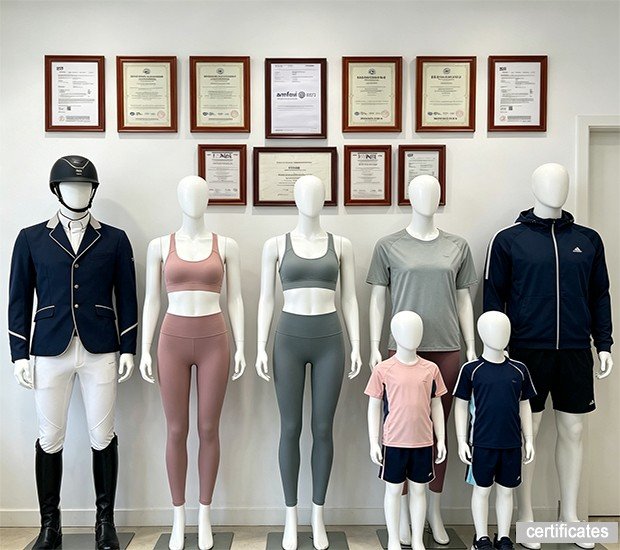
Trusted Manufacturing Standards For Global Sportswear Brands
We operate under internationally recognized quality, sustainability, and ethical manufacturing standards. Our certifications help ensure consistent product quality, responsible sourcing, and reliable production for global sportswear brands.
- 20+ Countries Served
- 6000+ Styles Developed
- 50,000 PCS Monthly Capacity
- 3-Day Sample Development
How Do Buyers Compare Price, MOQ, Sample and Production Terms?
Buyers should compare price, MOQ, sample fees and production terms only after confirming that shortlisted manufacturers are quoting substantially the same product. A lower unit price may come from lighter fabric, stock colors, simpler packaging or a different size assumption. MOQ should also be separated into style, color and fabric minimums. Commercial normalization makes supplier quotations easier to compare and exposes costs or conditions that may otherwise appear later.
A quotation is not just a unit price. It reflects a set of assumptions about the product and order.
When comparing one 100 Cotton Clothing Plus Size Manufacturer with another, buyers should therefore ask two questions:
What exactly is included in this price?
and
Which conditions could cause this price to change?
The answers can reveal more about the commercial fit of a supplier than a small difference in the initial unit price.
Why Can Two Manufacturers Quote Different Prices for the Same Product?
Two garments can look nearly identical in a reference image and still represent different manufacturing projects.
Consider a buyer requesting a relaxed 100% cotton plus-size T-shirt.
Supplier A quotes:
- 180 GSM cotton jersey
- Stock black
- Standard neck rib
- Existing label option
- Standard polybag
- XL–3XL
- 500 pieces
Supplier B quotes:
- 220 GSM cotton jersey
- Custom Pantone color
- Custom neck rib
- Woven main label and size label
- Printed custom packaging
- XL–6XL
- 500 pieces
The quotations should not be compared as though the suppliers are offering the same product.
Fabric weight alone changes material consumption. Custom dyeing can introduce fabric minimums and setup requirements. A wider extended-size range changes the size distribution and may affect average fabric usage. Custom labels and packaging add additional components.
Before concluding that one manufacturer is expensive, buyers should normalize the main cost drivers.
| Cost Driver | Questions to Normalize |
|---|---|
| Fabric | Same composition, construction and GSM? |
| Color | Stock color or custom dye? |
| Size Range | Same sizes and same quantity distribution? |
| Construction | Same seams, rib, pockets and details? |
| Branding | Same print, embroidery or other decoration? |
| Labels | Same main, size and care labels? |
| Packaging | Standard or custom? |
| Quantity | Same total quantity and color split? |
| Inspection | Same inspection responsibility? |
| Incoterm | EXW, FOB, DDP or another basis? |
Only after these variables are reasonably aligned does a unit-price comparison become meaningful.
A buyer does not need every quotation to be identical. Manufacturers may recommend different solutions based on available fabrics, equipment or order quantity. Those alternatives can be useful, but they should be identified as alternatives rather than hidden inside the price comparison.
What MOQ Should Buyers Compare: Style, Color or Fabric MOQ?
A published MOQ is often one of the first numbers buyers notice, but it can also be one of the easiest numbers to misunderstand.
“MOQ 100 pcs” can mean several different things:
- 100 pieces per order
- 100 pieces per style
- 100 pieces per color
- 100 pieces per fabric
- 100 pieces with mixed sizes
- 100 pieces only when using available fabric
- 100 pieces excluding custom labels or packaging minimums
For this reason, buyers should separate the garment manufacturer’s sewing MOQ from the minimums created elsewhere in the supply chain.
A factory may be willing to sew 100 pieces, while a fabric mill requires a larger quantity for a custom-dyed cotton fabric. A woven-label supplier may also have its own minimum. Custom packaging can introduce another minimum quantity.
The commercial structure may therefore look like this:
| MOQ Type | Example Question |
|---|---|
| Style MOQ | What is the minimum total quantity for one design? |
| Color MOQ | How many pieces are required per color? |
| Fabric MOQ | Does the selected cotton fabric have a minimum quantity? |
| Dye MOQ | Is there a minimum for a custom Pantone color? |
| Size MOQ | Can XL–6XL be mixed freely within the order? |
| Trim MOQ | Do custom labels, zippers or other trims create minimums? |
| Packaging MOQ | What minimum applies to custom bags or boxes? |
This distinction is especially important for startups.
Suppose a brand wants 100 pieces divided across five colors and six sizes. A factory advertising a 100-piece MOQ may still require 100 pieces per color, creating a real order of 500 pieces.
Another manufacturer may quote a higher unit price but allow the 100 pieces to be divided across two colors and multiple sizes. For a market test, the second structure could create less inventory risk even though the garment price is higher.
MOQ should therefore be evaluated as an inventory commitment, not simply as a number printed on a supplier page.
How Much Does a Custom Sample Cost and What Does the Fee Include?
Sample fees should be compared by scope rather than by the lowest number.
A sample can involve:
- Pattern preparation
- Fabric sourcing
- Individual cutting
- Sewing
- Custom print or embroidery setup
- Labels or trims
- Finishing
- Measurement checking
- Revision work
- Courier charges
Because a single sample cannot benefit from normal bulk-production efficiency, its unit cost can be much higher than the expected bulk garment price.
A supplier charging a higher sample fee may include pattern work, custom fabric sourcing and branding setup. Another supplier may quote a lower fee using an available fabric and exclude shipping.
Neither fee can be judged properly until the buyer knows what is included.
Useful questions include:
- Is pattern development included?
- Is the requested fabric included?
- Will the sample use the correct GSM?
- Is custom color development included?
- Are print or embroidery setup charges separate?
- Are custom labels included?
- How many revisions are included?
- Is courier freight included or charged separately?
- Is any sample fee refundable after a bulk order?
For supplier comparison, the most useful sample is not necessarily the cheapest one. It is the sample that gives the buyer enough information to judge whether the manufacturer can execute the project.
How Long Should Sampling and Bulk Production Take?
There is no single correct lead time for every cotton plus-size order.
Sampling can be relatively fast when the manufacturer already has an appropriate fabric, the Tech Pack is complete and the construction is straightforward. It can take longer when the project requires custom fabric, special colors, new trims, multiple decoration techniques or several fit revisions.
Bulk production has similar variables.
A quoted production time should therefore be linked to a clear starting point.
For example:
“20–25 working days”
is more useful when both parties understand whether the clock starts after:
- Deposit payment
- Fabric confirmation
- PP sample approval
- Label approval
- Material arrival
- All specifications are locked
Without that definition, two suppliers may appear to offer the same lead time while calculating it from different stages.
Buyers should also distinguish between manufacturing lead time and total delivery time.
A factory may complete production in 20 working days, but the buyer still needs to consider final inspection, balance payment, export handling and transportation.
A simple comparison can therefore separate:
Sample Time → Revision Time → Material Preparation → Bulk Production → Final Inspection → Shipping
This makes the timeline more useful for launch planning.
What Should Be Included in a Comparable Factory Quotation?
A serious quotation should contain enough information for the buyer to understand the commercial basis of the price.
For a 100% cotton extended-size program, a comparison sheet can include:
| Quotation Item | Supplier A | Supplier B | Supplier C |
|---|---|---|---|
| Product | |||
| Fabric Composition | |||
| Fabric Construction | |||
| GSM | |||
| Color Basis | |||
| Size Range | |||
| Order Quantity | |||
| MOQ Per Style | |||
| MOQ Per Color | |||
| Fabric MOQ | |||
| Unit Price | |||
| Sample Fee | |||
| Sample Lead Time | |||
| Bulk Lead Time | |||
| Labels Included | |||
| Packaging Included | |||
| Inspection Basis | |||
| Payment Terms | |||
| Incoterm | |||
| Quotation Validity |
This type of commercial normalization table prevents buyers from comparing a complete quotation with an incomplete one.
It can also expose missing information early.
For example, Supplier A may appear 6% cheaper until the buyer discovers that labels and packaging are excluded. Supplier B may have a higher garment price but include more of the required customization. Supplier C may offer the lowest sample fee but require a much larger custom-fabric MOQ.
The commercial question is therefore not:
“Which quotation has the lowest unit price?”
A more useful question is:
“Which quotation provides the most suitable total commercial structure for this order?”
When Is a Higher Price Commercially Reasonable?
A higher quotation is not automatically better, just as a lower quotation is not automatically worse.
The difference becomes meaningful only when buyers can identify what they receive in return.
A higher price may be commercially reasonable when it reflects:
- A heavier or more expensive cotton fabric
- More complex garment construction
- Higher fabric consumption
- A wider extended-size range
- Custom dyeing
- More complicated branding
- Lower production quantity
- Additional inspection or testing
- More expensive packaging
- Different delivery terms
However, buyers should not accept a higher quotation simply because a supplier describes itself as “premium.”
The additional cost should connect to a product specification, service requirement or commercial condition that matters to the order.
The same rule applies to a lower quotation. If a supplier is genuinely more efficient, has better access to the required material or has a production structure that fits the order particularly well, a lower price can be completely reasonable.
The purpose of normalization is not to make every manufacturer charge the same amount. It is to understand why the prices are different.
How Should Buyers Compare the Total Purchasing Commitment?
For small and growing brands, unit price can distract from a more important number: the amount of money and inventory required to place the order.
Consider two quotations:
Supplier A
- Unit price: $8.20
- MOQ: 500 pieces
- Five colors required
- Total initial inventory: 2,500 pieces
Supplier B
- Unit price: $9.10
- MOQ: 150 pieces
- Two colors allowed
- Total initial inventory: 300 pieces
Supplier A has the lower unit price.
Supplier B creates the lower initial inventory commitment.
For an established style with predictable sales, Supplier A’s structure may be commercially attractive. For a new brand testing an unfamiliar category, Supplier B may reduce the amount of capital exposed before demand is proven.
This does not identify a universal winner. It shows why brand stage and order risk should be part of supplier comparison.
When evaluating a 100 Cotton Clothing Plus Size Manufacturer, buyers should therefore compare at least four commercial numbers together:
Unit Price + MOQ + Total Order Value + Inventory Exposure
Freight, duties, inspection and development costs can then be added when the buyer needs a more complete landed-cost comparison.
A normalized quotation gives buyers a clearer basis for deciding which manufacturers deserve the next level of verification. The next step is no longer comparing what suppliers say they can do, but checking what they can demonstrate through samples, factory evidence, quality records and order-specific verification.
Which Type of 100 Cotton Clothing Plus Size Manufacturer Fits Your Order?
The right 100 Cotton Clothing Plus Size Manufacturer depends on the buyer’s order rather than one universal supplier profile. A startup may prioritize manageable MOQ and clear sampling, while an established brand may place more weight on repeatability, capacity and production control. Product complexity, cotton requirements, extended-size risk, customization and expected reorder volume should determine which manufacturer type remains on the final shortlist.
A manufacturer can have a large facility, long history and broad product catalog without being the most suitable supplier for every project.
The opposite is also true. A smaller specialist may be highly relevant for one product category but less appropriate when the buyer needs high-volume production across many styles.
This is why supplier selection should move from “Which factory looks strongest?” to “Which factory structure matches the risks of this order?”
The answer can change as the brand grows.
Which Manufacturer Type Fits a Startup Testing Its First Collection?
For a startup, the biggest sourcing risk is often not production capacity. It is committing too much inventory before demand has been proven.
Suppose a new brand wants to launch three 100% cotton plus-size tops across four colors and six sizes.
A manufacturer may offer a lower unit price, but if it requires 500 pieces for each color, the total inventory may be too much for a test order. Another supplier may have a higher unit price, but it can support fewer colors, mixed sizes and a more manageabl
The second supplier may fit the launch stage better even though its unit price is not the lowest.
Startup buyers can give more weight to:
- Manageable initial MOQ
- Mixed-size flexibility
- Clear fabric minimums
- Reasonable sample structure
- Clear communication
- Private-label availability
- Ability to explain additional customization costs
- Realistic production timing
- Possibility of future reorders
A startup should also be careful with extremely low MOQ claims.
A manufacturer may technically accept 50 or 100 garments when using existing materials, but a custom-dyed cotton fabric, special rib, custom packaging or branded trims can create separate minimums.
The relevant question is therefore not:
“What is your lowest MOQ?”
It is:
“What is the lowest commercially workable quantity for this exact specification?”
This distinction can prevent a low published MOQ from becoming a much larger order after development begins.
Which Manufacturer Type Fits a Brand Launching Its First Extended-Size Range?
A brand already selling standard sizes faces a different challenge when it moves into extended sizing.
The existing product may already have stable fabric, branding and construction. The new uncertainty is how the larger size range will be executed and verified.
For this project, buyers may give greater weight to a manufacturer that can show:
- Relevant plus-size product experience
- Extended-size measurement examples
- Ability to follow buyer-provided grade rules
- Fit-sample support
- Size-set capability where required
- Measurement-control procedures
- Experience with the relevant garment category
- Clear bulk measurement tolerances
A supplier should not receive additional credit simply because its website displays 5XL or 6XL.
The buyer needs to know whether the factory’s experience relates to the actual product.
A manufacturer experienced in loose plus-size T-shirts may not automatically have the same capability in fitted dresses, structured shirts or technical leggings. Product category and extended-size experience should be considered together.
For brands entering plus size for the first time, this can deserve more weight than a small difference in unit price.
The commercial risk of correcting a poorly executed size range after production can be much greater than the saving created by choosing the cheapest quotation.
Which Manufacturer Type Fits a Premium 100% Cotton Collection?
A premium cotton project changes the supplier comparison again.
The buyer may care about a particular jersey construction, heavier GSM, surface appearance, hand feel, custom color, finishing or wash performance. In this situation, fabric control becomes a larger part of supplier fit.
A suitable manufacturer should be able to clarify:
- Proposed cotton composition
- Fabric construction
- Target GSM
- Available or custom-developed color route
- Finishing requirements
- Material minimums
- Relevant wash expectations
- Bulk fabric confirmation method
- How the approved material will be referenced for production
Buyers should be cautious when the main evidence is simply the word “premium.”
Premium positioning should connect to specifications that can be communicated, sampled and later checked.
A manufacturer with the lowest garment price may not fit the project if it cannot source the required cotton construction at the required quantity. Another factory may have strong fabric sourcing but require a higher material MOQ.
The purchasing decision then becomes a trade-off between material requirements, inventory commitment and target positioning.
This is also where a specialist development partner may be more useful than a stock-product supplier. Brands still defining the fabric, fit and private-label requirements can first establish a production-ready specification with a custom 100% cotton plus size manufacturer before comparing bulk-production terms on a normalized basis.
Which Manufacturer Type Fits Private Label Retail Programs?
Private-label retail programs often require more than adding a logo to an existing garment.
The buyer may need:
- Main labels
- Size labels
- Care labels
- Hangtags
- Barcode or SKU information
- Custom polybags
- Carton requirements
- Retail packaging
- Color identification
- Size assortments
- Inspection requirements
- Reorder references
A manufacturer serving this type of buyer should therefore be evaluated not only for garment production but also for order-detail control.
For example, a factory may produce an excellent cotton T-shirt but have limited systems for managing many label versions, size assortments or packaging requirements. Another manufacturer may have stronger private-label organization even if both factories can sew the garment equally well.
Retail buyers should also investigate how order information moves from approval into production.
Important questions include:
- Which specifications become locked after approval?
- How are label files controlled?
- How are different sizes and colors identified?
- How are carton quantities confirmed?
- How are packaging changes communicated?
- What records remain available for reorders?
These questions become increasingly important as the number of SKUs grows.
A 100-piece single-color order is relatively simple to organize. A program containing five colors, six sizes and multiple label or packaging requirements creates many more opportunities for errors even when the garment itself is straightforward.
Which Manufacturer Type Fits Stable Repeat Orders?
Once a product has stable sales, the sourcing priority changes again.
The buyer is no longer asking only:
“Can this factory make the product?”
The more important question becomes:
“Can this factory make the approved product again?”
For repeat orders, useful supplier evidence can include:
- Retained product specifications
- Approved sample references
- Fabric records
- Color references
- Pattern records
- Measurement standards
- Trim and label specifications
- Packaging information
- QC records
- Revision history
- Reorder production planning
Repeatability becomes particularly important for 100% cotton products because a brand may need to control commercially noticeable differences between production runs.
The objective is not to assume that every future batch will be physically identical at a microscopic level. Textile and garment manufacturing involves normal production variation.
The objective is commercial consistency against agreed standards.
For an established seller, a slightly lower reorder price may have limited value if the next production run creates unexpected differences in fit, fabric feel, color or packaging.
Brands expecting stable replenishment can therefore give more weight to manufacturers with clear specification control and repeat-order organization.
Buyer–Manufacturer Fit Matrix
Different buyer profiles can place different weights on the same manufacturer capability.
| Buyer Situation | Higher-Priority Capabilities | Lower-Priority Factors |
|---|---|---|
| Startup Market Test | Manageable MOQ, mixed sizes, clear sampling, communication | Maximum production capacity |
| First Extended-Size Launch | Relevant plus-size evidence, grading execution, fit verification | Broad unrelated product catalog |
| Premium Cotton Collection | Fabric specification, sourcing capability, GSM/finish control | Lowest advertised unit price |
| Private Label Retail Program | Label, packaging, SKU and order-detail control | Extremely low sample price |
| Stable Repeat Orders | Repeatability, specification records, QC and capacity | Lowest possible initial MOQ |
The matrix is not a fixed scoring system.
A startup developing a premium heavyweight cotton collection may need both low inventory exposure and strong fabric capability. A retailer entering extended sizing may need both private-label organization and plus-size evidence.
Buyers should combine the categories that apply to the actual order.
How Should Buyers Weight Manufacturer Capabilities?
A simple weighted matrix can help when the final two or three suppliers all appear commercially viable.
For example:
| Evaluation Factor | Example Weight |
|---|---|
| Relevant Product Experience | 15% |
| Extended-Size Evidence | 20% |
| Cotton/Fabric Capability | 15% |
| Sample Execution | 15% |
| MOQ & Commercial Fit | 10% |
| Quality-Control Evidence | 10% |
| Production Capability | 5% |
| Communication & Revision Control | 5% |
| Repeat-Order Support | 5% |
The weighting should change according to the order.
If the project is a basic relaxed cotton T-shirt with an established size chart, extended-fit development may require less weight.
If the brand is entering 4XL–6XL for the first time, extended-size evidence may deserve considerably more attention.
If a product already sells thousands of units per season, capacity and repeat-order control can become more important than low initial MOQ.
A weighted comparison is useful because it prevents one attractive factor from dominating the entire purchasing decision.
A very low quotation should not erase weak sample performance.
A famous customer list should not erase an incompatible MOQ.
A large factory should not erase a lack of relevant plus-size evidence.
A fast sample should not erase repeated specification errors.
When Is a Specialist Better Than a General Apparel Manufacturer?
Specialization matters most when the product carries risks that are difficult to manage through a general manufacturing process.
A specialist may deserve more consideration when the project involves:
- Unfamiliar extended-size proportions
- A particularly wide size range
- Category-specific fit requirements
- Unusual cotton constructions
- Complex garment construction
- Special finishing
- Detailed retail compliance
- Frequent replenishment of an established product
A general apparel manufacturer can still be a strong option for straightforward products, especially when it offers competitive commercial terms and demonstrates that it can follow the buyer’s locked specifications accurately.
The decision should therefore not be reduced to:
Specialist = good
Generalist = bad
A more useful distinction is:
Does specialization reduce a meaningful risk in this order?
If the answer is yes, it deserves additional weight.
If the product is simple and specifications are already stable, broader manufacturing capability may be perfectly suitable.
What Does “Best Fit” Mean in Supplier Selection?
The final supplier does not need to have the highest capacity, lowest MOQ, fastest sample, longest company history and lowest unit price at the same time.
Those characteristics can conflict.
A factory designed for large-volume efficiency may not want a highly fragmented 100-piece test order. A small-batch specialist may be flexible during launch but may require additional evaluation when the buyer expects rapid volume growth.
A 100 Cotton Clothing Plus Size Manufacturer should therefore be judged against the risks of the actual order.
For an unfamiliar extended-size launch, relevant fit evidence may deserve more attention than a small price difference. For a premium cotton program, fabric sourcing and material minimums may carry more weight. For a proven bestseller, production consistency and replenishment can become the priority.
The strongest supplier fit exists when the manufacturer’s relevant capabilities, commercial structure and production model match the requirements that matter most to the buyer’s current program.
Once that fit has been established, the final purchasing decision can move from a broad manufacturer comparison to a smaller risk-based shortlist.
1. Product Development
Regular monthly product development ensures consistent updates to your brand line.
2. Fabric Sourcing
Regular monthly product development ensures consistent updates to your brand line.
3. Sample Making
Regular monthly product development ensures consistent updates to your brand line.
4. Bulk Production
Regular monthly product development ensures consistent updates to your brand line.
5. Packaging & Delivery
Regular monthly product development ensures consistent updates to your brand line.
How Should Buyers Test and Verify a China Manufacturer Before Bulk Production?
Buyers should verify a shortlisted manufacturer with order-specific evidence before committing to bulk production. Give competing suppliers substantially the same product requirements, compare samples under the same criteria, verify relevant manufacturing capability and confirm quality-control responsibilities. Certifications can support due diligence, but they should not replace product evidence. A supplier should be removed from the shortlist when critical requirements cannot be confirmed or repeated inconsistencies remain unresolved.
By this stage, most obviously unsuitable suppliers should already be gone.
The remaining manufacturers should have passed basic business screening, shown relevant product capability, provided reasonably comparable quotations and completed enough communication for the buyer to understand their commercial conditions.
The next step is different.
Instead of asking what the manufacturer says it can do, buyers need to examine what the manufacturer can demonstrate for the actual order.
What Should Every Shortlisted Manufacturer Receive?
For a meaningful comparison, the final two or three suppliers should receive substantially the same core product requirements.
If Supplier A receives a detailed Tech Pack, Supplier B receives three reference photos and Supplier C receives only a short message, the resulting samples cannot tell the buyer much about comparative manufacturing capability.
A standardized sample brief can include:
- Product drawing or reference
- Required fabric composition
- Fabric construction
- Target GSM or acceptable range
- Target color
- Measurement chart
- Grade rules where available
- Required sample size
- Construction details
- Stitching requirements
- Print or embroidery details
- Main label and care-label requirements
- Packaging requirements where relevant
- Measurement tolerances
- Specific points that must be checked
The objective is not to remove all manufacturer input. A supplier may identify a construction issue, recommend another fabric or suggest a commercially practical alternative.
That can be valuable.
The important point is that the buyer should know where the supplier followed the original specification and where it proposed an alternative.
This creates a much stronger test of a 100 Cotton Clothing Plus Size Manufacturer than sending different information to each candidate and comparing the results as though they came from the same brief.
What Should Buyers Check When Comparing Samples?
Sample comparison should go beyond asking whether the garment “looks good.”
A useful sample scorecard separates different areas of execution.
| Sample Area | What Buyers Can Compare |
|---|---|
| Fabric | Composition, construction, GSM, hand feel and surface appearance |
| Color | Match against the agreed color reference |
| Measurements | Actual measurements against the approved chart |
| Extended Fit | Proportion, balance and relevant fit points |
| Construction | Seams, stitching, neckline, hems and structural details |
| Branding | Logo size, placement and execution |
| Labels | Content, position and attachment |
| Workmanship | Loose threads, skipped stitches, puckering and visible defects |
| Wash Performance | Relevant dimensional or appearance changes under the agreed method |
| Communication Accuracy | Whether instructions and revisions were correctly understood |
The same evaluation criteria should be applied to each supplier.
For example, if shrinkage is important, do not wash only Supplier A’s sample. If measurement accuracy matters, measure every supplier’s sample using the same measurement method.
The buyer should also distinguish between a correctable sample issue and a capability warning.
A slightly incorrect logo position can usually be revised.
Repeated misunderstanding of the measurement chart, unexplained fabric substitution or failure to follow a clearly confirmed requirement deserves more attention because it may indicate a broader execution problem.
The question is not whether the first sample is perfect.
The more useful question is:
How accurately does the supplier understand the requirement, and how effectively does it correct deviations?
How Should Buyers Compare Sample Revisions?
Revision performance can reveal information that the first sample does not.
Suppose three suppliers receive the same comments:
- Increase body length by 2 cm
- Adjust sleeve opening
- Correct neckline width
- Change fabric to the approved GSM
- Move logo position by 1 cm
Supplier A corrects all five points.
Supplier B corrects three but misses two.
Supplier C changes the requested points but also alters an area that had already been approved.
The second round gives the buyer useful evidence about instruction control and revision discipline.
For a repeat-order business, this matters because apparel manufacturing depends on keeping approved information stable while changing only what has been authorized.
Buyers can therefore record revisions using a simple structure:
Comment → Required Change → Supplier Response → Revised Result → Approved / Revise Again
This is more useful than relying on scattered messages across email or chat.
Do Buyers Need a Factory Audit or Third-Party Inspection?
Not every order requires the same level of verification.
A buyer testing a relatively simple 100-piece cotton style may use a different due-diligence structure from a retailer preparing a large multi-style program.
Possible verification methods include:
- Business-license review
- Factory photos and videos
- Live video factory walkthrough
- Existing audit reports where relevant
- Buyer factory visit
- Independent factory audit
- Pre-production checks
- During-production inspection
- Pre-shipment inspection
- Laboratory testing when required by the product or market
Factory verification should also be considered within the buyer’s broader supply-chain due diligence process rather than treated only as a production-capacity check. Buyers managing responsible sourcing programs can refer to the OECD Due Diligence Guidance for Responsible Supply Chains in the Garment and Footwear Sector when developing a more structured approach to identifying and addressing supply-chain risks.
The appropriate level depends on order value, product risk, destination-market requirements and the buyer’s own compliance policies.
Third-party inspection can be particularly useful when the buyer cannot visit the manufacturing location personally. For example, a pre-shipment inspection can provide an independent check of defined product, quantity, workmanship and packaging requirements before shipment. It should not, however, be treated as a substitute for clear specifications, approved samples and agreed measurement tolerances.
An inspector cannot reliably determine whether a garment is “good enough” when the buyer has not defined what should be checked.
Inspection works better when the buyer has already established approved samples, measurement specifications, workmanship requirements, packaging standards and acceptable tolerances.
Which Certifications Matter for the Actual Order?
Certifications should be evaluated according to what they actually demonstrate.
A manufacturer may display several certificates, but buyers should still ask:
- Which legal entity is named?
- Which facility does the certificate cover?
- Is it currently valid?
- What is its scope?
- Does the buyer’s order require it?
- Does the material claim require separate supporting documentation?
- Does the destination market create additional compliance requirements?
Different certifications address different areas. A social-compliance audit is not evidence of cotton fiber composition. A recycled-material certification does not prove the fit accuracy of a plus-size T-shirt. A quality-management certificate does not mean every garment automatically meets the buyer’s measurement tolerances.
This distinction prevents certificate quantity from becoming a substitute for order-specific evidence.
For a cotton program, buyers may need documentation connected to the actual material or product claim. For a retailer with a social-compliance program, factory-level audit requirements may carry more weight. For another buyer, independent product testing may be the more important requirement.
The correct verification package therefore depends on the order.
How Can Buyers Verify That the Sample Represents Bulk Production?
A good sample is important, but the buyer is ultimately purchasing bulk garments rather than one sample.
Before production, the buyer should identify which approved information will serve as the manufacturing reference.
Depending on the project, that can include:
- Approved sample
- Approved PP sample
- Locked measurement chart
- Confirmed fabric reference
- Approved color
- Confirmed print or embroidery artwork
- Approved labels
- Approved trims
- Packaging specification
- Measurement tolerances
- Written revision history
These references help reduce ambiguity when production begins.
For supplier comparison, buyers should also ask how the manufacturer controls the transition from approved sample to bulk production.
The purpose is not to demand the same internal document names from every factory. Different manufacturers can organize their production records differently.
What matters is whether the important information is locked, retrievable and connected to the correct style.
This becomes more important when a brand has many SKUs or expects repeat orders.
When Should Buyers Remove a Manufacturer From the Shortlist?
A supplier should not be removed because of one minor correctable issue. Apparel development normally involves revisions.
However, some problems deserve more weight because they directly affect the commercial risk of the order.
Possible elimination criteria include:
- Required product category is outside demonstrated capability
- Critical fabric requirement cannot be met
- Required extended-size range cannot be supported
- MOQ remains commercially incompatible with the order
- Major quotation assumptions repeatedly change without explanation
- Supplier substitutes materials without approval
- Important sample instructions are repeatedly missed
- Critical measurement problems remain unresolved after revision
- Factory or business information cannot be reasonably verified
- Required compliance documentation cannot be provided
- Communication repeatedly contradicts confirmed specifications
- Production timing cannot meet the required launch window
- Payment or commercial conditions create unacceptable buyer risk
The key word is critical.
A manufacturer should not be eliminated because its sample fee is slightly higher or because its factory is smaller than another candidate. Those factors matter only in relation to the actual order.
A highly capable large manufacturer can still be unsuitable if its MOQ does not fit the buyer’s program.
A smaller manufacturer can still be unsuitable if it cannot demonstrate control over the required fabric, fit or production process.
Supplier elimination works best when the buyer defines non-negotiable requirements before comparing factories.
Sample Comparison Scorecard
Once samples have been received, buyers can use a weighted scorecard to keep the comparison focused.
| Evaluation Area | Suggested Weight | Supplier A | Supplier B | Supplier C |
|---|---|---|---|---|
| Fabric Match | 15% | |||
| Measurement Accuracy | 20% | |||
| Extended-Fit Execution | 20% | |||
| Construction & Workmanship | 15% | |||
| Branding Accuracy | 5% | |||
| Revision Accuracy | 10% | |||
| Communication Clarity | 5% | |||
| Commercial Fit | 10% |
The percentages are not universal.
For a fitted extended-size garment, measurement and fit evidence may deserve more weight. For a relatively simple loose T-shirt, fabric accuracy and commercial terms may carry more importance. For an established product being transferred from another supplier, repeatability against an existing specification may become the central concern.
The scorecard should therefore reflect the risk profile of the order, not a generic idea of the “best factory.”
What Should Buyers Verify Before Paying a Bulk Deposit?
Before moving from sample approval to a bulk commitment, the buyer should be able to answer several basic questions:
Product
- Is the required specification clear?
- Is the relevant sample approved?
- Are measurements and tolerances confirmed?
- Is the fabric reference confirmed?
Commercial
- Is the final unit price confirmed?
- Is the final quantity confirmed?
- Are color and size breakdowns confirmed?
- Are labels and packaging included or separately charged?
- Are payment terms clear?
- Is the applicable Incoterm clear?
Production
- What event starts the production lead time?
- Is material availability confirmed?
- What is the expected completion window?
- What inspection arrangement will apply?
Supplier
- Has the business identity been reasonably verified?
- Is the manufacturing arrangement understood?
- Are required certifications or audit documents valid for the intended purpose?
- Are critical responsibilities documented?
A 100 Cotton Clothing Plus Size Manufacturer that performs well at this stage has moved beyond marketing claims. The buyer now has evidence connected to the actual product, commercial structure and production requirements.
That does not eliminate manufacturing risk completely. It reduces avoidable uncertainty before a larger financial commitment is made.
Once the remaining suppliers have passed this verification stage, the shortlist can be narrowed according to a different question: Which type of manufacturer actually fits the buyer’s brand stage, product complexity and repeat-order requirements?

How Do You Build a Final Supplier Shortlist and Make the Purchasing Decision?
A final supplier shortlist should normally contain manufacturers that have passed the buyer’s non-negotiable requirements, quoted substantially comparable specifications, produced acceptable samples and demonstrated enough production evidence for the order. The final decision should then consider product risk, fabric risk, extended-fit risk, commercial risk, production risk and reorder risk together rather than allowing one attractive factor such as low price, low MOQ or fast sampling to decide the order.
By this stage, a buyer may have reduced ten manufacturers to two or three serious candidates.
The remaining suppliers may all appear capable. Their samples may be acceptable, their quotations may fall within the target range, and their commercial conditions may all be workable.
This is where supplier selection becomes more difficult.
The final decision should not restart the comparison from zero. Buyers can use the evidence already collected to remove unsuitable suppliers first, then compare the remaining candidates against the risks that matter most to the actual order.
Step 1 — Eliminate Suppliers That Fail Basic Requirements
The first reduction should be relatively objective.
Before comparing small differences in price or service, buyers should remove manufacturers that cannot meet a non-negotiable requirement.
Examples can include:
- Required 100% cotton specification cannot be supported
- Required size range cannot be produced
- Relevant extended-size capability cannot be demonstrated
- MOQ exceeds the commercially acceptable order quantity
- Required customization cannot be supported
- Production timing cannot meet the launch window
- Required compliance documentation is unavailable
- Critical sample problems remain unresolved
- Business or manufacturing information cannot be reasonably verified
- Payment conditions create unacceptable commercial risk
This approach prevents an attractive secondary factor from keeping an unsuitable supplier on the shortlist.
For example, if a brand can commercially commit to only 300 pieces and a manufacturer requires 1,000 pieces per color, the supplier may have excellent production capability but still be incompatible with that order.
Likewise, a very low quotation should not keep a supplier in the final round when the required extended-size specifications cannot be executed reliably.
The first question is therefore:
Can this supplier meet the critical requirements of the order?
Only suppliers that pass this stage need deeper comparison.
Step 2 — Compare Commercially Normalized Quotations
The remaining quotations should then be reviewed on a substantially comparable basis.
The buyer should check that each supplier is pricing the same or clearly identified equivalent requirements for:
- Fabric composition
- Fabric construction
- GSM
- Color
- Size range
- Size distribution
- Garment construction
- Branding
- Labels
- Packaging
- Order quantity
- Inspection requirements
- Payment terms
- Incoterm
If one supplier has proposed an alternative, that alternative can remain in the comparison, but it should be identified separately.
For example:
| Supplier | Original Requirement | Proposed Alternative | Price Effect | Buyer Decision |
|---|---|---|---|---|
| A | 220 GSM cotton | 220 GSM cotton | Baseline | Comparable |
| B | 220 GSM cotton | 200 GSM cotton | Lower price | Evaluate separately |
| C | 220 GSM cotton | 220 GSM cotton with different finish | Higher price | Check fabric benefit |
This prevents a cheaper substitute from appearing to be a direct price advantage.
The same principle applies to MOQ.
A quotation of $8.50 at 1,000 pieces and a quotation of $9.20 at 300 pieces represent different inventory commitments. Buyers should consider both unit economics and total purchasing exposure.
Step 3 — Compare Samples Under the Same Criteria
Price can narrow a shortlist, but samples provide physical evidence.
The buyer can bring forward the sample scorecard used during verification and compare:
- Fabric match
- GSM and hand feel
- Measurement accuracy
- Extended-size execution
- Construction
- Workmanship
- Branding
- Wash performance where relevant
- Revision accuracy
- Communication accuracy
The final sample comparison should focus particularly on critical deviations.
A small packaging adjustment should not automatically receive the same weight as an unresolved measurement problem.
Likewise, a slightly slower first sample may matter less if the manufacturer demonstrates accurate execution and strong revision control.
Buyers should distinguish between:
Minor Correctable Issue → Revision Needed
and
Repeated Critical Issue → Supplier Risk
This distinction keeps the final decision focused on production consequences rather than cosmetic differences between samples.
Step 4 — Compare Production and QC Evidence
An approved sample proves that a supplier can produce an acceptable sample.
It does not, by itself, prove that hundreds or thousands of bulk garments will remain within the agreed requirements.
Before the final decision, buyers can compare how each manufacturer plans to control:
- Approved product specifications
- Fabric reference
- Color reference
- Patterns and measurements
- Labels and trims
- Production instructions
- In-line checks
- Final inspection
- Packaging
- Non-conforming products
- Reorder information
The buyer does not need every factory to use exactly the same internal documents or terminology.
One supplier may call a document a production specification sheet, while another uses a different internal name. The important question is whether the required information is controlled and connected to the correct order.
For an established brand, buyers can also ask what happens when the product is reordered six months later.
Can the manufacturer identify the approved fabric?
Can it retrieve the correct measurements?
Can it confirm which logo file was used?
Can it reproduce the packaging arrangement?
These questions reveal whether the supplier relationship can extend beyond the first shipment.
Step 5 — Select the Supplier Whose Capabilities Match the Actual Order
The final purchasing decision should combine the evidence rather than search for a manufacturer that wins every individual category.
A practical final comparison can use six risk areas:
| Risk Area | Main Question |
|---|---|
| Product Risk | Can the supplier manufacture this garment construction correctly? |
| Fabric Risk | Can the required cotton specification be sourced and repeated? |
| Fit Risk | Can the required extended-size specifications be executed consistently? |
| Commercial Risk | Are MOQ, price, payment and inventory commitment workable? |
| Production Risk | Can the supplier control bulk production and required timing? |
| Reorder Risk | Can approved specifications be reproduced for future orders? |
The relative importance of these risks changes from project to project.
For a new extended-size collection, fit risk may deserve the greatest attention.
For a heavyweight premium cotton T-shirt, fabric risk may become more important.
For a startup testing demand, commercial risk and inventory exposure may dominate.
For an established bestseller, production and reorder risk can carry greater weight.
The final supplier should therefore fit the order rather than an abstract definition of the biggest or most impressive manufacturer.
How Can Buyers Use a Final Risk Matrix?
A simple risk matrix can help buyers compare the last two or three candidates without reducing the decision to price alone.
| Final Evaluation | Supplier A | Supplier B | Supplier C |
|---|---|---|---|
| Product Risk | Low / Medium / High | Low / Medium / High | Low / Medium / High |
| Fabric Risk | Low / Medium / High | Low / Medium / High | Low / Medium / High |
| Extended-Fit Risk | Low / Medium / High | Low / Medium / High | Low / Medium / High |
| Commercial Risk | Low / Medium / High | Low / Medium / High | Low / Medium / High |
| Production Risk | Low / Medium / High | Low / Medium / High | Low / Medium / High |
| Reorder Risk | Low / Medium / High | Low / Medium / High | Low / Medium / High |
| Critical Unresolved Issues |
The purpose of this matrix is not to create a mathematically perfect supplier ranking.
It helps buyers see where the remaining uncertainty sits.
Supplier A may have excellent fit execution but a relatively high fabric MOQ.
Supplier B may offer better commercial flexibility but require another size-set verification.
Supplier C may have the strongest production capacity but a longer lead time.
The purchasing team can then decide which risks are acceptable and which must be resolved before placing the order.
Should Buyers Choose One Manufacturer or Keep a Backup Supplier?
For some programs, maintaining a qualified backup supplier can reduce sourcing dependency.
This does not mean splitting every order between two factories.
A backup supplier can simply be a manufacturer that has already passed enough of the verification process to become a realistic alternative if the primary supplier later faces:
- Capacity constraints
- Material problems
- Lead-time conflicts
- Commercial changes
- Quality deterioration
- Communication problems
- Unexpected supply interruption
However, buyers should consider the cost of maintaining two approved sources.
Different factories may use different fabric suppliers, patterns, machines or production methods. Moving a product between factories may therefore require new sampling and approval rather than simply sending the same purchase order elsewhere.
For products where fit, hand feel and repeatability are commercially important, a backup supplier should be qualified, not merely listed in a spreadsheet.
What Should Buyers Record After Selecting a Supplier?
Supplier selection creates more long-term value when the evidence behind the decision is retained.
Useful records can include:
- Final quotation
- Approved product specifications
- Approved sample comments
- Final measurement chart
- Grade rules
- Fabric reference
- Color reference
- Artwork
- Labels
- Packaging specifications
- Inspection requirements
- Payment terms
- Production timing
- Supplier verification records
- Approved revisions
These records create a baseline for the first order and future replenishment.
They also help the buyer identify whether a future problem comes from a specification change, material change or production deviation.
For a growing brand, this information becomes increasingly valuable as more styles, colors and suppliers are added.
From a Top 10 List to a Qualified Supplier Shortlist
A Top 10 manufacturer list is useful for discovery, but discovery is only the beginning of sourcing.
The practical progression is:
10 Potential Manufacturers → Basic Screening → Comparable RFQs → 3–5 Commercial Candidates → Comparable Samples → 2–3 Verified Suppliers → Final Purchasing Decision
Not every project will follow exactly these numbers. Some buyers may begin with five suppliers; others may investigate more than ten.
The important point is that the list becomes smaller as the evidence becomes stronger.
A supplier should remain because it continues to match the order—not because it appeared high on an online list.
For buyers comparing a 100 Cotton Clothing Plus Size Manufacturer, the final choice should connect directly to the required cotton specification, extended-size evidence, order quantity, customization, production requirements and future replenishment plan.
That is what turns a broad manufacturer search into a commercially useful sourcing decision.
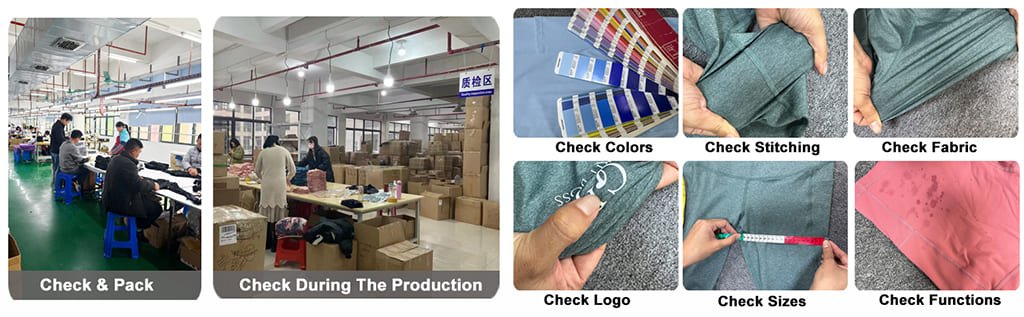
Frequently Asked Questions About Choosing a 100 Cotton Clothing Plus Size Manufacturer
1. What Should I Compare Between Two 100 Cotton Clothing Plus Size Manufacturers?
Compare the suppliers under substantially the same product and commercial requirements, including cotton composition, fabric construction, GSM, size range, quantity, colors, customization, MOQ, sample conditions, lead time and inspection requirements.
Do not compare unit prices first if the two manufacturers are working from different assumptions. One supplier may quote 180 GSM stock cotton while another quotes 220 GSM custom-dyed cotton. Their prices do not represent the same product.
Extended-size evidence should also be compared separately from a published size label. Ask about relevant plus-size production experience, measurement charts, grade rules, fit samples, size-set capability and bulk measurement tolerances.
A useful comparison combines product evidence + commercial terms + sample performance + production evidence rather than relying on one attractive number.
2. Which Questions Should I Ask a Plus Size Clothing Manufacturer Before Requesting a Quote?
Ask questions that define the actual order before requesting the final quotation. The manufacturer should understand the product, fabric, target sizes, quantities, colors, branding and packaging well enough to explain what its price and MOQ include.
Useful questions include:
Have you produced similar extended-size products?
Which size ranges have you handled?
Can you follow our measurement chart and grade rules?
What cotton construction and GSM are you quoting?
Is the fabric available or custom produced?
What is the MOQ per style and per color?
Can different sizes be mixed?
Does the fabric have a separate MOQ?
What does the sample fee include?
What starts the bulk-production lead time?
Which labels and packaging are included?
What inspection process applies to the order?
The objective is not to ask the greatest number of questions. It is to remove assumptions that could later change price, MOQ, fit or delivery conditions.
3. Is the Lowest Factory Price Usually the Best Choice?
No. The lowest factory quotation should be evaluated only after buyers confirm that the suppliers are pricing substantially comparable specifications. A lower price may result from lighter fabric, stock colors, simpler construction, different packaging, a narrower size range or a larger required order quantity.
The same principle applies in reverse: a higher price does not automatically prove better quality.
Buyers should identify why the quotations differ.
For example, a $7.80 garment with a 1,000-piece minimum can create a larger financial commitment than an $8.60 garment available at 300 pieces. For a proven bestseller, the first structure may be commercially attractive. For an untested launch, the second may reduce inventory exposure.
Price should therefore be considered together with MOQ, total order value, product specification and sourcing risk.
4. How Do I Know Whether Two 100% Cotton Quotations Are Comparable?
Two quotations become meaningfully comparable when the main fabric and product assumptions are aligned. Confirm at least the fiber composition, fabric construction, GSM, color basis, size range, quantity, garment construction, branding and packaging.
“100% cotton” alone is not enough.
A lightweight jersey and a heavyweight jersey can both be 100% cotton. Stock black and a custom Pantone color can also create different material costs and minimums.
Buyers should therefore request enough fabric information to understand what each supplier has included in the quotation. When possible, compare physical swatches or approved material references in addition to written descriptions.
If a manufacturer proposes an alternative fabric, keep it in the evaluation as an alternative quotation rather than treating it as a direct price comparison with the original specification.
5. What Is the Difference Between Style MOQ, Color MOQ and Fabric MOQ?
Style MOQ is the minimum quantity for one garment design, color MOQ is the minimum required for each color, and fabric MOQ is the minimum material quantity required by the fabric source or production process. These minimums can exist at the same time.
For example, a factory may advertise an MOQ of 100 pieces per style but require 100 pieces per color. If the buyer orders four colors, the practical garment commitment becomes 400 pieces.
Custom-dyed cotton can introduce another minimum because the fabric mill or dyeing process may require more material than the sewing factory needs for 100 garments.
Labels, trims and custom packaging can also have separate minimums.
Before choosing a 100 Cotton Clothing Plus Size Manufacturer, buyers should therefore ask what each published MOQ actually applies to and whether sizes can be mixed within the minimum quantity.
6. Do I Need a Fit Sample or Size Set Before Choosing a Manufacturer?
A fit sample is usually more useful during initial supplier comparison, while a size set becomes important when buyers need to verify how approved measurements and grading translate across additional sizes. The required level of sampling should follow the fit risk of the product.
Buyers do not necessarily need to order a complete size set from ten manufacturers.
A more efficient process is to screen suppliers first, request comparable fit samples from a smaller group, reduce the shortlist and then conduct additional size verification where necessary.
A loose XL–3XL cotton top may not require the same verification strategy as a fitted XL–6XL garment.
The sample plan should therefore reflect product complexity, size range, existing grade rules and the commercial consequences of a fit problem.
7. How Can I Verify a China Clothing Manufacturer Before Paying a Deposit?
Verify the supplier’s business identity, manufacturing arrangement, relevant product capability, sample execution, commercial terms and any order-specific compliance requirements before making a major production commitment.
Depending on the value and risk of the order, verification can include:
Business-license information
Factory photos or videos
Live video walkthrough
Relevant sample evidence
Factory visit
Existing audit documentation
Independent factory audit
Third-party inspection
Product testing where required
Confirmation of payment and company details
Certificates should also be checked for legal entity, facility, validity and scope when they are important to the order.
No single document proves that a manufacturer will execute every product correctly. Supplier verification works best when business evidence is combined with samples, specifications, commercial confirmation and production controls.
8. When Should I Reject a Manufacturer and Move to Another Supplier?
Consider removing a manufacturer when a critical order requirement cannot be met, important information cannot be reasonably verified, or repeated problems create a level of risk that the buyer is unwilling to accept. Minor correctable sample issues alone do not necessarily justify rejection.
More serious warning signs can include:
Unsupported required size range
Inability to meet a critical fabric specification
Repeated unexplained material substitutions
Major measurement problems that remain unresolved
MOQ incompatible with the buying plan
Repeated quotation changes without a clear reason
Required compliance evidence unavailable
Manufacturing information that cannot be reasonably verified
Production timing incompatible with the launch
Repeated failure to follow confirmed sample revisions
Commercial or payment conditions outside the buyer’s acceptable risk level
The final decision should remain connected to the actual order.
A manufacturer can be capable and still be unsuitable for a particular buyer. The most useful supplier shortlist contains manufacturers whose product capability, cotton requirements, extended-size evidence, commercial structure and production model match the risks and requirements of the program.