OEM/ODM Sportswear Manufacturer | 3-Day Sampling | Low MOQ | 50K Monthly Capacity | ISO9001 & BSCI Certified

what are riding pants called | Top 10 Naming Mistakes & Manufacturer Comparison
Discover what are riding pants called in equestrian retail, avoid common naming mistakes, and compare Chinese riding pants manufacturers. Learn how to identify breeches, jodhpurs, and riding tights, verify supplier capabilities, and make informed purchasing decisions for your brand.
Top 10 Naming Mistakes: What Are Riding Pants Called in Equestrian Retail?
The most common riding pants naming mistakes happen when retailers confuse product categories, use inaccurate technical descriptions, or accept manufacturer terminology without checking the actual garment. For buyers asking what are riding pants called, the answer depends on construction, fit, riding discipline, grip placement, and regional terminology. Breeches, jodhpurs, riding tights, and Western riding jeans are not automatically interchangeable. Retailers should use consistent product names across online listings, inventory records, and supplier documents to reduce customer confusion and purchasing errors.
A customer ordering full-seat breeches expects something different from a customer buying lightweight riding tights. Yet online catalogs often place both products under broad names such as riding leggings or equestrian pants. This may seem harmless until a retailer receives customer complaints about grip placement, boot compatibility, or the way the garment fits in the saddle.
The challenge becomes more serious when the same unclear terminology appears in supplier catalogs. A manufacturer may use a familiar retail name for several different garment constructions. If the buyer compares those products without checking their specifications, the resulting supplier shortlist may be based on products that are not actually comparable.
The following ten mistakes show where naming problems begin, why they matter commercially, and how retailers can avoid them.
Mistake #1: Calling Every Type of Riding Pants Breeches
Breeches are a recognized category of English riding apparel, but the word should not become a universal label for every garment worn while riding.
When buyers research what are riding pants called, they often encounter breeches as one of the first answers. That does not mean pull-on riding tights, traditional jodhpurs, and Western riding jeans should all be listed as breeches.
The differences are visible in garment construction:
Breeches: Generally feature a close-fitting lower leg designed to work with tall riding boots.
Jodhpurs: Traditionally extend to the ankle and are commonly paired with short riding boots.
Riding tights: Usually emphasize flexible, pull-on construction and stretch comfort.
Western riding jeans: Commonly use denim-style construction and are designed around Western riding preferences.
For example, a retailer might purchase a pull-on riding tight from a supplier that describes the product as yoga breeches. If the retailer publishes that name without checking the garment, customers looking for structured breeches may receive a product with a very different waistband and fit.
The correct approach is to classify the garment first and select the retail name second.
Retail buying lesson: When a supplier uses breeches as a general term, request actual product photographs, construction details, and a clear category description.
For retailers comparing what are riding pants called across different supplier catalogs, a consistent classification system is more reliable than accepting each manufacturer’s preferred terminology.
Mistake #2: Confusing Breeches with Jodhpurs
Breeches and jodhpurs are closely related, but traditional versions have important differences in length and boot compatibility.
The question what are riding pants called becomes particularly confusing when a retailer serves customers in several countries. Some markets use these terms more broadly than others, while traditional riding terminology maintains a clearer distinction.
Feature | Breeches | Traditional jodhpurs |
|---|---|---|
Typical length | Finishes around the lower calf or above the ankle | Extends to the ankle |
Common boot pairing | Tall riding boots | Short riding boots |
Lower-leg construction | Close-fitting calf finish | Longer ankle finish |
Retail consideration | Confirm calf fit and boot compatibility | Confirm ankle fit and length |
A retailer selling to junior riders may encounter traditional jodhpurs more frequently than a store focused on adult competition breeches. However, this is a market tendency, not a universal product rule.
The mistake is assuming that two garments are identical simply because they appear together in a manufacturer’s catalog.
When reviewing what are riding pants called in supplier descriptions, buyers should compare the garment’s actual measurements, lower-leg construction, and intended boot pairing.
Retail buying lesson: Product names should reflect the garment customers will receive, not just the wording commonly used by a supplier.
Mistake #3: Selling Ordinary Leggings as Technical Riding Tights
A pair of gym leggings can look very similar to riding tights in a product photograph. Both may have stretch fabric, an elastic waistband, and a fitted silhouette.
However, similar appearance does not prove similar performance.
When researching what are riding pants called, retailers should understand that riding tights describe a garment intended for equestrian use, not simply any pair of stretch leggings.
A riding garment needs to be evaluated in the position and conditions in which it will actually be worn. Important considerations include:
Seam placement: Seams should not create unnecessary pressure against the saddle.
Fabric recovery: The garment should maintain an appropriate fit after repeated stretching.
Opacity: Fabric should provide suitable coverage during movement.
Waistband stability: The waistband should remain comfortable and secure while riding.
Abrasion performance: Relevant fabric areas should withstand the intended level of contact and wear.
Grip performance: Any advertised grip feature should be supported by the actual garment.
Consider a retailer purchasing leggings from a general activewear supplier. The fabric may feel soft and stretchy, but that alone does not establish suitability for extended riding sessions.
The retailer should ask whether the garment has been evaluated for its intended equestrian use rather than relying on the manufacturer’s product category.
For buyers investigating what are riding pants called, the difference between ordinary leggings and riding tights is an important example of why technical claims must be supported by evidence.
Retail buying lesson: Never advertise riding-specific performance solely because a garment looks similar to equestrian apparel.
Mistake #4: Mixing Full-Seat and Knee-Patch Product Labels
Full-seat and knee-patch describe different areas of grip or reinforcement on riding pants.
A full-seat design generally covers a larger area around the seat and inner legs, while a knee-patch design concentrates grip or reinforcement around the inner knee.
These terms should not be treated as interchangeable.
When customers search what are riding pants called, they may also use functional terms such as full-seat breeches, silicone-grip riding tights, or knee-patch jodhpurs.
Those descriptions carry expectations about the actual product.
For example, a retailer may advertise full-seat silicone riding tights, while the supplier delivers a garment with grip only around the knees. The product may still be suitable for riding, but it does not match the advertised configuration.
Retailers should verify three separate details:
Grip location: Full seat, knee patch, or another specified area.
Grip material: Silicone application, fabric reinforcement, or another construction.
Grip pattern: Coverage, placement, and intended design.
A product with fabric reinforcement should not automatically be described as silicone grip. Similarly, full-seat coverage does not guarantee stronger grip or better comfort for every rider.
For retailers comparing what are riding pants called across different brands, grip terminology should be checked against the actual garment rather than treated as a general marketing description.
Retail buying lesson: Confirm grip material and placement before approving the product name used on retail listings.
Mistake #5: Treating Competition Breeches and Schooling Breeches as Identical
Competition breeches and schooling breeches may share similar patterns, fabrics, and construction methods. The difference often relates to intended use, styling, and applicable competition dress requirements.
When customers ask what are riding pants called for competition, they may be looking for garments that meet specific dress expectations rather than simply any pair of riding breeches.
Retailers should distinguish between:
Competition suitability: Whether the garment meets the relevant event’s dress requirements.
Everyday riding comfort: Whether the garment is appropriate for regular training.
Fabric and care requirements: Whether the material suits repeated use and washing.
Design features: Pockets, grip placement, closures, and waistband construction.
A white pair of breeches is not automatically approved for every competition. Likewise, a pair of schooling breeches may be entirely suitable for some events, depending on the rules.
The mistake is using competition as a promotional label without checking the intended discipline and relevant dress requirements. Retailers should consult the applicable FEI Dressage Rules when describing riding apparel intended for international dressage competitions.
For retailers studying what are riding pants called in different riding disciplines, the product’s intended use should be clearly distinguished from any claim of official competition compliance.
Retail buying lesson: Check the applicable competition rules before describing a product as competition-approved.
Mistake #6: Confusing Western Riding Jeans with English Riding Pants
Western riding jeans and English riding pants belong to different riding traditions and frequently require different garment construction.
Western riding jeans commonly emphasize denim-style materials, longer legs, and compatibility with Western riding boots. English breeches and tights generally emphasize a closer fit and construction suitable for English riding equipment.
When buyers search what are riding pants called, both categories may appear under general descriptions such as horseback riding pants.
However, the same manufacturer may not have equal experience producing both types.
A denim manufacturer may have relevant expertise in Western riding jeans but limited experience with silicone-grip breeches. A technical sportswear manufacturer may have strong stretch-fabric capabilities without specializing in Western denim construction.
This difference affects supplier selection.
A retailer developing an English riding collection should look for evidence of relevant breeches or riding tights production. A Western riding brand may need different experience in denim construction, stitching, fit, and garment finishing.
For buyers comparing what are riding pants called across Western and English retail categories, the name should lead to a more specific question: does the supplier have experience producing this particular type of garment?
Retail buying lesson: Evaluate manufacturers by relevant product experience rather than the number of equestrian categories advertised on their websites.
Mistake #7: Ignoring Men’s, Women’s and Children’s Fit Categories
Men’s, women’s, and children’s riding pants may share similar product names, but their patterns and sizing requirements are not necessarily interchangeable.
A manufacturer offering riding breeches in several size ranges does not automatically have experience developing appropriate fits for every customer group.
When retailers investigate what are riding pants called, they should also consider who will wear the product.
Important fit differences may include:
Waist-to-hip proportions.
Rise length and waistband shape.
Thigh and calf measurements.
Inseam length.
Size grading between adjacent sizes.
Comfort and mobility in the riding position.
Children’s riding pants deserve particular attention. Simply reducing an adult pattern may not produce suitable proportions for younger riders.
The same issue can appear when a retailer introduces a men’s collection based on an existing women’s riding tights pattern.
A consistent product name cannot replace proper fit evaluation.
For retailers comparing what are riding pants called in men’s, women’s, and children’s catalogs, the category should be supported by suitable sizing and garment proportions.
Retail buying lesson: Ask suppliers for relevant size charts and actual product evidence rather than assuming that one pattern can serve every customer group.
Mistake #8: Using UK, US and Australian Retail Terms Without Checking the Market
Equestrian terminology can vary between countries, riding communities, and retail brands.
A product described as riding leggings in one market may be marketed as riding tights in another. Traditional terms such as jodhpurs may also appear more frequently in certain customer groups.
When international retailers research what are riding pants called, they should avoid assuming that one term is equally familiar to every customer.
However, adapting terminology does not mean changing the underlying product classification.
A retailer should maintain one consistent internal product reference while choosing customer-facing wording appropriate for the target market.
For example:
Internal product category | Possible retail wording | Important condition |
|---|---|---|
Pull-on riding tights | Riding tights / riding leggings | Actual construction must match |
Structured riding breeches | Riding breeches | Lower-leg construction and fit verified |
Traditional jodhpurs | Jodhpurs | Length and boot compatibility verified |
Western riding jeans | Western riding jeans | Denim-style construction verified |
These are possible naming conventions, not fixed rules for every country.
Retailers should examine customer language, product reviews, and established local equestrian retailers before making terminology decisions.
For buyers studying what are riding pants called in international markets, the objective is to improve customer understanding without creating inconsistent supplier records.
Retail buying lesson: Adapt retail language to the market while keeping the product’s actual classification and technical identity consistent.
Mistake #9: Using Product Names That Promise Unverified Performance
Words such as breathable, compression, four-way stretch, abrasion-resistant, and moisture-wicking can make riding pants sound more technical.
However, these descriptions should reflect the actual fabric and garment.
When retailers ask what are riding pants called, the answer should not be determined by whichever performance terms make a product listing appear more attractive.
For example, a supplier may describe riding leggings as compression breeches even though the garment was not designed or evaluated for a defined compression function.
Another supplier may advertise abrasion-resistant fabric without providing evidence relevant to the intended use.
Retailers should distinguish between:
Product description | Verification needed |
|---|---|
Four-way stretch | Fabric stretch behavior in both directions |
Moisture-wicking | Relevant moisture-management evidence |
Compression | Intended fit and supporting performance information |
Abrasion-resistant | Appropriate test method and results |
Silicone grip | Actual application and durability |
Breathable | Material properties relevant to the claim |
Not every technical claim requires the same testing method. Buyers should request evidence appropriate to the property being advertised.
Retail buying lesson: Accurate, verifiable descriptions build more trust than long product titles filled with unsupported performance claims.
Mistake #10: Using Different Product Names in Retail Listings and Supplier Records
One of the most avoidable sourcing problems occurs when the retailer and manufacturer use different names for the same garment.
A buyer may approve a product described internally as full-seat riding tights, receive a supplier invoice referring to leggings, and publish a retail listing calling the garment breeches.
These terms may refer to the same approved style, but they can also conceal a genuine misunderstanding.
For brands researching what are riding pants called, consistent documentation is essential once a product becomes part of a commercial assortment.
A practical product record should contain:
Field | Example |
|---|---|
Internal style code | RT-FS-001 |
Approved product category | Full-Seat Riding Tights |
Retail product title | Women’s Full-Seat Riding Tights |
Customer category | Women’s Equestrian Apparel |
Grip description | Full-Seat Silicone Grip |
Supplier reference | RT-FS-001 |
Approved product version | Version 03 |
Illustrative product record, not a specification for an actual manufactured style.
The internal style code should remain consistent across supplier communications, inventory records, product photographs, and retail listings.
If a product name changes for marketing reasons, the underlying product reference should still identify the same approved garment.
Retail buying lesson: Product names can vary by market, but the product identity should remain traceable from supplier documentation to the finished retail listing.
What Should Retailers Check Before Approving Riding Pants Product Names?
A reliable product naming system should help customers understand the garment and help purchasing teams confirm that suppliers are offering the correct product.
Before approving a new riding pants listing, retailers should complete the following checks:
Correct category: Does the product name match the garment’s actual construction?
Customer group: Is the product intended for women, men, children, or a defined fit category?
Riding discipline: Does the description accurately reflect the intended riding use?
Grip description: Are grip location, material, and coverage correct?
Fabric claims: Can advertised performance features be supported?
Boot compatibility: Does the garment’s lower-leg design match the stated use?
Supplier consistency: Do product records and retail listings identify the same garment?
Market language: Will customers in the target country understand the product name?
A clear naming system does not require complicated terminology. It requires accurate descriptions that connect the product, the customer, and the supplier.
For retailers moving from terminology research into product development, the next step is to define the actual garment requirements. A clear understanding of custom riding pants manufacturing requirements can help buyers turn an identified product category into a more specific manufacturing brief.
The strongest equestrian retail catalogs do more than display attractive product photographs. They make it easy for customers to recognize the right garment and for purchasing teams to confirm that manufacturers are supplying what the brand intends to sell.
Which Chinese Riding Pants Manufacturers Should Equestrian Retailers Compare?
Equestrian retailers should compare Chinese riding pants manufacturers according to their actual product specialization, manufacturing experience, order requirements, quality evidence, and suitability for the intended retail market. When researching what are riding pants called, buyers may discover that suppliers use different names for similar garments. A useful manufacturer shortlist should therefore examine whether each company can demonstrate relevant experience with breeches, jodhpurs, riding tights, or related equestrian apparel rather than relying on product titles alone.
China offers several types of potential suppliers, from equestrian-focused manufacturers to broader technical sportswear companies. Some concentrate on fitted riding apparel, while others offer riding clothing alongside activewear, teamwear, or equestrian accessories.
For retailers, these differences matter more than a supplier’s position in a search result. A manufacturer offering many product categories is not necessarily more capable than a smaller specialist. Equally, a specialist manufacturer may not be the most practical choice for every budget, product range, or order size.
The following ten companies provide a starting point for supplier research. Their order reflects a comparison shortlist, not an independently audited ranking of manufacturing quality. Published commercial information should be reconfirmed before making purchasing commitments.
Chinese Riding Pants Manufacturer Comparison Table
Manufacturer | Location | Published or stated MOQ | Sampling / Bulk lead time | Main product focus |
|---|---|---|---|---|
Pair Fashion | Dongguan, Guangdong | 100 pcs standard products | About 7 days / 20–25 working days, subject to confirmation | Riding pants, tights, sportswear |
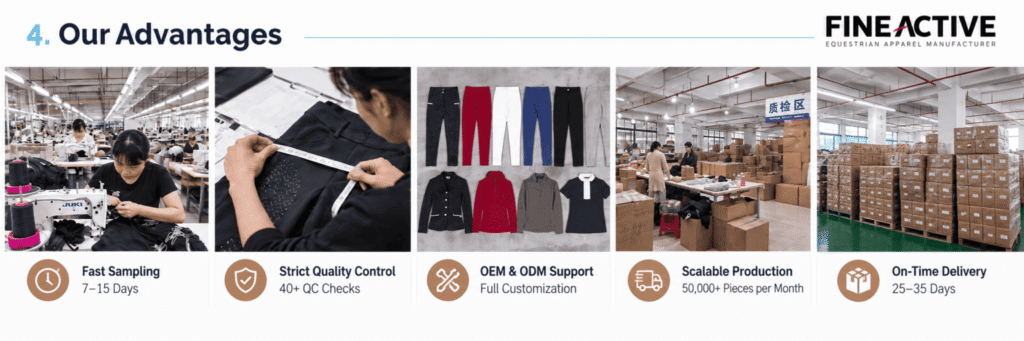
Fineactive | Dongguan, Guangdong | 100 pcs per style/color | 7–15 / 25–35 working days | Equestrian apparel |
Kala Apparel | Dongguan, Guangdong | 30–200 pcs across selected projects | Confirm by project | Riding tights, breeches, equestrian clothing |
Equifactory | Wuhan, Hubei | Confirm by project | About 2 weeks / 5–6 weeks | Equestrian clothing and related products |
Jinjiang Junqi | Jinjiang, Fujian | From 50 pcs | 5–7 days / published 15–20 days | Breeches, competition clothing |
Fex Equestrian | Jinjiang, Fujian | From 50 pcs | Confirm by project | Breeches, competition wear, outerwear |
Anqi Equestrian | Dongguan, Guangdong | Confirm by project | Confirm by project | Specialist equestrian apparel |
Dongguan Shuyu | Dongguan, Guangdong | Selected listings from 100 pcs | Confirm by project | Equestrian wear and activewear |
EquestCo | Dongguan, Guangdong | From 50 pcs | Around 7 working days / confirm bulk | Breeches, jackets, teamwear |
REINFORM | Hangzhou, Zhejiang | 300 pcs per style/color | 7–10 / 30–45 working days | Breeches, riding tights, equestrian clothing |
Figures reflect company-provided information or published supplier listings, not independently verified contractual commitments. MOQ may depend on style, color, material, and customization. Sample and production periods are not necessarily inclusive of approval, shipping, or customs clearance.
1. Pair Fashion — Riding Pants and Technical Sportswear Manufacturing
Location: Dongguan, Guangdong, China
Established: 2016
Standard MOQ: Starting from 100 pieces for standard products
Sampling: Normally around 7 days; selected initial samples may be faster
Bulk production: Commonly 20–25 working days under agreed production conditions
Core products: Riding breeches, riding tights, technical sportswear, sports bras, leggings, training apparel, and related garments
Pair Fashion is relevant to equestrian brands that want to compare riding pants production with broader technical sportswear capabilities. Its product background includes stretch garments, fitted apparel, functional fabrics, and private label clothing.
For retailers researching what are riding pants called, Pair Fashion is a potential candidate when the collection includes fitted riding pants, stretch riding tights, or related performance apparel.
The company’s broader sportswear experience may be useful when evaluating fabric stretch, recovery, garment movement, and consistent fit across related product categories.
Published and company-provided profile
Manufacturing experience: Operating since 2016.
Production structure: Company information describes seven production lines, including three associated with equestrian apparel.
Development capability: Pattern development, garment sampling, fabric selection, and technical garment production.
Quality control: Incoming material checks, in-process inspection, and finished garment inspection.
Certifications: Company materials reference ISO 9001, BSCI, GRS, CE, and RoHS-related documentation. Buyers should verify which certificates apply to the actual legal entity, manufacturing site, materials, or products. These are not interchangeable certifications.
Best suited for: Emerging and growing equestrian brands, private label retailers, and buyers developing riding tights or performance-oriented apparel collections.
Less suitable for: Buyers seeking only ready-stock branded retail goods, or projects requiring highly specialized products outside the company’s demonstrated garment categories.
Core advantages: Product development support, stretch-apparel experience, and the ability to evaluate several related garment categories.
Potential limitations: Buyers should verify the exact production location, technical capability for their riding pants category, and the current scope of applicable certifications.
When evaluating what are riding pants called in Pair Fashion’s product range, buyers should compare actual garment specifications rather than assume that every stretch riding product shares the same construction.
A practical first step is to request examples of the specific riding pants category under consideration, together with relevant fit and quality evidence.
2. Fineactive — Equestrian Apparel-Focused Manufacturing
Location: Dongguan, Guangdong, China
Manufacturing history: Since 2016
MOQ: 100 pieces per style per color
Sampling: 7–15 working days
Bulk production: 25–35 working days
Core products: Riding breeches, riding tights, competition shirts, show jackets, base layers, and equestrian outerwear
Fineactive focuses on equestrian clothing rather than general sportswear alone. Its published product range covers fitted riding garments, training apparel, and competition-related clothing.
For buyers searching what are riding pants called, Fineactive is worth considering when different riding pants types need to be assessed within a broader equestrian clothing collection.
A focused product range can make supplier discussions more relevant, particularly when buyers need to distinguish riding tights from structured breeches or coordinate several apparel categories.
Supplier profile
Specialization: Equestrian apparel for international brands.
MOQ structure: Published as 100 pieces per style per color.
Sampling: Published range of 7–15 working days.
Production: Published range of 25–35 working days after required approvals and material conditions.
Certifications: Buyers should request current, applicable documents and verify the legal entity and manufacturing scope.
Best suited for: Equestrian apparel brands seeking coordinated riding collections, specialist product development, and repeat-order manufacturing relationships.
Less suitable for: Retailers seeking only finished branded merchandise for immediate resale or buyers requiring very small custom quantities below the published minimum.
Core advantages: Clear equestrian product focus, publicly stated commercial conditions, and coverage across several riding apparel categories.
Potential limitations: Actual product specialization should still be verified through relevant samples, measurements, and manufacturing evidence.
When comparing what are riding pants called across Fineactive’s catalog, retailers should request separate evidence for riding tights, breeches, and other distinct constructions.
A specialist product focus is useful, but it does not replace sample evaluation or independent verification.
3. Kala Apparel — Equestrian Clothing with Flexible Product Options
Location: Dongguan, Guangdong, China
Experience: Company states more than ten years of manufacturing experience
MOQ: Publicly described as 30–200 pieces for selected projects; some ready-to-ship riding leggings start from 20 pieces
Sampling: Confirm by style and material
Bulk production: Confirm by quotation
Core products: Riding tights, riding breeches, base layers, show jackets, equestrian accessories, and other apparel
Kala Apparel presents itself as an equestrian clothing manufacturer serving startups and established brands. Its public information includes riding pants, technical apparel, and private label product development.
For retailers investigating what are riding pants called, Kala may be relevant when comparing flexible product categories and different levels of customization.
Its ready-to-ship options should be evaluated separately from fully customized manufacturing. A low minimum for an existing product does not automatically apply to a new design.
Supplier profile
Manufacturing location: Dongguan.
Product focus: Equestrian apparel alongside other technical clothing categories.
MOQ: Depends on whether the project involves ready-stock products, existing designs, or custom development.
Certifications: Kala publicly references BSCI, OEKO-TEX, ISO, and GRS-related credentials. Buyers should request valid certificates and check their scope.
Retail support: The company advertises private label, pattern development, and product customization services.
Best suited for: Startup brands, equestrian retailers testing selected product categories, and buyers considering both existing styles and customized apparel.
Less suitable for: Buyers assuming that a ready-stock MOQ automatically applies to original designs or complex technical products.
Core advantages: Publicly described flexible sourcing options, equestrian product coverage, and support for different brand development stages.
Potential limitations: MOQ ranges cover different project types, making written confirmation essential before comparing quotations.
When researching what are riding pants called, buyers should ask Kala to distinguish its existing riding leggings from any newly developed breeches or riding tights.
The most useful comparison is between products with equivalent construction, not simply products carrying similar names.
4. Equifactory — Equestrian Clothing and Multi-Product Sourcing
Published contact location: Wuhan, Hubei, China
Established: Exact founding year not confirmed from the reviewed company pages
MOQ: Confirm by project
Sampling: Approximately two weeks, according to its published FAQ
Bulk production: Generally five to six weeks, subject to product complexity
Core products: Riding pants, equestrian tops, jackets, socks, and related horse-riding products
Equifactory offers equestrian apparel alongside a wider selection of riding-related products. Its website describes design support, material selection, and custom clothing development.
For retailers researching what are riding pants called, Equifactory may be worth reviewing when a sourcing project includes riding pants and additional equestrian merchandise.
However, a broad product range does not establish that every listed category is manufactured at the same facility.
Supplier profile
Business location: Wuhan, Hubei.
Manufacturing location: Buyers should confirm the actual production site for each product.
Product scope: Equestrian clothing and selected horse-related goods.
Sampling and lead time: Published guidance gives approximately two weeks for samples and five to six weeks for production.
Certifications: Current certificates and applicable manufacturing scope should be requested directly.
Best suited for: Retailers exploring several equestrian product categories through one sourcing relationship.
Less suitable for: Buyers who require confirmed in-house production of every product category before making initial contact.
Core advantages: Broad equestrian product coverage and publicly available sampling and production guidance.
Potential limitations: Manufacturing responsibilities and facility locations need to be verified for the specific product being purchased.
When comparing what are riding pants called across Equifactory’s listings, buyers should request product-specific references and clarify whether the supplier directly manufactures the garment or coordinates production through another facility.
That distinction can affect quality accountability, inspection arrangements, and supplier transparency.
5. Jinjiang Junqi Equestrian Sportswear — Specialist Equestrian Apparel Production
Location: Jinjiang, Fujian, China
Established: Company states 2013
MOQ: Published starting point of 50 pieces
Sampling: Published 5–7 days
Bulk production: Published guidance of 15–20 days for selected orders
Core products: Riding breeches, competition shirts, equestrian jackets, protective vests, and related riding apparel
Jinjiang Junqi Equestrian Sportswear, operating through ClothesEquestrian, presents a specialized equestrian manufacturing profile.
For buyers researching what are riding pants called, the company is relevant because its published product range includes riding breeches with different grip configurations.
Its website also provides information about manufacturing facilities, product categories, and technical apparel production.
Supplier profile
Manufacturing history: Company states that it has focused on equestrian apparel since 2013.
Facility: Publicly describes an 8,200-square-metre manufacturing operation.
MOQ: Starting from 50 pieces, subject to actual product requirements.
Certifications: Claims ISO 9001, OEKO-TEX Standard 100, and BSCI-related credentials. Protective equipment certifications should be assessed separately from apparel manufacturing.
Product coverage: Riding breeches, competition clothing, jackets, and selected protective products.
Best suited for: Equestrian brands seeking a specialist supplier with publicly described technical apparel capabilities.
Less suitable for: Buyers who need immediate delivery of retail-ready branded stock without development or order planning.
Core advantages: Focused equestrian product range, published facility information, and clearly described production capabilities.
Potential limitations: Published short lead times should be confirmed against material availability, order quantity, and the actual approval schedule.
When comparing what are riding pants called in Junqi’s product catalog, buyers should distinguish full-seat breeches, knee-grip breeches, and other riding pants constructions.
Relevant product samples and current certification documents should be checked before drawing conclusions about manufacturing performance.
6. Fex Equestrian — Small-Batch Equestrian Apparel Manufacturing
Location: Jinjiang, Quanzhou, Fujian, China
Established: Company states 2016
MOQ: Published starting point of 50 pieces
Sampling: Confirm by project
Bulk production: Confirm by project
Core products: Riding breeches, competition wear, riding tops, and equestrian outerwear
Fex Equestrian presents itself as a specialist manufacturer serving equestrian brands, particularly those targeting the British market.
For retailers asking what are riding pants called, Fex is a potential candidate when traditional English riding apparel and relevant fit requirements are important.
The company’s published information describes pattern development, silicone application, embroidery, and garment construction capabilities.
Supplier profile
Manufacturing experience: Company states that operations began in 2016.
Facility: Publicly describes an approximately 1,800-square-metre facility.
Product specialization: Breeches, competition clothing, riding tops, and outerwear.
MOQ: From 50 pieces, according to company information.
Certifications: References OEKO-TEX, ISO 9001, Sedex SMETA, and UK REACH compliance. Buyers should distinguish material testing, management certification, social audits, and regulatory compliance.
Best suited for: Smaller equestrian labels, British-market riding brands, and buyers requiring relevant breeches experience.
Less suitable for: Projects outside its demonstrated equestrian clothing focus or buyers requiring immediate stock availability without confirmation.
Core advantages: Specialist product positioning and publicly described pattern and garment construction capabilities.
Potential limitations: Actual sampling schedules, bulk lead times, and certificate validity require direct confirmation.
When comparing what are riding pants called in the company’s catalog, buyers should check whether the relevant garment follows the intended market’s fit and construction expectations.
A supplier’s familiarity with British sizing terminology is useful, but actual fit approval remains essential.
7. Anqi Equestrian Apparel — Riding-Specific Product Development
Location: Dongguan, Guangdong, China
Established: Company states 2012
MOQ: Confirm by project
Sampling: Confirm by project
Bulk production: Confirm by project
Core products: Specialist equestrian apparel, including riding garments developed around rider movement and fit
Anqi Equestrian Apparel describes a manufacturing operation focused on equestrian clothing and riding-specific garment development.
For buyers researching what are riding pants called, Anqi may be relevant when fit, saddle-contact comfort, and garment construction are important supplier evaluation criteria.
Its published company profile discusses pattern development, stretch stitching, silicone grip application, and fabric testing.
Supplier profile
Manufacturing history: Company states that it was established in 2012.
Location: Humen, Dongguan.
Facility: Publicly describes an approximately 1,800-square-metre operation.
Technical focus: Riding posture, pattern development, stretch construction, and silicone grip.
Testing: Website references abrasion, washing, seam-strength, and dimensional-stability testing methods.
Certifications: Current applicable certificates should be requested; descriptions of testing equipment are not equivalent to independent certification.
Best suited for: Equestrian brands seeking to evaluate riding-specific fit and construction capabilities.
Less suitable for: Buyers who require fully published MOQ, price, and delivery terms before contacting a supplier.
Core advantages: Publicly described riding-specific technical focus and attention to garment performance.
Potential limitations: Commercial conditions and the independence of technical testing evidence need verification.
When comparing what are riding pants called, retailers should ask Anqi for examples of products matching their intended riding discipline and customer group.
Technical claims should be assessed through relevant samples and test records rather than website descriptions alone.
8. Dongguan Shuyu Activewear — Equestrian Apparel and General Activewear
Location: Dongguan, Guangdong, China
Manufacturing history: Predecessor operation reportedly founded in 2012
MOQ: Selected published riding pants listings start at 100 pieces
Sampling: Available; project-specific timing requires confirmation
Bulk production: Confirm by project and production season
Core products: Riding breeches, riding tights, equestrian tops, yoga wear, sportswear, and related apparel
Dongguan Shuyu Activewear operates across equestrian clothing and several other activewear categories.
For retailers researching what are riding pants called, Shuyu is relevant when comparing specialist riding garments with related stretch sportswear products.
Its public supplier listings include riding breeches and silicone-grip riding pants, making it possible to identify specific product categories for further evaluation.
Supplier profile
Business location: Dongguan.
Manufacturing background: Company states that its predecessor operation began in 2012.
Product coverage: Equestrian apparel, yoga wear, sportswear, and other clothing.
MOQ: Selected product listings show 100-piece minimums.
Lead time: Marketplace information indicates that lead times may vary substantially by season; a dated quotation is necessary.
Certifications: Buyers should request relevant current documentation rather than assume marketplace supplier status proves product certification.
Best suited for: Brands comparing equestrian clothing with general technical sportswear capabilities.
Less suitable for: Buyers requiring a supplier dedicated exclusively to equestrian clothing.
Core advantages: Broad stretch-apparel product range and publicly listed equestrian products.
Potential limitations: Buyers should confirm which production lines and teams handle riding pants and whether the quoted schedule reflects the actual project.
When evaluating what are riding pants called across Shuyu’s product listings, retailers should distinguish riding-specific construction from ordinary activewear.
The most relevant question is whether the supplier can demonstrate experience with the actual garment being sourced.
9. EquestCo — Equestrian Apparel for UK-Focused Buyers
Location: Humen, Dongguan, Guangdong, China
Established: Company states 2015
MOQ: Published starting point of 50 pieces
Sampling: Approximately seven working days according to its published process
Bulk production: Confirm by project
Core products: Riding breeches, show jackets, competition shirts, and equestrian teamwear
EquestCo presents itself as a manufacturer focused on equestrian clothing for the UK market.
For buyers asking what are riding pants called, EquestCo may be relevant when British equestrian terminology, riding breeches, and smaller brand collections are important considerations.
The company publishes information about its Dongguan facility, product range, and quality-control procedures.
Supplier profile
Manufacturing history: Company states that it began in 2015.
Facility: Publicly describes a 2,000-square-metre operation.
MOQ: Starting from 50 pieces.
Sampling: Website describes a seven-working-day sample stage.
Certifications: References OEKO-TEX Standard 100, BSCI, and ISO 9001:2015-related credentials. Buyers should verify certificate holders and scope.
Market focus: UK equestrian brands, riding clubs, and related buyers.
Best suited for: UK-focused equestrian retailers, smaller riding brands, and buyers seeking riding apparel alongside teamwear.
Less suitable for: Buyers whose product requirements fall outside the company’s demonstrated equestrian categories.
Core advantages: Clear UK-market positioning, published facility information, and relevant breeches product coverage.
Potential limitations: Commercial terms and quality claims should be verified through current documents and samples.
When comparing what are riding pants called in EquestCo’s range, buyers should check whether the garment construction matches the intended retail terminology and customer expectations.
The company’s UK focus may be useful for initial supplier screening, but it should not replace independent fit and quality evaluation.
10. REINFORM — Structured Equestrian Apparel Manufacturing
Location: Lin’an District, Hangzhou, Zhejiang, China
Established: Company states 2016
MOQ: 300 pieces per style per color
Sampling: 7–10 working days
Bulk production: 30–45 working days
Core products: Riding breeches, riding tights, base layers, show shirts, equestrian outerwear, and polo shirts
REINFORM presents a focused equestrian apparel manufacturing service with clearly published minimum order quantities and development timelines.
For retailers researching what are riding pants called, REINFORM is relevant when a brand needs to compare several distinct riding pants categories within a structured apparel collection.
Its riding breeches range includes full-seat, knee-grip, men’s, and youth product directions.
Supplier profile
Manufacturing history: Company states operations began in 2016.
Location: Hangzhou, Zhejiang.
MOQ: 300 pieces per style per color.
Sampling: Published 7–10 working days.
Bulk production: Published 30–45 working days.
Certifications: Specific current manufacturing and material certifications should be requested directly.
Best suited for: Established equestrian brands and retailers able to meet the published style-and-color minimums.
Less suitable for: Startups seeking custom orders substantially below 300 pieces per style per color.
Core advantages: Clear published order conditions, focused equestrian apparel range, and distinct product directions for different rider groups.
Potential limitations: The higher published MOQ may create greater initial inventory exposure for smaller brands.
When comparing what are riding pants called in REINFORM’s product range, buyers should examine the differences between its breeches and riding tights before selecting a manufacturing partner.
A clearly defined MOQ is helpful for screening, but buyers should still confirm material requirements, fit specifications, and the evidence supporting the supplier’s claimed capabilities.
Which Manufacturer Should Make Your Final Shortlist?
The most suitable manufacturer depends on the type of riding pants your customers expect, the quantity your business can support, and the evidence available for the actual product.
A practical shortlist should include three kinds of candidates:
Product specialists: Manufacturers with demonstrated experience in the exact breeches, jodhpurs, or riding tights category required.
Commercially suitable suppliers: Companies whose confirmed order conditions match your business model and inventory capacity.
Verifiable manufacturers: Suppliers willing to provide current company information, relevant samples, applicable certificates, and clear production responsibilities.
Do not automatically choose the supplier with the lowest MOQ or the shortest advertised lead time. A short production schedule has limited value if the garment does not match the required fit or product category.
For retailers moving from supplier comparison to an actual product project, reviewing private label riding pants production requirements can help clarify the information needed for a manufacturing enquiry.
The purpose of this shortlist is to identify manufacturers worth investigating, not to declare a winner without reviewing their products. A good supplier decision starts with comparable evidence and ends with a manufacturer whose capabilities match the garments your customers intend to buy.

Custom Cherry Blossom Print Yoga Leggings OEM ODM High Waist Workout Pants
Custom Girls Activewear T-Shirt OEM ODM Kids Performance Tee
Custom Girls Biker Shorts OEM ODM Kids Activewear Shorts
Custom Girls Equestrian Base Layer Short Sleeve Riding Shirt OEM ODM
Custom Girls Sports Bra OEM ODM Youth Activewear Training Bra
Custom High Neck Performance Crop Tank Top OEM ODM Activewear
Custom High Support Cross Back Sports Bra OEM ODM Workout Bra
Custom High Waist Pleated Tennis Skort OEM ODM Women’s Tennis Wear
How Do Riding Pants Naming Mistakes Affect Retail Categories, Customer Trust and Returns?
Incorrect riding pants names can lead to confusing product categories, misleading descriptions, unsuitable purchases, and avoidable returns. For retailers researching what are riding pants called, the main challenge is not simply choosing between breeches, jodhpurs, and riding tights. It is making sure customers can find the right garment and understand its actual features. Accurate product names, consistent category filters, and reliable supplier information help retailers improve product discovery, protect customer trust, and reduce purchasing mistakes.
A customer who orders full-seat breeches but receives knee-grip riding tights may be disappointed even if the garment is well made. The problem is not necessarily manufacturing quality. It may be that the retailer used the wrong product name or failed to describe the grip configuration.
For equestrian retailers, these mistakes can affect the entire purchasing cycle, from product discovery to inventory replenishment.
4.1. How Can Incorrect Product Names Cause Equestrian Retail Category Errors?
Retail categories help customers narrow their choices before they read individual product descriptions.
When a shopper selects riding breeches, they expect products that match that category. If the results include ordinary leggings, Western riding jeans, and unrelated training pants, the category becomes less useful.
For retailers investigating what are riding pants called, the first step is to separate the main product category from secondary product features.
A practical category structure might look like this:
Main category | Secondary attributes | Example retail product title |
|---|---|---|
Riding Breeches | Full-seat, knee-grip, competition, schooling | Women’s Full-Seat Riding Breeches |
Riding Tights | Pull-on, silicone grip, lightweight, thermal | Women’s Silicone-Grip Riding Tights |
Jodhpurs | Traditional ankle length, junior, short-boot compatible | Children’s Traditional Riding Jodhpurs |
Western Riding Jeans | Denim, bootcut, stretch, reinforced construction | Women’s Stretch Western Riding Jeans |
The main category identifies the garment type. Secondary attributes help customers choose between products within that category.
A retailer asking what are riding pants called should not use full-seat, breathable, or competition as substitutes for the actual garment category.
For example, full-seat describes grip placement. It does not explain whether the garment is a pair of structured breeches or pull-on riding tights.
The same principle applies to thermal and waterproof descriptions. These terms describe particular properties rather than the complete garment type.
A useful retail category should answer what the product is before explaining what makes it different.
Avoid Creating Too Many Overlapping Categories
Some retailers create separate categories for riding leggings, equestrian leggings, horse riding tights, and women’s riding tights, even when these names refer to the same underlying product group.
This can make navigation more complicated and create unnecessary duplication.
When retailers research what are riding pants called, they should decide which terms represent genuinely different products and which are alternative customer expressions.
Alternative terms can be included naturally in relevant descriptions without creating separate product categories for every variation.
A consistent category system is especially important when the retailer sells through several channels, such as its own website, marketplaces, and wholesale catalogs.
4.2. Which Naming Mistakes Create Misleading Product Expectations?
Customers do not judge riding pants only by appearance.
They also consider fit, comfort, grip, riding discipline, fabric performance, and compatibility with riding boots.
A product title creates expectations before the customer examines the specifications.
For buyers studying what are riding pants called, this means a naming error can become a product expectation problem.
Consider three common examples.
Example 1: Full-seat breeches advertised, knee-grip tights delivered
The customer expects a larger grip area and a particular garment construction. The actual product has a different grip arrangement and pull-on fit.
Even if the tights are comfortable, they do not match the advertised description.
Example 2: Competition breeches advertised without checking dress requirements
A customer purchases the garment for a specific event but later discovers that the design does not meet the applicable dress rules.
The retailer may face a complaint even though the garment itself has no manufacturing defect.
Example 3: Traditional jodhpurs advertised, short breeches supplied
The customer expects ankle-length riding pants suitable for short boots. The received garment finishes higher on the leg.
The problem becomes obvious when the customer tries to wear the garment with the intended footwear.
When retailers investigate what are riding pants called, they should consider the practical expectations associated with each product name.
A useful product description should explain:
Garment construction: Pull-on tights, structured breeches, traditional jodhpurs, or jeans.
Intended use: Training, competition, recreational riding, or Western riding.
Fit: Rise, waistband, leg length, and size guidance.
Grip: Location, material, and coverage.
Fabric: Composition and supported performance properties.
Boot compatibility: Relevant lower-leg design information.
The objective is not to make every product description longer. It is to include the details that help customers make the right decision.
For retailers comparing what are riding pants called across different brands, accurate product descriptions also make competing products easier to evaluate.
4.3. How Should Retailers Organize Riding Pants Product Titles, Filters and SKUs?
A good product naming system should work across the retail website, inventory software, supplier records, and customer service team.
If each department uses different terminology, errors can appear even when the original product information was correct.
For retailers researching what are riding pants called, the most practical solution is to establish a standard naming structure.
Recommended Product Title Structure
A useful retail product title can follow this order:
Customer group + product category + defining feature + optional product name
Examples:
Women’s Full-Seat Riding Breeches
Men’s Knee-Grip Riding Breeches
Children’s Traditional Riding Jodhpurs
Women’s Thermal Riding Tights
Women’s Stretch Western Riding Jeans
This structure places the main product category near the beginning and adds meaningful information without filling the title with unnecessary claims.
When buyers ask what are riding pants called, the answer should remain clear even when the product title includes several additional features.
Product Filters Should Describe Verifiable Attributes
Retail filters should help customers narrow their choices according to actual garment characteristics.
Filter | Recommended values | Verification requirement |
|---|---|---|
Product type | Breeches, tights, jodhpurs, Western jeans | Confirm construction |
Grip type | Full-seat, knee-grip, no added grip | Confirm location and material |
Customer group | Women, men, children | Confirm fit and sizing |
Riding use | Schooling, competition, recreational, Western | Confirm intended use |
Fabric features | Stretch, thermal, moisture-wicking | Support technical claims |
Leg design | Calf-length, ankle-length, bootcut | Confirm measurements |
Waistband | Pull-on, structured, high-rise | Confirm actual construction |
Avoid adding filters that cannot be applied consistently across the catalog.
For example, a retailer should not use compression as a filter unless the products have been appropriately evaluated for that claim.
For retailers studying what are riding pants called, a smaller number of accurate filters is usually more useful than a large collection of inconsistent marketing terms.
SKU Codes Should Remain Stable
A product title may change when a retailer enters a new market, but the underlying SKU should remain traceable.
For example:
Product information | Example |
|---|---|
Internal style code | RB-FS-025 |
Approved product category | Full-Seat Riding Breeches |
Customer-facing title | Women’s Full-Seat Riding Breeches |
Color | Navy |
Size | EU 38 |
SKU | RB-FS-025-NV-38 |
Supplier product reference | RB-FS-025 |
Illustrative SKU structure for retail inventory management.
When retailers investigate what are riding pants called, they should distinguish between customer-facing product language and internal inventory identification.
The product title helps shoppers understand the garment. The SKU helps the business track exactly which garment has been purchased, stored, sold, or returned.
4.4. Do Incorrect Riding Pants Names Increase Returns and Inventory Risks?
Incorrect product names can contribute to returns when customers receive garments that do not match their expectations.
However, naming errors are not the only cause of returns. Fit problems, incorrect sizing, material defects, delivery issues, and changes in customer preference can also contribute.
For retailers researching what are riding pants called, the important question is whether clearer product information could prevent some avoidable purchasing mistakes.
How Naming Errors Can Affect Returns
Consider a retailer selling three different riding pants styles:
Full-seat breeches.
Knee-grip riding tights.
Traditional jodhpurs.
If all three are listed simply as riding leggings, customers may struggle to understand the differences.
Some customers may order the wrong product because they cannot identify the construction or grip type they prefer.
Others may purchase several styles and return the unsuitable options.
A more accurate naming system cannot eliminate returns, but it can reduce confusion before purchase.
For retailers comparing what are riding pants called, the commercial value of accurate terminology comes from improving the match between customer expectations and the actual garment.
How Naming Errors Can Affect Inventory
Incorrect product categories can also distort inventory reporting.
For example, a retailer may record all riding pants sales under one general category.
This makes it difficult to identify whether customers prefer structured breeches, pull-on tights, or traditional jodhpurs.
The result may be inaccurate replenishment decisions.
A retailer could reorder an unpopular product because its sales were combined with a better-performing category.
When buyers investigate what are riding pants called, they should consider how naming decisions affect product-level sales data.
Accurate categories allow retailers to analyze demand by garment type rather than relying on broad totals.
An Illustrative Cost Example
Suppose an equestrian retailer sells 1,000 pairs of riding pants during a season.
Assume that 40 pairs are returned because customers misunderstood the garment category or an important product feature.
If each return creates an average handling and processing cost of $8, the direct processing cost would be:
40 returns × $8 = $320
This example excludes potential return shipping, discounts, damaged packaging, resale losses, and customer service time.
The figures are illustrative, not industry return-rate benchmarks.
The purpose is to show how a relatively small number of avoidable product misunderstandings can create measurable operating costs.
For retailers researching what are riding pants called, improving product classification can be a practical part of reducing unnecessary customer confusion and inventory mistakes.
4.5. What Should a Retail Naming Audit Checklist Include?
Retailers should review product names before publishing new collections and whenever existing listings are updated.
A naming audit does not need to become a complicated administrative process. It should focus on whether the product information is accurate, consistent, and useful to customers.
For buyers studying what are riding pants called, the following checklist provides a practical starting point.
Audit question | Pass condition | Action if incorrect |
|---|---|---|
Is the main product category correct? | Matches actual garment construction | Reclassify the product |
Does the title identify the intended customer? | Customer group matches fit and sizing | Correct title and size information |
Is grip placement described accurately? | Matches physical garment | Update title, filters, and photographs |
Are technical fabric claims supported? | Relevant evidence available | Remove or qualify unsupported claims |
Is the intended riding use accurate? | Consistent with product characteristics | Correct use description |
Are regional terms understandable? | Appropriate for target customers | Adjust customer-facing wording |
Does the SKU identify the approved garment? | Matches supplier and inventory records | Correct product references |
Are photographs consistent with the description? | Images show the listed features | Replace or clarify images |
Are supplier documents consistent? | Same product identity throughout | Resolve discrepancies before ordering |
Use Customer Feedback to Improve Product Naming
Customer service teams often hear the first signs of a naming problem.
Repeated questions such as “Are these breeches or tights?” or “Do these have full-seat grip?” may indicate that the product title or description is unclear.
Return reasons can provide similar information.
When retailers investigate what are riding pants called, they should examine customer questions alongside product specifications.
A recurring misunderstanding may justify changing a title, improving product photographs, or adding a clearer comparison between related styles.
However, retailers should avoid changing the technical product category simply to match popular search language.
The product’s actual construction must remain the foundation of the description.
Keep Retail and Supplier Information Connected
A retailer’s product naming system should also be understandable to its suppliers.
If the retail team describes a garment as full-seat riding tights while the supplier uses a different name, both parties should agree on the same style reference and technical description.
For retailers comparing what are riding pants called across supplier catalogs, this consistency helps prevent product identification errors.
A clear product record supports more accurate purchasing, inventory management, customer service, and future replenishment.
The best retail naming system is not the one with the most keywords or the longest product titles. It is the one that helps customers choose correctly and allows the business to track each garment accurately.
Why Should Equestrian Retailers Consider Chinese Riding Pants Manufacturers?
Chinese riding pants manufacturers are worth considering because China has an established textile supply chain, access to technical fabrics, specialized garment production, and a wide range of apparel suppliers. For retailers researching what are riding pants called, these advantages can make it easier to compare manufacturers producing breeches, jodhpurs, riding tights, and Western riding apparel. However, China is not automatically the best sourcing location for every order. The right decision depends on product specialization, supplier transparency, quality requirements, shipping costs, and the retailer’s market.
A riding pants supplier should offer more than an attractive catalog. The company needs to understand the actual garment category, the materials used, and the expectations of the customers who will wear it.
China’s apparel supply chain is particularly relevant when a collection requires different fabrics, grip applications, garment constructions, and size ranges. But buyers should judge these capabilities at the individual manufacturer level. A country with extensive textile resources can still have suppliers whose experience does not match a particular equestrian product.
3.1. What Makes China Relevant to Global Equestrian Apparel Sourcing?
China remains a major global apparel sourcing destination because its manufacturing network extends beyond garment assembly. Textile mills, fabric finishing operations, accessory suppliers, printing specialists, garment manufacturers, and logistics providers operate across established industrial regions.
According to the HKUST Li & Fung Supply Chain Institute’s Global Supply Chain Report 2025, China accounted for nearly 30% of global apparel exports and 43.5% of textile exports in 2024. These figures demonstrate the scale of its supply chain, although they do not measure equestrian apparel production specifically.
For an equestrian retailer, this matters because riding pants often combine several technical requirements in one garment.
A pair of riding tights may require stretch fabric with suitable recovery, a comfortable waistband, carefully positioned seams, and durable silicone grip. Structured breeches may require different waistband construction, closures, calf finishing, and reinforcement.
When buyers investigate what are riding pants called, they should connect each product name to the manufacturing skills required to produce it.
China’s main sourcing advantages include:
Fabric availability: Access to a wide range of knitted, woven, stretch, and performance-oriented fabrics.
Specialized production: Manufacturers with experience in technical sportswear, fitted garments, and equestrian clothing.
Component sourcing: Access to zippers, elastic waistbands, labels, trims, and other garment components.
Manufacturing flexibility: Different suppliers can support different product categories, quantities, and technical requirements.
Export experience: Many apparel suppliers have experience serving international brands and retailers.
These are supply-chain advantages, not guarantees that every manufacturer has the same capabilities.
For example, a retailer asking what are riding pants called may identify riding tights as its primary product category. The next question should be whether the supplier has experience handling stretch fabrics, saddle-contact seams, and grip applications.
A different retailer researching what are riding pants called may be developing traditional jodhpurs. That buyer should focus more closely on ankle construction, garment length, fit, and boot compatibility.
A third retailer using what are riding pants called to research Western riding apparel may need a manufacturer experienced in denim-style construction rather than lightweight stretch leggings.
These three buyers are sourcing riding pants, but they should not necessarily approach the same type of manufacturer.
The advantage of China’s manufacturing network is the opportunity to find different kinds of specialists, not the assumption that one supplier can produce every equestrian garment equally well.
How Should Buyers Compare Chinese Manufacturing Regions?
China’s apparel industry includes several important production regions. Their broader manufacturing characteristics can help buyers organize an initial search, but regional location alone does not establish equestrian specialization.
Manufacturing region | Broader apparel strengths | What equestrian buyers should investigate |
|---|---|---|
Guangdong | Sportswear, garment development, apparel manufacturing networks | Riding tights, stretch construction, pattern development |
Fujian | Sportswear, activewear, footwear and garment production | Breeches, technical sportswear, equestrian garment experience |
Zhejiang | Textiles, apparel manufacturing and sourcing networks | Fabric options, fitted apparel, production capabilities |
Jiangsu | Textile production, fabric processing and garment manufacturing | Material performance, technical textiles and garment construction |
A manufacturer located in a recognized apparel region is not automatically more suitable than a supplier elsewhere.
For retailers comparing what are riding pants called across Chinese supplier catalogs, relevant product evidence should carry more weight than the supplier’s city or province.
3.2. Which Types of Chinese Manufacturers Serve Different Equestrian Retail Markets?
Chinese apparel suppliers do not all serve the same customers.
Some manufacturers concentrate on equestrian clothing. Others produce general activewear, sportswear, denim, or outdoor apparel and may offer selected riding products.
This distinction becomes important when retailers search what are riding pants called and discover dozens of suppliers using similar product descriptions.
A company advertising riding breeches may specialize in English equestrian apparel. Another may manufacture ordinary leggings and offer riding-inspired styles. Both may appear in the same search results, but their experience could be very different.
Specialist Equestrian Manufacturers
Specialist equestrian manufacturers generally focus on products designed for riding, such as breeches, riding tights, competition shirts, and riding jackets.
Their potential advantage is familiarity with riding-specific requirements, including saddle-contact comfort, boot compatibility, and discipline-related styling.
However, specialization should be demonstrated through actual products.
For buyers researching what are riding pants called, a specialist supplier should be able to explain the construction differences between the products it offers.
For example, if a company claims to manufacture both breeches and jodhpurs, buyers should ask to see examples showing the relevant differences in length and lower-leg construction.
Technical Activewear Manufacturers
Technical activewear manufacturers may have experience producing leggings, compression-style garments, sports bras, training clothing, and stretch apparel.
These capabilities can be relevant to riding tights, particularly where fabric recovery, stretch stitching, and close-fitting construction are important.
But experience with yoga leggings does not automatically establish expertise in equestrian apparel.
When retailers investigate what are riding pants called, they should ask whether an activewear supplier has produced garments intended for actual riding rather than relying on the similarity between leggings and riding tights.
Denim and Casual Apparel Manufacturers
Western riding jeans may require different manufacturing skills from English riding tights.
A denim-oriented supplier may understand traditional jean construction, heavier woven fabrics, reinforced stitching, and Western-style garment finishing.
However, that experience does not necessarily transfer to silicone-grip breeches or lightweight technical riding leggings.
Retailers comparing what are riding pants called across English and Western riding markets should therefore evaluate the manufacturer’s experience with the relevant product category.
Multi-Category Apparel Manufacturers
Some companies offer equestrian clothing alongside general sportswear, outerwear, or casual apparel.
This may be useful for retailers building collections that include riding pants, tops, jackets, and related garments.
The main question is whether the supplier has the necessary production capabilities for each category.
A wide product catalog can indicate commercial flexibility, but it can also include products sourced from external manufacturers.
Buyers should verify who actually produces each garment and who is responsible for quality.
Manufacturer type | Potential strengths | Main questions for buyers |
|---|---|---|
Equestrian specialist | Riding-specific product knowledge | Does its experience match the exact garment? |
Technical activewear manufacturer | Stretch fabrics and fitted garment construction | Has it produced riding-specific apparel? |
Denim manufacturer | Western jeans and structured woven garments | Can it meet riding fit and durability requirements? |
Multi-category manufacturer | Coordinated apparel sourcing | Which products are manufactured directly? |
For retailers studying what are riding pants called, manufacturer specialization should be matched to the garment’s actual construction rather than its general commercial name.
A manufacturer with fewer product categories but stronger evidence in the required category may be a better choice than a larger supplier with an impressive but unrelated catalog.
3.3. China Manufacturer vs Trading Company vs Overseas Supplier: Which Is More Suitable?
There is no single sourcing model that works best for every equestrian retailer.
Direct manufacturers, trading companies, and overseas suppliers can all provide useful services. The differences lie in production responsibility, communication, sourcing flexibility, logistics, and commercial risk.
For buyers researching what are riding pants called, choosing a sourcing model should come after identifying the correct garment category.
Otherwise, the buyer may compare suppliers that are offering different products under similar names.
Direct Chinese Manufacturers
Working directly with a Chinese manufacturer may give buyers closer access to production personnel, technical information, and product-specific manufacturing records.
This can be valuable when evaluating unusual fit requirements or specialized garment construction.
However, direct communication does not automatically guarantee better quality or lower total costs.
A manufacturer may outsource certain operations, including specialized printing, embroidery, or fabric processing. Buyers should understand which processes are performed directly and which involve outside partners.
When retailers investigate what are riding pants called, direct manufacturer communication can help clarify whether the company understands the requested product category.
The most useful evidence is not simply a salesperson’s assurance. It is the ability to provide relevant garment examples, manufacturing information, and consistent technical answers.
Chinese Trading Companies
A trading company may coordinate production through one or several manufacturers.
This arrangement can be useful for retailers sourcing several product categories that require different manufacturing capabilities.
For example, a retailer might need riding tights, Western riding jeans, competition shirts, and equestrian accessories. One direct manufacturer may not specialize in all four categories.
A trading company may help coordinate suppliers, consolidate communications, and organize shipments.
The main risk is unclear responsibility.
Buyers should establish which company manufactures the garments, who controls changes to product specifications, and who is responsible if delivered products fail to meet agreed requirements.
For retailers comparing what are riding pants called across several supplier catalogs, a trading company can be useful when it provides transparent access to the actual producers.
It becomes less attractive when production locations, subcontracting arrangements, or quality responsibilities remain unclear.
Overseas and Nearshore Suppliers
Suppliers located closer to the retail market may offer shorter transportation routes, easier site visits, or more convenient communication.
These advantages can be particularly important for urgent replenishment or products with uncertain demand.
However, geographic proximity does not automatically mean lower costs, better technical expertise, or greater production flexibility.
Retailers should compare the complete sourcing arrangement, including manufacturing capability, transportation, import requirements, and inventory risk.
The China-Britain Business Council’s sourcing guidance similarly emphasizes that supplier selection depends on price, quality, technical complexity, logistics, and reliability rather than purchase price alone.
Sourcing Model Comparison
Decision factor | Direct Chinese manufacturer | Chinese trading company | Overseas or nearshore supplier |
|---|---|---|---|
Production communication | Potentially more direct | Usually coordinated through an intermediary | Depends on supplier structure |
Product-category coverage | Depends on specialization | May combine several producers | Depends on local supplier network |
Manufacturing transparency | Must be verified | Requires producer disclosure | Must also be verified |
Technical changes | May be discussed with production team | May involve additional communication steps | Depends on production arrangement |
Transportation distance | Longer for many Western markets | Similar if goods ship from China | Often shorter when geographically close |
Commercial flexibility | Depends on manufacturer | Depends on supplier network | Depends on local capacity |
Main risk | Assuming direct control without verification | Unclear subcontracting or accountability | Assuming proximity guarantees suitability |
The comparison should not stop at company type.
For retailers asking what are riding pants called, the manufacturer or sourcing partner must first demonstrate that the quoted garment matches the intended retail category.
A supplier that understands the product but uses a trading model may be more suitable than a direct manufacturer with limited relevant experience.
Likewise, a direct manufacturer with proven technical capability may offer better production visibility than a sourcing arrangement involving several undisclosed facilities.
The best sourcing model is the one that gives the buyer reliable product evidence, clear responsibilities, and commercially workable conditions.
3.4. When Is China Not the Best Sourcing Option for an Equestrian Retailer?
China’s manufacturing capabilities are extensive, but international sourcing introduces costs and risks that do not affect every retailer equally.
A low unit price can become less attractive after transportation, import duties, inspection costs, and inventory commitments are considered.
For retailers researching what are riding pants called, identifying the correct product category is only the first step. The sourcing location must also fit the business’s actual requirements.
When Delivery Speed Matters More Than Production Cost
Consider a retailer that unexpectedly sells out of a popular riding pants style shortly before a major competition season.
If the business needs replacement inventory within a very short period, a distant manufacturer may not be the most practical option.
Even when production is available, international transportation, customs clearance, and local distribution can add time.
A nearby supplier or existing domestic inventory source may provide a better solution.
When buyers research what are riding pants called for urgent seasonal purchasing, they should prioritize confirmed stock availability and realistic delivery dates rather than assuming a new overseas production order can solve the shortage.
When the Required Quantity Is Too Small
A retailer testing a new product category may only need a limited number of garments.
If the required quantity is below a manufacturer’s commercially workable minimum, the buyer may face excess inventory or unfavorable unit costs.
In that situation, purchasing existing products from a distributor or using a smaller-scale local supplier may be more appropriate.
For retailers comparing what are riding pants called across different retail categories, initial demand should influence the sourcing decision.
A business should not purchase more jodhpurs or riding tights than it can reasonably sell simply to meet a supplier’s minimum quantity.
When the Manufacturer Cannot Demonstrate Relevant Experience
China’s large apparel industry includes manufacturers with very different technical strengths.
A company may produce excellent general sportswear but have little experience with structured equestrian breeches.
Another may specialize in denim but lack the equipment or technical knowledge required for silicone-grip riding tights.
For buyers investigating what are riding pants called, the supplier’s location should never compensate for missing product experience.
If a manufacturer cannot provide credible evidence of relevant garment construction, the buyer should continue comparing alternatives.
When Import Costs and Trade Requirements Change the Decision
Import duties, product classification, shipping costs, and destination-market requirements can affect the commercial outcome.
These factors vary by product, country, and transaction. They should be checked using current information rather than estimated from an unrelated clothing order.
A retailer importing technical riding tights may face different customs classification questions from one importing denim riding jeans.
The correct classification depends on the actual product characteristics and applicable customs rules, not simply the retail name.
For retailers researching what are riding pants called, this is another reason to maintain accurate garment descriptions and material specifications.
When a Diversified Supplier Network Is More Appropriate
Established equestrian retailers may benefit from using more than one sourcing location.
For example, a brand might use a Chinese manufacturer for planned technical apparel collections while maintaining a nearby supplier for selected urgent replenishment needs.
This does not mean that either sourcing location is universally better.
The decision should reflect demand stability, product complexity, inventory requirements, and delivery risk.
Research on global apparel supply chains describes how brands increasingly combine Chinese production with additional sourcing locations rather than relying on one country for every product.
cascale.org+1
For buyers comparing what are riding pants called across multiple retail collections, a diversified sourcing approach may help match each product category to the most appropriate manufacturer.
A Practical China Sourcing Decision Checklist for Equestrian Retailers
Before selecting a Chinese riding pants manufacturer, buyers should answer the following questions:
Product fit: Does the manufacturer have experience with the exact riding pants category?
Technical evidence: Can the supplier demonstrate relevant construction and material capabilities?
Manufacturing responsibility: Who produces the garments, and which operations are subcontracted?
Business suitability: Are the commercial conditions appropriate for the retailer’s actual demand?
Quality accountability: Who is responsible for inspection, nonconforming products, and corrective action?
Logistics: Does the complete delivery arrangement support the planned retail launch?
Supply continuity: Can the sourcing arrangement support future orders without creating unacceptable inventory risk?
Alternatives: Would a nearby supplier, distributor, or diversified sourcing strategy offer a better commercial outcome?
Choosing China should be a product-based and evidence-based decision, not simply a reaction to a lower quoted price.
The right manufacturer is one that can demonstrate relevant experience, communicate clearly, and support the retailer’s product and commercial requirements.
1. Product Development
Regular monthly product development ensures consistent updates to your brand line.
2. Fabric Sourcing
Regular monthly product development ensures consistent updates to your brand line.
3. Sample Making
Regular monthly product development ensures consistent updates to your brand line.
4. Bulk Production
Regular monthly product development ensures consistent updates to your brand line.
5. Packaging & Delivery
Regular monthly product development ensures consistent updates to your brand line.
How Can Retail Buyers Compare Riding Pants Manufacturers Without Misleading Product Claims?
Retail buyers should compare riding pants manufacturers using verifiable product evidence, confirmed business information, relevant manufacturing experience, and clear quality responsibilities. For buyers researching what are riding pants called, supplier terminology alone cannot prove manufacturing capability. A company advertising breeches, jodhpurs, and riding tights should demonstrate experience with the actual construction of those garments. Buyers should request relevant product examples, verify company identity, check applicable certificates, and investigate inconsistencies before placing a supplier on their final shortlist.
A supplier’s website may show beautiful riding apparel, detailed product descriptions, and impressive certification logos. However, those details do not automatically establish that the company manufactures the products itself or has the technical experience required for a particular garment.
The purpose of supplier verification is not to find a company with the most certificates or the largest product catalog. It is to identify a manufacturer that can provide reliable evidence for the products your retail business intends to sell.
5.1. What Product Evidence Should Buyers Request from Each Manufacturer?
Product photographs are useful for understanding a supplier’s range, but they provide limited information about construction, materials, or production consistency.
When buyers search what are riding pants called, they may find several manufacturers offering visually similar products under different names.
One supplier may describe a garment as full-seat breeches, while another calls a similar-looking product silicone riding leggings. Without further information, it is difficult to determine whether these garments are technically comparable.
Buyers should request evidence in five areas:
Relevant product experience: Examples of garments similar to the intended retail category.
Construction details: Waistband design, seam placement, lower-leg finishing, pockets, and closures.
Material information: Fabric composition, stretch characteristics, weight, and relevant performance properties.
Functional features: Grip placement, reinforcement, and other riding-specific details.
Quality evidence: Inspection methods, measurement records, and relevant test results.
A manufacturer does not need to disclose another customer’s confidential designs. However, it should be able to demonstrate relevant capabilities through authorized product examples, nonconfidential technical information, or suitable reference garments.
Product Photographs vs Manufacturing Evidence
A photograph can show the appearance of a pair of riding breeches. It cannot reliably demonstrate fabric recovery, seam strength, or how the garment behaves during riding.
For retailers investigating what are riding pants called, the distinction between appearance and manufacturing evidence is particularly important when comparing riding tights with ordinary leggings.
Consider a supplier offering full-seat riding tights.
The product photograph may show a silicone pattern around the seat and inner legs. But buyers still need to understand whether the application is consistent, whether the fabric is suitable for riding, and whether the construction matches the intended product category.
Supplier evidence | What it can demonstrate | What it cannot prove alone |
|---|---|---|
Product photographs | Appearance and visible design features | Durability or production consistency |
Physical garment samples | Construction, fit, and workmanship of the submitted item | Consistency across future orders |
Fabric specifications | Stated material composition and properties | Actual performance without suitable verification |
Test reports | Results for identified materials or products under stated conditions | Performance of unrelated garments |
Inspection records | Checks performed on a particular production lot | Quality of all future production |
Factory videos | Visible equipment and operations at the recorded location | Ownership or control of every production process |
When comparing what are riding pants called across supplier catalogs, buyers should ask for evidence corresponding to the exact product category rather than accepting unrelated examples.
A manufacturer experienced in yoga leggings may have relevant stretch-apparel knowledge, but that experience should not automatically qualify it as a specialist producer of structured competition breeches.
The most useful supplier evidence is specific, current, and directly related to the garment being purchased.
5.2. How Can Buyers Verify Factory Identity and Actual Product Experience?
A professional website does not establish that a supplier operates the manufacturing facility shown in its photographs.
Some businesses manufacture garments directly. Others coordinate production through partner factories. Both arrangements can be commercially legitimate, but buyers need to understand who is responsible for the product.
For retailers researching what are riding pants called, supplier verification should begin with the legal business identity and actual production location.
Verify the Business Entity
Buyers should request the supplier’s registered company name and confirm that it matches relevant commercial documents.
For Chinese suppliers, useful checks may include:
Registered Chinese company name.
Unified Social Credit Code.
Registered business address.
Business registration status.
Actual production facility address.
Name of the entity issuing quotations and invoices.
Relationship between the contracting company and the production facility.
China’s National Enterprise Credit Information Publicity System provides a route for checking registered enterprise information. Buyers should use the official system and understand that registration confirms business information, not product quality or technical competence.
When buyers investigate what are riding pants called, company registration is only the first stage of supplier evaluation.
A registered apparel business may still lack relevant experience producing riding breeches or technical riding tights.
Verify the Actual Production Site
A supplier’s office, showroom, warehouse, and manufacturing facility may be located at different addresses.
Retail buyers should establish where their products will actually be manufactured.
Useful questions include:
Which facility will produce the riding pants?
Does the company own, lease, or subcontract the production operation?
Which processes are performed at that location?
Are silicone application, embroidery, printing, or fabric finishing handled elsewhere?
Can the supplier provide a current factory walkthrough or support an independent inspection?
Who is responsible for resolving quality problems involving subcontracted processes?
A live video walkthrough can provide useful preliminary evidence, but it should not be treated as equivalent to an independent factory audit.
For retailers comparing what are riding pants called across different manufacturers, the important issue is whether the production facility has relevant equipment, personnel, and experience.
Verify Product Experience, Not Just Years in Business
A company established fifteen years ago may have only recently introduced equestrian apparel.
Another manufacturer with a shorter operating history may have concentrated on riding clothing from the beginning.
Neither fact automatically determines which supplier is better.
When researching what are riding pants called, buyers should ask how long the manufacturer has produced the specific garment category.
For example, experience with general sports leggings is not identical to experience with full-seat silicone riding tights.
Similarly, experience producing technical riding tights does not automatically establish expertise in traditional jodhpurs.
A supplier’s relevant product history is more informative than its founding year alone.
5.3. Which Certifications and Inspection Records Are Relevant to Supplier Evaluation?
Certifications can provide useful information about management systems, workplace assessments, materials, or specific product requirements.
However, different certifications address different issues.
A supplier may display several certification logos without explaining which legal entity, factory, material, or product each document covers.
For buyers researching what are riding pants called, the correct approach is to evaluate whether the evidence is relevant to the actual riding pants being purchased.
Understand What Different Documents Mean
Certification or document | Main relevance | Important limitation |
|---|---|---|
ISO 9001 | Quality management system | Does not certify every garment as defect-free |
OEKO-TEX STANDARD 100 | Testing for harmful substances in covered textile articles | Certificate scope must cover the relevant product or components |
GRS | Recycled content and applicable chain-of-custody requirements | Does not automatically prove riding performance |
amfori BSCI | Social compliance monitoring | An audit or monitoring result is not a universal product quality certificate |
SMETA | Social and ethical trade audit methodology | Not a product performance certification |
Fabric test report | Specific tested material properties | Results apply only within the stated test scope |
Finished garment inspection report | Findings for an identified production lot | Does not guarantee future orders |
Retailers should distinguish a certification from an audit report, a laboratory test result, and a supplier’s internal quality record.
These documents are not interchangeable.
Check Certificate Scope and Validity
A certificate may be genuine but irrelevant to the product being purchased. Buyers can use the official OEKO-TEX Label Check to verify the status of an OEKO-TEX label and should confirm that its scope covers the relevant material or product.
For example, an OEKO-TEX certificate covering a particular fabric does not automatically establish that every finished garment made by the supplier is covered.
Similarly, a quality management certificate issued to one facility should not be assumed to cover an unrelated subcontractor.
When buyers investigate what are riding pants called, they should check:
The certificate holder’s legal name.
The issuing organization.
Certificate or report number.
Validity dates.
Covered facility, material, or product.
Relevant standard and version.
Whether the issuing organization provides an independent verification route.
For product safety and chemical compliance, destination-market requirements should also be reviewed. A general claim of compliance is not a substitute for determining which rules apply to the actual product.
Evaluate Inspection Records
Inspection records can help buyers understand how a manufacturer identifies and controls defects.
For riding pants, relevant inspection points may include:
Waist, hip, thigh, and inseam measurements.
Seam construction and visible stitching defects.
Grip placement and application quality.
Fabric appearance and color consistency.
Zipper, button, and waistband functionality.
Product labeling and size identification.
Packing accuracy and garment identification.
The acceptance criteria should be appropriate for the actual product and agreed purchasing requirements.
For retailers comparing what are riding pants called, inspection evidence should relate to the specific riding pants category.
A report for an ordinary sports T-shirt provides little direct evidence about silicone-grip breeches.
A certificate should support a specific claim. It should never replace an assessment of the manufacturer’s actual product capabilities.
5.4. How Should Buyers Compare Manufacturers When Public Information Is Incomplete?
Not every manufacturer publishes its complete production capacity, commercial conditions, certification details, or factory information online.
Limited public information does not automatically indicate a poor supplier. Some manufacturers protect customer confidentiality or provide detailed technical information only during direct discussions.
However, buyers should not fill information gaps with assumptions.
When researching what are riding pants called, a retailer may find one manufacturer with a detailed equestrian catalog and another with only a small selection of product photographs.
The first company may be easier to evaluate initially, but the second should not automatically be considered less capable.
The appropriate response is to request comparable evidence from both suppliers.
Use a Supplier Evidence Matrix
A simple evidence matrix helps buyers separate confirmed information from marketing claims.
Evaluation item | Verified | Supplier-stated | Not confirmed |
|---|---|---|---|
Registered company identity | Official records checked | Company provided name | No reliable information |
Actual manufacturing location | Independent confirmation | Supplier provided address | Production site unclear |
Relevant riding pants experience | Samples and records reviewed | Website or salesperson claims experience | No category-specific evidence |
Applicable certifications | Issuer and scope checked | Certificate images supplied | Documents unavailable |
Product testing | Relevant reports reviewed | Testing claimed | No supporting evidence |
Quality responsibility | Documented and agreed | Supplier describes process | Responsibility unclear |
This system prevents buyers from treating all information as equally reliable.
For retailers investigating what are riding pants called, a supplier’s product terminology should also be checked against actual garment examples.
A company that consistently distinguishes breeches, jodhpurs, and riding tights may demonstrate useful product knowledge. But accurate terminology alone is not proof of manufacturing competence.
Compare Suppliers Using the Same Evidence Requirements
Buyers should avoid requesting detailed information from one supplier while accepting general claims from another.
Instead, prepare a consistent evidence request covering company identity, relevant product examples, production responsibilities, quality documentation, and commercial reliability.
For example, if three manufacturers are being evaluated for full-seat riding tights, each should be asked to demonstrate experience with that product category.
A supplier should not receive a higher evaluation simply because its website contains more photographs or stronger marketing language.
When comparing what are riding pants called, the purpose is to establish whether the manufacturers are capable of producing equivalent garments.
Unknown information should remain unknown until evidence is available.
This is particularly important when comparing privately held manufacturers whose public disclosures may vary substantially.
5.5. Which Warning Signs Should Remove a Supplier from the Shortlist?
Not every supplier weakness requires immediate rejection.
A slow response, limited English communication, or a modest website may be inconvenient without necessarily indicating poor manufacturing quality.
However, certain problems create risks that buyers should not ignore.
For retailers researching what are riding pants called, the most serious warning signs involve identity, product capability, evidence integrity, and accountability.
Warning Sign #1: Unverifiable Company Identity
A supplier refuses to provide a registered company name or gives inconsistent business information.
The company name on commercial documents may also differ from the claimed manufacturer without a clear explanation.
Recommended action: Pause evaluation until the legal and commercial relationships are clarified.
Warning Sign #2: Misleading Factory Claims
A supplier claims to manufacture every product directly but cannot identify where the garments are produced.
Factory photographs, addresses, or ownership claims may be inconsistent.
Recommended action: Request production-site clarification and independent verification where justified.
Warning Sign #3: Unrelated Product Evidence
A supplier claims extensive equestrian manufacturing experience but provides only ordinary gym leggings or unrelated clothing samples.
When buyers investigate what are riding pants called, this may indicate that the supplier is using equestrian terminology without demonstrating relevant product knowledge.
Recommended action: Request category-specific evidence before proceeding.
Warning Sign #4: Questionable Certification Documents
A supplier provides expired certificates, documents belonging to unrelated companies, or images that cannot be checked with the issuer.
Recommended action: Verify the document independently. Do not treat an unverifiable certificate as valid evidence.
Warning Sign #5: Inconsistent Technical Answers
The sales representative describes a product as full-seat silicone breeches, while technical personnel identify it as knee-grip riding tights.
Occasional terminology differences can be resolved, but repeated contradictions may indicate weak product documentation or internal communication.
For retailers comparing what are riding pants called, inconsistent answers should trigger a closer review of the supplier’s actual product understanding.
Recommended action: Require a consistent product reference and written technical clarification.
Warning Sign #6: No Clear Quality Responsibility
A supplier cannot explain who checks the finished garments, who handles defects, or who is responsible for outsourced operations.
Recommended action: Do not approve the supplier until quality responsibilities are clearly established.
Warning Sign #7: Pressure to Commit Before Verification
A supplier insists on immediate payment or order confirmation while refusing reasonable requests for business information or relevant product evidence.
Recommended action: Delay commitment until essential verification is complete.
A Practical Supplier Verification Checklist
Before approving a riding pants manufacturer for further commercial discussions, retail buyers should confirm the following:
Business identity: The registered company and contracting entity are clear.
Production location: The actual garment manufacturing site is identified.
Product specialization: The supplier has demonstrated relevant riding pants experience.
Technical understanding: The supplier can explain the required garment construction.
Material evidence: Important fabric and performance claims have appropriate support.
Certifications: Applicable documents are current and independently verifiable where possible.
Quality accountability: Inspection and corrective-action responsibilities are defined.
Communication: Commercial and technical teams provide consistent information.
Transparency: Subcontracted operations and manufacturing responsibilities are disclosed.
Commercial reliability: The supplier can provide clear written commitments appropriate to the project.
For retailers investigating what are riding pants called, accurate terminology should be treated as the beginning of supplier evaluation, not the final proof of capability.
A manufacturer may use the correct product names but still lack the necessary technical experience. Another supplier may use slightly different commercial terminology while producing suitable garments.
The decisive question is whether the company can demonstrate that its manufacturing capabilities match the actual product.
The strongest supplier shortlist is built on verified evidence, not impressive claims.

Which Chinese Riding Pants Manufacturer Is Best? A Practical Supplier Scorecard
The best Chinese riding pants manufacturer should have relevant product experience, reliable quality control, clear manufacturing responsibilities, and commercial conditions that meet the buyer’s business needs.
For retailers researching what are riding pants called, it is useful if a supplier can explain the differences between breeches, jodhpurs, and riding tights. However, knowing these product names does not mean the supplier has the ability to manufacture them.
Buyers should use a practical supplier scorecard that includes basic verification requirements and weighted evaluation criteria. This helps buyers compare different manufacturers based on consistent evidence instead of only trusting their marketing claims.
A manufacturer may offer competitive prices and an attractive product catalog but lack experience with the exact riding pants a retailer needs. Another may have strong technical capabilities but require order quantities that create excessive inventory risk for a small brand.
Neither supplier should automatically receive the highest ranking.
The purpose of a supplier scorecard is to identify the best match for a specific purchasing project, not to declare one manufacturer superior for every equestrian brand.
6.1. Which Supplier Evaluation Criteria Matter Most to Equestrian Retail Buyers?
The first step is to establish what the retailer is actually purchasing.
A buyer asking what are riding pants called may be comparing structured competition breeches, lightweight riding tights, or traditional jodhpurs. These garments require different manufacturing capabilities.
Before scoring suppliers, define the product category and the evidence required to demonstrate relevant experience.
Seven evaluation criteria are particularly useful:
Product specialization: Experience with the exact riding pants category.
Technical capability: Understanding of fabric, construction, fit, and riding-specific features.
Quality evidence: Relevant inspection records, test reports, and quality responsibilities.
Manufacturing transparency: Clear information about production locations and subcontracting.
Commercial suitability: Order conditions appropriate for the buyer’s business.
Communication reliability: Consistent technical and commercial information.
Supply continuity: Ability to support repeat orders and manage production risks.
These criteria should not receive equal importance in every project.
For example, a startup developing its first riding tights collection may be particularly concerned about inventory exposure. An established brand replacing an existing supplier may place greater weight on consistent fit and repeat-order reliability.
When buyers investigate what are riding pants called, the product category should influence the weighting system.
A manufacturer with excellent denim experience should not automatically receive a high technical score for silicone-grip riding tights.
Similarly, a specialist riding tights manufacturer should not be assumed to have equal expertise in Western riding jeans.
The score should measure suitability for the actual garment, not the supplier’s overall marketing appeal.
6.2. How Should Buyers Weight Product Specialization, Evidence and Commercial Reliability?
A weighted scorecard helps retailers compare suppliers using the same criteria.
The following model uses a total of 100 points. It is designed for equestrian retailers evaluating manufacturers for a defined riding pants collection.
Recommended 100-Point Manufacturer Scorecard
Evaluation criterion | Maximum points | What buyers should examine |
|---|---|---|
Relevant product specialization | 25 | Experience with the exact riding pants category |
Technical manufacturing capability | 20 | Construction, fit, materials, and riding-specific features |
Quality evidence and accountability | 20 | Inspection records, testing, defect handling |
Manufacturing transparency | 10 | Factory identity, production location, subcontracting |
Commercial suitability | 10 | Order conditions and inventory exposure |
Communication reliability | 10 | Accuracy, consistency, responsiveness |
Supply continuity | 5 | Repeat-order planning and production stability |
Total | 100 |
A high score should require supporting evidence.
For retailers researching what are riding pants called, a supplier that uses accurate terminology but cannot demonstrate relevant production experience should not receive full points for product specialization.
Likewise, a company that claims excellent quality without providing inspection evidence should not receive the maximum quality score.
How to Calculate the Score
Rate each criterion from 0 to 5:
Rating | Meaning |
|---|---|
0 | No credible evidence |
1 | Very limited evidence or major concerns |
2 | Partial evidence with important gaps |
3 | Acceptable evidence for the stated requirement |
4 | Strong, relevant evidence |
5 | Comprehensive, independently supported evidence |
Multiply the rating by the criterion’s maximum points, then divide by five.
For example, a manufacturer receiving a rating of 4 out of 5 for product specialization would receive:
4 ÷ 5 × 25 = 20 points
This approach allows buyers to score different criteria consistently.
However, a score should never override a mandatory safety, identity, or legal requirement.
For buyers comparing what are riding pants called across several manufacturers, the scoring system should only be applied after confirming that the suppliers are being evaluated for equivalent garments.
6.3. What Are the Mandatory Disqualification Criteria Before Scoring?
Some supplier risks are too important to be balanced against a low price or attractive product samples.
A manufacturer should not receive a high overall ranking if essential business information cannot be verified or if it cannot demonstrate the required product capability.
For retailers investigating what are riding pants called, the following requirements should be checked before assigning weighted scores.
Mandatory Supplier Screening Checklist
Requirement | Pass condition | Action if failed |
|---|---|---|
Legal business identity | Registered entity and contracting party are clear | Pause or reject |
Production responsibility | Actual manufacturer and subcontracting arrangements identified | Pause until clarified |
Relevant product capability | Credible evidence for the required riding pants category | Reject for this project if capability is absent |
Applicable legal compliance | Required destination-market obligations can be met | Reject if noncompliance cannot be resolved |
Evidence integrity | No material falsification of documents or product claims | Reject |
Quality accountability | Responsibility for defects and corrective actions is clear | Pause until agreed |
Commercial transparency | Essential order commitments can be documented | Pause until clarified |
A supplier should not be rejected only because its website is simple or because it does not show all commercial information online.
The more important thing is whether the company can provide reasonable and consistent evidence when buyers ask for it.
When retailers research what are riding pants called, different suppliers may use slightly different names for the same product. This does not mean the supplier should be rejected.
However, a supplier that repeatedly misrepresents the garment’s construction or refuses to clarify its actual capabilities presents a more serious concern.
Why Mandatory Screening Matters
Imagine two suppliers competing for a riding tights project.
Supplier A offers a lower price and attractive photographs but cannot identify the actual manufacturing facility.
Supplier B provides a clear factory address, relevant garment examples, and consistent technical information.
Even if Supplier A appears more competitive commercially, the missing production information creates a risk that should be resolved before scoring.
For buyers investigating what are riding pants called, the same principle applies to product claims.
A supplier that advertises full-seat riding breeches but cannot provide evidence of relevant construction experience should not receive a high technical rating merely because its website uses the correct terminology.
A strong overall score cannot compensate for a critical verification failure.
6.4. How Can Startups and Established Brands Use Different Supplier Selection Priorities?
A startup and an established equestrian retailer may be purchasing similar riding pants, but their commercial priorities can be very different. Brands planning a wider collection can also explore custom horse brand clothing manufacturing when evaluating suppliers for coordinated riding apparel.
A startup may need to control initial inventory investment and avoid committing to more products than it can sell.
An established brand may already understand customer demand and place greater importance on consistent repeat production.
For retailers researching what are riding pants called, the correct supplier selection strategy depends on both product requirements and business maturity.
Startup Equestrian Brands
Startups should prioritize:
Relevant product experience.
Manageable order commitments.
Clear technical communication.
Reliable product evidence.
Financial exposure from unsold inventory.
A startup should not automatically choose the manufacturer with the lowest minimum order quantity.
A small order from an unsuitable supplier can still create significant problems if the products do not meet customer expectations.
For buyers investigating what are riding pants called, the first collection should usually focus on clearly defined product categories rather than trying to launch every type of riding pants at once.
For example, a startup may achieve a more manageable product range by starting with one riding tights category and a limited number of carefully selected variations.
Established Equestrian Brands
Established brands may prioritize:
Repeat-order consistency.
Stable product measurements.
Reliable material sourcing.
Quality inspection records.
Production continuity.
Clear corrective-action procedures.
An established brand may accept a higher minimum quantity if the supplier demonstrates stronger repeatability and technical control.
When buyers compare what are riding pants called, they should consider whether the manufacturer can maintain the same garment identity and quality across multiple production orders.
A riding tights style that performs well in the first order should not change significantly in fit, fabric behavior, or grip placement without approved modifications.
Different Weightings for Different Buyer Types
Evaluation criterion | Startup brand | Established brand |
|---|---|---|
Relevant product specialization | 20 | 25 |
Technical capability | 15 | 20 |
Quality evidence | 15 | 20 |
Manufacturing transparency | 10 | 10 |
Commercial suitability | 25 | 5 |
Communication reliability | 10 | 10 |
Supply continuity | 5 | 10 |
Total | 100 | 100 |
These weights are illustrative. Buyers should adjust them according to their actual commercial priorities.
For retailers researching what are riding pants called, the important point is that the best supplier for a small initial collection may not be the best supplier for a large repeat-order program.
6.5. How Should Buyers Make a Final Shortlist Without Treating Rankings as Factory Audits?
A supplier comparison should end with a manageable shortlist, not a false sense of certainty.
Publicly available company information can help identify potential manufacturers, but it rarely provides enough evidence for a reliable quality ranking.
For retailers investigating what are riding pants called, a manufacturer’s website may demonstrate that it offers riding breeches or riding tights. It does not necessarily prove that the company can meet the buyer’s specific technical and quality requirements.
Example: Comparing Three Hypothetical Manufacturers
Consider an equestrian retailer sourcing full-seat riding tights.
Three suppliers pass the initial identity and compliance checks. The retailer then evaluates them using the standard 100-point scorecard.
Criterion | Maximum | Supplier A | Supplier B | Supplier C |
|---|---|---|---|---|
Product specialization | 25 | 20 | 25 | 15 |
Technical capability | 20 | 16 | 16 | 12 |
Quality evidence | 20 | 12 | 16 | 16 |
Manufacturing transparency | 10 | 8 | 8 | 10 |
Commercial suitability | 10 | 10 | 6 | 8 |
Communication reliability | 10 | 8 | 8 | 6 |
Supply continuity | 5 | 3 | 4 | 4 |
Total | 100 | 77 | 83 | 75 |
Illustrative scores for hypothetical suppliers. These figures are not ratings of the manufacturers listed earlier in this article.
Supplier B receives the highest score because it demonstrates stronger relevant product specialization and quality evidence.
Supplier A remains commercially attractive, particularly for a buyer concerned about initial order commitments.
Supplier C provides stronger manufacturing transparency but has less convincing evidence for the exact riding tights category.
The scorecard helps organize the decision, but it does not replace direct supplier verification.
For buyers comparing what are riding pants called, the final selection should reflect the actual garment, business requirements, and evidence reviewed.
How to Interpret the Results
A practical interpretation could be:
85–100 points: Strong candidate, subject to final verification.
70–84 points: Potentially suitable, with identified gaps to resolve.
55–69 points: Significant concerns requiring further evidence.
Below 55 points: Generally unsuitable under the current evaluation criteria.
These ranges are decision aids, not certified industry standards.
A supplier scoring 90 points should still be rejected if a mandatory compliance requirement fails.
Likewise, a supplier scoring 75 points may become suitable after resolving specific evidence gaps.
When retailers investigate what are riding pants called, they should avoid assigning high scores simply because a manufacturer uses familiar equestrian terminology or displays a large product range.
Evidence quality matters more than presentation quality.
Final Supplier Selection: From Shortlist to Purchasing Decision
Once the evaluation is complete, buyers should retain a small number of suppliers that meet the mandatory requirements and demonstrate relevant product experience.
The final decision should consider:
Whether the manufacturer understands the exact riding pants category.
Whether its production capabilities match the garment’s construction.
Whether quality and compliance evidence is credible.
Whether commercial conditions fit the retailer’s business.
Whether manufacturing responsibilities are transparent.
Whether unresolved risks have been documented and addressed.
For retailers researching what are riding pants called, the strongest manufacturer is not necessarily the company offering the widest product catalog or the lowest advertised price.
It is the supplier whose capabilities can be demonstrated against the buyer’s actual requirements.
After identifying suitable manufacturers, buyers can review riding pants MOQ and bulk pricing considerations to understand which commercial details should be clarified before proceeding with a private label order.
A well-designed supplier scorecard helps buyers make decisions based on relevant evidence, commercial suitability, and manageable risk.
The best Chinese riding pants manufacturer is the one that can consistently produce the right garment for the right customer under clearly understood purchasing conditions.

What Should Retailers Verify Before Approving a Chinese Riding Pants Supplier?
Before approving a Chinese riding pants supplier, retailers should check whether the actual garments match the retail product categories, whether the product claims have supporting evidence, whether the supplier clearly understands repeat-order requirements, and whether all quality or compliance problems have been solved.
For buyers researching what are riding pants called, using the correct product name is only the first step. Before final approval, buyers should check the product documents, reliable technical evidence, clear responsibility for quality problems, and whether the supplier can keep product quality consistent in future orders.
A supplier may have a professional website, suitable product photographs, and competitive commercial conditions. However, these advantages do not automatically mean the company is ready to supply a particular retail collection.
For equestrian retailers, supplier approval is a commercial decision with consequences for customer satisfaction, inventory accuracy, product reputation, and future purchasing.
The final review should establish not only whether the supplier can produce the intended garment, but also whether the buyer has enough reliable information to accept the remaining risks.
7.1. Which Product Claims Require Independent Verification?
Product descriptions often contain terms such as full-seat grip, breathable fabric, four-way stretch, compression, abrasion resistance, and competition-ready construction.
These descriptions can help customers understand the product, but they should not be accepted without appropriate supporting evidence.
For retailers investigating what are riding pants called, the first verification task is to separate the garment’s identity from its performance claims.
A pair of riding tights may correctly be described as riding tights because of its construction and intended use. However, calling the same garment abrasion-resistant or compression-supportive introduces additional claims that require evidence.
Verify Product Identity First
Retailers should confirm the actual construction of the garment.
Important questions include:
Is the garment a structured pair of breeches or pull-on riding tights?
Does the lower-leg construction match traditional jodhpurs?
Is the grip located at the knees, across the seat, or in another defined area?
Does the garment use woven fabric, knitted fabric, or a combination?
Is the product intended for schooling, competition, recreational riding, or Western riding?
When buyers research what are riding pants called, these distinctions should be confirmed before accepting broader descriptions of comfort or performance.
A product with attractive silicone decoration should not automatically be marketed as functional full-seat riding breeches.
The grip location, application, and actual garment construction need to support the description.
Verify Technical Performance Claims
A manufacturer may describe a fabric as breathable, moisture-wicking, durable, or high-stretch.
Such claims should be evaluated according to the intended meaning and the evidence available.
Product claim | Evidence buyers should request | Common verification problem |
|---|---|---|
Four-way stretch | Fabric specifications and appropriate stretch testing | Stretch is claimed without defining the tested material |
Stretch recovery | Relevant recovery test results | High stretch is confused with good recovery |
Abrasion resistance | Test results using an identified method | Results for another fabric are presented |
Moisture management | Appropriate material performance testing | General fabric marketing is treated as proof |
Full-seat silicone grip | Physical sample and application details | Grip coverage differs from the product description |
Colorfastness | Relevant washing, rubbing, or perspiration tests | Results are missing or unrelated to the garment |
Competition suitability | Product characteristics checked against applicable rules | A general competition claim is treated as universal approval |
For retailers comparing what are riding pants called across several manufacturers, test reports should identify the material or product tested.
A report for one fabric should not automatically be used to support claims about another fabric.
Likewise, a manufacturer’s internal test result should be distinguished from an independent laboratory report.
The purpose of verification is not to collect the greatest number of documents. It is to confirm that each important claim has evidence relevant to the actual garment.
7.2. How Can Buyers Check Whether Supplier Samples Match Listed Product Categories?
A sample may look attractive and still fail to match the intended retail category.
For example, a supplier may submit a pair of pull-on riding tights when the retailer requested structured breeches with a defined waistband and closure.
The garment may be well made, but it does not meet the buyer’s original product requirement.
For retailers researching what are riding pants called, sample evaluation should begin by checking whether the supplier has submitted the correct type of garment.
Compare the Sample Against the Product Identity
A practical review should include the following information:
Verification point | Retail requirement | What to check on the sample |
|---|---|---|
Product category | Breeches, tights, jodhpurs, or Western jeans | Actual garment construction |
Waistband | Pull-on, structured, or other approved design | Construction and fit |
Grip configuration | Full-seat, knee-grip, or none | Placement and coverage |
Leg construction | Calf-length, ankle-length, or bootcut | Length and finishing |
Fabric | Approved composition and characteristics | Material identification and available test evidence |
Intended customer | Women, men, children, or defined fit group | Pattern and size specifications |
Retail description | Accurate product features | Consistency with physical garment |
When buyers check what are riding pants called, they should not approve a garment only because the supplier uses the product name they requested.
The actual garment must have the features and construction that match this product name.
Check Fit in the Intended Riding Position
Riding pants are worn during movement and in contact with riding equipment.
A garment that fits well while standing may behave differently when the wearer sits in the saddle.
Relevant checks can include waistband movement, seam pressure, knee flexibility, lower-leg comfort, and the position of grip applications.
For retailers comparing what are riding pants called, the appropriate fit review depends on the product category.
Traditional jodhpurs may require particular attention to ankle length and compatibility with short riding boots.
Structured breeches may require closer evaluation of closures, waistband construction, and calf finishing.
Riding tights may require attention to fabric recovery, waistband stability, and seam comfort.
These checks should reflect the intended customer and riding activity.
Record the Approved Product Identity
Once a sample has been accepted, the retailer should maintain a clear record of the garment’s identity.
That record may include the style reference, product category, approved construction, material information, measurements, grip configuration, and relevant photographs.
For retailers researching what are riding pants called, this helps prevent the same garment from being described differently by purchasing, merchandising, and supplier personnel.
The approved product record should also be consistent with the retail listing and internal inventory system.
A sample should confirm that the supplier understands and can produce the intended garment, not merely that it can create something visually similar.
7.3. What Should Buyers Ask About Repeat-Order Consistency and Complaint Handling?
A supplier’s first successful order is useful evidence, but it does not guarantee that future orders will be identical.
Materials may change, production personnel may change, and subcontracted processes may be handled differently over time.
For retailers investigating what are riding pants called, repeat-order consistency is especially important when customers expect to purchase the same style again.
A customer who previously purchased a comfortable pair of riding tights may expect the same fit, fabric feel, and grip placement when ordering another color or replacing a worn pair.
If the product changes without explanation, the retailer may receive complaints even when the new garment appears acceptable.
Questions About Repeat Production
Retailers should ask manufacturers:
How are approved product specifications retained?
How are fabric substitutions identified and communicated?
What happens if the original material becomes unavailable?
How are measurements checked across repeat orders?
Are grip patterns and application positions controlled?
How are production changes documented?
Who approves changes before they affect customer orders?
When buyers compare what are riding pants called across different suppliers, these questions help determine whether the manufacturer can maintain a consistent product identity.
A manufacturer should not substitute a different riding tights construction simply because both products are commonly described as equestrian leggings.
Questions About Customer Complaints
Retailers should also understand how the supplier responds when a product problem is reported.
Relevant questions include:
Who receives and investigates quality complaints?
What evidence is required to investigate a reported defect?
How are affected styles, sizes, colors, or production lots identified?
How does the supplier determine whether a problem is isolated or systematic?
What corrective actions are available?
How is the effectiveness of corrective action checked?
Who communicates the outcome to the retailer?
For buyers researching what are riding pants called, complaint handling should include product identification as well as defect investigation.
If the retailer reports a problem with full-seat riding breeches, the supplier must be able to identify the correct garment, production lot, and relevant construction details.
A vague complaint record such as “riding pants quality issue” may not provide enough information to investigate the cause.
Example: A Repeat-Order Grip Problem
Consider a retailer that previously purchased full-seat silicone riding tights.
Customers were satisfied with the first order. However, a later order shows inconsistent silicone coverage on several garments.
The retailer should be able to identify the affected products and determine whether the issue resulted from an application change, production variation, or another cause.
The supplier should then investigate the problem and provide a documented response.
For retailers comparing what are riding pants called, the lesson is that accurate product identification supports effective quality investigation.
The retailer needs to know exactly which garment and feature failed, rather than treating all riding pants as one interchangeable category.
Reliable repeat production depends on controlled product information and clear responsibility when something changes.
7.4. Which Unresolved Risks Should Delay Final Supplier Approval?
Not every concern requires permanent supplier rejection.
Some issues can be resolved through additional documents, technical clarification, or independent verification.
However, final approval should not be granted while essential risks remain unresolved.
For retailers researching what are riding pants called, the most important unresolved risks are those that affect product identity, legal compliance, manufacturing accountability, and customer expectations.
Critical Approval Risks
Unresolved issue | Why it matters | Recommended decision |
|---|---|---|
Actual manufacturer cannot be identified | Production responsibility remains unclear | Delay approval |
Product category does not match the sample | Retail listing may mislead customers | Delay approval until corrected |
Required compliance evidence is missing | Product may not meet applicable market requirements | Do not approve until resolved |
Material or performance claims are unsupported | Customer-facing descriptions may be misleading | Remove claims or obtain evidence |
Major quality concerns remain open | Product performance is uncertain | Delay approval |
Subcontracting responsibility is unclear | Accountability may be difficult to establish | Require clarification |
Approved specifications are inconsistent | Future orders may not match the intended product | Resolve documentation |
Complaint responsibilities are undefined | Problems may remain unresolved after delivery | Establish responsibilities |
A supplier should not receive final approval simply because the purchasing team has already invested time in the evaluation.
Past effort does not reduce future risk.
For retailers investigating what are riding pants called, unresolved differences between product names and actual garment construction should be treated as substantive issues.
If the supplier describes a garment as full-seat breeches while the approved sample is a pair of knee-grip riding tights, the discrepancy should be resolved before the product enters the retail catalog.
Distinguish Critical Risks From Manageable Gaps
Some missing information may be commercially inconvenient without preventing supplier approval.
For example, a supplier may need additional time to provide a nonessential company presentation or an optional product photograph.
These issues differ from missing compliance evidence, unclear manufacturing responsibility, or a product that does not match the agreed category.
When buyers compare what are riding pants called, they should classify unresolved issues according to their actual impact.
A useful system is:
Critical: Approval cannot proceed until the issue is resolved.
Major: Approval is delayed until an acceptable corrective action or documented decision is established.
Minor: The issue can be tracked without changing the fundamental supplier suitability decision.
The classification should reflect the retailer’s own risk requirements and applicable legal obligations.
A critical issue should not be downgraded simply to meet a launch deadline.
Final Approval Record
Before approving a supplier, retailers should document:
The supplier’s verified legal identity.
The actual manufacturing location.
The intended riding pants category.
The relevant product evidence reviewed.
The status of applicable compliance requirements.
The approved product identity and specifications.
Quality and complaint responsibilities.
Remaining risks and their resolution.
The person authorized to make the final purchasing decision.
For retailers researching what are riding pants called, a final approval record connects product terminology with manufacturing accountability.
It helps ensure that the garment described to customers is the garment the supplier has been evaluated to produce.
Final Supplier Approval: Choose Evidence Over Assumptions
Supplier approval should be the result of a documented decision rather than an impression formed from product photographs, low prices, or persuasive sales presentations.
A suitable Chinese riding pants manufacturer should demonstrate relevant product experience, provide credible evidence for important claims, maintain clear manufacturing responsibilities, and support consistent product identification.
For retailers comparing what are riding pants called, the final decision should also consider whether the supplier can maintain the same garment category and essential product characteristics across future orders.
A manufacturer may be suitable for riding tights but not for traditional jodhpurs. Another may have strong breeches experience but limited capability in Western riding jeans.
These differences should influence approval decisions.
The goal is not to approve the largest number of suppliers. It is to approve manufacturers whose verified capabilities match the products your customers expect to receive.